This site is supported by our readers. We may earn a commission, at no cost to you, if you purchase through links.

Watch a snake come off a hook wrong and you’ll see it happen fast: head snaps up, body coils tight, tongue flicking double time. That snake isn’t calm anymore. It’s evaluating threat.
So can snake hooks stress out snakes? Yes, but the tool isn’t the real problem. Technique decides everything, from grip pressure to lift speed to how much support the body gets along the way. A hook used right calms a nervous snake down. Used wrong, it does the opposite, and fast.
Here’s where the line sits, what stress actually looks like on your snake, and how to handle that hook so it works for you instead of against you.
Table Of Contents
Key Takeaways
- The hook itself isn’t what stresses a snake out—it’s all about your technique, from how you grip it to how slowly you lift.
- Watch for warning signs like tight coiling, rapid tongue flicking, hissing, or strikes at the hook, since these tell you to back off before things escalate.
- Match the hook’s size and width to your snake, support the front third of its body, and lift smoothly over 2-3 seconds to keep pressure and stress to a minimum.
- Skip hook handling during shedding, within 48 hours of feeding, during illness, or right after a big move, since your snake needs recovery time in these situations.
Yes, Snake Hooks Can Stress Snakes

Short answer? Yes. A hook can spike stress or ease it, and the difference comes down to how you use it. Here’s what actually shapes that outcome.
Used with patience and the right timing, a hook can turn feeding time into a calm ritual instead of a tug-of-war, which is exactly why so many keepers swear by proven trust-building techniques for ball pythons.
Stress Depends on Handling
A hook itself isn’t the stressor. How you use it is.
Hook grip pressure, handling speed control, and body support position all shape whether a nervous pet snake stays calm or coils tight. Steady hands, correct hook material choice, and a slow approach turn the same tool into either a stress reduction aid or a trigger. Technique decides everything.
Brief Stress Versus Distress
Not all stress reads the same. Brief stress fades in seconds to minutes; distress lingers for hours or days.
Watch for the shift:
- Loose muscle tone versus tight coiling
- Cortisol spikes briefly; corticosterone floods the system during distress
- Quick recovery versus stalled feeding, digestion, shedding
Cross 15-20 minutes without relief, and reptile stress reduction becomes damage control, not prevention. Left unaddressed, chronic stress can trigger long-term physiological consequences like weight loss, suppressed immunity, and shortened lifespan.
Individual Temperament Matters
Two snakes, same species, same hook, wildly different reactions. That’s temperament.
High reactivity means fast head movements, quick startle. Low reactivity stays calm, barely moves.
Your snake temperament evaluation should track stress thresholds too. Some snakes recover in seconds; others need minutes. Handling adaptability varies just as much, some acclimate fast, others resist every time.
Hooks May Reduce Handling Stress
Temperament aside, the tool itself can work in your favor. Gentle lifting technique with proper hook size selection helps the mid-body, cutting twisting and sudden jolts. Keeping distance limits perceived threat from your hand near the head. That’s the case for safer reptile handling: fewer fumbles, smoother stress-free transfers, and welfare standards that actually hold up under scrutiny.
When Snake Hooks May Reduce Stress

Not every hook interaction spikes cortisol and sends your snake into defense mode. Used right, a hook actually lowers stress compared to bare-handed grabs in certain situations. Here’s when reaching for one works in your snake’s favor.
Nervous Pet Snakes
Not every snake bolts from a hook, some flinch at a shadow. Nervous pet snakes carry elevated baseline stress, so hands near the head spike it fast. A hook keeps distance, letting you read defensive posture before contact.
Watch for:
- Rapid tongue flicking
- Tight coiling
- Refusal to explore
These signals guide handling frequency and recovery time between sessions.
Unknown Snake Temperament
New to your care, or freshly rescued? You don’t know its history yet. Species behavior varies widely, and captivity length shapes reactions too.
Give a new snake time to settle in before assuming its hisses signal lasting aggression, and check out this guide on preventing defensive behavior in pet snakes for practical, species-aware tips.
A hook lets you test novelty response first, watching coiling or tongue flicking before hands ever get close. That’s smart temperament assessment, not caution for its own sake.
Large Snake Transfers
For moving a heavy-bodied constrictor across facilities, a hook keeps hands clear during the riskiest phase of large snake transfers.
- Secure transport containers, ventilated and escape-resistant
- Pre-transfer acclimation to lower baseline stress
- Route planning for shortest travel time
- Temperature and humidity control matching native range
- Post-transfer monitoring for 24 to 72 hours
Support the body’s midsection, never squeeze. That single habit prevents most transfer injuries.
Safer Enclosure Access
Reaching into an enclosure blind invites strikes. Good barrier design and door security cut that risk before the hook ever enters.
Reinforced latches stop accidental openings. Visual markers along the edge signal safe zones. Fixed shelves add stability, while slide-out trays give quick, partial access, so you’re not looming over the whole enclosure every time.
Maintaining Comfortable Distance
Think of the hook as your personal space buffer, not a shortcut past it. Approach from a safe angle, beside the snake, never looming overhead. Pause before enclosure access. Watch head direction; if it tracks you, stop.
Keep tools at arm’s length. Distance regulation isn’t optional here. It’s the difference between calm handling and a defensive strike.
Signs Your Snake Feels Stressed

Your snake talks to you constantly—just not in words. Body language tells the real story, long before a bite ever happens. Here’s what to watch for.
Even the calmest snake has limits, so it helps to understand whether pet snakes can truly be affectionate toward their owners and what comfort really looks like.
Your snake speaks through body language long before it ever resorts to a bite
Hissing and Defensive Coiling
A hiss is your snake’s first warning shot, air forced hard through a constricted glottis. Watch for a tight defensive S-coil too, head centered, body loaded like a spring. Both signal rising coil tension.
- A loud, sharp hiss
- A barrel-tight body coil
- A head pulled low and central
Back off. Don’t push further.
Striking at The Hook
Ignoring the hiss? Next comes contact. A quick head snap toward the hook is your snake’s defensive strike response, testing that barrier at close range.
One strike within the zone often means more. Repeated strike behavior signals mounting distress, not curiosity.
Close the enclosure. Try again tomorrow. Pushing past a strike only escalates things.
Rapid Breathing or Movements
A snake that’s stopped hissing isn’t necessarily calm. Watch the breathing instead.
Heavy breathing above resting rate signals stress, especially paired with jerky motion.
- Quick head jerks
- Sudden body shifts
- Tense muscle tremors
- Breathing rate spikes
- Restless repositioning
Jerky motion worsens breathing stress. Controlled handling techniques, slow and deliberate, keep respiration steadier and signal safety to your snake.
Tail Flicking and Escaping
Breathing tells you stress is building. The tail tells you what’s next.
A rapid side-to-side flick is a sensory check before flight, and it often means your snake’s already planning an escape route. Excess belly pressure or a pinched tail amplifies it fast.
Loosen your grip, support the midline, and watch: calmer contact means fewer flicks, fewer bolts toward the nearest gap.
Hiding After Handling
Once you set your snake down, watch where it goes.
A quick retreat to cover is normal, not failure. Hide placement near the handling spot matters, along with substrate texture and prior temperament. Bold snakes settle fast; shy ones linger.
Give quiet time after handling. Consistent routines build habituation, shortening hiding bouts session by session.
Why Snake Hooks Trigger Stress

A hook itself isn’t the problem. Stress creeps in through how it’s used. Here are the five mistakes that turn a helpful tool into a trigger.
Sudden Movement or Contact
A fast approach spooks snakes fast. Quick pressure shifts and abrupt contact trigger startle reflexes, tense coiling, defensive posture. Even a light nudge near the head can read as a threat.
Move slow, stay predictable. Approach from the side, never head-on. Watch body language, wide eyes, tucked tail, before you touch. Sudden movement erases trust fast.
Poor Body Support
Hanging weight ruins trust fast. Without proper torso support, ribs strain and the spine kinks under lateral pressure.
Support one-third back from the tail, cradling weight evenly. Skip this, and tail hind sections thrash, proprioceptive feedback drops, muscles fatigue within minutes.
Lift slowly and steadily. Prevent dangling at all costs, uneven weight distribution invites slipping, escape attempts, and real stress.
Excessive Head Pressure
Pinning a hook too close behind the skull forces awkward head direction control, and the snake fights that grip instinctively.
Blood flow strains, neck tension builds fast. Support onethird back from the tail instead, never near the head.
Lift slowly and steadily, prevent dangling. That single habit spares unnecessary strain and keeps handling calm.
Prolonged or Repeated Handling
Ten minutes on the hook feels different than two. Cortisol climbs the longer you handle, and it stays elevated after release.
Watch for stress accumulation: tighter coiling, faster tongue flicks, reluctance to relax. Cap sessions at 5-10 minutes, then observe. Repeated daily handling erodes tolerance and appetite. Give 24-48 hours recovery before trying again.
Incorrect Hook Size
Wrong tool, wrong outcome. Incorrect hook size causes slipping, uneven neck pressure, and spine injury risk.
- Match jaw width to neck girth
- Narrow jaws for young snakes
- Wider jaws for constrictors
- Test fit before live use
- Replace bent or worn hooks
Poor fit means scale abrasion and thrashing. Get sizing right, every time.
Choose and Use Snake Hooks Gently
Good technique starts before you even touch the hook. Gear and gentleness go hand in hand—get one wrong, and stress follows fast. Here’s what proper hook selection and handling actually look like.
Match Hook to Snake Size

Size mismatch causes most stress. A hatchling needs a short 12 to 18 inch shaft; an adult constrictor needs 25 to 40 cm for real control.
Hook length selection dictates handling distance too, longer shafts keep your hands 2 to 3 feet from strike range. Get it wrong and you’re pinching folds or crowding the head. Match the tool, ease the tension.
Use Wider Constrictor Hooks

Length matters, but width matters just as much. Ball pythons and other heavy-bodied constrictors need wide hooks for heavy bodies, distributing force across a broad arc instead of pinching scales.
Look for high-strength steel or coated alloys built to resist bending under load. A wider mouth stabilizes the whole body during repositioning, protecting welfare while giving you real control.
Approach Slowly From Beside

A wider hook won’t help if your approach spooks the snake first. Come in from the side, not head-on, keeping the head aligned with the enclosure edge. Move within a 5 to 10 degree arc, slow and deliberate. Watch for tightening coils or arching away. That’s your cue to stop and reassess.
Support The Front Body Third
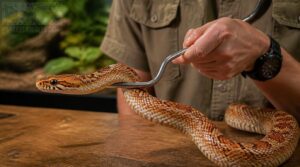
Once your approach is steady, place the hook just behind the head, never on the neck. Aim for spinal support across the front third, roughly one-third of body length. Correct front third alignment keeps the head steady and reduces lunging. Balanced pressure here beats squeezing every time. Watch body language: tight coils mean stop.
Lift Smoothly Without Jerking

With support settled, the lift itself decides your outcome. Rise slowly, 2 to 3 seconds, one continuous motion. No stops, no bursts.
- Keep forearm steady, elbow quiet
- Match hook speed to body weight
- Cradle, don’t lever
- Watch for tension building
- Avoid sudden jerks entirely
Smooth beats fast. Every time.
When to Avoid Snake Hook Handling

Not every day is a good day for hook handling. Sometimes the best move is putting the hook down entirely. Here’s when to skip it and leave your snake alone.
During The Shedding Cycle
Cloudy eyes mean skin’s forming underneath. Fluid buildup loosens the old layer, and activity reduction is normal, not a red flag. Handling now risks tearing that shed skin integrity apart, and hooks add pressure snakes can’t tolerate mid-cycle.
Wait until the shed skin comes off in one piece. Check humidity control, 60-80% keeps things smooth. Then resume handling.
Within 48 Hours After Feeding
That full belly isn’t just resting, it’s working. Digestion pulls blood flow inward, leaving less reserve for a defensive response if startled.
Wait a full 48 hours minimum. Watch for:
- Extreme lethargy
- Visible swelling
- Refused feeding response
- Regurgitation risk
- Labored breathing
Rushing this window stresses digestion and appetite both. Patience now means a safer transfer later.
During Illness or Injury
A sick or injured snake needs rest, not a hook near its wound. Skip handling entirely unless it’s essential care, feeding, or medication.
Watch for swelling, discoloration, or labored breathing, all pain indicators. Stress delays healing, suppresses immunity, and raises infection risk. Keep sessions under five minutes, support multiple points, and prioritize calm recovery over routine handling.
After Moving Enclosures
New enclosure, new stressors. Give a freshly moved snake 48 hours before you even think about the hook.
Scent transfer and substrate consistency matter more than you’d guess. Match hide box placement and water dish location to the old setup, mist gradually, and read body language before reaching for snake handling hooks.
Following Repeated Defensive Strikes
One strike rarely ends there. Repeated defensive strikes spike arousal, and stress accumulates fast, shortening your safe handling window with each attempt.
Watch for behavioral fatigue: sluggish reactions, flared nostrils, twitchy tail movements.
Recovery signs:
- Calm coil within minutes
- Breathing normalizes (3-5 min)
- Defensive posture resets
- Appetite returns in 24-48 hrs
- Activity normalizes within days
Wait for these before another attempt.
Frequently Asked Questions (FAQs)
Do snake hooks hurt snakes?
Used correctly, hooks don’t hurt snakes. Gentle hook placement under the front third, slow lifting, and proper hook material keep pressure light. Pain only happens with rough handling, wrong hook size, or careless jerks against the body.
What stresses a snake out?
Sudden touches, loud noises, and poor temperament matching all spike stress. Add sensory overload, frequent handling, no recovery time, or weak feeding response, and defensive coiling follows fast. Read snake behavior before every interaction.
How long does snake hook training take?
Funny enough, most snakes settle into hook training faster than their owners expect. Bold individuals often reach basic comfort in 2 to 4 weeks, while cautious ones need 8 to 12 weeks of steady, patient sessions.
Can hooks be used on aquatic snakes?
Rarely, and only for zone transfers.
Water snake hook use means narrow, stainless steel hooks that resist corrosion, guiding rather than lifting.
Avoid hooking submerged bodies.
Prefer tubing or nets, since wet scales make aquatic hook safety and hook control genuinely unstable.
Do snakes eventually get used to hooks?
Practice makes perfect, and many snakes do settle in. With consistent, gentle hook familiarity over time, defensive strikes often fade. Still, temperament varies. Some snakes acclimate within weeks; others need months of calm, routine handling to trust it.
Are tongs a better alternative to hooks?
For nervous or unknown-temperament snakes, tongs often beat hooks. Their scissor grip keeps hands from the strike zone, aids body thirds without pinching, and helps smoother, slower transfers, reducing defensive coiling and stress spikes hooks sometimes trigger.
How often should you clean a snake hook?
Every single session, no exceptions. Wipe your snake handling hooks with 70% isopropyl alcohol after each use, especially after feces contact, then air dry fully.
This hook maintenance routine keeps reptile enclosure hygiene tight and allows safe reptile transfer methods between snakes.
Conclusion
The tool that calms a snake is the same one that can panic it. That’s the paradox at the center of this question: can snake hooks stress out snakes comes down to hands, not hardware. Technique separates the two outcomes.
Slow approaches, proper support, correct sizing, these turn a hook into reassurance instead of threat. Master the mechanics, read the body language, and that hook becomes what it was always meant to be: a bridge of trust, not a trigger.