This site is supported by our readers. We may earn a commission, at no cost to you, if you purchase through links.
Two ball pythons can share a cage, a clutch, even a birthday—and still produce offspring that look nothing alike. That’s not random luck. It’s DNA doing exactly what it’s built to do, expressing hidden alleles that suddenly become visible in the babies that follow.
Breeders chase these outcomes for stunning morphs worth thousands, but the real payoff comes from understanding the code behind the color. Once you grasp how genotype shapes phenotype, those "surprise" hatchlings stop being mysteries.
That’s where the genetics of snake color morphs comes in—and it starts with a single question: what actually controls pigment at the molecular level?
Table Of Contents
- Key Takeaways
- What Are Snake Color Morph Genetics?
- How Snake Color Traits Are Inherited
- Pigment Mutations Behind Snake Colors
- Pattern Genes and Designer Morphs
- Health, Ethics, and Responsible Breeding
- Frequently Asked Questions (FAQs)
- What is the rarest snake color?
- What is the rarest morph of a snake?
- Do daughters inherit more from mother or father?
- Can snakes hear you?
- How do environmental factors affect morph intensity?
- What causes incomplete dominance in snake genetics?
- Can morphs revert to wild-type appearances?
- How do line breeding effects impact genetics?
- What determines morph market value and rarity?
- Can two different morphs be bred together safely?
- Conclusion
Key Takeaways
- Hidden recessive alleles let two normal-looking snakes produce surprising offspring, so tracking genotype (not just appearance) is essential for predicting breeding outcomes.
- Different inheritance patterns—recessive, dominant, co-dominant—determine how likely a trait is to show up, with Punnett squares offering a reliable way to calculate those odds before breeding.
- Distinct pigment mutations (like albinism, axanthic, and melanism) and pattern genes (like piebald and motley) each disrupt specific biological pathways, producing visually unique morphs that can be stacked for even more complex designs.
- Responsible breeding requires prioritizing genetic diversity and careful record-keeping to avoid problems like inbreeding depression and neurological issues such as wobble syndrome.
What Are Snake Color Morph Genetics?
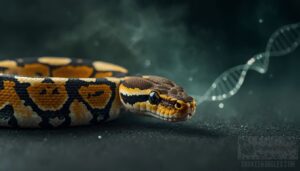
Every stunning morph you’ve ever admired traces back to a specific genetic story, one written in genes, alleles, and inherited code. Before you can predict what a breeding pair will produce, you need to understand how that code actually works. Here’s where snake color genetics really starts.
Getting familiar with the basics of snake color pattern inheritance gives you the foundation to predict outcomes before you ever pair up your first breeders.
Genes, Alleles, and DNA
Curiosity about a snake’s stunning color starts at the molecular level, inside its DNA.
Every trait traces back to genes—DNA sequences mapped to a specific chromosome locus, guiding protein synthesis. Genes come in variant forms called alleles, inherited one from each parent. These alternative versions of genes determine the specific phenotypic expression of a trait.
- DNA holds base sequences (A, C, G, T)
- Genes occupy fixed loci
- Alleles create variation
- Mutations alter proteins
- Genome structure organizes it all
Genotype Versus Phenotype
Once you know the alleles, the next question is what they actually build.
Genotype is the inherited allele set; phenotype is what you see. Genotype stays fixed for life, but phenotype shifts with environment, diet, even stress. Two snakes can share identical genotypes yet display different phenotypic variation—which is why hidden allele carriers matter so much for predicting real outcomes.
Visuals Versus Hidden Genes
Genotype tells you what’s really there; phenotype only shows part of it. Recessive alleles hide in plain sight—a snake can carry one copy and look completely standard. That’s why carrier identification matters so much: pair two hidden carriers, and suddenly a new visual morph appears. Predicting these outcomes requires lineage tracing, since phenotype masking makes guesswork unreliable without pedigree data.
Color Morphs Versus Localities
Locality vs Morph confuses even experienced keepers—the two aren’t the same thing. Locality marks geographic origin, tied to wild-population genetics and regional color adaptation. Morph describes a specific phenotype, potentially appearing anywhere.
- Locality reflects environmental color pressures, not always distinct genes
- Geographic gene flow homogenizes traits absent isolation
- Provenance tracking prevents mislabeling wildtype variation as true morphs
Skipping this distinction muddies your breeding records fast.
Why Morphs Look Different
Ever wonder why two snakes with identical genes can look different? Blame chromatophore cell function—pigment synthesis pathways, structural light interaction from iridophores, and developmental timing all shape genotype into phenotype.
Diet matters too, since the nutrients your snake eats feed its pigment cells, so a snake diet for better coloration can help explain those week-to-week swings in vividness.
If you’re new to the hobby, these best ball python morphs for beginners show how those color differences play out in hardy, easygoing snakes.
Somatic mosaicism adds further variation, producing localized pigmentation patterns from mutations arising mid-development. So genetic mutations in snakes don’t guarantee uniform results; melanin pathway activity and cellular timing determine each morph’s final, sometimes stunning, appearance.
How Snake Color Traits Are Inherited
Once you know what a gene and an allele actually are, the next step is watching how they get passed down. Every morph you’ve ever admired follows one of a handful of inheritance patterns, and knowing which one you’re dealing with changes how you breed for it. Here’s how each pattern actually plays out, starting with the most common one you’ll encounter.
Recessive traits are especially easy to misjudge by eye alone, which is why so many breeders lean on ball python genetics and visual trait guides before trusting a guess over a DNA test.
Recessive traits are the classic starting point, but pairing them with dominant or co-dominant genes is how breeders create the striking ball python morphs with unique patterns collectors chase after.
Recessive Morph Inheritance

Two copies, or nothing shows. That’s the whole game with recessive genetic mutation inheritance—carriers (aa masked by A) look wild-type, hiding the allele across generations. Pair two carriers, and Mendelian inheritance math gives you a 25% shot at homozygous recessive offspring, 50% carriers, 25% clean. Skip careful lineage tracking, and hidden alleles quietly accumulate, resurfacing generations later when you least expect it.
Dominant Morph Inheritance

Where recessive traits hide, dominant mutations announce themselves immediately—single allele expression means one copy shows full phenotype. Cross a heterozygous dominant with a normal, and breeding probability lands near 50% affected offspring.
Since genotype and phenotype match visually, heterozygous visual identification is straightforward. Pedigree pattern tracking confirms it: dominant morphs surface every generation a carrier breeds, no dominance probability modeling required for basic dominant-recessive inheritance patterns.
Co-Dominant and Super Forms
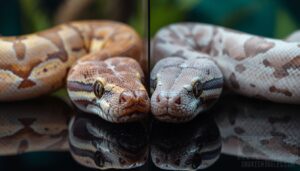
Codominant alleles play by different rules entirely—both copies leave visible fingerprints. Pastel is your classic example: one allele produces a distinct heterozygous look, two produce a super form that’s qualitatively different, not just darker. This allele interaction makes codominant probability easy to model.
Identifying visual supers takes practice, but predictable phenotypic expression makes codominant inheritance a breeder’s favorite for planning stacked morph projects.
Heterozygous and Homozygous Snakes
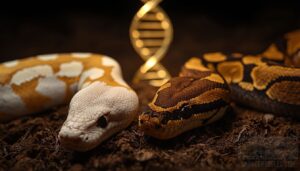
Your snake’s genotype boils down to allele dosage: one mutant copy makes it heterozygous, two make it homozygous. Phenotype prediction depends on which:
- Het = often normal-looking, carrier status hidden
- Homozygous recessive = full visual trait
- Homozygous dominant = guaranteed inheritance
- Supers = homozygous codominant form
- Testing confirms hidden alleles when looks won’t
Punnett Square Basics
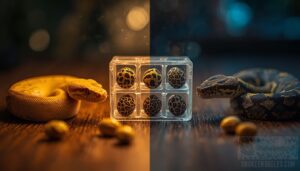
Want to predict offspring before eggs even hatch? A Punnett square maps every possible allele combination from two parents, splitting a monohybrid cross into four boxes.
| Het x Het | A | a |
|---|---|---|
| A | AA | Aa |
| a | Aa | aa |
Gametes assort randomly, giving equal probability per box—that 1:2:1 genotype ratio becomes a 3:1 dominant-recessive phenotype split.
Pigment Mutations Behind Snake Colors
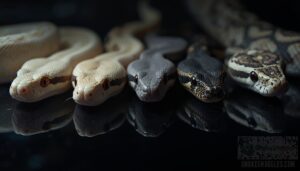
Every color you see on a snake traces back to a specific cellular malfunction, one you can actually name and predict. Pigment cells follow their own biochemical rules, and when a mutation disrupts one pathway, the visual result is entirely different from a mutation disrupting another.
Here’s how five of the most common pigment mutations reshape a snake’s appearance, one pathway at a time.
Melanin and Albinism
Blank slates aren’t random—they’re broken pathways. Albino snakes lack functional tyrosinase, the enzyme converting tyrosine into eumelanin and pheomelanin. That mutation halts melanosome transport before pigment ever reaches the skin, leaving pink or red irises exposed.
You’ll notice retinal effects too, since melanin helps with normal eye development. Without UV protection, albino snakes face greater sun-related risk in bright enclosures.
Axanthic Color Loss
Where albinism strips color from the eyes outward, axanthic mutations work on the yellow channel itself. Xanthophore pigment reduction blocks yellow-orange synthesis, while iridophore reflection loss kills the shine. Add carotenoid pathway disruption, and reds fade too, leaving melanophore dominance to paint snakes in grayish, bluish tones.
It’s a recessive pigmentation pathway—breed two carriers for the classic shift.
Anerythristic Red Reduction
Where axanthic wipes yellow, anerythristic red reduction targets erythrin pigment loss directly, leaving melanin intact.
This recessive allele expression needs two copies for visible red pigment reduction—carriers look normal.
You’ll spot it through:
- Scale color contrast shifts toward black and yellow
- Faded or absent red/orange saddles
- Variable expression across individuals
- Carrier phenotype identification via pedigree tracking, not appearance
Melanism and Dark Morphs
Flip the script from pigment loss to pigment gain, and you land on melanism—elevated melanin deposition darkening scales toward black. The MC1R pathway drives this, boosting pigment production directly.
Dark morph inheritance varies: recessive, dominant, or co-dominant depending on species. Effects run deeper than looks, too—altering thermoregulation efficiency and camouflage effectiveness across different habitats and lighting conditions.
Dilute and Pastel Effects
Where albinism erases pigment and melanism piles it on, dilute and pastel work the middle ground—softening rather than deleting. Pigment saturation shifts downward, muting melanin-rich patterns while preserving scale structure.
Dilute pattern softening blurs contrast between dark and light zones; pastel hue blending nudges tones toward creams and soft browns.
Stack these with other loci, and chromatic interaction effects produce genuinely stunning intermediate phenotypes.
Pattern Genes and Designer Morphs
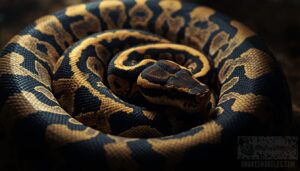
Pigments give a snake its color, but pattern genes decide how that color gets arranged across the body. These mutations control everything from scattered white patches to rearranged stripes, and combining them is how breeders create truly stunning designer morphs.
Here’s what you need to know about the genes shaping pattern, and the challenges that come with stacking them.
Piebald and Leucistic Traits
Picture a snake wearing a torn white sheet over patches of its natural color — that’s piebald in simple terms.
- Piebald: asymmetrical white patches from melanoblast migration defects, often KIT gene-linked
- Leucistic: systemic pigment loss, but normal eye color remains
- Eye color distinguishes both from albinism
- Different inheritance patterns, same convergent coloration
- Pigment deposition failures drive phenotypic expression differences
Stripe and Motley Patterns
Two dorsal lines versus rounded, merging saddles — that’s your quickest visual split between Stripe and Motley. These patterns are allelic, sharing one locus, so zygosity prediction accuracy matters when forecasting offspring.
One Motley copy usually dominates over Stripe, while double Stripe alleles preserve longitudinal stripe alignment. Motley also drives ventral pattern reduction and saddle shape variation, sometimes yielding intermediate Motley Stripe phenotypic expression in your clutches.
Mutation Stacking Basics
Stacking is where designer morphs come alive: you combine multiple mutations into one lineage, layering additive effects without erasing prior traits. But watch for epistatic risks — one gene can mask another, muddying phenotype predictability.
Genotype tracking matters more as visual complexity grows. Managing lineage diversity through careful selective breeding keeps your stacks stunning, stable, and genetically sound.
Triple Recessive Morphs
Want the best genetic flex? Combine three recessive alleles into one lineage, and you’re chasing triple homozygous expression — a multi-gene composite pattern requiring six mutant alleles total.
Start with double hets, verify through genetic testing (not just phenotype), and track lineage very carefully. Triple recessive complexity means longer timelines, more losses, but stunning payoff once inheritance patterns finally align across all three homozygous recessive genes.
Morph Identification Challenges
Ever confidently named a morph, only to be proven wrong by a genetic test? That’s morph identification fundamentally — tricky. Lighting influence shifts contrast, juvenile patterning hides true colors, and phenotype discordance masks genotype. Add labeling inconsistency and documentation errors, and even experienced breeders misjudge pattern expression. Genotype vs phenotype isn’t academic here — it’s the difference between accurate breeding and costly guesswork.
Health, Ethics, and Responsible Breeding
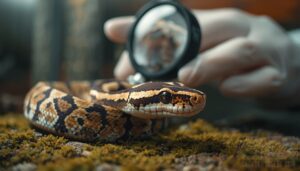
Chasing stunning colors is only half the job — you owe it to your snakes to breed responsibly. That means understanding what genetic diversity actually protects you from, and where certain morphs carry real biological risk. Here’s what every serious breeder needs to keep in mind.
Genetic Diversity Matters
Every stunning morph you produce still carries genes from a shared pool, and that pool’s health matters more than any single trait. Genetic diversity fuels population strength, disease resistance, and adaptive potential across generations.
Narrow breeding shrinks allele frequency, weakening genetic recombination’s benefits. Captive lines lose the evolutionary stability wild gene flow provides—which is exactly why thoughtful pairings protect your collection’s long-term species survival.
Inbreeding and Weak Vigor
When you keep pairing related snakes to lock in a look, you’re not just concentrating good genes—you’re doubling up on the hidden bad ones too, and that trade-off shows up as reduced vigor sooner than most breeders expect.
Pairing related snakes to lock in a look doubles the hidden bad genes along with the good, and vigor pays the price
Genetic bottlenecking brings inbreeding depression: slower growth, poor feeding, fragile immunity.
- Vitality loss across clutches
- Reduced genetic variation
- Compounding neurological defects
Careful lineage management protects long-term vigor.
Wobble-Linked Morphs
Wobble syndrome stands apart from garden-variety inbreeding depression—it’s a direct neurological movement abnormality tied to specific alleles, most notoriously the spider gene.
Neural circuit alterations affect balance, so carriers show head tilts or tremors, worse under stress. Mutation stacking in designer morphs can compound this.
Vestibular function assessment and ethical breeding transparency matter here: disclose known wobble lines before selling.
Accurate Breeding Records
Disclosing wobble lines only works if your records back it up. Traceable lineage starts with a digital spreadsheet: dam, sire, clutch size, survival, genotype notes.
Verifying sire identities before mating prevents costly data entry errors down the line. Track inheritance patterns across generations, and you’ll catch phenotype surprises before they surprise buyers—selective breeding demands nothing less in this industry.
Conservation-Friendly Choices
Because market demand can outpace ethics, choose captive breeding over wild collection whenever possible, and favor lines with proven genetic diversity to avoid inbreeding depression.
Support Ethical Sourcing from breeders documenting Localized Populations, join Citizen Science tracking efforts, and follow Wildlife Regulation compliance. These choices reduce genetic drift, protect species survival, and keep your hobby aligned with real conservation outcomes—not just stunning morphs.
Frequently Asked Questions (FAQs)
What is the rarest snake color?
Pinning down one single "rarest" is tricky, but Lavender Albino ball pythons rank among the top contenders — their scarcity stems from recessive inheritance, near-total pigment loss, and the rare genetic pairing needed to produce that stunning lavender-and-red combination.
What is the rarest morph of a snake?
The blue eyed leucistic ball python claims the title, prized for its pure white body and striking blue eyes. Captive rarity factors, triple recessive complexity, and strong collector desirability push market value into the tens of thousands.
Do daughters inherit more from mother or father?
Neither parent dominates: autosomal gene balance splits evenly, but daughters get maternal mitochondrial DNA lineage plus paternal X contribution alongside their mother’s X, creating distinctive X-linked trait expression patterns unique to their genotype and phenotype.
Can snakes hear you?
Yes, through jawbone sound conduction and inner-ear vibration detection rather than eardrums. They pick up low frequency sensitivity below 600 Hz, so loud speech registers as ground vibration more than actual "hearing" you talk.
How do environmental factors affect morph intensity?
Same genotype, wildly different snake — that’s environment at work. Temperature drives pigment synthesis, light exposure shifts saturation, carotenoid-rich diets boost reds and oranges, while stress and poor substrate reflection desaturate phenotypes, altering gene expression and pigment deposition without touching the actual DNA.
What causes incomplete dominance in snake genetics?
A single mutant allele cuts protein activity without eliminating it — you get partial enzyme output, so pigment pathways bleed together rather than switch fully, producing an intermediate phenotype between homozygous normal and homozygous mutant forms.
Can morphs revert to wild-type appearances?
Coming full circle" isn’t really on the table here — true reversion requires wild-type allele restoration, not just wishful breeding. Outcrossing over generations, leaning on haplo-sufficiency and gene dosage, can produce offspring closely resembling authentic wildtype specimens.
How do line breeding effects impact genetics?
Repeated line breeding drives homozygosity risks and genetic drift, fixing prized traits while shrinking diversity. You gain lineage stability and predictable morphs, but sacrifice adaptive strength—selective breeding this tight rewards patience, not shortcuts.
What determines morph market value and rarity?
Think of the reptile market like a gemstone trade—rarity and clarity set the price. Market demand, gene complexity, and supply scarcity drive value; striking, complex morphs command premiums, while simple recessives stay affordable for newer breeders.
Can two different morphs be bred together safely?
Yes, when you assess genetic compatibility and health beforehand. Cross-morph pairings follow predictable inheritance patterns, boost genetic diversity, and support offspring health viability — provided you monitor parental wellness and manage mating stress throughout the pairing process responsibly.
Conclusion
Every hidden allele, every recessive pairing, every stacked mutation tells you something concrete about what’s coming in the next clutch. That’s the real reward behind the genetics of snake color morphs—not just stunning pattern combos, but the power to predict them.
Master the Punnett square, respect genetic diversity, and keep careful records. Your breeding program stops being guesswork and becomes a science. The hatchlings you produce next season won’t be surprises. They’ll be proof of what you already know.