This site is supported by our readers. We may earn a commission, at no cost to you, if you purchase through links.

A single black rat snake patrolling your barn can eliminate hundreds of rodents a year, work no trap or poison matches. Pull that snake out, and you’ll watch grain losses climb, tick-borne disease risk creep upward, and the whole food web wobble.
That’s snake environmental health in short: the tangled, consequential relationship between snake populations and the ecosystems—and people—depending on them. Vets like me see the fallout up close, from mercury-laden kidneys in watershed species to the 138,000 annual deaths snakebite still causes worldwide.
Understanding how these animals engineer soil, cycle nutrients, and signal pollution before we notice it ourselves changes how you see the next snake in your yard.
Table Of Contents
- Key Takeaways
- What is Snake Environmental Health?
- How Snakes Support Healthy Ecosystems
- Major Environmental Threats to Snakes
- How Pollution Affects Snake Health
- Protecting Snakes, Habitats, and People
- Frequently Asked Questions (FAQs)
- What is snake environmental health?
- Are snakes good for the environment?
- How do snakes affect the environment?
- Are snakes a sign of a healthy ecosystem?
- What smell will keep snakes away?
- Can humans get diseases from snakes?
- Do snakes do anything for the environment?
- How long will a snake stay in your house?
- How does ecotoxicology affect snake populations?
- What are the benefits of snakes?
- Conclusion
Key Takeaways
- A single snake can wipe out hundreds of rodents a year, so losing snakes from your property means more crop damage, more disease risk, and a shakier local food web.
- Snakes act as living pollution alarms, since toxins like mercury and pesticides build up in their tissue and reveal contamination in soil and water long before it’s obvious elsewhere.
- Habitat fragmentation, roads, climate change, fungal disease, and fear-driven killing are all squeezing snake populations at once, making corridors and safer land management essential to their survival.
- Snakebites still kill up to 138,000 people a year worldwide, so learning basic prevention and coexistence habits protects you while also protecting the snakes doing quiet ecological work around you.
What is Snake Environmental Health?

Snake environmental health sits at the intersection of habitat function, habitat quality, and human safety, and understanding it starts with a few key ideas. You’ll want a clear picture of how snakes fit into the bigger environmental puzzle before looking at specific threats or solutions. Here’s what shapes that foundation.
Snakes occupy a wide range of niches across ecosystems, and getting familiar with rare snake breeds and their habitats helps round out that foundational understanding.
Snakes, Ecosystems, and Human Health
Since one snake can eliminate hundreds of rodents yearly, its absence ripples straight into your community’s health.
Snakes provide:
- Disease regulation via rodent control
- Ecological balance through predator-prey stability
- Environment strength as environmental indicators
- Medically important venom compounds
Habitat destruction and human-snake conflict threaten these community health linkages—proof that Snake Environmental Health isn’t abstract science, but your family’s practical safeguard.
Snakes also play a key role in environment engineering roles by aiding seed dispersal and maintaining soil health.
Habitat and Species Distribution
Where a snake lives determines whether it thrives. Species distribution spans deserts to wetlands, shaped by elevation, prey, and microclimate thermoregulation needs.
Seasonal habitat use drives snakes toward basking rocks or shaded burrows as temperatures shift. Habitat loss and fragmentation, though, disrupt geographic range shifts and patch quality alike—making wildlife corridors and habitat restoration your best tools for keeping populations connected and resilient.
Environmental Health Warning Signs
A stable range only matters if the population within it stays healthy—and that’s where pollution bioindicators come in. Mercury bioaccumulation above 0.3 ppm in industrial watersheds signals contamination long before symptoms appear elsewhere.
Suppressed immunity, reduced hatchling survival, and impaired coordination all count as species vulnerability markers, flagging environment instability you’d otherwise miss until it’s widespread.
Global Snakebite Health Burden
Bioindicators tell only half the story—the other half is human. Snakebite is a public health concern killing up to 138,000 people yearly, disability far exceeding deaths.
Snakebite kills up to 138,000 people yearly, a public health crisis where disability far outweighs the death toll
- Rural farmers losing limbs, livelihoods, futures
- Children walking miles for lifesaving medications
- Families drowning in treatment costs nobody warned them about
Treatment accessibility gaps keep human–snake conflict deadly where it’s most preventable.
How Snakes Support Healthy Ecosystems
When you picture a healthy habitat, you probably don’t think of snakes first, but you should. These animals quietly hold entire food webs, soils, and even farm yields together, often without you noticing their work at all. Here’s where their influence actually shows up.
By tracking heat, scent, and vibration with astonishing precision, snakes are master hunters, and understanding how snakes detect prey reveals just how finely tuned their role in nature really is.
Natural Rodent Population Control

Picture a single black rat snake clearing dozens of rodents from your barn each year—that’s natural pest control with no chemicals involved.
Predator-prey relationships keep rodent reproduction in check before density-dependent breeding spirals upward. This ecological balance depends on habitat connectivity; fragmented land breaks the food web stability snakes provide, letting rodent populations rebound fast.
Agricultural Crop Protection
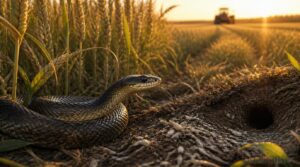
Ask any grain farmer what’s eating their profits, and rodents rank high on the list. Snakes function as biological pest control, cutting crop damage before it starts.
This fits neatly into sustainable agriculture: pair snake predation with resistant crop varieties, cultural control practices, and pesticide threshold monitoring, and you’ll rely less on chemical sprays while protecting yield naturally.
Food Web Stability

Because snakes hunt across multiple prey types, they maintain predator-prey balance, preventing rodent booms and busts. This link strength diversity dampens synchronized crashes elsewhere in the web.
Remove that moderate pressure and trophic cascades follow: rodents surge, vegetation suffers, disease vectors spread. Species interdependence keeps energy flowing steadily, so your local natural environment balance depends more on snakes than most people realize.
Nutrient Cycling and Soil Health

Beneath every den lies quiet chemistry: burrowing loosens soil, boosting aeration and water infiltration, while waste and carcasses fuel microbial decomposition.
That process releases nitrogen and phosphorus back into circulation, sustaining nutrient cycling and carbon-nutrient balance that crops and native plants depend on.
- Improved soil structure
- Steady nutrient release
- Enhanced water retention
Protect that engineering, and you’re protecting natural services far beyond the burrow.
Snakes as Environmental Bioindicators

Long before a spill makes headlines, snakes already carry the evidence in their tissue. As environmental sentinels, their liver reveals pollutant accumulation and site-specific contamination history.
Pesticide residues, body condition, and reproductive health all shift with habitat quality, making snakes reliable tools for habitat contamination assessment and ongoing natural world health signaling that guides real conservation decisions.
Major Environmental Threats to Snakes
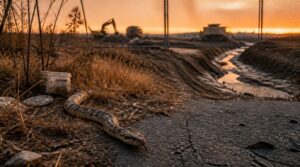
If you think snakes have it easy out there, think again: their world is shrinking, warming, and growing more dangerous by the year. From bulldozers to blacktop, the pressures stacking up against these animals come from nearly every direction you can imagine. Here’s a look at the five biggest threats putting snake populations at risk.
Habitat Loss and Fragmentation
Picture a highway slicing through prime timber rattlesnake territory: that’s habitat fragmentation in action. Smaller patches mean less central habitat, weaker genetic diversity, and rising isolation risk. Edge effects expose snakes to pesticide drift and predators.
You’ll protect populations best by supporting wildlife corridors that reconnect fragmented land, preserving the connectivity snakes need to feed, breed, and survive.
Climate Change and Thermal Stress
As ectotherms, snakes borrow every degree of body heat from their surroundings, so climate change pushes many past their thermal tolerance limits. Rising heatwave frequency shrinks safe foraging windows, while shifting seasonal activity brings earlier emergence into unstable weather. Reproductive success suffers when gestation runs too hot. That’s why conservation planning now prioritizes thermal refuges and climate adaptability.
Road Mortality and Development
Where hot skin meets hot asphalt, thermal stress gives way to a blunter killer: traffic. Road fragmentation splits habitat into patches snakes still try to cross, driving up crossing mortality at predictable habitat edges. Slow movers linger on pavement longest.
Lower speed limits and connected wildlife corridors cut collisions, but road mortality keeps climbing wherever development outpaces mitigation.
Human-Snake Conflict and Persecution
Traffic isn’t the only thing killing snakes on sight—people are. Fear-based persecution remains a leading driver of Human-Snake Conflict: one Nepal survey found 86% of respondents feared snakes, and 49% wanted all venomous species exterminated.
Retaliatory killings often follow cultural superstitions—snake gods, omens, hidden power—regardless of whether the snake was harmless. Farmers face real livelihood risks, but killing indiscriminately backfires, removing rodent control and worsening future conflict.
Safer coexistence starts with identification skills:
- Learn local venomous species by sight
- Avoid tall grass and brush piles barefoot
- Never corner or provoke a snake
- Support Community Education programs
- Report bites immediately for proper care
Fungal Disease and Pathogens
Fear isn’t the only killer—fungal pathogens now stalk hibernacula too. Ophidiomyces ophidiicola thrives in cool, humid dens, killing 80% of eastern timber rattlesnakes overwintering there.
This fungus invades keratin, evading immune defenses while spores spread through soil and direct contact. Wildlife disease like this signals environmental imbalance—another bioindicator warning you that habitat degradation and climate shifts are eroding species survival.
How Pollution Affects Snake Health
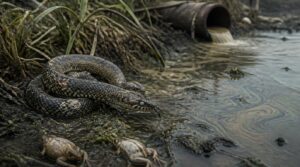
When you walk through a field laced with pesticides or a stream tainted by industrial runoff, you’re not the only one absorbing that chemical burden, the snakes living there are too.
These toxins don’t just pass through; they build up in tissue, disrupt hormones, and quietly erode an animal’s ability to reproduce, fight infection, and move with precision.
Here’s a closer look at the specific ways pollution takes its toll on snake health.
Pesticide Exposure and Poisoning
A snake gliding through a freshly sprayed field is absorbing poison through its skin with every inch of movement. Dermal exposure is the primary route, though organophosphates also cause muscle tremors and respiratory failure.
Agricultural runoff zones are high-risk settings. Prevention means reducing pesticide residue in soil and water before it ever reaches scales.
Heavy Metal Bioaccumulation
Mercury tells a quiet story in scale and sinew. Piscivorous snakes in northeastern watersheds show metal tissue accumulation exceeding 0.3 ppm, evidence of trophic transfer patterns moving contaminants up the food web.
Sediment metal uptake feeds this cycle continuously. Watch for:
- Liver and kidney deposits
- Suppressed immune function
- Elevated pollution biomarkers
- Chronic ecotoxicological impact
Your local watershed’s health shows in every snake you find there.
Reproductive and Developmental Harm
Before a snake ever hatches, its future can already be compromised. Contaminated mothers transfer toxins during egg formation, disrupting hormone signaling that guides embryo growth. The result: smaller hatchlings, reproductive failures, and lower survival rates.
Multiply this across breeding seasons, layer in habitat loss and climate change, and you get measurable population decline—a slow-motion ecotoxicological impact rippling through generations.
Immune and Neurological Effects
A contaminated snake’s own defenses can turn against it. Toxic pollution triggers lymphocyte suppression, blunting immune response, while mercury neurotoxicity damages nerve tissue directly.
Blood-brain barrier disruption lets inflammatory signals flood neural tissue, fueling chronic neural inflammation. You’ll notice behavioral movement changes—clumsy strikes, sluggish escapes—signaling contaminant bioaccumulation has compromised the nervous system your patient depends on for survival.
Snakes as Pollution Sentinels
What if the same animal poisoning your yard could also map the poison itself? That’s the sentinel species role snakes fill: site-faithful, long-lived, and ideal for tissue analysis.
- Lead in scales
- DDE near farmland
- PCBs by highways
- Mercury in wetlands
This biomonitoring reveals pollution hotspots and contaminant mapping—ecotoxicology’s early-warning system for Snake Environmental Health.
Protecting Snakes, Habitats, and People

Protecting snakes isn’t just about goodwill; it demands coordinated action across habitat, chemistry, and human behavior. You’ll find that real progress happens when restoration, safer coexistence, and public education work together rather than in isolation. Here’s where that effort actually takes shape, piece by piece.
Habitat Restoration and Wildlife Corridors
A fragmented landscape kills slowly. Habitat connectivity through wildlife corridors—wide, native-planted, linked to stepping stones—lets populations move, breed, and survive.
| Corridor Feature | Why It Matters |
|---|---|
| Native vegetation | Feeds real food webs |
| Adequate width | Reduces deadly edge effects |
| Road crossings | Cuts vehicle mortality |
| Stepping stones | Bridges unavoidable gaps |
| Long-term management | Prevents restoration collapse |
Without this, conservation strategies fail before they start.
Pollution and Pesticide Reduction
Corridors mean little if the ground beneath them carries toxic pollution. Reducing pesticide runoff, adopting eco-friendly pest control, and cutting soil contamination protect water quality and prevent the ecotoxicological impact seen in bioaccumulated pesticide residue.
- Scout before spraying—treat only real thresholds
- Choose low-drift, low-toxicity products
- Install grass buffers along waterways
- Adopt non-toxic alternatives where possible
Safer Human-Snake Coexistence
Clean soil means little if you’re still standing too close to the snake itself. Space separation works best: mow grass, clear brush, and back away 10 feet if one appears.
Seal gaps as small as ¼ inch for home exclusion. Skip DIY relocation—long-distance moves raise mortality. Call trained professionals instead.
Snakebite Prevention and Education
Coexistence only works if you know how to avoid a strike in the first place. Globally, snakebites injure 5.4 million people yearly, killing up to 138,000—so prevention beats treatment every time.
Teach kids to spot tall grass and debris piles, wear boots, freeze, and call an adult. Communities need local-language messaging, first aid basics (no cutting, no ice), and trained health workers for fast, effective care.
Conservation Research and Monitoring
Prevention only works long-term if researchers keep watching population trends. Effective monitoring starts with clear objectives, baseline data, and consistent field protocols. Programs need:
- Trained staff and permits
- GPS/satellite tools
- Time-series data systems
- Adaptive management links
Funding and legislative backing determine whether tracking survives long enough to matter—which is exactly what climate adaptability demands.
Frequently Asked Questions (FAQs)
What is snake environmental health?
Think of it as a scaly report card for the wild: your snake population’s condition reveals natural world balance indicators, pollution sensitivity, and habitat quality, guiding conservation strategies before biodiversity quietly unravels.
Are snakes good for the environment?
Yes. Snakes deliver natural pest control, sustain food web support, and act as biodiversity indicators, keeping ecological balance intact, protecting crops, and signaling habitat health long before other warning systems catch environmental decline.
As autumn light fades and many species settle into winter hibernation, understanding how snake habitats shift with the seasons reveals just how closely these reptiles are tied to the forest’s rhythm.
How do snakes affect the environment?
The most feared creatures often do the most healing work. Snakes deliver natural pest control, sustain predator-prey relationships, and act as biodiversity indicators—their decline destabilizes food webs, damages crops, and signals deeper ecological balance failures across entire habitats.
Are snakes a sign of a healthy ecosystem?
Not by themselves, but they’re a strong bioindicator species: their presence signals stable prey, intact habitat structure, and balanced predator-prey relationships, reflecting genuine natural world health rather than proving it outright.
What smell will keep snakes away?
Mothballs smell dangerous, yet cinnamon and clove oil smell safer and work better.
Cinnamaldehyde and eugenol genuinely irritate snakes’ senses, while garlic and vinegar offer weaker, short-lived backup—reapply near entry points after rain for real results.
Can humans get diseases from snakes?
Absolutely: zoonotic disease transmission happens through Salmonella, bacterial bite infections, and parasites like sparganosis. Handling snakes or their waste poses real risk, especially for children and immunocompromised people, making hand hygiene your best defense after any contact.
Do snakes do anything for the environment?
Yes: as natural pest controllers, seed dispersers, and soil aerators, they stabilize prey populations, cycle nutrients, and steady food webs—making them reliable environment health indicators wherever they hunt, burrow, or bask.
How long will a snake stay in your house?
Duration depends on food and shelter quality: rodent infestations can hold a snake for months, while scarce prey drives it out within 48 hours. Temperature, humidity, and human disturbance—foot traffic, loud appliances—also determine whether it lingers or leaves fast.
How does ecotoxicology affect snake populations?
Chemical burdens quietly reshape snake populations: toxin bioaccumulation from contaminated prey drives pollutant exposure, weakening reproduction and immunity.
Pesticide exposure and heavy metal accumulation compound over time, making certain species reliable pollution sentinels for tracking ecosystem-wide contamination.
What are the benefits of snakes?
Snakes deliver natural pest control by consuming rodents that damage crops and spread tick-borne disease. As both predator and prey, they stabilize food webs, support biodiversity, and their venom fuels lifesaving medical research.
Conclusion
One rat snake devouring 300 rodents yearly outperforms any bait station on your property. That single statistic captures why snake environmental health matters far beyond curiosity: it’s agriculture, disease prevention, and ecological balance woven into one scaled, often-misunderstood creature.
Protect the habitat, respect the animal, and you’re not just saving a species. You’re safeguarding the quiet machinery that keeps your soil fertile, your barns clear, and your risks measurably lower.