This site is supported by our readers. We may earn a commission, at no cost to you, if you purchase through links.

A ball python costs $50. A high-white piebald morph with the right genetics? That same species can run past $10,000, scales and all. That gap tells you everything about why snake keeping has become part science, part obsession.
You’ll find that unique snake types to own span a wild range—docile corn snakes perfect for first-time owners, tentacled hunters that detect prey through water vibrations, emerald tree boas that shift color as they mature. Each species carries its own genetics, temperament, and care demands.
Whether you’re chasing rare morphs or rock-solid beginner picks, you’re about to discover which snakes deserve a spot in your collection—and exactly what keeping them takes.
Table Of Contents
- Key Takeaways
- Unique Snake Types You Can Own
- Striking Snake Morphs and Patterns
- Rare and Exotic Snake Species for Enthusiasts
- Unusual Pet Snakes and Their Fascinating Traits
- Essential Care Tips for Unique Pet Snakes
- Frequently Asked Questions (FAQs)
- What’s the nicest snake to own?
- What snake is worth $100,000?
- Can snakes hear you?
- What are the most unique snakes?
- What is the coolest snake to own as a pet?
- What is the most unique snake?
- What permits are required for exotic snakes?
- How much do unique snake morphs cost?
- Which snakes are illegal in my state?
- Do rare snakes need specialized veterinarians?
- Conclusion
Key Takeaways
- Snake ownership spans a huge range, from $50 beginner species like corn snakes and ball pythons to rare morphs and exotic species costing $10,000 or more.
- Beginner-friendly snakes like ball pythons, corn snakes, and rosy boas succeed because of their docile temperament, manageable size, and forgiving care requirements.
- Morph genetics—including iridescence, albinism, piebald patterns, and axanthic traits—create dramatic visual variety and significant price differences based on rarity and breeding difficulty.
- Responsible ownership of any snake requires matching species-specific enclosure, diet, and humidity needs with proper legal permits and veterinary care.
Unique Snake Types You Can Own
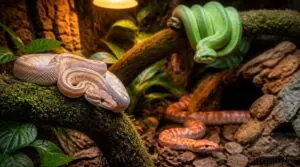
You’ll find snake ownership opens up a world far beyond your average pet store options. Whether you’re drawn to calm beginner species or ready for something with more personality, there’s a snake built for your comfort level. Here’s where you’ll start figuring out which one fits your life.
If you’re leaning toward the low-key end of the spectrum, check out this guide to easygoing snake species that are ideal for first-time owners before bringing one home.
Beginner-Friendly Snake Species
Five species make snake ownership approachable, even if you’ve never handled one before. Ball pythons bring famously calm temperament, often coiling up rather than striking. Corn snakes stay manageable near 4 feet. Milk snakes offer wide availability and steady feeding. Rosy boas rarely bite. Gopher snakes show tough, adaptable robustness—proving nonvenomous doesn’t mean boring.
Ball pythons specifically require high humidity levels within their enclosures.
Small Scale and Manageable Snakes
Not every snake needs a spare bedroom. Kenyan sand boas top out around 1.5–2.5 feet, making them ideal for juvenile enclosures as small as 10 gallons.
- Compact, docile temperament
- Minimal handling stress
- Small prey sizing (pinkies to fuzzies)
- 15–25 year lifespan commitment
Their manageable size doesn’t mean manageable expectations—these exotic pet snakes still demand genuine reptile husbandry.
Snakes With Distinct Feeding Habits
Size isn’t the only thing separating one species from another—diet defines behavior just as much.
Egg-eating snakes swallow whole eggs, cracking shells against specialized throat vertebrae before regurgitating the empty husk. Ophiophagous hunters like kingsnakes prey on other serpents, even venomous ones. Meanwhile, rodent specialists like corn snakes eat every 1–2 weeks. Digestion rates shift with prey type, body temperature, and overall metabolism.
Temperament and Handling Needs
Diet shapes behavior, but temperament decides whether you’ll actually enjoy the handling.
Docile, nonvenomous snakes like corn snakes and ball pythons tolerate routine handling well. Watch for defensive strike triggers—sudden movements, post-feeding grogginess. Acclimation techniques matter most: short sessions, gradual increases, consistent timing. Newly acquired snakes need patience; handling stress signals (hissing, retreat attempts) fade with repeated, gentle exposure.
Species Comparison for New Owners
Which beginner snake actually fits your lifestyle? It depends on priorities.
- Ball Python: calm care level, minimal handling, small enclosure
- Corn Snake: docile, predictable growth, ideal first pet
- King Snake: curious temperament, varied diet, hardy health
- Garter Snake: skittish at first, needs humidity attention
For raw beginner-friendly ease, corn snakes and ball pythons win—simple habitat complexity, forgiving dietary needs, and steady temperament make them the best pet snakes for newcomers.
Striking Snake Morphs and Patterns
You’ll find that color and pattern genetics turn snake ownership into something close to an art form. From nanostructured scales that scatter rainbow light to pigment mutations that strip away color entirely, breeders have unlocked some genuinely stunning variations.
Here’s a closer look at the morphs and patterns that make certain snakes true showstoppers.
From ghostly axanthics to vibrant reticulated patterns, exploring a detailed guide to garter snake morphs reveals just how varied responsibly bred snakes can be.
Iridescent and Rainbow-Colored Scales
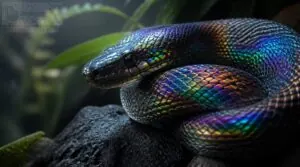
Ever watch a snake shimmer like oil on water? That’s structural color at work—no pigment involved, just nanostructured scales bending light through interference.
Microscopic keratin layers and diffraction grooves shift hues by angle.
| Factor | Effect |
|---|---|
| Angle | Color shift |
| Light | Diffuse = best |
| Health | Dulling = warning |
| Structure | Nanostructures create color |
Lavender Albino and High White Piebald
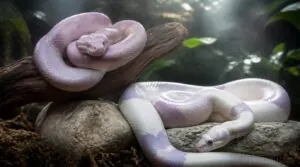
A soft candy-shell of a snake, that’s what you’re getting with a lavender albino. Reduced melanin creates that pastel body tone, paired with red eyes that catch light beautifully.
Pair it with high white piebald genetics and you’ll find dramatic white patches against pale lavender backgrounds—true showstoppers among unique snake morphs.
Breeding these rare snake species demands patience: both traits need carrier pairings, and offspring color intensity varies wildly due to polygenic influences.
Smart morph selection focuses on lineages known for consistent lavender depth and breeding color stability, since siblings from one clutch can look dramatically different.
Scaleless and Leucistic Morphs
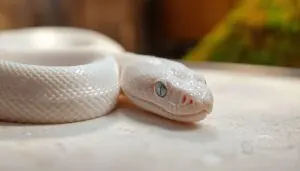
Picture a snake dipped in satin—that’s scaleless skin texture for you, smooth and glossy under any light.
Pair it with leucistic eye contrast, ivory bodies against blue-grey eyes, and you’ve got true showstopper morphs.
This double recessive breeding combo demands specialized care: soft substrate necessity, gentle handling, and constant skin abrasion prevention guide smart morph selection among today’s most unique snake morphs.
Axanthic and Monochrome Genetics
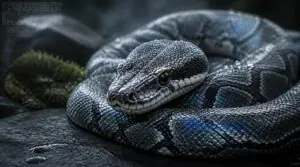
Strip away yellow, and you’re left with something hauntingly beautiful: xanthophore pigment reduction creates true monochrome snakes in silver, gray, and jet black.
This recessive allele expression demands two carrier parents, so serious breeders track axanthic lineage carefully. Pair it with structural iridescence, and you’ll find patterns still glowing faintly beneath that grayscale canvas—proof genetics can mute color without erasing shimmer entirely.
Unusual Spots and Skin Textures
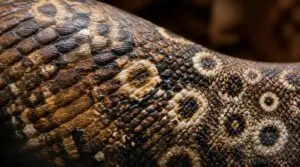
Not every wow-factor morph relies on color alone—texture and pattern do plenty of heavy lifting. Reticulated pattern aesthetics create net-like scale artistry, while hypopigmented rings produce bullseye effects across the body.
Run your fingers over keeled scales and you’ll feel a rugged, ridged texture; granular skin texture offers a rougher, bumpier contrast.
These physical details make every unique morph genuinely one-of-a-kind.
Rare and Exotic Snake Species for Enthusiasts
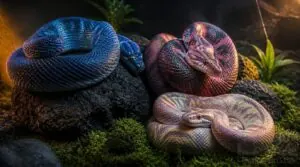
You’ll find that once you’ve mastered the basics, a whole new tier of ownership opens up—one built for collectors chasing something truly special. These species demand more skill, more research, and often deeper pockets, but they reward you with traits few other pets can match.
Here’s a closer look at five standout species worth knowing before you commit.
Boelen’s Python Ownership
You’ll find few snakes command a room like Boelen’s python, its iridescent scales flashing blue-purple like oil on water. Native to New Guinea’s montane forests above 1,000 meters, it demands high-altitude humidity and cool retreats.
- Adults reach 2.5–3.5 meters
- Prices often exceed $10,000
- Legal ownership requires CITES permits
Ethical captive breeding matters—wild populations remain vulnerable.
Emerald Tree Boa Features
Where Boelen’s python dazzles with shifting purples, the emerald tree boa answers with pure, saturated green—arboreal royalty with a heart shaped head and yellow ventral belly for striking contrast.
| Trait | Juvenile | Adult |
|---|---|---|
| Color | Orange-red | Emerald green |
| Timeline | Birth | Within 1 year |
| Function | Camouflage shift | Canopy ambush |
Its prehensile tail anchors branch-hanging strikes, while nocturnal vision traits sharpen nighttime hunting precision.
Brazilian Rainbow Boa Highlights
Swap the emerald boa’s solid green for something more dazzling: Brazilian Rainbow Boas boast rainbow scale refraction, their scale ridges acting as prisms that shift blue to purple in shifting light.
You’ll appreciate this semi-aquatic species’ Amazonian roots, thriving near rivers with 60-70% humidity. Nocturnal hunters using heat-sensing, they constrict rodents tightly before feeding—a stunning, practical addition for enthusiasts craving genuine visual spectacle.
Tentacled Snake Adaptations
From rainbow scales to something stranger: this species uses rostral tentacles to detect water vibrations in murky freshwater, curving into a J-shape to mimic vegetation. Remarkably, they anticipate a fish’s escape path, striking where prey will be, not where it’s. That predictive accuracy, paired with dorsoventral flattening for swimming, makes them true aquatic ambush specialists.
Using rostral tentacles to sense vibrations, the tentacled snake strikes where a fish will be, not where it is
Blue Coral Snake Traits
Picture a snake-hunting snake and you’ll grasp why enthusiasts covet the Blue Coral Snake. Its calliotoxin venom targets sodium channels for near-instant paralysis, delivered through elongated glands built for striking venomous prey—juvenile cobras included. That blue-black body with red warning coloration screams danger.
As a semi-fossorial species, it needs deep substrate and humidity, making it a genuinely difficult exotic pet care challenge.
Unusual Pet Snakes and Their Fascinating Traits
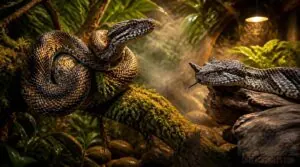
You’ll find that not every special snake fits neatly into the "beginner" or "exotic" boxes covered so far. Some species stand out for sheer personality, others for looks so odd they seem almost invented, and a few surprise you with how easily they adapt to home life.
Here’s a rundown of five standout snakes and the traits that make each one worth knowing.
Long-Nosed Vine Snake Characteristics
A twig with a brain and a bite—that’s Ahaetulla nasuta. Its elongated snout aids camouflage and lets it probe foliage for hidden prey. You’ll appreciate:
- Arboreal hunting stealth among vines
- Green/brown coloration blending into leaves
- Mild venom subduing lizards, geckos
- Tropical habitat adaptation across South/Southeast Asia
Reaching 1.1–1.4 meters, this exotic species showcases astonishing morphology within diverse snake ownership options.
Dragon Snake Appearance
Few snakes wear armor quite like Xenodermus javanicus. You’ll notice three raised keeled rows forming a dragon-like crest instantly.
| Feature | Detail |
|---|---|
| Dorsal ridge | Three keeled rows |
| Color | Near-black, iridescent sheen |
| Length | 30–60cm |
| Texture | Rough, prickly camouflage |
Dark, uniform scales shift with humidity—an iridescent shimmer aiding concealment. Small nocturnal eyes complete this striking, low-slung silhouette.
Hog Island Boa Temperament
Want a boa that greets handling like a chill afternoon nap? The Hog Island Boa delivers exactly that, rarely striking defensively when housed with proper hides.
- Gentle, curious exploration during handling
- Minimal gaping or muscle tensing when socialized young
- Calm males; slightly bolder females while breeding
- Crepuscular activity peaks at dawn and dusk
- Reduced stress through consistent, quiet handling sessions
Gopher Snake Adaptability
Few snakes match the sheer habitat flexibility of the gopher snake, thriving from sandy deserts to grassy farmland.
| Trait | Adaptation |
|---|---|
| Diet | Rodents, birds, eggs |
| Defense | Rattlesnake mimicry |
You’ll appreciate their defensive mimicry—hissing and tail-vibrating like rattlers—plus seasonal activity shifts and burrow-sharing for warmth, making them remarkably resilient among unique snake types to own.
Rough Green Snake Behavior
A living emerald ribbon, that’s what you’re getting with the rough green snake. This arboreal hunter spends daylight hours basking and stalking crickets and caterpillars through foliage—no constriction needed, just a quick strike and swallow.
Threatened? It’ll flatten defensively, release a foul defensive musk, then flee. Spring mating brings pheromone-driven courtship, proving gentle snake species diversity still fascinates enthusiasts craving authentic animal behaviorism.
Essential Care Tips for Unique Pet Snakes
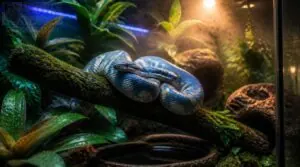
Owning something this exotic comes with real responsibility, and you’ll want to get the fundamentals right from day one. Every species on this list has its own quirks, from humidity needs to feeding schedules to legal red tape. Here’s what you’ll need to know to keep your unique pet thriving.
Enclosure and Habitat Requirements
Building the right enclosure separates thriving snakes from stressed ones. You’ll need 2 to 3 times your snake’s length in linear space, plus branches every 6-12 inches for arboreal climbers.
Nail your temperature gradients—28-32°C basking zones, cooling to 24-28°C—alongside 40-60% humidity, tracked with digital probes. Choose substrate matching natural behavior, and secure every latch.
Escape-proofing isn’t optional; it’s survival.
Specialized Diet and Nutrition
Get your enclosure dialed in, and diet becomes the next piece of the puzzle. Prey sizing rules matter—aim for 1 to 1.5 times your snake’s girth. Frozen thawed benefits include lower injury and disease risk versus live feeding.
Match feeding to metabolic feeding cycles—every 5 to 14 days depending on age. Watch digestion health indicators: consistent sheds, no bloating, steady weight signal your nutrient balance is spot-on.
Safe Handling and Acclimation
Your snake’s diet is dialed in—now comes the trust-building part. Give new snakes a 1 to 2 week acclimation period before handling begins.
Watch for stress signals like tongue flicking or trembling, and pause immediately. Skip handling for 24-48 hours post-feeding to avoid regurgitation. Use secure transfer containers, support the entire body, and wash hands to prevent scent transfer between docile and defensive individuals alike.
Legal and Ethical Ownership
Trust means nothing without paperwork backing it up. Before buying, confirm species-specific permits, since Germany regulates many reptiles by species and purpose.
- Keep traceable breeding records
- Verify international trade compliance
- Request lawful acquisition proof
- Check secure enclosure standards
- Follow ethical rehoming protocols
Whether venomous or nonvenomous, documentation protects both you and species conservation efforts—breeding challenges only compound without it.
Health and Veterinary Considerations
Why does a healthy-looking snake still need a vet visit? Because parasites hide well. Schedule fecal screenings after acquisition.
| Sign | Possible Issue | Action |
|---|---|---|
| Gaping, wheezing | Respiratory infection | Vet exam |
| Mouth swelling | Stomatitis | Oral treatment |
| Weight loss | Parasites/impaction | Fecal test |
Always wash hands—zoonotic risks are real. Consistent weigh-ins catch trouble early.
Frequently Asked Questions (FAQs)
What’s the nicest snake to own?
For pure docile temperament, corn snakes and ball pythons top the ranking—both stress-free, gentle, and forgiving with handling.
They’re widely considered the best first pets, offering calm demeanors and easy acclimation that beginner-friendly keepers genuinely appreciate.
What snake is worth $100,000?
Scaleless ball pythons with elite breeder pedigrees top the charts, sometimes hitting six figures. Rare morph valuation depends on clean lineage, genetic demand, and auction hype—proof that luxury reptile investments can rival fine art among serious collectors.
Can snakes hear you?
Like an old telegraph line picking up vibrations, snakes sense you through jawbone sound transmission and groundborne cues rather than eardrums—detecting low-frequency rumbles below 600 Hz, meaning your footsteps register far louder than your voice ever will.
What are the most unique snakes?
You’ll find gliding flying snakes, death-mimicking Hognoses, tentacled aquatic hunters with sensory organs, venomous Blue Coral Snakes delivering neurotoxins, and prehensile-tailed tree boas—each showcasing striking appearance and astonishing adaptations that make truly rare and unusual snake species worth appreciating.
What is the coolest snake to own as a pet?
The ball python takes the crown for most owners—calm, slow-moving, and endlessly patient with handling. Its rare morphs deliver jaw-dropping visual variety, while manageable size and steady temperament make daily care genuinely enjoyable rather than stressful.
What is the most unique snake?
It’s no coincidence evolution built a snake with facial radar: the tentacled snake uses paired sensory appendages to detect water vibrations within 10cm, ambushing fish underwater with astonishing precision, unlike any other aquatic hunter.
What permits are required for exotic snakes?
You’ll need CITES permits for listed species, plus state wildlife licenses and local exotic authorization.
Venomous snakes demand extra USDA paperwork; customs documentation matters for imports.
Check invasive species bans and national conservation laws before buying—penalties include confiscation.
How much do unique snake morphs cost?
Think of morph pricing like the stock market for scales—genetic rarity drives value. You’ll spend $50 on basic corn snake patterns or $50,000+ for scaleless piebald ball pythons, with breeder reputation and breeding difficulty pushing most unique morphs into that $200-2,000 range.
Which snakes are illegal in my state?
Legality hinges on local permit requirements and species protection status—venomous snakes like rattlesnakes and cobras face tight restrictions.
Always run a jurisdiction legality check with your veterinary authority before buying, since husbandry compliance and welfare standards vary widely by state.
Do rare snakes need specialized veterinarians?
Funny how the same vet who treats your neighbor’s ball python might freeze up on a Boelen’s Python—species-specific dosing, husbandry-linked illness, and anesthesia risks demand a true exotic specialist, not general reptile experience alone.
Conclusion
Every shed skin tells a story of transformation—your snake’s journey mirrors your own growth as a keeper.
Choosing among unique snake types to own isn’t about chasing price tags or rarity alone; it’s about matching temperament, care demands, and genetics to your skill level. Start humble, research relentlessly, and let your collection grow with your confidence.
The scales may be cold, but the reward, that quiet mastery over something wild, runs warm.