This site is supported by our readers. We may earn a commission, at no cost to you, if you purchase through links.
Kingsnakes earn their name by eating other snakes, yet most captive deaths trace back to something far less dramatic: a wrong-sized tank or a stuck thermostat. You don’t need a herpetology degree to keep one alive. You need accurate numbers and a routine you actually follow.
Get the enclosure, temperature gradient, and feeding schedule right, and a kingsnake will thrive for 15-20 years with minimal fuss. Get them wrong, and you’re looking at impaction, respiratory infection, or a snake that refuses food for weeks. This guide walks through kingsnake diet and habitat setup step by step, from hatchling tubs to adult tank security, so you can build a system that works.
Table Of Contents
- Key Takeaways
- Choose The Right Kingsnake Enclosure Size
- Set Up Temperature, Humidity, and Lighting
- Add Substrate, Hides, and Enrichment
- Feed Your Kingsnake Safely
- Maintain a Healthy Kingsnake Habitat
- Frequently Asked Questions (FAQs)
- What is the best habitat for kingsnakes?
- Do king snakes like to be held?
- What do king snakes prefer to eat?
- How to tell if a king snake is hungry?
- What do king snakes need in their habitat?
- What is the best setup for a king snake?
- How often should kingsnakes shed their skin?
- Can kingsnakes be handled during feeding time?
- What vaccines or medical care do kingsnakes need?
- How long do kingsnakes typically live in captivity?
- Conclusion
Key Takeaways
- Most kingsnake deaths result from incorrect enclosure size, temperature, or humidity rather than disease, so precise setup is the top priority for long-term health.
- Provide a temperature gradient of 85-90°F on the warm side and 75-85°F on the cool side, with humidity between 30-50%, to support digestion, shedding, and thermoregulation.
- Match prey size to your snake’s girth (not length) and follow age-based feeding intervals—every 5-10 days for hatchlings, stretching to 10-14 days for adults—to avoid regurgitation or impaction.
- House kingsnakes alone in secure, well-ventilated enclosures with locking lids, since cohabitation risks cannibalism and escape-prone lids undermine safety.
Choose The Right Kingsnake Enclosure Size
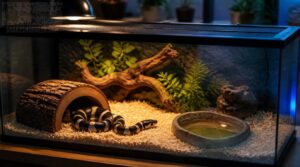
Enclosure size makes or breaks your kingsnake’s health. Get it wrong, and you’re fighting stress, poor appetite, and escape attempts from day one. Here’s what you need to know before you buy a tank.
If your kingsnake seems anxious even in a properly sized tank, checking out common reasons snakes hide and how to fix them can help you spot other stressors you might be missing.
Hatchling Enclosure Dimensions
A hatchling under 15 grams needs just 12x12x18 inches to start. Bigger isn’t better here—too much open space stresses newly hatched kingsnakes and hampers feeding response.
Follow the 1.5 to 2 times girth width rule for comfortable movement. Around 20 grams, plan your move up to an 18x18x24 inch enclosure. Secure, ventilated lids are non-negotiable for these initial space needs.
Adult Tank Size
Growth doesn’t stop at 20 grams, and neither should your enclosure sizing. Adults need a minimum 40-gallon tank, roughly 36x18x18 inches, hitting that critical minimum floor area of 6 square feet.
Larger specimens? Bump up to 55-75 gallons. Tank length requirements matter more than height here—kingsnakes are ground-dwelling, so prioritize floor space for enrichment over vertical climbing room. When selecting an enclosure, always consider the animal requirements and space needed for long-term health.
Secure Locking Lids
Kingsnakes are escape artists. Even a spacious 55-gallon tank fails if the lid doesn’t hold.
Use snap-lock or twist-and-seal lids with an audible click for confirmed closure. Check gaskets regularly—compression wear breaks seals over time.
Run weekly security inspections on latches, hinges, and locking lugs. Tamper-evident indicators reveal prying attempts before a snake exploits them. BPA-free, impact-rated plastic resists cracking under repeated locking cycles.
Ventilation and Airflow
A locked lid means nothing if air can’t move through it. Screened vents on opposite sides create cross ventilation, pulling fresh air in and pushing stale, humid air out.
- Avoid stacked decor blocking vents
- Use hygrometers to monitor microclimate
- Favor slow, continuous airflow over bursts
- Position vents to prevent stagnant zones
- Combine natural and mechanical ventilation as needed
Good airflow keeps humidity balanced and mold-free.
One Snake Per Enclosure
Two kingsnakes in one tank is a recipe for disaster. These snakes are solitary predators, and cohabitation risks include cannibalism, especially between mismatched sizes.
Housing two kingsnakes together invites disaster—these solitary predators risk cannibalizing each other, especially when sizes don’t match
Territorial behavior triggers social stress even without a bite. One snake, one enclosure—no exceptions.
This single rule shapes your whole approach to habitat setup, feeding schedules, and long-term reptile husbandry success.
Set Up Temperature, Humidity, and Lighting
Your kingsnake can’t regulate its own body heat, so the enclosure has to do that job for it. Getting temperature, humidity, and lighting right isn’t optional—it’s the foundation of a healthy setup. Here’s exactly what each zone needs.
Aim for a warm side of 85-90°F and a cool side of 70-80°F using a thermostat-controlled heat source, and check out this complete guide to California kingsnake temperature and humidity requirements for setup specifics.
Once your kingsnake’s habitat is dialed in, proper thawing frozen prey correctly becomes the next key step toward stress-free feeding.
Warm Side Temperatures
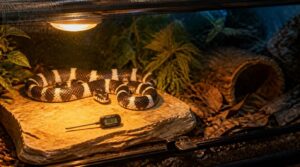
Basking spots make or break your snake’s ability to thermoregulate. Set the warm side between 85–90°F, verified with a thermal probe placed directly at the basking area, not the ambient air.
Position the heat source away from cords and hides. Keep it reachable but shielded from direct contact. The warm zone should cover roughly one third of the enclosure, preserving an accurate thermal gradient your kingsnake depends on daily.
Cool Side Temperatures
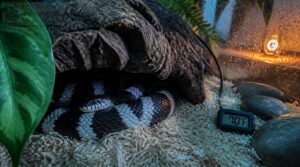
Rarely does the cool zone get enough credit, but it’s what keeps your kingsnake from overheating. Target 75–85°F, staying 8–12°F below the warm side.
Skip direct light here—radiant heat sneaks in fast. Use a non-heat sensor for accurate cool-side monitoring, and check readings against room ambient daily to catch drift before it disrupts the gradient.
Nighttime Temperature Drops

Once the sun sets, radiative heat loss takes over fast. Clear, dry nights make the drop even worse—don’t let temps fall below 70°F.
Substrate holds daytime warmth briefly, softening the decline. Use a thermostat with a nighttime probe to catch drift early. A subtle ceramic heat emitter prevents dangerous lows without disrupting the natural thermal gradient your kingsnake relies on for digestion and shedding.
Ideal Humidity Range
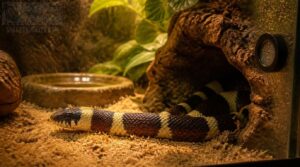
Dry air is a kingsnake’s silent enemy. Keep relative humidity between 30-50%, with a sweet spot of 40-45% for steady shedding.
A hygrometer takes the guesswork out of it — check out these practical tips for maintaining ideal shed humidity levels to keep your snake’s environment dialed in year-round.
Aspen or paper substrate buffers swings naturally. A damp hide raises local moisture without soaking the whole tank—watch for mold if levels creep past 50%.
Track daily readings with a hygrometer. Seasonal drift happens; adjust gradually, never abruptly.
Daylight and UVB Options
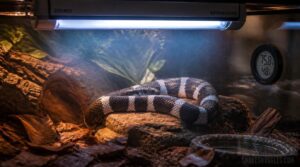
Kingsnakes don’t strictly need UVB, but skipping it wastes a free health boost. Low-output UVB (2.0-5.0) helps with vitamin D3 and natural UVA behavior benefits.
- Fluorescent bulbs: replace every 6-12 months
- Place fixtures 12-18 inches from basking spot
- Run a 12-14 hour photoperiod with dawn-dusk transitions
- Check UV index periodically for lighting distance safety
Add Substrate, Hides, and Enrichment
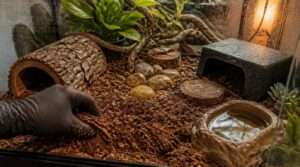
Temperature and humidity are dialed in, so now it’s time to build out the enclosure itself. Substrate, hides, and decor aren’t just for looks, they shape how your kingsnake behaves day to day. Here’s what belongs in the tank and what you need to leave out.
Safe Substrate Choices
Pick a substrate that holds moisture without staying soggy. Coconut coir and cypress mulch retain humidity well, supporting sheds and burrowing behavior.
Aspen shavings offer good airflow with low dust. Paper bedding cuts impaction risks and simplifies spot cleaning.
Clean topsoil mixes enable bioactive setups. Match substrate depth to your snake’s burrowing habits for a healthier terrarium.
Substrates to Avoid
Not every substrate belongs in a kingsnake tank. Steer clear of these:
- Gravel or crushed brick — causes impaction and mouth injuries
- Silica sand or cornstarch dust — irritates lungs, feeds mold
- Clumping coconut fibers — traps bacteria in anaerobic pockets
- Dyed or unstable sands — pigments scales, risks ingestion
Cedar and pine are off-limits too. Toxic oils cause respiratory distress and skin irritation.
Warm and Cool Hides
Substrate matters, but hides make or break your thermal setup. Provide two: one warm, one cool.
Ideal hide sizing means snug coiled fit, contacting three walls. Use ceramic or stone—hide material safety rules out cloth or mold-prone fabrics.
Strategic hide placement grants thermal gradient access, letting your kingsnake self-regulate. Inspect monthly; proper hide cleaning protocols prevent bacterial buildup and support smart microclimate management.
Water Dish Placement
Two hides handle temperature. Best dish placement controls hydration—put the water dish on the cool end, away from basking heat.
- Ceramic, weighted, wide-rimmed for stability
- Refill daily for hydration accessibility
- Clean weekly to curb bacteria
Material selection tips: skip lightweight plastic; it tips easily. Watch behavioral water needs—soaking signals shedding or dehydration in your kingsnake husbandry routine.
Branches and Climbing Decor
Give your kingsnake something to climb, not just crawl. Branch mounting safety matters most—secure hardware prevents wobble and injury.
Mix natural wood types like manzanita for texture and traction, spanning proper widths for girth support.
Design a climbing route layout at varied heights, away from water and heat. Weekly cleaning and mold checks keep decor safe long-term.
Feed Your Kingsnake Safely
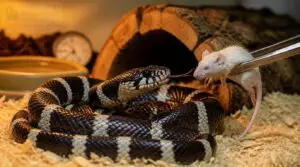
Feeding time carries real risk if you skip the basics. Your kingsnake’s health depends on getting prey size, timing, and handling right every single time. Here’s what you need to know before you drop that first mouse in.
Frozen-thawed Prey Basics
Never feed live prey. Kingsnakes thrive on a whole prey diet, but rodents must be fully thawed first.
- Thaw in the fridge 12–24 hours
- Confirm temp with an infrared thermometer
- Check for elastic, non-mushy texture
- Store thawed prey separately, organized by size
Proper thawing frozenthawed prey meets nutritional requirements and triggers a real feeding response.
Proper Prey Size
Girth, not length, determines proper prey size for kingsnake feeding. Measure your snake at its widest point and match prey diameter closely—never exceeding 1.5 times that width.
Follow the 10% body weight rule for growing snakes. Oversized meals risk regurgitation and impaction. Watch digestion: quick recovery within 24-48 hours signals correct sizing. Reassess after each shed as growth stages progress.
Feeding Schedule by Age
Age dictates appetite. Hatchlings and juveniles need frequent meals every 5-10 days to fuel rapid growth. Subadults shift to every 7-10 days with larger prey matching girth. Adults settle into 10-14 day intervals.
Pairing the right feeding schedule with proper thermoregulation is key — a guide to troubleshooting snake appetite issues can help if your snake refuses meals despite a well-maintained temperature gradient.
- Skipping meals stunts hatchling growth
- Overfeeding juveniles risks obesity
- Subadults need steady, not rushed, sizing
- Adults thrive on patience
- Cooler seasons naturally slow appetite
Thawing and Warming Prey
Cold prey won’t trigger a strike. Submerge sealed prey in warm water 30-60 minutes for best thawing methods—never microwave, which causes uneven, scorching hotspots.
| Step | Tool | Target |
|---|---|---|
| Thaw | Warm water | Flexible center |
| Verify | Infrared thermometer | 100-105°F |
| Warm | Water bath | Surface heat |
Check surface temperature verification before feeding; this mimics live prey and encourages strong feeding responses.
Tongs and Bite Prevention
Your fingers aren’t feeding tools. Ideal tongs length runs 10-12 inches for smaller kingsnakes, 15-18 inches for larger, feisty specimens.
Choose stainless steel with non-slip grips—tongs material selection matters when strikes come fast. Sanitizing feeding tools before and after each session prevents pathogen transfer.
Designate separate tongs per enclosure. Signal feeding with a hook first; this feeding signal technique curbs defensive strikes and keeps your kingsnake diet routine predictable.
Maintain a Healthy Kingsnake Habitat
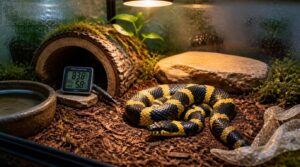
Feeding your kingsnake right is only half the job. Long-term health depends on daily habits and a sharp eye for trouble. Here’s what routine maintenance and monitoring should look like.
Daily Spot-cleaning
Daily spot-cleaning keeps bacteria and odor from taking over your snake enclosure. Remove waste the moment you see it, using gloves and a dedicated cleaning kit.
Wipe soiled substrate, glass, and decor with a reptile-safe disinfectant, then rinse residue fully. Clean water bowls separately. Skip scented sprays—they irritate respiratory tissue. Good sanitation protocols now prevent bigger habitat maintenance headaches later.
Monthly Substrate Changes
Spot-cleaning takes care of daily waste, but full substrate replacement happens monthly. Remove all bedding, scrub the enclosure, then replace with fresh material—coconut coir, cypress mulch, or aspen.
Watch for odor indicators: ammonia smell or mold means an early change. Moisture retention matters too—top off coir or bark between cycles. Bioactive setups need less full replacement, but monthly inspection stays non-negotiable for proper terrarium management.
Temperature Monitoring Tools
Digital thermometers and hygrometers beat stick-on strips every time. Use two probe sensors—one per zone—to track thermal regulation accurately.
Sensor accuracy types matter: thermistors respond fast in tight spaces. Digital sensor connectivity lets you view real-time cloud dashboards with automated alert systems for drift. Calibrate probes against a known reference to meet calibration compliance standards. Consistent climate control depends on it.
Shedding Support
A snake preparing to shed loosens its old skin in one piece—clean sheds signal good hydration. Keep humidity at 40-60%, offer a soaking dish, and use aspen for smoother texture.
Watch for retained eye caps or stuck tail skin. Boost humidity with light mistings or a humid hide if pieces remain—don’t ignore repeated incomplete sheds.
Illness and Stress Signs
Why does your kingsnake refuse three meals in a row? Feeding refusal often signals stress or illness.
Watch for respiratory distress sounds—wheezing, popping, gaping. Track lethargy, weight loss, and skin discoloration weekly.
These changes can point to nutrient deficiency, metabolic bone disease, or impaction risk. Reduce stress, monitor closely, and call your reptile vet if symptoms persist beyond 48 hours.
Frequently Asked Questions (FAQs)
What is the best habitat for kingsnakes?
Give your snake a secure, appropriately-sized enclosure with strong temperature gradients, 40-60% humidity, deep substrate for burrowing, hides on both ends, and climbing decor. Run new setups a full week before move-in using digital monitoring tools.
Do king snakes like to be held?
Think of a shy dog warming to a gentle owner: kingsnakes follow the same script. With consistent socialization, they tolerate handling well, often wrapping your arm for security. Watch for stress signals—they’ll flee rather than strike when frightened.
What do king snakes prefer to eat?
Rodents rule the menu, but wild kingsnakes also eat lizards, birds, eggs, amphibians, and even other snakes. Captive diets stay simpler: whole prey matched to girth, with dietary variety and seasonal appetite shifts supporting proper nutritional requirements.
How to tell if a king snake is hungry?
Like an old telegraph operator reading signals, watch for rapid tongue flicking, coiled alert posture, and prey-scent tracking. Hunger stays purposeful, unlike stress pacing.
Check body condition against your kingsnake diet’s feeding schedule before offering prey with feeding tongs.
What do king snakes need in their habitat?
Your kingsnake needs a secure 40-gallon enclosure with a temperature gradient (75–90°F), 40–60% humidity, warm and cool hides, a sturdy water dish, climbing branches for enrichment, and burrow-friendly substrate supporting natural digging behavior.
What is the best setup for a king snake?
Picture a Fort Knox for reptiles: a locking, escape-proof enclosure with a precise 75–90°F gradient, UVB lighting, hides, and a stable water dish—your kingsnake’s climate-controlled apartment for safe, healthy living.
How often should kingsnakes shed their skin?
Hatchlings shed every 2–3 weeks amid growth spurts; adults slow to 2–6 times yearly. Watch for dull, cloudy skin—it signals molting. Stable humidity (50–60%) prevents dysecdysis and helps guarantee healthy, complete shedding cycles.
If the rhythm still feels unpredictable, tracking each cycle against how long the shedding process actually takes can help you spot patterns and catch early signs of trouble.
Can kingsnakes be handled during feeding time?
Don’t rock the boat during mealtime. Feeding triggers predatory behavior and high regurgitation risk—handling now spikes stress cues and bite odds. Use feeding tongs, manage prey scent on your hands, then wait 48 hours before resuming handling.
What vaccines or medical care do kingsnakes need?
No vaccines needed. Schedule exotic veterinarian exams for parasite screening and reptile wellness checks.
Watch for respiratory infection signs, mouth rot symptoms, and mites.
If you notice any of these warning signs, this snow corn snake care guide walks through common health issues and how to address them early.
Quarantine new arrivals 3-6 months, maintain dietary supplementation, and practice diligent parasite management for lasting health.
How long do kingsnakes typically live in captivity?
Some kingsnakes outlive family dogs: 15–20 years is standard captivity, occasionally stretching past Consistent husbandry drives this longevity—stable temps, proper humidity, disease-free enclosures, and correct nutrition beat wild survival odds every single time.
Conclusion
Funny thing about a snake that eats other snakes: it’s often undone by a thermometer, not a rival. That’s the irony of kingsnake diet and habitat setup—the biggest threats are boring ones.
Correct temperatures, appropriate prey size, and a secure lid matter more than any dramatic intervention. Skip the guesswork, follow the numbers, and stick to the routine. Do that, and you’re not just avoiding disaster. You’re building two decades of steady, unremarkable health.