This site is supported by our readers. We may earn a commission, at no cost to you, if you purchase through links.

Picture a snake with a spiky, dinosaur-like crest running down its back and scales that flash blue and gold under torchlight. That’s Xenodermus javanicus, and it’s not from mythology. These dragon snake facts read like fiction, but every detail comes straight from herpetological research.
This nonvenomous wetland dweller from Southeast Asia spends its nights ambushing frogs in rice paddies and peat swamps, then vanishes under logs by dawn. Its ZZ/ZW sex chromosomes alone make it a genetic oddity among snakes.
Get ready to meet one of the animal kingdom’s strangest, most secretive reptiles, and learn what it actually takes to understand or care for one.
Table Of Contents
- Key Takeaways
- Dragon Snake Facts: Species Overview
- Dragon Snake Size, Scales, and Appearance
- Dragon Snake Habitat and Nocturnal Behavior
- Dragon Snake Diet, Defense, and Reproduction
- Dragon Snake Captivity and Conservation Facts
- Frequently Asked Questions (FAQs)
- Are dragon snakes omnivores, herbivores, or carnivores?
- Can you own a pet dragon snake?
- How long do dragon snakes live?
- How often do dragon snakes breed?
- What are some interesting facts about the dragon snake?
- Can you keep a dragon snake as a pet?
- Where do dragon snakes live?
- What is the behavior of a dragon snake?
- Why do dragons resemble snakes?
- What do you know about dragons?
- Conclusion
Key Takeaways
- The dragon snake (Xenodermus javanicus) is a completely nonvenomous, secretive wetland species from Southeast Asia that relies on camouflage, musk, and tonic immobility instead of venom or constriction to survive.
- Its dramatic look—three raised dorsal ridges and iridescent, light-bending scales—comes from structural color and unique scale morphology rather than pigment or fangs.
- As a strict nocturnal ambush hunter, it feeds only on frogs, tadpoles, and small fish, striking in under 0.2 seconds and needing food just once every 7 to 10 days.
- Keeping one in captivity is a serious challenge best left to experienced keepers, since it demands precise humidity (85-95%), cool temperatures (72-77°F), and minimal handling to avoid stress.
Dragon Snake Facts: Species Overview

Meet a snake that looks like it wandered out of folklore. Before you get to scales and swamps, you need the basics — what it’s called, where it sits on the family tree, and why scientists still scratch their heads over it. Here’s your quick rundown.
Once you’ve got its story straight, it’s worth checking its skin for unwelcome hitchhikers, since spotting the warning signs of snake mites can save you a lot of trouble down the road.
Scientific Name and Snake Family
Here’s a reveal: the dragon snake isn’t a cobra cousin at all. Its real name, Xenodermus javanicus, places it in family Xenodermidae, not Elapidae. Named by Bleeker in 1860, it’s a taxonomic monotype, the sole species in a monotypic genus. No fangs, no venom glands. Just evolutionary weirdness worth studying.
This sets it apart from the roughly 3,600 snake species worldwide, most of which belong to larger, well-documented families.
Common Names and Taxonomy
Names shift depending who’s talking. Call it dragon snake in English texts, but Southeast Asian communities use naga idioma or water dragon. Taxonomy gets messy too. Some regional lists lump it under Ptyas classification, though Xenodermus genus is the accurate placement for Xenodermus javanicus. It even carries unusual ZZ/ZW chromosomes, a genetic quirk fitting its monotypic status.
Nonvenomous Species Overview
That ZZ/ZW quirk fits a bigger truth: this snake is entirely nonvenomous. No fangs, no toxin glands, nothing.
Instead, it survives Southeast Asia’s wetland habitats through defensive mimicry, bluffing predators rather than poisoning them. Taxonomic classification confirms it, physical adaptations back it up. Nocturnal activity keeps confrontations rare anyway. Nature skipped the venom and handed it theatrics instead.
Evolutionary Uniqueness
Theatrics aside, this snake’s oddity runs deeper, straight into its DNA. Mitochondrial DNA distinctness marks a genetic lineage divergence separate from other regional serpents.
Add unique scale morphology, a specialized skull structure adaptation, and teeth built for grabbing slippery prey. Together, they place Xenodermus firmly outside the ordinary evolutionary lineage of snakes, a true evolutionary oddity.
Natural History Research Gaps
For all anyone knows about its eerie defenses, the dragon snake keeps plenty of secrets. Population monitoring is nearly nonexistent, leaving true geographic range and habitat use patterns murky at best.
Scientists still lack solid data on life cycle timing and genetic diversity. IUCN lists it Least Concern, but with data this thin, "Data Deficient" might fit better.
Dragon Snake Size, Scales, and Appearance
One look at a dragon snake and you’ll understand the name instantly. This isn’t your average smooth-scaled serpent—every inch of it looks built for drama. Here’s what makes its size, scales, and face so unmistakably its own.
Three Raised Dorsal Scale Rows

Run your finger down a dragon snake’s back and you’ll feel it instantly: three ridges, rough as bark. These raised dorsal scales form a zigzag crest from neck to tail, separated by grooves of normal-height scale. It’s a key identification feature, found nowhere else quite like this.
Function matters too: grip on mud, moisture shedding, and camouflage against dappled light.
Adult Size and Body Shape
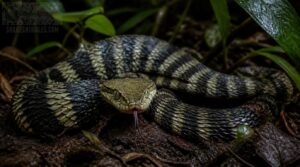
A body built for stealth, that’s the dragon snake in one phrase. Adults stretch 24 to 30 inches, females larger than males.
That slender build pairs with a manageable appetite, and understanding feeding schedules through resources like how long ball pythons can safely skip meals helps keepers replicate those healthy captive routines.
Torso uniformity holds along a laterally compressed frame, tapering toward a slender tail. Add a triangular head, sharp neck shift, and vertical pupils, and you’ve got a predator shaped entirely for ambush.
Coloration and Iridescent Sheen

Catch dragon snakes at dawn and you’ll swear their scales change color mid-crawl. That’s structural color, not pigment: microscopic ridges bend light like a butterfly wing.
Dark gray dorsal scales flash blue, green, and gold depending on angle. Wetland light and dusk shadows boost it, aiding camouflage and, likely, mate signaling among the reeds.
Head, Eyes, and Nostrils

That triangular head isn’t just for show. It’s a precision hunting tool, wider than the neck, built around big black eyes and oversized nostrils.
- Rounded, oblong skull shape
- Large eyes for low-light vision
- Big nostrils detect odor plumes
- Wide jaw joints for engulfing prey
Rigid skull plates protect the brain while that pointed snout snaps fast and true.
Male and Female Differences

Can you sex a dragon snake at a glance? Mostly, yes. Females win on larger body size; males carry thicker, longer tails with a visible hemipenial bulge. Breeding season sharpens male coloration too.
| Trait | Male vs. Female |
|---|---|
| Tail length | Longer in males |
| Body size | Larger in females |
| Hemipenal bulge | Visible in males |
| Breeding color | Bolder in males |
Dragon Snake Habitat and Nocturnal Behavior

Where a snake lives says everything about how it survives. Dragon snakes didn’t end up shy, nocturnal swamp-dwellers by accident — their whole world shaped that behavior. Here’s what that world actually looks like.
Southeast Asian Geographic Range
Dozens of river basins stitch this snake’s world together. Dragon snakes range across mainland Southeast Asia, Thailand, Malaysia, and Myanmar, then out to Sumatra, Borneo, and Java. The Malay Peninsula acts as a natural bridge. Island populations grow genetically isolated over time.
Elevation stays under 500 meters. Monsoon rains dictate everything, flooding wetlands that keep this secretive hunter connected.
Swamps, Wetlands, and Rice Paddies
Follow the floodwater and you’ll find this snake’s true home: swamps, peat forests, and rice paddies. These wetland habitats aren’t empty backdrops. They’re living systems.
- Amphibian breeding grounds teeming with tadpoles
- Water spinach and duckweed feeding invertebrates
- Dragonfly larvae signaling water quality
- Algae mats fueling small fish
- Reeds sheltering nesting birds
A nocturnal predator thrives where amphibian prey is abundant.
Elevation and Microhabitat Preferences
Rice paddies sit low. But dragon snakes climb too, tracking a wide elevation range from swamp plains up to 1,500 meters.
Lowlands mean flooded, vegetated pockets. Higher up, the elevation gradient shifts them toward riparian corridors, bamboo, streamside cover, cooler thermal refuges. Rainfall dictates the ceiling: wetter regions stretch their range further upslope.
Nocturnal and Secretive Activity
Elevation shifts the map, but darkness rules the clock. Dragon snakes are strictly nocturnal, vanishing into hidden daytime rest under logs and roots before emerging at midnight activity peaks.
Their nocturnal vision controls low light with ease. Movement even tracks lunar cycle patterns, peaking near new moons. This secretive nature, paired with stealth foraging techniques near submerged ambush zones, keeps predators guessing and prey unaware.
Wetland Temperature and Humidity
Beneath the canopy, water rules everything. Saturated soils create thermal inertia wetlands that resist swings, holding steady 72-77°F.
- Shaded pools staying cool under leaf cover
- Groundwater seeping in at stable temps
- Humid air clinging near 85-95%
- Evaporative cooling dropping surface heat
- Root mats trapping ground moisture
This temperature buffering effect, paired with tight humidity microclimates, sustains the swamp habitat dragon snakes depend on entirely.
Dragon Snake Diet, Defense, and Reproduction

Survival for a dragon snake means playing it smart, not tough. No venom, no muscle — just timing, camouflage, and a few clever tricks passed down through generations. Here’s how this swamp specialist hunts, defends itself, and keeps its bloodline going.
Frogs, Tadpoles, and Fish
Dragon snakes are picky eaters, and picky in a specific way. Their menu? Frogs, tadpoles, and small fish, full stop. No rodents, ever.
As tadpoles metamorphose from plant-grazers into hunters, they become prime targets themselves, caught in a wetland food web where today’s predator was yesterday’s prey. That’s aquatic specialization at its finest.
Ambush Hunting Without Constriction
Watch one hunt and you’ll see patience weaponized. Dragon snakes are opportunistic hunters that vanish into vegetation, then strike in under 0.2 seconds once motion ripples the water’s edge.
The dragon snake hides in silence, then strikes in under 0.2 seconds when prey disturbs the water
No constriction needed:
- A precise head snap
- Instant immobilization
- Silent retreat to safety
- Patient distance monitoring
That’s nocturnal foraging perfected, speed and stealth over brute force.
Tonic Immobility, Hissing, and Musk
Cornered dragon snakes run a three-stage playbook. First comes cloacal musk, a pungent chemical signal. Next, a rasping hiss, its volume shifting with stress. Push further and you’ll trigger tonic immobility, a stress-induced freeze with slowed heart rate.
| Trigger | Response | Duration |
|---|---|---|
| Handling | Musk release | Seconds |
| Cornering | Hissing | 1-3 sec |
| Restraint | Tonic immobility | Minutes |
Egg-Laying and Clutch Size
Rain triggers romance. Once the wet season hits, dragon snakes settle into their reproductive cycle, mating then resting 1-2 weeks before nesting.
Females dig into damp soil banks, choosing shaded spots near water. There, they lay 4-8 smooth, white oviparous eggs, each roughly 20-25mm across, in one solid clutch. Female size and condition drive clutch size. Incubation: 45-60 days, humidity above 70%.
Growth, Maturity, and Lifespan
From hatchling to adult, growth moves fast then slows. Juveniles pack on 8-12cm in year one alone, chasing sexual maturity by age two.
Wild lifespans rarely exceed a few years. Predation and habitat quality decide who survives infancy. Captivity flips the odds though: proper humidity and feeding routines stretch captive longevity to 8-10 years, sometimes more.
Dragon Snake Captivity and Conservation Facts

So you’ve made it past the biology lesson—now comes the hard part. Keeping a dragon snake alive in captivity isn’t like keeping a corn snake; this species demands precision, not guesswork. Here’s what actually goes into building its world.
Observation-Only Handling Expectations
Since dragon snakes rank among the most stress-prone captives alive, treat yours as an observation-only pet, not a handling project. Watch for a defensive posture or freeze-and-flatten response, both signal it’s time to back off. Practice gentle approach protocols:
- Move slowly, no sudden reaches
- Keep hands distant
- Skip neck restraint
- Read stress indicators before touching
Passive monitoring beats contact, every time.
Enclosure and Substrate Requirements
Watching from a distance is only half the job. Get the enclosure right, and your dragon snake practically cares for itself.
Go glass or acrylic, secured lid, minimum size scaled to the snake. Layer coconut coir mix with sphagnum moss for moisture retention. Add plastic hides near screened vents for a humidity gradient.
| Element | Requirement | Purpose |
|---|---|---|
| Enclosure | 20-gal min | Space |
| Substrate | Coir/moss | Moisture |
| Hides | 2+ plastic | Security |
| Vents | Screened | Airflow |
| Lid | Secure | Containment |
Humidity and Temperature Sensitivity
This is a cool temperature reptile, plain and simple. Keep the gradient at 72 to 77F, humidity 85 to 95 percent. Push past 80F and thermal regulation limits get tested fast.
Humidity impact behavior shows up quick too. Dense moss buffers microclimate humidity swings, mimicking swamp margins where your snake naturally patrols after dark.
Specialized Feeding Challenges
Getting a dragon snake to eat is where most keepers stumble. This is a specialized diet snake, strictly frogs, tadpoles, small fish. No rodents, ever.
Prey size matching prevents choking. Live prey reluctance is common; try frozen-thawed prey instead. Feed every 7 to 10 days. Watch for stress-induced anorexia after handling, and mist during feedings for hydration.
Conservation Status and Pet Trade
Here’s the catch: no formal IUCN listing exists under "dragon snake." It’s a trade name, not a taxon.
Real threats are clear though: habitat loss from wetland drainage, pesticide runoff, and wild collection. CITES rules govern trade, but enforcement lags. Captive breeding eases wild pressure, while population monitoring and consumer awareness campaigns push buyers toward legal, sustainable stock.
Frequently Asked Questions (FAQs)
Are dragon snakes omnivores, herbivores, or carnivores?
Pure carnivores, no debate. Frogs, tadpoles, and small fish make up their entire menu, hunted only at night. They strike live prey via ambush, then swallow it whole, feeding roughly every 7 to 10 days as adults.
Can you own a pet dragon snake?
It’s less a pet and more a locked vault: legal ownership hinges on strict permits, captive-bred sourcing, and welfare compliance. Xenodermus javanicus stays rare in the pet trade, protecting wild Southeast Asia populations from exploitation.
How long do dragon snakes live?
With steady care, dragon snakes live up to 10 years in captivity. Stable humidity, cool temps, and low stress matter most. Wild survival drops sharply, often just a few years, due to predation and harsh conditions affecting growth and maturity.
How often do dragon snakes breed?
Once a year, usually. Females hit reproductive maturity around 18 to 24 months, then lay 2 to 6 eggs when rainy-season humidity and temperature cues align, incubating 40 to 60 days before hatchlings emerge.
What are some interesting facts about the dragon snake?
Ever met a snake that plays dead, then musks you out of spite? Xenodermus javanicus sports three raised ridges, hunts frogs by night in Southeast Asia’s swamps, and survives only where humidity control stays near-perfect.
Can you keep a dragon snake as a pet?
Technically yes, but Xenodermus javanicus is difficult to keep in captivity. Extreme humidity, narrow temperature ranges, live prey diets, and severe stress sensitivity make it a specialist’s snake, not a beginner’s first exotic pet.
Where do dragon snakes live?
Home is where the water is. Dragon snakes haunt Southeast Asia’s humid forests, from Thailand to Borneo, favoring swamp ecosystems, marshy lowland rainforest, and rice paddies, up to 1,000 meters, wherever damp cover meets standing water.
What is the behavior of a dragon snake?
Secretive and strictly nocturnal, this snake hunts after dark, then freezes solid using tonic immobility when threatened. Cornered, it releases musky cloacal secretions as a last resort. Biting stays rare, it prefers hiding over conflict.
Why do dragons resemble snakes?
Long body, sharp scales, ancient fear: dragons borrow every trait from real snakes. Water associations, fear response, and cultural exchange across Southeast Asia shaped the myth. Nature wrote the blueprint; artists just added wings.
What do you know about dragons?
Dragon myths worldwide span cultures, from fire-breathing legends in Europe to water-controlling serpents in Asia. Symbols of power and guarded treasure, they still shape modern dragon media, and inspired the real, nocturnal Southeast Asian dragon snake.
Conclusion
Long before Jurassic Park made dragons feel scientific, this snake was already wearing its armor in Javan swamps, ignoring Hollywood entirely. That’s the real lesson buried in these dragon snake facts.
This isn’t a creature built for handling or applause. It thrives in shadow, hunts on its own terms, and rewards only those who study rather than seize. Respect its wildness. Some power isn’t meant to be tamed, only understood.