This site is supported by our readers. We may earn a commission, at no cost to you, if you purchase through links.

Picture a snake with lips so white they seem painted on—glowing against skin that flashes gold, green, and purple as it moves. That’s your first clue you’re looking at a white lipped python, one of New Guinea’s most striking constrictors.
These snakes pack heat-sensing pits, ontogenetic color changes, and a temperament that swings from "chill" to "absolutely not" depending on the day. Owners love them and respect them in equal measure.
Ready to learn what makes this species tick, from hatchling to full-grown powerhouse? Let’s get into it.
Table Of Contents
- Key Takeaways
- What is a White-Lipped Python?
- White-Lipped Python Habitat and Behavior
- White-Lipped Python Size, Lifespan, and Reproduction
- White-Lipped Python Enclosure and Care Requirements
- White-Lipped Python Feeding, Handling, and Health
- Frequently Asked Questions (FAQs)
- Are white-lipped pythons good pets?
- What snake is worth $100,000?
- How big does a white-lipped python get?
- How much does a white-lipped python cost?
- What is a white lipped python?
- Are white lipped pythons right for You?
- Are white lipped pythons Hardy?
- Where do white lipped pythons live?
- How big do white lipped pythons get?
- What are the different color variations of white-lipped pythons?
- Conclusion
Key Takeaways
- Your white-lipped python isn’t a beginner’s snake—its defensive strikes, strict enclosure needs, and 15-25 year lifespan mean it’s built for experienced keepers only.
- You’ll need a spacious enclosure (6x2x2 feet minimum) with a 30-34°C basking spot, 60-80% humidity, and plenty of climbing room to keep this semi-arboreal hunter healthy.
- Those iridescent scales aren’t pigment at all—they’re structural, bending light into shifting gold, green, and purple as your snake grows from bold juvenile colors into camouflaged adult tones.
- Feeding schedules shift with age (every 5-7 days for hatchlings, stretching to 4-6 weeks for adults), and waiting 48 hours after meals before handling helps you avoid defensive bites.
What is a White-Lipped Python?
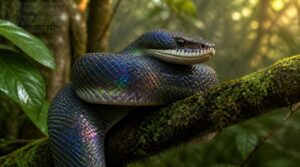
This snake is more than just a pretty face with a killer light show. Get to know its name, its cousins, and what makes it tick before we talk cages. Here’s what you’re actually working with.
Scientific Classification and Common Names
Before you can care for one, you need to know what to call it. This snake wears many name tags: Leiopython albertisii, White Lipped Python, D’Albertis’ python, even Bothrochilus albertisii in older texts. Genus Leiopython, species albertisii—that’s your taxonomic anchor. Family Pythonidae, order Squamata. One species, countless labels. Names shift; the snake doesn’t.
Beyond the name tags, that glossy, iridescent sheen is what truly sets this species apart—see the full python species identification guide for how it compares to relatives.
The classification follows a hierarchical system based on observable characteristics. Linnaean classification system is used to organize species like this python into taxonomic ranks.
Northern and Southern Forms
Names aside, this python isn’t one-size-fits-all. Northern whitelipped pythons run smaller, cooler-toned—gray to olive with subdued contrast. Southern form white lipped pythons show up warmer: golden base, bold dark saddles.
- Geographic split: north hugs coastal highlands, south favors lowland swamps
- Habitat preference: dense canopy versus riparian edges
- Build: southern snakes average larger
Breeding season lines up with rainy months for both.
Iridescent Scales and White Lips
Color aside, watch a Bothrochilus albertisii move through sunlight and you’ll see the real magic: light refraction across its scales, shifting gold to green to purple. This isn’t pigment—it’s structure, catching rays like oil on water.
Then there’s the lip pattern contrast. Bright white labial scales rim the mouth, sharp against dark skin. Function? Camouflage and signaling, both at once.
Heat-Sensing Pits and Hunting
Between each eye and nostril sits a small pit lined with a heat-sensitive membrane. It reads temperature shifts smaller than a thousandth of a degree.
That’s heat detection accuracy at work—finding warm bodies hidden in leaf litter or shadow. Since these are nocturnal hunters, pits guide thermal strike precision even in pitch dark, overcoming prey camouflage that fools regular eyesight.
Juvenile-to-Adult Color Changes
Watch a hatchling grow up and you’re watching ontogenetic color change in real time. Bright yellow bands fade into olive green. Lip patterns blur, ventral scales shift from cream to warm gray, and that rainbow iridescence softens.
Nature’s slowly trading flash for camouflage—juvenile coloration is bold, adult coloration blends into forest shadow. Smart trade-off for survival.
As it grows, a white-lipped python trades bold juvenile flash for the camouflage that keeps adults alive
White-Lipped Python Habitat and Behavior

Before you build an enclosure, you need to know what this snake calls home in the wild. Its native range, activity patterns, and temperament all shape the choices you’ll make later. Let’s start with where you’ll actually find one slithering around New Guinea.
Native Range Across New Guinea
One island, countless hidden corners — that’s home turf for the White Lipped Python.
Despite their feisty reputation, these snakes rely on speed and defensive bluffing rather than venom, as this guide on white-lipped python aggression and temperament explains.
Found only on New Guinea, it spans both Papua New Guinea and Indonesian West Papua. Populations stretch from coastal rainforest habitats up through New Guinea lowlands into island elevation zones near 1,200 meters. Riverine swamp corridors link these pockets together, driving population genetic variation — proof this snake, sometimes called the D’Albertis python or northern whitelipped python (Leiopython albertisii), adapts wherever water flows.
Rainforest and Swamp Habitats
Picture layers stacked like apartment floors — emergent trees towering 45 meters up, understory shaded below. That’s canopy stratification at work.
Down where roots meet waterlogged soils, swamp forests thrive. Buttress roots grip unstable ground. Humidity stays above 75%, rarely dipping — that stability is why replicating a tropical rainforest habitat matters so much for captive setups.
Nocturnal and Semi-Arboreal Activity
Darkness is when this snake comes alive. Nocturnal hunters by nature, they leave roost sites after sunset, using heat pits to track warm bodies in pitch black.
Being semiarboreal, they climb often — short bursts from ground to branch, ambushing prey along canopy foraging routes. Ground-to-branch transitions happen fast, especially when the thermal gradient outside stays mild and humidity control keeps forest air thick.
Defensive Behavior and Temperament
Startled? This snake doesn’t bluff long. Its first move is a tight defensive coil, head tucked, body flattened low.
Given an exit, it flees to cover. Cornered, expect a gaping threat display, hissing, maybe a thrash — strikes stay low, aimed at hands, not faces.
Stress spikes heart rate fast. Calm, steady handling keeps that defensive temperament in check.
Wild Versus Captive-Bred Temperament
Same species, different snake. Wild-caught individuals stay wary, quick to coil, slow to trust.
Captive-bred pythons settle fast — calmer handling, steadier feeding, quicker recovery from stress.
Feeding-wise, wild ones refuse new prey longer. Socially, they’re loners; captive-bred snakes tolerate close quarters better.
Bottom line: temperament isn’t fixed — it’s shaped by origin and experience.
White-Lipped Python Size, Lifespan, and Reproduction

Size and lifespan aren’t just trivia—they shape how you plan for this snake’s future. Your White-Lipped Python will grow, mature, and maybe even breed, and each stage brings its own questions. Here’s what to expect from egg to full-grown adult.
Adult Length and Growth Rate
Give it four years, and your snake goes from noodle to nearly full-grown.
Adult white lipped pythons hit 6 to 7 feet, sometimes pushing past that with good genetics and steady care. Growth rate depends on feeding consistency and low stress—captive snakes often outpace wild growth.
- Year 1: 3–4 feet
- Year 2: 5–6 feet
- Year 4+: near-max length
Sex Differences and Maturity
Length tells you size, not readiness. Sexual maturity hinges on sex.
Females mature faster—breeding by two to three years old, once they hit that 1.0 to 1.5 kilogram threshold. Males lag behind, needing three to four years and a beefed-up tail base for locking during mating.
It’s a numbers game your white lipped python plays by weight, not birthdays.
Typical Captive Lifespan
Weight determines maturity—time determines longevity.
A healthy white-lipped python lives 15 to 25 years in captivity, some pushing past 30 with sharp husbandry. Enclosure stability, steady temperatures, and consistent diet drive that number. Regular veterinary care and health monitoring catch problems early. Skip the guesswork, stick to the gradient, feed on schedule—your snake pays you back in decades.
Breeding and Egg Laying
Longevity’s nice, but babies are the real payoff. White-lipped pythons are oviparous—egg layers, no live birth here.
Breeding season lines up with dry-season cues. Clutch size runs 6-14 eggs, tied to female size and body condition.
Females nest in leaf litter or loose soil pockets. Skip live incubation dreams—these snakes don’t brood. External incubation is mandatory.
Incubation and Hatchling Development
Once eggs hit the incubator, patience becomes your best tool. Expect 60-90 days at a stable 28-32°C—wild swings spike deformity risk.
Turn eggs daily. Keep humidity levels balanced to protect the shell without drowning it.
Watch yolk sac absorption—it fuels those final growth stages. Healthy hatchlings show real hatchling vigor: alert eyes, strong grip, active exploring within hours.
White-Lipped Python Enclosure and Care Requirements
Setting up a home for your white-lipped python takes more than just a big tank. This snake needs the right space, temperature, and humidity to actually thrive—not just survive. Here’s exactly what to get right.
Adult Enclosure Size and Layout

Think 6 Long x 2 Wide x 2 Tall, minimum. This isn’t a snake you cage—it’s one you house.
- Floor space: open, corner-free
- Vertical height: 4-6 feet of climbing room
- Hide placement: two, opposite ends
- Enrichment: branches sized for a 30 years-long resident
Bioactive setups shine here too, giving your python a living, breathing world instead of a box.
Temperature Gradient and Basking Zone
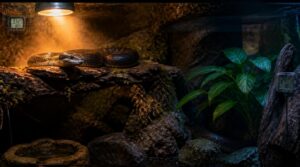
Get the thermal gradient wrong and your python pays for it in digestion problems.
Aim for a 30-34°C basking spot, cool end around 24-26°C.
| Zone | Temp Range | Placement |
|---|---|---|
| Basking | 30-34°C | Elevated shelf |
| Cool side | 24-26°C | Opposite end |
| Ambient | Gradient between | Floor level |
Use two probes. Thermostats keep it steady—no guesswork required.
Humidity, Hydration, and Ventilation
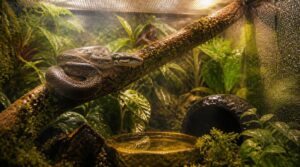
Rainforest air is thick for a reason—your enclosure should feel the same way.
Target 60-80% humidity, dipping slightly for adults. Seal gaps, add a humid hide, and mist daily for juveniles.
Fresh water always. Soak monthly if shedding looks rough.
Vent without drafts—screened panels work. Watch for condensation; that’s your cue to dial back.
Substrate, Hides, and Climbing Enrichment

Your substrate is the foundation—literally. Coconut fiber or organic topsoil, 5-8 inches deep, holds moisture and lets your python burrow like it would in the wild.
Place double hides on opposite ends—warm and cool sides both need cover.
Add jungle vines and low branches, spaced for easy S-shaped coils. Rotate enrichment every 2-4 weeks. Keeps things interesting.
Lighting, UVB, and Bioactive Options
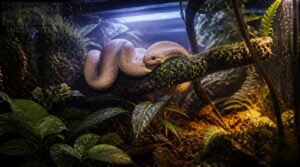
Does a nocturnal snake even need light? Yes—for a bioactive terrarium, not just the python.
Use 5.0 UVB tubes or T5 HO for low-moderate output. Place fixtures close to the canopy for real UVB reach.
Add plant grow lights for foliage. Run dawn-dusk simulation, 12-14 hours. Check UVB monitoring schedule yearly—bulbs dim before they die.
White-Lipped Python Feeding, Handling, and Health
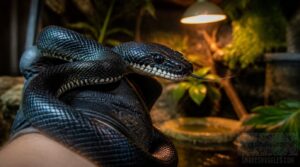
Your white-lipped python has its enclosure set up and ready. Now comes the part that keeps it healthy and keeps your fingers safe—feeding, handling, and spotting trouble early. Here’s what you need to know.
Natural Diet and Captive Prey
In the wild, white-lips hunt rats and small mammals across the forest floor, striking fast and using pure constriction—no venom involved.
Captive keepers mirror this with frozen and thawed rats, sized to match the snake’s girth. Prey size matching prevents regurgitation. Whole vertebrate prey items simulate natural feeding, keeping digestion smooth and instinct sharp.
Age-Based Feeding Schedule
Matching prey to age keeps growth on track. Hatchlings eat every 5-7 days, juveniles shift to 7-14, subadults stretch to 14-21, adults settle at 4-6 weeks.
Prey climbs from 5g pinkies to 600g rats as girth increases. Pause feeding during shedding. Watch weight—two stalled feedings means it’s time to reassess.
Safe Handling and Bite Prevention
Feeding schedules matter, but bite prevention keeps hands intact.
White-lips have a reputation—quick, defensive strikes when startled.
- Wait 48 hours post-feeding before handling
- Support the body with two hands, none by the head
- Watch body language—coiled posture or gaping means back off
Approach from the side, not overhead. Skip dusk handling sessions. Slow, steady moves beat sudden grabs every time.
Common Health Problems and Warning Signs
Good handling habits won’t stop every problem—know the warning signs too.
Respiratory infection shows up as wheezing, open-mouth breathing, or nasal discharge.
Scale rot turns scales mushy and discolored. Watch for retained shed sticking to eyes.
Metabolic bone disease causes tremors, soft jaws, spinal curves.
Digestive distress means regurgitation or no defecation for 10+ days.
Dehydration shows wrinkled skin, sunken eyes—act fast.
Parasite Prevention and Veterinary Care
Since prevention beats treatment every time, stick to a monthly fecal exam schedule—catches Giardia and coccidia early.
Add quarterly deworming, a strict quarantine protocol (30 days minimum), and regular enclosure sanitation to block mite infestations and parasite spread.
Find an exotic animal veterinarian for annual checkups. They’ll catch scale rot or respiratory infection before it snowballs into something serious.
Frequently Asked Questions (FAQs)
Are white-lipped pythons good pets?
Honestly? Only for experienced keepers. Their defensive temperament, strike-happy reflexes, and strict enclosure size, temperature gradient, and humidity needs make them a serious long-term commitment—not a beginner-friendly snake to grab on impulse.
What snake is worth $100,000?
High blue green tree pythons top the charts, with reported sales near $445,800. Rarity, color intensity, and breeder lineage drive these prices—far above your White-Lipped Python’s modest cost as an exotic pet.
How big does a white-lipped python get?
Big enough to earn its "long" reputation—pun intended. Adults hit five to seven feet, females outsizing males. Rare specimens stretch to 213 cm, with captive growth steady for the first two to three years.
How much does a white-lipped python cost?
Expect $300 to $700 for a captive bred juvenile snake, with standard, non-morph animals often landing near $350–$ High-end morphs or proven breeders can exceed $1,000 — plus shipping fees of $50–$150 on top.
What is a white lipped python?
Picture a glossy black shadow rippling with rainbow light. That’s Leiopython albertisii, a non-venomous constrictor from New Guinea’s lowland forests—named for its striking white lips, a nocturnal hunter built for tropical, humid terrain.
Are white lipped pythons right for You?
The gentlest-looking pet often demands the toughest owner. This snake isn’t beginner-friendly—defensive behavior, minimal handling tolerance, and a two-to-three-decade lifespan commitment mean it suits patient, experienced keepers over first-timers seeking a cuddly companion.
Are white lipped pythons Hardy?
Not exactly. Health strength is solid—strong disease resistance, quick recovery. But stress tolerance is low. Skip the right enclosure size or humidity, and you’ll see respiratory infection or scale rot fast. Hardy body, sensitive nerves.
Where do white lipped pythons live?
Home turf is the New Guinea lowlands—rainforest edges, swampy habitats, and riverine zones below 1,200 meters. They also range onto nearby islands, always chasing that humid, prey-rich tropical snake habitat they can’t live without.
How big do white lipped pythons get?
Don’t let that six-foot frame fool you. Growth stretches over 5 to 7 years, females outpacing males—5 to 5 feet versus 5 to Southern populations occasionally push past 8 feet.
What are the different color variations of white-lipped pythons?
Northern forms run bronze to tan with sharp white lips. Southern forms lean deep olive-brown, sometimes near-black.
Both flash iridescent scales as adults — a shifting rainbow sheen New Guinea breeders prize in captive breeding lines.
Conclusion
Those white lips aren’t just a pretty accessory—they’re a promise, and this snake keeps it. A white lipped python isn’t a beginner’s pet, and it isn’t a couch potato either. It’s a bold, moody, gorgeous animal that demands respect and rewards patience.
Get the enclosure right, handle with confidence, and watch juvenile bronze fade into adult iridescence. That transformation, scale by scale, is the whole point.
Master the basics, and you’ll gain a lifelong companion, not just a snake.