This site is supported by our readers. We may earn a commission, at no cost to you, if you purchase through links.

A ball python pressed against the glass, pacing, refusing food—most keepers blame stress without knowing what’s driving it. The answer is almost always the enclosure, and more specifically, what’s missing from it.
Hides aren’t decoration or optional enrichment. They’re the structural foundation of a ball python’s sense of safety, and getting the number and placement wrong creates problems that look unrelated until you understand the animal’s biology.
Two hides are the non-negotiable minimum, each serving a distinct function tied to how ball pythons regulate their body temperature. Add a third during shed cycles, and you’ve covered nearly every welfare gap in a single husbandry decision.
Table Of Contents
Key Takeaways
- Your ball python needs at least two hides — one on the warm side (88–92°F) and one on the cool side (76–80°F) — because without both being available at all times, thermoregulation breaks down and stress behaviors like glass-surfing or food refusal follow quickly.
- A third humid hide packed with damp sphagnum moss, targeting 70–90% interior humidity near the warm side, makes a real difference during shedding and covers nearly every welfare gap in one simple addition.
- The best hides share four non-negotiable traits: a snug fit (roughly 1.5× your snake’s girth), a single entrance, smooth edges with stable construction, and non-porous materials that actually clean up properly.
- Hide placement and sizing aren’t set-and-forget decisions — you’ll need to resize every four to six months as your snake grows, and shift hides only a few inches at a time to avoid overwhelming an animal that doesn’t handle sudden change well.
How Many Hides Does a Ball Python Need?
Most ball pythons don’t need a complex setup — they need the right one. At minimum, your enclosure should have two hides, but a third can make a real difference during shedding season.
Adding a third hide near the moist middle zone works especially well alongside the ball python tank decoration tips that help recreate a more natural, stress-free environment.
Here’s what you need to know about each type and why it matters.
The Two-Hide Minimum Rule
Every ball python needs at least two hides — no exceptions. This isn’t a preference; it’s a thermoregulation strategy rooted in how these snakes regulate body temperature across a thermal gradient. One hide belongs on the warm side, one on the cool side.
Two hides aren’t optional for ball pythons — they’re a thermoregulation strategy, one warm, one cool
- Microhabitat preference drives daily hide selection
- Stress reduction improves appetite and immune function
- Health indicators like feeding response confirm proper hide placement guidelines
Why Both Hides Must Stay Available at All Times
Both hides need to stay in place around the clock. Remove one — even briefly — and you’ve disrupted your snake’s thermoregulation choice. Ball pythons don’t adapt quickly to sudden changes; they respond with stress behaviors like glass-surfing or feeding refusal.
| Hide Position | Key Function |
|---|---|
| Warm side hide | Promotes behavioral consistency and digestion |
| Cool side hide | Allows stress reduction and hydration access |
| Thermal gradient access | Drives health monitoring through retreat patterns |
| Hide placement guidelines | Stabilize cortisol and appetite long-term |
Adding a Third Humid Hide for Shedding Support
A third hide rounds out the 3-hide system nicely, especially during shedding. Fill it with damp sphagnum moss, targeting 60–70% interior humidity — your Pre‑Shed Humidity Targets for a humid hide for shedding. Keep it on the warm side for Moisture Retention Materials to work effectively.
Check moss regularly; Mold Prevention Strategies start with replacing dry or sour‑smelling substrate fast.
For detailed guidance, see the optimal humidity hide setup guide.
Behavioral Signs Your Ball Python Needs More Hides
Your snake’s behavior tells you when the hide count isn’t working. Watch for these stress signals:
- Excessive day hiding or refusing to settle in any available hide
- Pacing and circling the enclosure repeatedly instead of resting
- Rapid tongue flicking paired with defensive striking during handling
These behavioral indicators of enclosure suitability — snake’s hide preference shifts when hide security feels inadequate — confirm that the number of hides a ball python needs isn’t enough.
What Makes a Good Ball Python Hide?
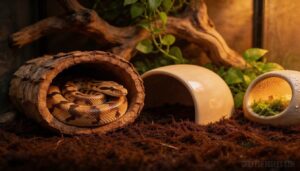
Not every hide deserves a spot in your ball python’s enclosure. The best ones share a few non-negotiable traits — and once you know what to look for, bad options become easy to spot.
Once you understand the key traits, picking the right one gets much easier — this breakdown of the best hide types for ball pythons walks you through exactly what separates a great hide from a stressful one.
Here’s what actually matters when choosing a hide that works.
Snug Fit — Why Size and Shape Matter Most
Size isn’t just a comfort issue — it directly affects whether your ball python feels safe enough to eat, shed, and behave normally. A snug fit hide works because tight contact on the sides, back, and floor mimics a burrow. The curved interior surface and rounded chamber shape reduce empty air pockets that make the snake feel exposed. A tapered entryway lets it slide in without excessive probing, and a low profile design keeps the hide flush against the substrate. Use this snug fit ratio as your baseline: interior dimensions roughly 1.5× the snake’s girth at its widest point.
| Weight Range | Recommended Interior Size | Snug Fit Ratio |
|---|---|---|
| Under 150g (Hatchling) | ~4″ × 3″ | 1.5× girth |
| 150–500g (Juvenile) | ~5″ × 4″ | 1.5× girth |
| 500g+ (Sub-adult/Adult) | ~6–8″ × 5–6″ | 1.5–2× girth |
Resize every four to six months — what fits at 300g won’t cut it at 900g.
Security — Single Entrance Design for Stress Reduction
One entrance isn’t an arbitrary design choice — it’s the whole point. A single entrance creates what behaviorists call reduced cognitive load: your ball python reads one approach vector, processes one entry, and settles.
Dual openings introduce minimal visual noise but enough uncertainty to trigger vigilance.
Single Gate Psychology explains this well — clear wayfinding and efficient monitoring of one passage mean less scanning, less stress, better feeding response.
Safety — Smooth Edges and Stable Construction
A hide that tips, cracks, or splinters mid-shed is a real injury risk. Look for these construction non-negotiables:
- Rounded corners and Edge Guard Installation prevent cuts during entry and exit
- A Non-Slip Base with Corrosion-Resistant Hardware keeps the structure stable under movement
- Nonporous material resists bacterial growth and tolerates repeated disinfection without degrading
Material safety and sturdiness aren’t optional upgrades — they’re baseline requirements.
Easy to Clean — Non-Porous Materials and Sanitizing
Bacteria don’t take days off — and neither should your cleaning routine.
Nonporous materials like ABS plastic, PVC, and food-grade resin block absorption entirely, keeping bacterial growth on the surface where disinfectants can actually reach it.
| Factor | Nonporous Material | Porous Material |
|---|---|---|
| Mold Prevention | High | Low |
| Disinfectant Choice | Bleach or vinegar | Limited options |
| Material Durability | Long-lasting | Degrades faster |
Stick to a consistent Maintenance Schedule: wipe weekly, deep-clean monthly using a bleach sanitization protocol (1:30 ratio). The right Cleaning Tools — a soft brush and rinse bottle — make cleaning and sanitizing reptile hides straightforward.
Natural Look — Mimicking Burrow Environments
A ball python doesn’t just want shelter — it wants to feel buried. Natural hide materials like hollowed logs, coconut shells, and cork bark tap into that instinct.
- Burrow Entrance Design: Rounded, single openings with Texture Contrast reduce scale snagging
- Rock Work Integration: Stone-like surfaces support Microhabitat Variation across the enclosure
- Natural Color Palette: Earth tones blend hides into burrowing enrichment zones naturally
Top 5 Hides for Ball Pythons
Not every hide on the market is worth your money or your snake’s trust. These five options earn their place through the right fit, easy cleaning, and real security.
Here’s worth considering for your setup.
1. Galapagos Sphagnum Moss Terrarium Substrate
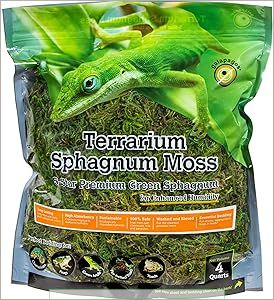
Sphagnum moss isn’t a hide on its own, but it’s what separates a good humid hide from a great one. Galapagos’s 4-quart bag gives you plenty to pack your humid hide two-thirds full, wring it damp (not dripping), and let it do its job — holding humidity at 80–90% right where your snake needs it most during shedding cycles.
It’s sustainably sourced, non-toxic, and easy to swap out every two to three weeks before mold becomes a problem.
| Best For | Reptile and amphibian owners who need a reliable, natural-looking substrate that holds humidity well — especially during shedding season. |
|---|---|
| Price | $10.49 |
| Material | Sphagnum moss |
| Animal Suitability | Snakes, geckos, frogs |
| Ease of Cleaning | Moderate; requires maintenance |
| Humidity Support | High; retains moisture |
| Size Limitation | May need multiple bags |
| Additional Features |
|
- Holds moisture really well, keeping humidity in that 80–90% sweet spot for tropical setups
- Sustainably sourced and non-toxic, so it’s safe for even sensitive animals
- The resealable bag makes storage easy between uses
- Can go moldy fast if airflow is poor or you skip regular cleanings
- Some batches seem heavily dyed — expect greenish water when you soak it
- The bag is mostly air, so it feels smaller than the price suggests
2. Leoterra Reptile Hide Snake Lizard Gecko
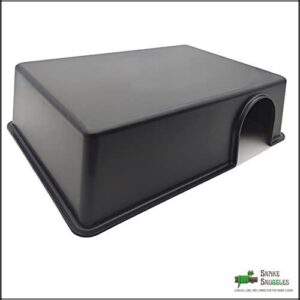
Once the moss is sorted, you need a solid shell around it — and the Leoterra hide delivers that without the premium price tag. At $12.99, it measures 10.23" × 7.48" × 2.75" and fits sub-adults up to roughly 200 g comfortably.
The rigid black plastic, smooth rounded edges, and top‑seal design all check the right boxes: no injury risk, easy to wipe clean, and decent humidity retention.
Lightweight for larger snakes, so weigh it down if yours likes to bulldoze furniture.
| Best For | Hobbyists keeping small to medium reptiles — ball pythons, corn snakes, geckos, or lizards — who want a clean, functional hide without spending a lot. |
|---|---|
| Price | $12.99 |
| Material | Plastic |
| Animal Suitability | Ball pythons, corn snakes, geckos |
| Ease of Cleaning | Easy; rinse or wipe |
| Humidity Support | Moderate; top-seal design |
| Size Limitation | Too small for snakes >200g |
| Additional Features |
|
- Smooth rounded plastic means no sharp edges scraping your reptile
- Top-seal design helps trap moisture, great for species that need a humid spot
- Easy to rinse clean and affordable enough to grab a few at once
- Snakes over 200 g will likely find it too snug — size up if yours is bigger
- Lightweight build means a determined snake can nudge or flip it
- Some buyers feel it runs slightly smaller than the listed dimensions suggest
3. Natural Coconut Hideout for Reptiles
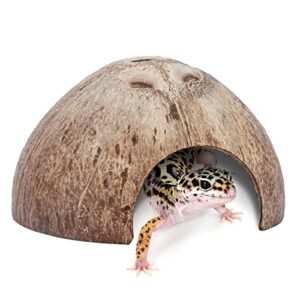
If budget and aesthetics both matter, the Niteangel Natural Coconut Hideout earns its spot. Each pack includes two coconut-shell halves with a smooth interior and naturally textured exterior — no chemicals, no lacquers.
The dark interior mimics an underground burrow, which ball pythons respond to immediately. At roughly 5 inches across, it fits hatchlings and small juveniles well.
Sand the entry edges lightly before use, and replace it once cracks appear. Biodegradable means it won’t last forever, but it’s hard to beat the natural look.
| Best For | Small reptiles, amphibians, and invertebrates — especially hatchlings and juveniles who need a snug, stress-reducing hide. |
|---|---|
| Price | Not listed |
| Material | Coconut shell |
| Animal Suitability | Geckos, lizards, amphibians |
| Ease of Cleaning | Moderate; boil before use |
| Humidity Support | Moderate; wet or dry use |
| Size Limitation | Not for larger species |
| Additional Features |
|
- 100% natural coconut shell — no chemicals or lacquers, so it’s safe for sensitive species
- Comes with two halves per pack, giving you flexibility in placement or setup
- The dark, enclosed interior mimics a natural burrow, which most small reptiles take to right away
- Entry edges can be rough out of the box and may need a quick sand before use
- Tannin leaching means you’ll want to boil or soak it before dropping it in an aquarium
- It’s biodegradable, so expect to replace it eventually — and shipping damage is a known risk
4. Zoo Med Small Reptile Cave
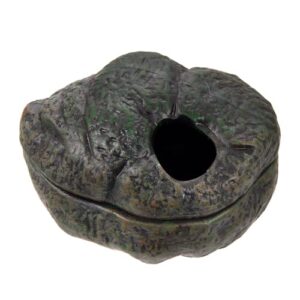
For a purpose-built option, the Zoo Med Reptile Shelter 3-in-1 is worth $17. The resin construction withstands weekly disinfection without degrading, and the removable lid makes moss replacement take about two minutes.
Interior dimensions run 5" × 4" — snug enough for hatchlings and small juveniles, but you’ll need to size up as your snake crosses the 500g mark. Pack it with damp sphagnum moss and it becomes a reliable humid hide that holds 80–90% humidity consistently.
| Best For | Small reptile owners keeping hatchlings or juveniles like leopard geckos, corn snakes, or ball pythons who need a reliable humid hide for shedding and laying eggs. |
|---|---|
| Price | $17.48 |
| Material | Resin |
| Animal Suitability | Leopard geckos, ball pythons |
| Ease of Cleaning | Easy; washable, sterilizable |
| Humidity Support | High; fillable moist hide |
| Size Limitation | Small; outgrown quickly |
| Additional Features |
|
- Removable lid makes cleaning and moss replacement quick and easy
- Holds humidity well when packed with damp sphagnum moss — great for shedding
- Durable resin handles regular disinfection without breaking down
- Small interior gets outgrown fast once your snake hits around 500g
- Lid sits loosely and can get knocked off by more active reptiles
- Resin can crack or go brittle if it’s exposed to high heat for too long
5. Zilla Terrarium Rock Den
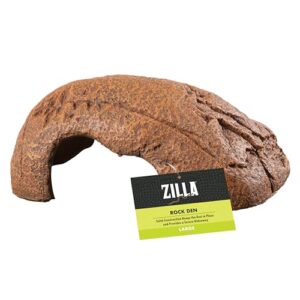
If you need something with a bit more visual weight, the Zilla Rock Den runs $18.56 and brings a naturalistic look that blends cleanly into desert or forest setups. Its non-porous plastic surface wipes down fast, and the solid construction stays put when your snake moves around.
At 5"W × 9.5"D × 4"H, it fits juvenile ball pythons comfortably. Watch the edges out of the box — a few users report sharpness that’s worth sanding before you place it.
| Best For | Small reptile owners — especially those keeping leopard geckos, corn snakes, or juvenile ball pythons — who want an affordable, easy-to-clean hide that fits a desert-themed setup. |
|---|---|
| Price | $18.56 |
| Material | Rigid plastic |
| Animal Suitability | Leopard geckos, juvenile ball pythons |
| Ease of Cleaning | Easy; warm soapy water |
| Humidity Support | Low; non-porous, dry hide |
| Size Limitation | Too small for adult snakes |
| Additional Features |
|
- Heavy and stable, so it stays put even when your reptile pushes against it
- Non-porous plastic cleans up quickly with warm, soapy water
- Naturalistic orange tone blends well into desert-style terrariums
- Edges can be sharp right out of the box and may need a quick sand before use
- Interior crevices and lips can trap waste and shed skin, making deep cleaning a bit fiddly
- Too small for adult snakes or larger reptiles, so you may outgrow it fast
Where to Place Ball Python Hides in The Enclosure
Getting the hides into the right spots is just as important as choosing the right ones. Placement directly affects whether your ball python actually uses them — and whether it stays healthy long-term.
Here’s exactly where each hide should go and why it matters.
Warm-Side Hide Placement and Temperature Range
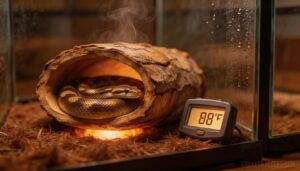
Your warm hide belongs directly over your heat source — that’s non-negotiable. Position it so the interior surfaces hit 88–92°F, verified with a surface temperature check using an infrared thermometer, not just ambient air readings.
Thermostat sync keeps that zone stable without overheating. Proper heat source placement and gradient balance guarantee the hide functions as a true thermal retreat, not just a decoration.
Cool-Side Hide Placement and Temperature Range
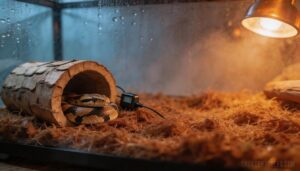
Place your cool hide at the opposite end from the heat source — this heat source offset is what makes your temperature gradient functional. The cool zone should read 76–80°F at substrate level.
Keep substrate humidity moderate, around 40–60%, and position your thermostat sensor nearby to catch any drift. Good airflow management prevents stagnant cold pockets that throw off your readings.
Positioning The Humid Hide for Shedding Cycles
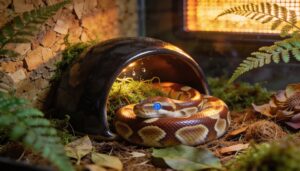
Shedding season calls for a dedicated humid hide — and where you put it matters just as much as what’s in it. Shift Zone Placement is your goal: near the warm side, but not directly over the heat source.
- Keep a Glass Proximity Buffer of 2–3 inches to prevent condensation buildup
- Pack damp sphagnum moss for Moss Moisture Management, targeting 70–90% inside during the preshed phase
- Use Humidity Sensor Placement near the opening for accurate humidity control readings
Block the entrance from direct airflow — Ventilation Control keeps your ball python shedding guide conditions stable throughout the preshed humid hide preparation window.
Sizing Hides as Your Ball Python Grows
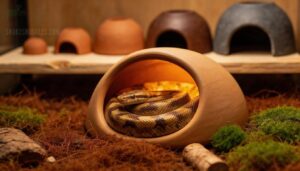
Your ball python won’t fit the same hide at 1,500 g that worked at 150 g — Growth Stage Scaling is non‑negotiable.
Use this weight‑ and age‑based hide sizing chart as your baseline:
| Weight Range | Recommended Hide Size |
|---|---|
| Under 150 g | XS (~4″ × 3″) |
| 150–500 g | Small‑Medium (~5″ × 4″) |
| 500–1,500 g | Medium (~6″ × 5″) |
| Over 1,500 g | Large (~8″ × 6″) |
Measure midbody circumference to confirm snug fit — there shouldn’t be room to spare beside your coiled snake.
Frequently Asked Questions (FAQs)
How many hides should a ball python have?
A ball python needs a minimum of two hides — one on the warm side, one on the cool side.
This basic hide requirement keeps thermoregulation on track and chronic stress out of the picture.
Does a ball python need a hide?
Yes, a ball python absolutely needs a hide. It’s not optional — without one, you’ll see clear stress indicators like feeding motivation drops, glass-surfing, and refusal to settle.
Can you use DIY hides for ball pythons?
Absolutely — DIY hides work well when built from food-safe, nonporous materials like PVC or sealed resin.
Sand all edges smooth, keep one entry point, and size it snugly to your snake’s girth.
How often should ball python hides be cleaned?
Spot clean hides whenever you spot waste or debris — don’t wait. Do a monthly deep clean with full disinfection. Check humid hides more often during shedding cycles.
What materials are safest for ball python hides?
Plastic and resin top the list. They’re non-porous, smooth, and won’t harbor bacteria the way porous materials do — making sanitation straightforward and reliable for long-term safety.
Should you rotate or move hides regularly?
Move hides a few inches monthly rather than fully relocating them.
Small shifts introduce routine variation and microclimate shifts without overwhelming your snake, supporting healthy enclosure dynamics through subtle behavioral stimulus.
How do hides reduce stress in ball pythons?
Visual concealment alone can eliminate a world of anxiety for a ball python. A snug hide gives constant cover, enabling reduced cortisol, calm feeding behavior, and controlled microclimate access without forcing the snake into the open.
Conclusion
Wrapping up your ball python’s hide setup is like "hiding" in plain sight—it’s about creating a sense of security. You’ve learned that two hides are the minimum, with a third humid hide supporting shedding cycles.
By prioritizing your ball python’s need for hides, you’re addressing its biological requirements. A well-structured enclosure with adequate hides helps reduce stress.
Now, you know how many hides your ball python needs for a safe environment.