This site is supported by our readers. We may earn a commission, at no cost to you, if you purchase through links.
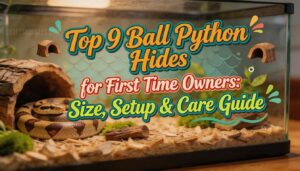
A ball python curled in the open corner of its enclosure isn’t resting—it’s stressed. These snakes evolved to spend most of their lives tucked inside tight burrows, and without that same sense of enclosed security, they stop eating, hide in plain sight, and shed poorly. The right hide fixes all of that.
For first-time owners, choosing ball python hides feels deceptively simple until you’re staring at a wall of options with no idea what actually matters. Size, material, placement, temperature—each detail shapes how settled your snake feels in its new home.
The picks and setup guidelines ahead cut through the guesswork.
Table Of Contents
Key Takeaways
- A ball python needs at least two hides — one on the warm side (86–90°F) and one on the cool side (72–80°F) — to thermoregulate properly and stay stress-free.
- The hide should fit snugly around your snake’s coiled body, with a single entrance just wide enough to enter, since too much space makes your snake feel exposed rather than secure.
- Add a humid hide packed with damp sphagnum moss the moment you spot pre-shed signs like milky eyes or dull skin, because dry conditions lead directly to stuck sheds.
- Clean hides weekly with spot checks, deep-clean monthly with a diluted bleach solution, and replace any hide that holds odor, shows cracks, or no longer fits your snake’s size.
A good rule of thumb is to add a third hide in the middle as a humid retreat during shed, and this guide to ball python hide setups breaks down sizing and placement in more detail.
Top 9 Ball Python Hides
Each hide on this list was chosen with first-time owners in mind — practical, easy to clean, and sized right for a ball python.
If you’re also thinking ahead to a naturalistic setup, this guide to ball python hides for bioactive enclosures is worth bookmarking now.
Some work best as warm-side hides, others shine as cool-side or humid options. Here’s what made the cut.
1. Zilla Rock Lair Reptile Hide
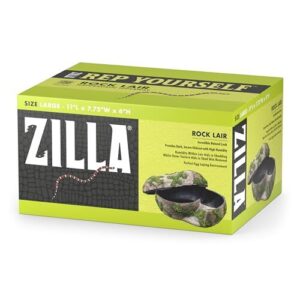
If you want something that looks natural and actually works, the Zilla Rock Lair is worth a look.
It measures 11 × 6 × 8 inches and fits comfortably in tanks up to 40 gallons.
The rough exterior doubles as a shedding surface, and the removable top makes health checks easy.
At $49.99, it’s mid-range in price.
Just note — you’ll need to add damp sphagnum moss inside to get real humidity benefits.
| Best For | Owners of small to medium reptiles like leopard geckos or ball pythons who want a functional hide that also helps with shedding and humidity. |
|---|---|
| Material | Rigid plastic |
| Removable Lid | Yes |
| Dimensions | 11x6x8 in |
| Color | Grey |
| Humidity Retention | Yes |
| Easy to Clean | Yes |
| Additional Features |
|
- Rough exterior gives reptiles a natural surface to rub against while shedding
- Removable top makes health checks and cleaning quick and easy
- Weighted base stays put under heat lamps without shifting around
- Several buyers have received units damaged during shipping
- You have to add damp substrate yourself to actually get the humidity benefits
- The dark, snug interior can make it tricky to spot your animal at a glance
2. Exo Terra Large Snake Cave
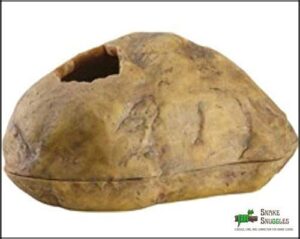
The Zilla Rock Lair is a solid pick, but if you want a hide that doubles as a humid cave right out of the box, the Exo Terra Large Snake Cave (PT2847) is worth considering.
It measures about 9.8 × 7.4 × 4.7 inches and comes with moss already included — just dampen it and you’ve got a ready-made humid hide.
The non-porous resin cleans up fast, and the weighted base won’t shift when your snake coils inside. It fits juveniles to mid-size adults well, though snakes over 4 feet may find the entrance a bit tight.
| Best For | Reptile owners with medium-sized snakes or lizards who want a stable, easy-to-clean hide that can double as a humid spot for shedding or egg incubation. |
|---|---|
| Material | Rigid plastic |
| Removable Lid | Yes |
| Dimensions | 7.1×8.8×10.6 in |
| Color | Brown |
| Humidity Retention | Yes |
| Easy to Clean | Yes |
| Additional Features |
|
- Comes with moss included — just add water and you’ve got a humid hide ready to go
- Heavy base stays put even when a snake is coiled inside or a heat pad is running underneath
- Removable top makes feeding, health checks, and cleaning quick and hassle-free
- The entrance opening runs small, so snakes over 4 feet may have trouble getting in comfortably
- Solid plastic bottom can get hot on the warm side of the enclosure, so placement matters
- Small drainage holes from manufacturing may let moisture leak through the bottom
3. Exo Terra Extra Large Reptile Cave
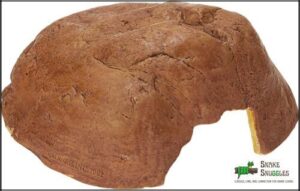
If your ball python is full-grown, the Exo Terra Extra Large Reptile Cave (PT2854) gives them real room to stretch out and coil comfortably. It measures about 10.2 × 11 × 4.3 inches — plenty of floor space for adult females, especially.
The resin build is non-porous, so cleaning stays simple.
One thing to check before placing it: run your fingers along the interior edges. Some units come with slightly sharp molding seams that are easy to file smooth before first use.
| Best For | Owners of adult ball pythons, bearded dragons, or large geckos who need a roomy, durable hide that fits naturally into their terrarium setup. |
|---|---|
| Material | Resin |
| Removable Lid | No |
| Dimensions | 10.23×11.02×4.33 in |
| Color | Black |
| Humidity Retention | Yes |
| Easy to Clean | Yes |
| Additional Features |
|
- Plenty of space for full-grown reptiles — the 10.2 × 11 inch floor gives even large adult females room to coil comfortably
- Resin build is non-porous and easy to wipe down, making routine cleaning quick and straightforward
- Holds heat well overnight, which is a real plus for species that need stable temperatures after lights go out
- Some units arrive with sharp molding seams on the interior edges — worth filing smooth before dropping it in the tank
- The large footprint can eat up a lot of floor space, so it’s not a great fit for tanks smaller than 10 gallons
- Repeated washing or high humidity exposure can cause the interior surface to degrade and get sticky over time
4. Zilla Bark Bends Terrarium Hide
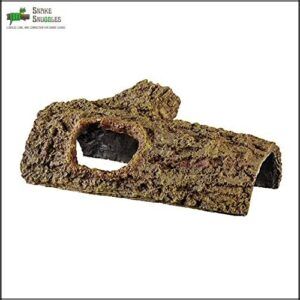
Not every hide needs to look like a cave. The Zilla Bark Bends Terrarium Hide takes a different shape — an open-ended curved bark design that lets you watch your snake inside without lifting anything.
That open layout works well for hatchlings and juveniles.
The textured exterior also gives them something to rub against during a shed. It’s non-porous plastic, so cleaning is straightforward. Just check the edges before placing it — a quick sand can prevent any rough spots from becoming a problem.
| Best For | Owners of hatchlings, juveniles, or smaller reptiles like corn snakes and bearded dragons who want to observe their pet without disturbing the hide. |
|---|---|
| Material | Rigid plastic |
| Removable Lid | No |
| Dimensions | 10.75x5x5.5 in |
| Color | Brown |
| Humidity Retention | No |
| Easy to Clean | Yes |
| Additional Features |
|
- The open-ended design lets you watch shedding and nesting behavior without moving anything
- Textured surface gives reptiles a natural rubbing spot during sheds
- Non-porous plastic cleans up easily and resists bacteria buildup
- Edges around the top hole can be sharp and may need sanding before use
- Opening is too small for larger snakes or adult ball pythons
- Heavy enough that repositioning it later is a bit of a hassle
5. Zilla Vertical Rock Cave Grey
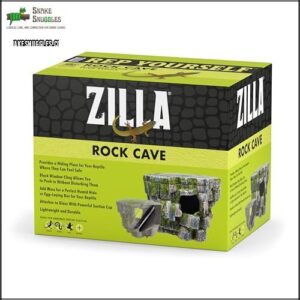
Here’s one that breaks the mold a little. The Zilla Vertical Rock Cave Grey mounts directly onto the glass with suction cups, so it doesn’t eat up any floor space.
That’s a real advantage in smaller enclosures. It has a removable lid, a dark interior, and a realistic rock texture, your snake won’t second-guess.
The included black window cling lets you peek in without stressing them out. Just make sure the glass is clean before mounting — suction cups need a smooth surface to hold.
| Best For | Arboreal reptiles like crested geckos and tree frogs, or any owner working with a smaller enclosure who needs a hide that doesn’t steal floor space. |
|---|---|
| Material | Hard plastic/foam |
| Removable Lid | Yes |
| Dimensions | 7.9×5.5×6.3 in |
| Color | Grey |
| Humidity Retention | No |
| Easy to Clean | Yes |
| Additional Features |
|
- Mounts on the glass with a suction cup, so it keeps the floor clear for other hides or décor
- Dark interior with a removable lid makes it easy to drop in a feeder cup or small water dish
- The black window cling lets you check on your animal without spooking them
- Suction cup can slip if the glass isn’t spotless, so placement isn’t always set-and-forget
- It’s on the larger side, which can feel bulky in a compact tank
- Some units have come with rough or unfinished edges, so worth a quick inspection before putting it in with a delicate animal
6. Zilla X Large Terrarium Rock Den
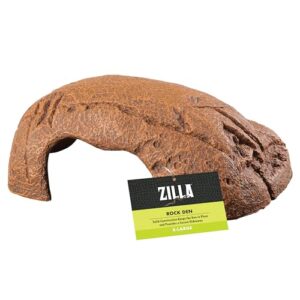
If your snake is pushing past the juvenile stage, this den is worth a look. The Zilla X Large Terrarium Rock Den runs 12 to 14 inches long with a roomy interior chamber — plenty of space for a sub-adult to coil comfortably.
If you add some damp moss inside, it doubles as a humid hide for easier shedding — a simple upgrade that makes a real difference.
The non-porous plastic exterior cleans up fast with soap and water, and the weighted base keeps it planted even when your snake shifts around inside.
The recessed entrance limits light, so your ball python actually feels secure in there.
| Best For | Reptile owners with smaller or younger animals like juvenile leopard geckos, corn snakes, or hatchling ball pythons who need a secure, easy-to-clean hide. |
|---|---|
| Material | Rigid plastic |
| Removable Lid | No |
| Dimensions | 6x5x7 in |
| Color | Orange |
| Humidity Retention | No |
| Easy to Clean | Yes |
| Additional Features |
|
- Non-porous plastic wipes down quickly with soap and water, so keeping it clean is pretty painless
- Heavy, stable base means it stays put even when your reptile is moving in and out
- The small, dark entrance actually does its job — gives reptiles that enclosed, secure feeling they’re after
- Interior space is limited, so larger or fast-growing reptiles will outgrow it quickly
- Edges and the underside lip can be sharp right out of the box and may need some sanding before it’s safe to use
- The complex interior shape makes it tricky to clean thoroughly, and waste or shed skin can get stuck inside
7. Pangea Medium Reptile Hide Box
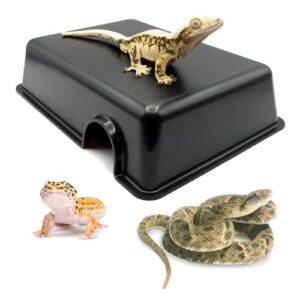
The Pangea Medium Reptile Hide Box keeps things simple — and that’s exactly the point.
Measuring 10 × 7 × 2.25 inches, it fits neatly inside standard 28–32 quart tubs without wasting space.
The 1/8-inch thick non-porous plastic wipes clean in seconds, and the offset entrance gives your ball python that snug, enclosed feeling it craves.
won’t tip when your snake shifts around inside.
For adult ball pythons and sub-adults, this is a reliable, no-fuss option that just works.
| Best For | Reptile keepers with adult or sub-adult ball pythons, terrestrial geckos, skinks, or similarly sized ground-dwelling reptiles who want a simple, easy-to-clean hide. |
|---|---|
| Material | Rigid plastic |
| Removable Lid | No |
| Dimensions | 10x7x2.25 in |
| Color | Black |
| Humidity Retention | Yes |
| Easy to Clean | Yes |
| Additional Features |
|
- Non-porous plastic cleans up fast — just hot water and a sanitizer and you’re done
- The offset entrance gives reptiles that snug, tucked-away feeling that helps reduce stress
- Can pull double duty as a humid hide or basking platform with a little setup
- Bigger snakes can lift or nudge it out of place, which defeats the purpose of a secure hide
- The entrance opening runs a bit tight for some species, so check sizing before you buy
- Similar hides are floating around at lower prices elsewhere, so shop around first
8. Zoo Med Large Reptile Shelter Cave
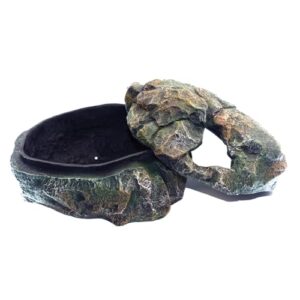
The Zoo Med Repti Shelter 3-in-1 Cave (RC-32) does three jobs at once — hide, shedding spot, and egg chamber — without any extra gear.
The large size measures 6 × 12 × 11 inches and is built from resin, so it holds up through regular soaks and scrubbing. Pack the tray with damp sphagnum moss, and it becomes a reliable humid hide that keeps moisture right where your snake needs it. The removable lid makes cleaning and egg checks easy. It’s a solid pick for sub-adults and adults.
| Best For | Small to medium reptile owners — think leopard geckos, corn snakes, and baby pythons — who want a hide that doubles as a shedding spot and egg chamber all in one. |
|---|---|
| Material | Ceramic |
| Removable Lid | Yes |
| Dimensions | 6x12x11 in |
| Color | Black |
| Humidity Retention | Yes |
| Easy to Clean | Yes |
| Additional Features |
|
- Three functions in one piece — hide, humid shedding cave, and nesting spot — so you’re not cluttering the tank with extra accessories
- Removable lid makes egg checks and cleaning genuinely easy instead of a hassle
- Heavy ceramic build stays put even when curious climbers scramble on top of it
- Ceramic can crack under prolonged high heat, so placement on the hot side needs some care
- The lid fits loosely on some units, which can be a problem with more active or escape-prone species
- At $61.99 it costs noticeably more than a basic plastic hide, and occasional shipping damage means you’ll want to inspect it carefully when it arrives
9. Leoterra Ball Python Hide
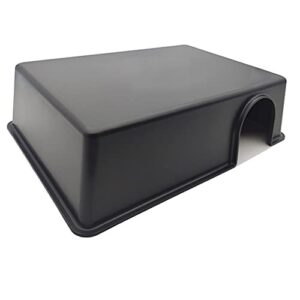
If you want simple and functional, this one delivers. The Leoterra hide measures 16.5 × 10.6 × 4.3 inches — roomy enough for most adult ball pythons without wasted space.
Its top-seal design holds humidity well, making it a solid choice for the warm side of your enclosure.
The odorless, BPA-free plastic cleans up fast with soap and water.
One heads-up: heavier snakes can lift it, so add a small weight if needed.
| Best For | Adult ball python owners who want a no-fuss, easy-to-clean hide that keeps humidity where it needs to be. |
|---|---|
| Material | High-impact plastic |
| Removable Lid | No |
| Dimensions | 16.5×10.6×4.3 in |
| Color | Black |
| Humidity Retention | Yes |
| Easy to Clean | Yes |
| Additional Features |
|
- Roomy enough for most adult ball pythons at 16.5 × 10.6 × 4.3 inches
- Top-seal design helps hold humidity, great for the warm hide spot
- Odorless plastic wipes clean in minutes — no deep scrubbing needed
- Lighter snakes can lift it, so you may need to weigh it down
- Very large snakes might find it tighter than expected — measure before buying
- Plain black plastic won’t win any style points if you prefer a natural-looking setup
Why Ball Pythons Need Hides
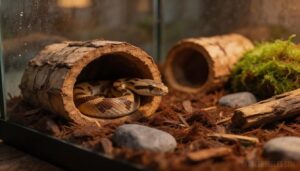
Hides aren’t optional for ball pythons — they’re the difference between a snake that thrives and one that slowly shuts down.
Without them, stress builds fast, feeding stops, and shedding turns into a mess.
Here’s why getting this right matters more than almost anything else in the enclosure.
Stress Reduction and Security
A hide isn’t just furniture — it’s your ball python’s entire sense of safety. Without one, cortisol levels climb, glass-surfing starts, and feeding stops. Visual privacy from an opaque, snug-fit hide cuts stress fast. Microclimate consistency inside the hide builds a predictable routine that your snake learns to trust.
A hide isn’t furniture — it’s the only thing standing between your ball python and chronic stress
Four ways a secure hide reduces stress:
- Handling Acclimation — Post-handling, returning your snake to a familiar hide speeds recovery to a calm baseline behavior.
- Cortisol Monitoring — A single entrance hide limits perceived threats, keeping stress hormones lower long-term.
- Enrichment Integration — A weighted base prevents tipping, so the hide stays a reliable retreat.
- Security Through Snug Fit — A properly sized hide reduces defensive responses like tail-whipping during enclosure checks.
Warm- and Cool-side Thermoregulation
Once your snake feels safe, it shifts focus to temperature. Ball pythons can’t generate body heat, so they rely entirely on your thermal gradient setup.
A warm hide on the warm side of the enclosure raises core temperature for digestion, while a cool hide on the cool side of the enclosure lets it shed excess heat.
| Hide Location | Temperature Range |
|---|---|
| Warm side | 86–90°F |
| Cool side | 76–80°F |
Microclimate monitoring inside each hide matters more than ambient readings. Surface conductivity through the hide floor transfers heat directly into your snake’s body — so temperature gradient placement and thermostat reliability aren’t optional. Without a proper heat source placement strategy, your snake overheats or stays too cold to function.
Humid Hide Support for Shedding
Shedding is where a humid hide earns its place. When your ball python’s eyes go blue and its skin turns dull, that’s your cue — pre‑shed moisture becomes the priority.
Placing the hide on the warm side placement enhances humidity.
A humid hide packed with sphagnum moss substrate choice gives your snake a private, damp retreat to soften old skin from nose to tail.
- Humidity gradient benefits guide your python naturally toward the humid hide
- Shedding stress reduction happens when moisture is always available, not scrambled for
- holds water slowly, releasing it evenly without soaking the floor
- Mold prevention strategies start with damp moss — never dripping wet
- A humid hide for shedding grows with your snake through every size upgrade as python grows
Better Feeding Response and Digestion
A secure hide does more than calm nerves — it directly aids feeding behavior. When your ball python feels safe, it’s far more likely to eat.
Prey warmth matters too; warm prey triggers a stronger strike response.
After eating, post-meal temperature stability helps digestion run smoothly.
Stress-free handling and smart feeding timing, paired with hydration management, keep your snake eating consistently.
Natural Burrow Behavior in Captivity
Ball pythons are natural burrowers — in the wild, they spend most of their time tucked into tight underground gaps. That same burrowing instinct, when replicated in captive environments, is exactly what a good hide helps. Your snake relies on Burrow Entrance Preference, Microclimate Selection, and Substrate Cover Strategy to feel grounded.
- Single-entrance hides mirror natural burrow depth utilization
- A natural look hide blends function with environmental authenticity
- Humid hide filled with sphagnum moss helps microclimate creation within hides
- Substrate placed under hides encourages instinctive burrowing social interaction patterns
How Many Hides They Need
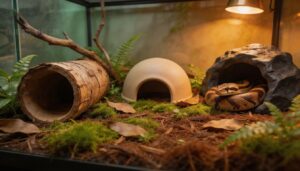
Most first-time owners don’t realize that one hide simply isn’t enough. Your ball python needs at least two, placed on opposite ends of the enclosure, and sometimes a third.
Here’s how to set it up right.
Two Hides Minimum for Beginners
Two hides are your starting point — no exceptions. A Minimalist Hide Setup works perfectly for Beginner Enclosure Planning: one warm, one cool. This Stress-Free Pairing gives your python real choice without overwhelming your budget or schedule.
| Hide Role | Key Benefit |
|---|---|
| Warm-side hide | Aids digestion |
| Cool-side hide | Allows thermoregulation |
| Both together | Reduces stress behavior |
Start with minimum of two hides, then grow from there.
Warm Dry Hide on One End
The warm dry hide sits on the heated end of your enclosure, anchoring the thermal gradient that keeps your python healthy.
Thermal Gradient Positioning starts here — place it with Entrance Directionality facing inward, away from the cool side.
Choose Humidity Isolation Design with smooth, non-porous surfaces for Surface Texture Choice, a Weighted Base Stability bottom, and a single entrance for a snug fit.
Cool Dry Hide on The Opposite End
On the opposite end from your warm hide, place a cool dry hide to complete the Temperature Zone Separation, your python needs.
This Opposite End Location creates a clear temperature gradient — your snake moves between zones as it regulates body heat.
Keep the Thermal Gradient Placement in a Draft-Free Zone, maintain Pathway Accessibility to both hides, and plan for a size upgrade as your python grows.
When to Add a Humid Hide
Add a humid hide the moment you spot pre‑shed cues — milky eyes and color dulling are your signals. If you’re also noticing frequent basking or low enclosure humidity, don’t wait.
The importance of humidity hides for shedding can’t be overstated. Pack sphagnum moss inside for moisture retention, and that microclimate creation within hides gives your ball python exactly what it needs.
Benefits of a Three-hide Setup
Three hides do more than just fill space — they give your ball python real territory choice and behavioral enrichment. With a 3Hide System for Ball Pythons, you create microhabitat variety that facilitates everything from digestion to shedding:
- Reduced aggression during routine enclosure maintenance
- Enhanced observation of natural exploration patterns
- Stable thermal gradient, with importance of humidity hides for shedding never ignored
Add multiple hide options and size upgrade as python grows.
What Makes a Good Hide
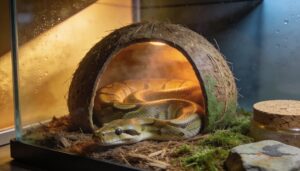
Not every hide you find at the pet store is worth putting in your snake’s enclosure. A good one checks few key boxes that actually affect your ball python’s health and daily comfort.
Here’s what to look for before you buy.
Snug Fit Comes First
Size matters more than you’d think. The right snug fit hide selection criteria come down to coil diameter, snout clearance, and fit tolerance — the interior should just barely fit your ball python’s curled body.
Entrance width should let the snake enter head-first without room to turn around.
Edge rounding and size matching protect belly scales.
Too spacious, and your snake won’t feel secure.
Single Entrance for Better Security
Once your snake feels snug inside, the hide’s entrance design takes over.
A single entrance keeps things secure — one way in, one way out.
Look for a rounded entrance edge to protect scales, uniform opening size for consistent access, and sealed seams to hold humidity.
A weighted base with a non-slip bottom and sturdy base prevents tipping when your snake settles in.
Smooth, Safe, Non-toxic Materials
Material safety matters more than most beginners expect.
Non-porous surfaces and BPA-free plastics prevent chemical leaching and make cleaning straightforward. Look for food-grade silicone components, formaldehyde-free coatings, and a rounded edge design that won’t catch scales.
- Non-porous surfaces resist bacteria buildup
- BPA-free plastics avoid hormone-disrupting compounds
- Food-grade silicone tolerates heat without off-gassing
- Formaldehyde-free coatings keep air clean
- Smooth plastic with rounded edges protects skin
Weighted, Tip-resistant Construction
A safe material doesn’t help much if the hide tips every time your ball python pushes against it. Look for a weighted base with low center of gravity and non‑slip foot design — these keep the hide flat and secure.
Rounded edge geometry and material stiffness prevent rocking on uneven substrate.
A sturdy, secure hide with proper base weight distribution stays put, even when your snake coils inside.
Easy-to-clean Non-porous Surfaces
Once the hide stays put, your next concern is keeping it clean. Nonporous material — like acrylic resin or cast resin — makes that genuinely easy.
Smooth surface benefits include zero microcracks where bacteria hide, and chemical‑resistant coatings handle disinfectants without dulling.
UV stable finishes resist yellowing under terrarium lights.
Quick wipe keeps your ball python’s hides hygienic between deep cleans.
Natural Look Versus Pure Function
Aesthetic integration matters more than most first-time owners expect. A natural look — earthy tones, stone textures, realistic scale — helps your ball python feel genuinely secure, not like it’s hiding inside a plastic toy.
The good news? Natural versus artificial hide materials aren’t a tradeoff anymore. Resin hides now offer color harmony and texture versus cleanability in one package: nonporous material, easy to clean, and visually grounded in your enclosure’s landscape.
Hide Size and Placement
Getting hide size wrong is one of the easiest mistakes to make, and it’s also one of the easiest to fix once you know what to look for. The right fit changes depending on your snake’s age and weight, and placement matters just as much as size.
Here’s what you need to know at every stage.
Hatchling Hide Size Guidelines
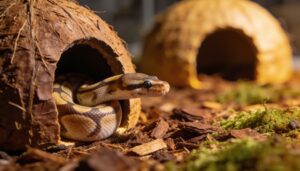
Hatchlings need hides that feel like a tight burrow, not an open room. Weight-based sizing works best here — snakes under 150 g fit well in a 4 × 3 inch footprint.
Your girth-width ratio target is 70–85%, meaning the interior should touch the snake on multiple sides. Entrance clearance matters too: just wide enough to enter, with no gap around the body.
Juvenile Hide Size Guidelines
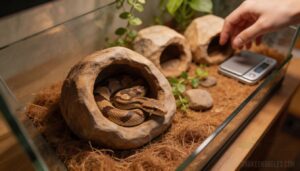
Once your juvenile ball python hits 150–500 g, hide size becomes a moving target. Stage-specific dimensions sit around 5 × 4 inches, but weight thresholds matter more than length-width ratio alone — the interior should still hug the body on multiple sides.
Growth increment checks every few weeks, because juveniles grow fast and fit evaluation timing can mean the difference between a secure snake and a stressed one.
Sub-adult and Adult Hide Sizes
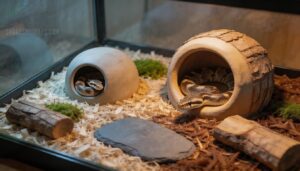
Sub-adults (500–1,500 g) need hides around 6 × 5 inches — enough coiling space without leaving room to feel exposed. Adult ball pythons shift into the 8 × 12 inch range, where weight-based dimensions and body length ratio both matter.
Entrance diameter should let your snake slip in snugly. Thermal zoning fit depends on placing right-sized hides at each temperature end.
Warm Hide Temperature Range
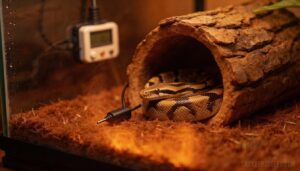
Your warm hide should sit between 86 and 90°F — that’s the sweet spot for digestion and comfort. Think of 88°F as your target during ideal temp range calibration.
Use a thermostat for heat source alignment and a digital probe for temperature monitoring tools.
Even with a nighttime temp shift, keep your warm hide efficiency steady using lightless heat sources.
Cool Hide Temperature Range
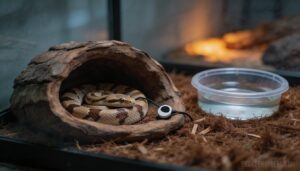
Your cool side hide should stay between 72–80°F — the lower anchor of your temperature gradient. Keep your thermometer placement at snake level inside the hide, not above it.
Heat source distance does most of the work here; the farther from your heat panel, the cooler it stays. Watch for nighttime cool drop, and make seasonal temperature adjustments if your home runs cold.
Best Humid Hide Placement
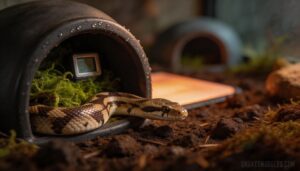
Most keepers place the humid hide near the heat source — and for good reason. That intermediate zone placement hits the sweet spot for microclimate creation within hides without overheating your snake.
Here’s what works best for placement of hides in temperature zones:
- Near Heat Source – maximizes moss evaporation for peak humidity
- Intermediate Zone – balances warmth and moisture access naturally
- Opposite Ends Strategy – use two humid hides for shedding support
- Humidity Monitoring Spot – place your hygrometer inside, not outside
Keep substrate moisture control consistent; re‑dampen moss every 2–3 days. The importance of humidity hides for shedding can’t be overstated — dry hides mean stuck shed. Best Commercial Ball Python Hides Reviewed often highlight humid hide options for molting, so choose non‑porous resin that stays damp without warping.
Signs a Hide is Too Big
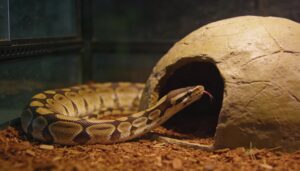
Size matters more than most new owners expect.
If your ball python sits in a flat resting posture with limited body contact against the walls, the hide is too big. Watch for entrance hesitation — your snake sniffing the opening but not committing. Excess headroom and partial body exposure while resting are clear signs.
Ensuring proper size and fit of hides directly impacts behavior.
Signs a Hide is Too Small
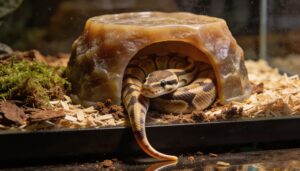
A too-small hide shows itself fast. Watch for tail tip protrusion — that tail hanging out after your ball python has settled is a clear red flag.
Partial body coverage and limited coil space mean your snake can’t fully disappear, which kills stress reduction and disrupts shedding. Frequent hide avoidance and entrance pressure shift — where the hide actually moves — both say it’s time to check your size guidelines for snake hides.
Cleaning and Replacing Hides
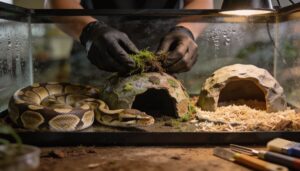
A clean hide isn’t just about looks — it directly affects your snake’s health. Bacteria, mold, and old moss can build up faster than you’d expect, especially in a humid hide.
Here’s what a solid cleaning routine actually looks like.
Weekly Spot-cleaning Routine
Think of weekly maintenance as your first line of defense.
Start with glove hygiene — disposable gloves minimize contamination every session. Do a quick substrate spot removal of waste, then handle your water bowl rinse with hot water and a reptile-safe cleaner.
Check enclosure ventilation isn’t blocked, wipe damp surfaces for mold prevention, and do a fast moss refresh check.
Monthly Deep-clean Schedule
Once a month, go deeper than your weekly routine. Use a Room Rotation Plan to tackle one enclosure zone at a time — hides, substrate, décor — so it doesn’t pile up.
A simple Cleaning Calendar with a Supply Checklist keeps your cleaning and maintenance of reptile hides on track. Task Prioritization and Progress Tracking help you stay consistent without feeling overwhelmed.
Safe Disinfection Methods
For nonporous plastic hides, a 1:30 bleach solution works well — but Bleach Dilution Ratios matter. Too strong damages materials; too weak skips actual disinfection.
Follow Contact Time Guidelines: keep the hide visibly wet for 5–10 minutes.
Rinse thoroughly, then air-dry completely.
Always use Ventilation and PPE — gloves, fresh air.
These cleaning and sanitization protocols for hides keep things safe for your snake.
Replacing Moss in Humid Hides
Sphagnum moss doesn’t last forever — swap it out every 2–4 weeks as part of your cleaning and maintenance routine for reptile hides.
Moss Preparation Steps for a fresh humid hide:
- Squeeze pre-soaked moss until barely damp
- Watch for dark, mushy Moss Quality Indicators
- Bag used moss for Moss Disposal Safety
- Mist lightly for steady Moss Moisture Management
Mold prevention starts here.
Checking for Cracks and Sharp Edges
Every cleaning session is your best chance to catch damage before it hurts your snake. Run your fingertip along the entry hole for an Edge Sharpness Check — surface burrs or rough spots snag scales fast. Do a quick Crack Visual Survey on seams and corners, where Microfracture Spotting matters most. A Structural Integrity Test is simple: press gently on walls and listen for creaking.
| Inspection Step | What to Look For | Action Required |
|---|---|---|
| Edge Sharpness Check | Burrs or rough entry edges | Sand or discard |
| Crack Visual Survey | Lines along seams or corners | Discard if 2mm+ |
| Microfracture Spotting | Hairline cracks near stress points | Monitor or replace |
| Surface Burr Detection | Raised material on interior surfaces | Discard immediately |
| Structural Integrity Test | Flex, creaking, or deformation | Replace right away |
Sharp edges and hidden cracks compromise both material safety and nontoxic hide construction — and your snake’s security depends on a clean, intact space.
When to Replace Worn-out Hides
A hide that passes cleaning but still smells is already failing. Replace it when Odor Persistence lingers after washing — that’s Material Degradation working against you.
Mold Detection matters too; if mold keeps returning, the surface is compromised.
A Fit Mismatch from growth, or any Structural Integrity loss like wobbling or warping, means it’s time for a new one.
Frequently Asked Questions (FAQs)
Are ball pythons good for first time owners?
Ball pythons have a calm beginner temperament and a manageable learning curve, making them a solid first reptile — as long as you’re ready to stay consistent with health monitoring and proper setup.
How long will a snake stay in hiding?
Don’t worry — your snake isn’t hiding from you personally.
Most stay tucked away for few hours to several days, depending on digestion, shedding cycles, stress levels, age, or humidity needs inside the enclosure.
Can ball pythons share a hide with each other?
No, ball pythons shouldn’t share a hide. They’re solitary by nature, and competition dynamics over one space cause stress, temperature monopolization, and even aggression signs.
Each snake needs its own secure hide.
How do hides affect a ball pythons sleep?
A secure hide gives your snake sidewall contact, darkness preference support, and microclimate consistency — all key to longer rest duration and better circadian alignment through a stable thermal gradient between the warm side hide and cool hide.
Should hides be covered or left fully exposed?
Keep hides covered and opaque. Visual privacy and reduced light exposure lower stress quickly.
A secure hide with a single entrance, partially buried for substrate integration, beats any open, fully exposed option every time.
Do hides need to match the enclosures décor?
No, hides don’t need to match perfectly. Aesthetic Integration matters less than function.
Still, neutral tones and natural look textures support Decorative Balance and Lighting Compatibility, making your naturalistic habitat feel cohesive without sacrificing your snake’s comfort.
Conclusion
As you set up your ball python’s enclosure, it’s a coincidence that the right hide can make all the difference. A secure, cozy space helps reduce stress and promotes well-being.
When choosing ball python hides for first-time owners, consider size, material, and placement.
With the right setup, your snake will thrive.
Remember, a happy snake is a healthy snake.
Make informed choices, and enjoy the rewarding experience of caring for your pet.