This site is supported by our readers. We may earn a commission, at no cost to you, if you purchase through links.
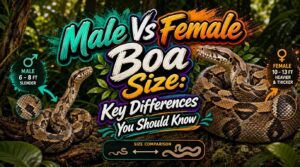
Most people assume boa constrictors grow based on how well you feed them—but sex plays a bigger role than diet ever will. A healthy female boa regularly outgrows her male counterpart by a full foot or more, even under identical care conditions.
That size gap isn’t random variation; it’s biology doing exactly what it’s designed to do.
Female boas evolved larger bodies to carry and birth live young, sometimes 30–60 neonates per litter, which demands serious internal real estate.
Understanding male vs female boa size helps you anticipate housing needs, veterinary costs, and long-term care requirements before they catch you off guard.
Table Of Contents
- Key Takeaways
- Male Vs Female Boa Size Comparison
- Factors Influencing Boa Size by Sex
- Subspecies and Regional Size Variation
- Reproductive Advantages of Larger Females
- Health and Cost Considerations by Sex
- Top 10 Colorful Feather Boas for Owners
- 1. JICASTO Colorful Feather Boa with Heart Sunglasses
- 2. Multicolor 5ft Artificial Feather Boa
- 3. MAOFENG Fuchsia Turkey Feather Boa
- 4. Max Fun Feather Boas Assorted Colors
- 5. Handmade Pink Turkey Feather Boa
- 6. Larryhot Pink LED Feather Boa
- 7. JICASTO Colorful LED Feather Boa
- 8. Shenyi Hot Pink Feather Boa
- 9. Five Foot Colorful Feather Boas
- 10. Fluffy Feather Boa Decoration
- Frequently Asked Questions (FAQs)
- Conclusion
Key Takeaways
- Female boas consistently grow 1–3 feet longer than males due to reproductive biology, not diet, reaching up to 12 feet in captivity compared to a male’s typical 6-foot plateau.
- Your boa’s genetics and lineage set the true size ceiling — offspring from Amazonian lines can dwarf island-origin boas even under identical feeding and housing conditions.
- Once a female hits maturity around age 3–4, her body keeps adding girth and length for years, which means your enclosure and vet budget need to grow with her.
- Male-specific risks like hemipenile prolapse and female emergency costs like dystocia treatment (up to $3,000) make sex-specific health planning a non‑negotiable part of responsible ownership.
Male Vs Female Boa Size Comparison
Male and female boa constrictors are not built the same, and those differences go well beyond a few inches. Females tend to run longer, heavier, and grow at a different pace than males once they hit maturity. Here’s a closer look at what the numbers actually show.
The gap widens significantly after sexual maturity, as covered in detail in this breakdown of boa constrictor growth and maturity timelines.
Average Length Differences
Regarding the average size of a boa constrictor, the length gap between sexes is clear and consistent. Male boa constrictors usually reach 5 to 6 feet in captivity, while female boa constrictors commonly hit 6 to 8 feet. That size difference reflects classic sexual dimorphism playing out steadily over each snake’s lifetime.
| Category | Male Boa | Female Boa |
|---|---|---|
| Average captive length | 5–6 ft | 6–8 ft |
| Length at maturity | ~6 ft | ~7–8 ft |
| Max recorded captive length | ~9 ft | Up to 12 ft |
| Post-maturity growth | Plateaus quickly | Gradual extension |
| Growth rate comparison | Slower after year 3 | Continues longer |
Length dimorphism trends stay consistent across most populations, and the female male ratio in length can reach nearly 1.3:1 at full maturity. Females keep growing gradually even after sexual maturity, while males plateau sooner — a classic maturity length gap that shapes how you plan housing and feeding long-term.
Average Weight Differences
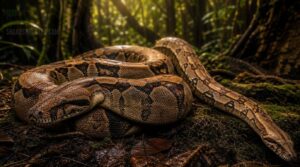
Weight tells a different story than length alone. Adult male boas usually weigh 2.0–5.0 kg, while females range from 2.5–6.0 kg — and larger females can push past 8.0 kg. This parallels findings that an early adiposity rebound is associated with increased adult body weight.nn| Sex | Typical Weight Range |n|—|—|n| Male | 2.0–5.0 kg |n| Female | 2.5–6.0+ kg |nnThat sexual mass gap comes down to reproductive biology — females simply carry more fat and tissue.
Growth Patterns After Maturity
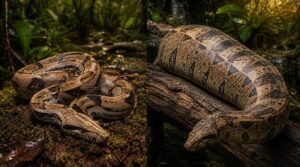
Once boas hit sexual maturity around 3–4 years, growth rate differences become clear. The male boa constrictor plateaus earlier, with length stabilizing and weight changing very little. The female boa constrictor keeps gaining girth for years, driven by reproductive fat storage.
Seasonal feeding shifts can temporarily affect body condition, but long-term, both sexes change less than 5 percent in body length.
Maximum Recorded Sizes
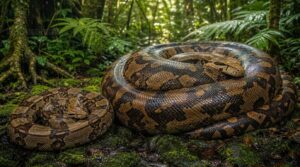
When you look at extreme size records, the gap becomes hard to ignore. The largest documented boa — a captive female — reportedly reached 18 feet. Wild females top out near 13 feet, while most males max around 10 to 12. That size difference reflects consistent sexual dimorphism across both captive and wild populations.
| Category | Male Boa Constrictor | Female Boa Constrictor |
|---|---|---|
| Captive Max | ~12 ft | ~18 ft |
| Wild Max | ~10 ft | ~13 ft |
| Typical Adult | 8–10 ft | 10–14 ft |
Factors Influencing Boa Size by Sex
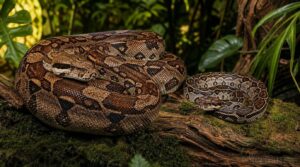
Size in boa constrictors isn’t just luck of the draw — several real factors shape how big your snake gets, and sex plays a central role in all of them.
Genetics, diet, housing, and feeding habits can all push a boa toward the larger or smaller end of its potential range.
Here’s a closer look at what actually drives those size differences between males and females.
Genetic and Lineage Effects
Think of genetics as the blueprint your boa is born with — it sets the ceiling for how large they’ll ever grow. Genetic size inheritance plays a major role in the size dimorphism you see between males and females, with allele frequency patterns across subspecies directly shaping growth potential before environment ever gets a chance to intervene.
Lineage growth potential matters more than many keepers realize. Offspring from large Amazonian lineages tend to reach greater maximum lengths, while island-origin boas carry inherited metabolic traits that naturally cap adult size. Heritage metabolic traits passed through generations influence how efficiently a boa converts food into growth, which is why two boas fed identically can still end up noticeably different in size.
Genetic adaptation effects also explain regional variation. Colombian red-tailed lineages, for instance, carry distinct allele frequencies tied to larger adult frames, whereas dwarf populations retain smaller sizes due to limited genetic variation. If you’re serious about predicting how big your boa will get, knowing its lineage and considering genetic health screening gives you a real advantage — because the genes truly do tell most of the story.
Diet and Nutrition Impact
What you feed your boa — and how often — directly shapes how large it grows. Caloric balance effects matter here: females naturally require more energy to sustain their greater mass, while males need less. Feeding prey delivering roughly 10% of body weight weekly accelerates growth, especially in juveniles.
For deeper context, see why female boas typically grow larger than males and how genetics influence that difference.
Protein needs support tissue development, and adequate hydration keeps metabolism running efficiently across both sexes.
Environmental and Housing Factors
Your boa’s enclosure environment directly influences how large it grows. A proper thermal gradient — warm side around 88–92°F, cool side near 78°F — promotes efficient digestion and steady growth.
Humidity control matters too; aim for 60–70%. Good ventilation design prevents stagnant air, reducing respiratory stress that can stall development in both sexes.
Feeding Frequency and Methods
How often you feed your boa plays a direct role in how large it ultimately grows.
Juveniles thrive on weekly feeding schedules, while adults do well every 10–14 days.
Match prey size to midbody girth, and always use tongs with pre‑thawed frozen prey.
After meals, leave your boa undisturbed — stress disrupts digestion and can slow growth noticeably in both sexes.
Subspecies and Regional Size Variation
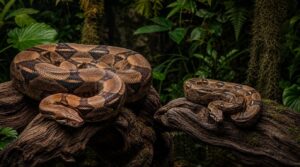
Not all boa constrictors are built the same, and where a snake comes from has a lot to do with how big it gets. Subspecies and regional lineages can push size expectations in very different directions for both males and females. Here’s a closer look at how that plays out across four key groups.
Amazonian Boa Vs Imperator
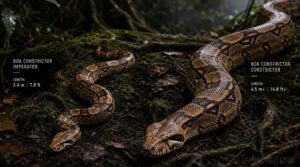
Boa constrictor constrictor (Amazonian) and Boa constrictor imperator sit at opposite ends of the size spectrum.
Female Amazonians commonly reach 8–12 feet, while Imperator females usually top out at 6–10 feet.
Habitat influence plays a real role here — richer prey availability in Amazonian regions drives faster growth velocity and earlier maturity, widening sexual dimorphism between male and female boa constrictors across both taxa.
Dwarf and Island Populations
Island populations tell a different story. The Hog Island boa, for example, matures at just 4–5 feet — roughly half the size of mainland Amazonian relatives.
Island dwarfism shapes both sexes, though larger females still outsize males even within these compact populations.
Limited food availability and genetic isolation drive this size reduction, keeping sexual dimorphism intact but scaled down considerably.
Colombian Red-tailed Boas
Colombian Red-tailed boas are among the largest Boa constrictor subspecies you’ll encounter. Females regularly reach 10–12 feet, while males usually top out around 7–9 feet.
That size gap directly shapes your terrarium setup, dietary needs, and handling approach — especially once females hit full maturity and their feeding demands increase noticeably.
Genetic Variability
Size isn’t just about diet or husbandry — genetics shape the ceiling. Research shows genetic factors account for up to 50% of individual size variability, meaning your boa’s genetic potential is baked in from day one.
Three things genetics directly controls:
- How pronounced sexual size dimorphism becomes at maturity
- Regional allele frequency differences that separate island dwarfs from mainland giants
- Heterozygosity levels that influence overall growth resilience
Reproductive Advantages of Larger Females
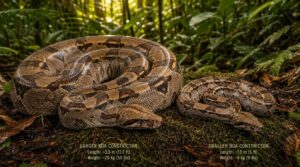
Female boas aren’t just bigger by chance — their size comes with some serious reproductive payoffs. Everything from how many offspring they carry to how well they sustain a long gestation ties back to body size. Here’s a closer look at the key advantages that make larger females stand out.
Clutch Size and Gestation
Regarding reproductive biology, clutch size scaling is one of the clearest advantages larger female boa constrictors hold. A bigger body cavity means room for more developing young — females can produce 20–50% larger litters than smaller individuals.
Gestation periods usually run 5–8 months, and reproductive output rises consistently with female body size and age.
Nutritional Needs During Pregnancy
During gestation, female nutritional demands increase markedly. Larger females carry bigger litters over a 5–8 month gestation period, requiring steady protein intake, adequate hydration, and strong calcium-vitamin D coordination to support developing embryos.
Their greater body mass allows them to store more energy reserves — a clear advantage smaller females simply don’t have.
Prey Size and Energy Reserves
Larger females shift their prey size preference toward bigger, more energy-dense meals during gestation. This isn’t accidental — their energy reserve capacity directly sustains developing embryos over a 5–8 month stretch.
Males, driven by metabolism differences and active courtship, favor frequent smaller meals instead. That size difference shapes everything, from feeding habits to how efficiently each sex converts prey into usable reproductive fuel.
Selective Pressure for Size
Evolution has quietly been selecting for this size difference for generations. Larger females produce bigger clutches and healthier offspring — that’s reproductive success in action.
Evolution has favored larger female boas for generations because bigger bodies mean bigger clutches and healthier offspring
Genetic selection dynamics consistently favor females with greater mass, while resource allocation tradeoffs keep males leaner and more agile. Over time, this sexual dimorphism became fixed across nearly every subspecies.
Health and Cost Considerations by Sex
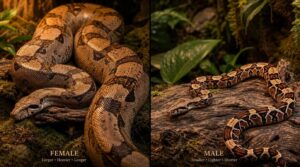
Owning a boa isn’t just about space and feeding schedules — vet bills and sex-specific health risks are part of the picture too. Females and males come with their own set of medical considerations that can affect your budget over time. Here’s what you should know before committing to either sex.
Veterinary Costs for Large Females
Owning a large female boa means your vet costs can climb fast. Routine exams run $75–$150, but surgical fee scaling means bigger snakes cost more in anesthesia, staff time, and monitoring. Here’s what to budget for:
- Pregnancy ultrasound costs – imaging to confirm gestation adds diagnostic fees
- Emergency dystocia treatment – urgent care can exceed $800–$3,000
- Diagnostic imaging fees – X-rays or CT scans run separate from exam costs
- Post-op pain management – prescriptions add weekly expenses after any procedure
Male-Specific Health Issues
Male boas come with their own set of health concerns that are easy to overlook. Their cloacal spurs and hemipenes require regular inspection, since retained shed and infections in these structures are common. Reproductive problems like hemipenile prolapse can escalate quickly without prompt care.
| Issue | Common Cause |
|---|---|
| Hemipenile prolapse | Rough handling or infection |
| Spur infections | Poor hygiene or retained shed |
Insurance for Boa Owners
Few people think about exotic pet insurance until something goes wrong. For boa constrictor owners, that oversight can get expensive fast.
Liability coverage options protect you if your snake injures a visitor, while enclosure insurance policies cover damaged or stolen habitats.
Veterinary expense riders help offset emergency costs, and premium factors like enclosure size, subspecies, and incident history affect your rate.
Regional insurance availability varies, so check local regulations first.
Top 10 Colorful Feather Boas for Owners
Not every boa owner is all business — sometimes you want a little flair to go with the hobby. Feather boas make great accessories for themed events, photoshoots, or just showing off your love for these astonishing reptiles. Here are ten colorful options worth checking out.
1. JICASTO Colorful Feather Boa with Heart Sunglasses
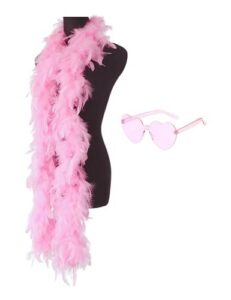
The JICASTO Colorful Feather Boa with Heart Sunglasses is a fun, practical pick if you want a bold accessory for parties, Halloween, or Mardi Gras. Each set comes with a 2-meter (6.6 ft) boa made from natural turkey feathers, professionally cleaned and sanitized, plus matching heart-shaped rimless sunglasses — all for $8.99.
Keep in mind it sheds feathers with heavy handling, so it’s best suited for short-term event wear rather than repeated use.
| Best For | Anyone who wants a bold, colorful accessory for a one-night event like a Halloween party, Mardi Gras, or New Year’s Eve celebration. |
|---|---|
| Material | Natural turkey feathers |
| Length | 2 m / 6.6 ft |
| Quantity | 1 boa + sunglasses |
| Price | $8.99 |
| Shedding | Significant shedding |
| Primary Use | Parties and costume events |
| Additional Features |
|
- Great value at $8.99 — you get a 6.6 ft boa and matching heart sunglasses in one set
- Comes in six bright colors, so it’s easy to match a costume or theme
- Natural turkey feathers that are cleaned and sanitized, and the boa is hand-washable if needed
- Sheds feathers noticeably during wear, so don’t expect it to last beyond a single event
- Feather density can feel thinner and less fluffy than it looks in photos
- The sunglasses are basic plastic — fine for a photo, but don’t count on them lasting the night
2. Multicolor 5ft Artificial Feather Boa
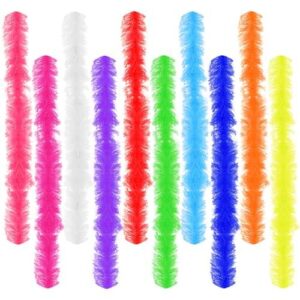
If you want something more budget-friendly and low-maintenance, the Multicolor 5ft Artificial Feather Boa is worth a look. Each pack includes 10 boas in different bright colors, made from lightweight synthetic polyester.
At roughly 5 feet long, they’re easy to wrap, trim, or drape. They won’t shed like natural feathers, though the thinner build — about 4 inches wide — means less volume overall.
Great for parties or themed events, but not ideal for heavy, repeated wear.
| Best For | Anyone who needs a fun, colorful accessory for parties, costumes, or themed events without spending a lot. |
|---|---|
| Material | Synthetic polyester |
| Length | 5 ft |
| Quantity | 10 boas |
| Price | Not specified |
| Shedding | Minimal shedding |
| Primary Use | Costumes and parties |
| Additional Features |
|
- You get 10 boas in different bright colors — great variety for group events or parties
- Lightweight and easy to store, trim, or wrap however you need
- Minimal shedding compared to real feather boas
- Pretty thin at about 4 inches wide, so don’t expect a big, fluffy look
- Synthetic material won’t pass for real feathers if you need something realistic
- May not hold up well with heavy or repeated use
3. MAOFENG Fuchsia Turkey Feather Boa
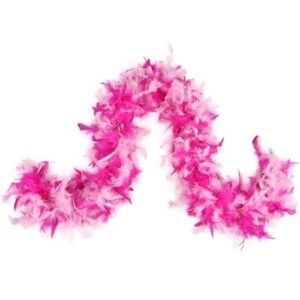
Step up from synthetic and you’ll notice the difference right away. The MAOFENG Fuchsia Turkey Boa is built from genuine turkey feathers on a reinforced nylon core, giving it a fuller, more dramatic look than polyester alternatives.
At 72 inches long and around 110 grams, it drapes well on most adults.
The bright magenta holds up under stage lighting without much color transfer.
One heads-up: hang it 24–48 hours before use to restore its shape after packaging.
| Best For | Anyone who needs a bold, eye-catching boa for costumes, stage performances, photo shoots, or themed parties and wants real feathers over synthetic fluff. |
|---|---|
| Material | Natural turkey feathers |
| Length | 1.64 yd / 150 cm |
| Quantity | 1 boa |
| Price | Not specified |
| Shedding | Moderate shedding |
| Primary Use | Costumes and performances |
| Additional Features |
|
- Made from natural turkey feathers, so it looks and feels more dramatic than polyester alternatives
- Comes in 22 vibrant colors, including a bright fuchsia that holds up well under stage lighting
- Light enough to wear comfortably at around 30g per boa
- Feathers can shed right out of the package, which gets messy fast
- Some users notice a scratchy feel and a faint chemical odor
- Needs 24–48 hours of hanging before it looks its best, and quality can vary between boas
4. Max Fun Feather Boas Assorted Colors
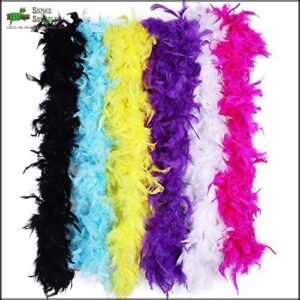
If you’re outfitting a group, Max Fun Feather Boas solve the "matching colors" problem instantly. Each set includes six boas — yellow, Cambridge blue, black, white, hot pink, and purple — all 6.56 feet long.
That’s enough length for adults to drape dramatically over both shoulders.
Fair warning: they shed and may transfer dye, so wear them over costumes you don’t mind getting a little messy.
For one-time party use, though, the color variety is hard to beat.
| Best For | Groups heading to costume parties, Mardi Gras, or themed events who want matching colors without the hassle of buying boas separately. |
|---|---|
| Material | Natural-look feathers |
| Length | 2 m / 6.6 ft |
| Quantity | 6 boas |
| Price | Not specified |
| Shedding | Heavy shedding |
| Primary Use | Parties and décor |
| Additional Features |
|
- Six different colors in one pack — no hunting for individual boas
- Each boa runs 6.56 feet, plenty of length for a dramatic look
- Safe, non-toxic materials make them easy to hand out to any age group
- Heavy shedding means feathers end up on everything — clothes, drinks, you name it
- Dye can transfer onto skin and fabric, so wear them over something you don’t mind staining
- Construction is on the thin side; don’t expect thick, fluffy boas straight out of the bag
5. Handmade Pink Turkey Feather Boa
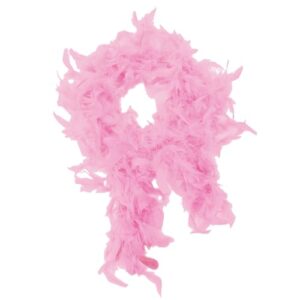
If solid pink is your theme, the Handmade Pink Turkey Feather Boa keeps things simple and striking. At 2 m (6.5 ft) long and roughly 40 g, it’s light enough to wear around your neck for an entire performance without fatigue.
Real turkey feathers give it a soft, full texture that catches light well.
At $6.99 per pair, it’s one of the better value options here.
Just shake it out before wearing — feathers settle during shipping.
| Best For | Performers, costume lovers, and anyone who needs an affordable, eye-catching pink boa for dance, cosplay, burlesque, themed parties, or dress-up play. |
|---|---|
| Material | Natural turkey feathers |
| Length | 2 m / 6.5 ft |
| Quantity | 1 pair |
| Price | $6.99 |
| Shedding | Some shedding |
| Primary Use | Costume and dance |
| Additional Features |
|
- Real turkey feathers give it a soft, full look that holds up well under stage lighting
- At $6.99 a pair, it’s hard to beat the price for what you get
- Light enough (just 40 g) to wear through a whole performance without it weighing you down
- Feathers shed during unpacking, so you’ll need to shake it out and let it air before use
- Delicate build means it won’t hold up to rough handling or prolonged heavy wear
- Can feel thin or uncomfortable if worn as more than a decorative accent
6. Larryhot Pink LED Feather Boa
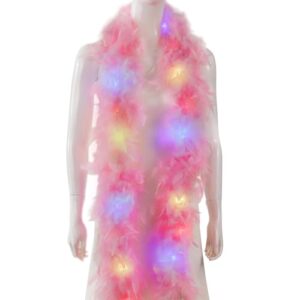
When your boa enclosure needs a little after‑dark flair, the Larryhot Pink LED Feather Boa delivers something genuinely eye‑catching.
At 6 ft long with 20 embedded pink LEDs, it offers three lighting modes — steady, slow flash, and fast flash — so you can match the mood of any event.
Battery life runs 24–48 hours, and it weighs just 75 g.
For $12.34, that’s solid value for a costume party or themed reptile expo appearance.
| Best For | Anyone who wants an affordable, eye-catching accessory for costume parties, Mardi Gras, Halloween, or themed events — and doesn’t mind a little extra fluffing out of the box. |
|---|---|
| Material | Natural turkey feathers |
| Length | 2 yd / 6 ft |
| Quantity | 1 boa |
| Price | $12.34 |
| Shedding | Prone to shedding |
| Primary Use | Costume and décor |
| Additional Features |
|
- 20 pink LEDs with three lighting modes give you real versatility for any vibe
- 24–48 hours of battery life means it’ll last the whole night (and then some)
- At $12.34 for 6 ft of lit-up feather boa, the value is hard to argue with
- Feathers shed and some units come out thinner than the photos suggest
- The switch can be finicky — you might need to fiddle with it to keep it on or off
- Vacuum packaging flattens the feathers, so plan on spending a few minutes fluffing before you wear it
7. JICASTO Colorful LED Feather Boa
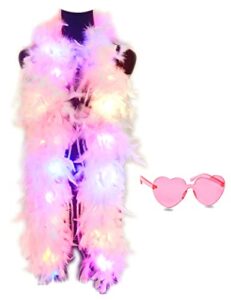
The JICASTO Colorful LED Feather Boa takes things up a notch with multicolor LEDs instead of a single hue. At 6.6 ft long with 20 LEDs, it cycles through colors automatically, giving you that rainbow effect without any manual switching.
It comes with matching heart-shaped sunglasses in the same color, which is a nice touch for coordinated costumes.
At $14.99, it’s slightly pricier than single-color options, but the included accessory makes it reasonable value overall.
| Best For | Anyone who wants a fun, eye-catching accessory for costume parties, Mardi Gras, Halloween, or any low-light event where standing out (literally) matters. |
|---|---|
| Material | Natural turkey feathers |
| Length | 2 m / 6.6 ft |
| Quantity | 1 boa + sunglasses |
| Price | $14.99 |
| Shedding | Thin, prone to shedding |
| Primary Use | Dance and costume parties |
| Additional Features |
|
- 20 multicolor LEDs cycle through colors automatically — no fussing with settings
- Comes with matching heart-shaped sunglasses, so your look is already coordinated
- At $14.99 with an accessory included, it’s solid value for a one-night event
- Feathers shed easily and will end up on your clothes and everywhere around you
- Feels a bit thin and flimsy compared to denser boas — don’t expect luxury
- LED reliability is hit or miss, and there’s no info on how long the batteries last
8. Shenyi Hot Pink Feather Boa
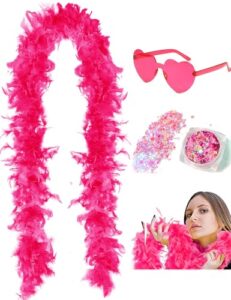
At just $9.99, the Shenyi Hot Pink Feather Boa is one of the more budget-friendly picks on this list. It runs 2 yards (roughly 6 feet) and weighs 45 g, so it’s light and easy to wear for hours.
The hot pink color reads bright in person — sometimes more neon than the product images suggest.
Fair warning: it sheds noticeably, so shake it out before you wear it.
| Best For | Anyone who needs a fun, throwaway accessory for a bachelorette party, Halloween, or a themed event without spending more than ten bucks. |
|---|---|
| Material | Natural feathers with glitter |
| Length | 2 yd / 6 ft |
| Quantity | 1 boa + sunglasses |
| Price | $9.99 |
| Shedding | Noticeable shedding |
| Primary Use | Bachelorette and parties |
| Additional Features |
|
- At $9.99, it’s easy to grab a few without worrying about the cost
- Six feet of boa gives you plenty to work with for draping or sharing
- The body glitter and heart-shaped sunglasses make it a ready-to-go party kit
- Sheds a lot — you’ll leave a feather trail wherever you go
- The glitter can irritate skin, so it’s worth testing before a long night out
- The color runs more neon than the photos show, which might not match your outfit
9. Five Foot Colorful Feather Boas
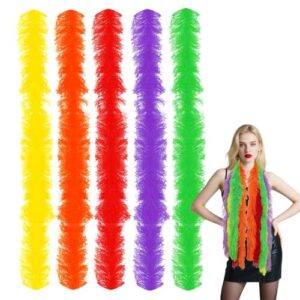
If you want color variety without breaking the bank, this set delivers.
The Five Foot Colorful Feather Boas come as a pack of 10, covering five colors — yellow, orange, red, purple, and green — two of each. At roughly 5 ft (152 cm) per boa, you get enough for a group.
They’re lightweight synthetic polyester, so don’t expect thick fluff, but for parties or dress‑up, they get the job done.
| Best For | Anyone planning group events, parties, or dress-up activities who wants a colorful, budget-friendly set without spending a lot. |
|---|---|
| Material | Synthetic polyester |
| Length | 5 ft / 152 cm |
| Quantity | 10 boas |
| Price | Not specified |
| Shedding | Low shedding |
| Primary Use | Costumes and group events |
| Additional Features |
|
- You get 10 boas across five colors, so there’s plenty to go around for groups or kids’ activities.
- Lightweight and easy to carry — toss them in a bag and go.
- Can be trimmed to fit, which gives you a little flexibility for costumes or crafts.
- The fluff is on the thin side — don’t expect the full, dramatic look of a traditional feather boa.
- These are synthetic, so the texture won’t feel or look like real feathers.
- Budget pricing shows in durability — they’re great for one-time events but may not hold up to heavy repeat use.
10. Fluffy Feather Boa Decoration
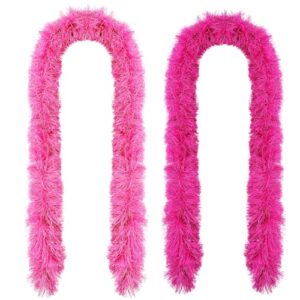
Sometimes it’s the simple options that stick around longest. The Fluffy Feather Boa Decoration leans into that idea — soft Chandelle or marabou feathers wrapped around a lightweight core, with reinforced ends to cut down on shedding.
It runs 4 to 6 feet in length and stays well under 0.5 kg, so it’s easy to drape, wear, or prop without fuss.
Store it dry, give it a shake after unpacking, and it holds up well for parties, photo shoots, or themed décor.
| Best For | Anyone who needs a fun, affordable accent for costumes, party décor, or craft projects and doesn’t mind a little fluff on their clothes. |
|---|---|
| Material | Synthetic polyester |
| Length | 150 cm / 1.64 yd |
| Quantity | 2 boas |
| Price | $6.99 |
| Shedding | Minor shedding |
| Primary Use | DIY crafts and costume |
| Additional Features |
|
- Two boas for under $7 is a solid deal — great for parties or bulk gifting.
- Comes in 12 colors and cuts easily, so it works for a wide range of DIY projects.
- Lightweight and flexible, which makes it comfortable to wear or drape anywhere.
- Vacuum-sealed packaging flattens the fibers — you might need a hair dryer to bring it back to life.
- It sheds a bit, and some buyers have found it thinner or shorter than expected.
- The synthetic feel won’t match a real feather boa, so it may not satisfy everyone on quality.
Frequently Asked Questions (FAQs)
How do male and female boas behave differently?
Males tend to be more active and curious, exploring their enclosures frequently. Females are calmer but show strong defensive aggression when protecting offspring. Male aggression often surfaces during territorial disputes with other males.
At what age do boas reach full size?
Boas don’t hit their full size overnight. Most reach sexual maturity by age 3–4, but true maximum size often isn’t achieved until 5–7 years, with some individuals growing slowly into their teens.
Can you tell a boas sex visually?
You can get a rough idea from the tail. Males have longer, thicker tails that taper gradually past the vent, while females have shorter, stubbier tails. It’s a clue, not a guarantee.
For a deeper breakdown of how tail morphology compares across sexing methods, this guide to ball python sexing techniques puts tail-probing and visual cues in useful context alongside each method’s accuracy.
For a clearer breakdown of what to look for, sexing corn snakes by tail shape and taper walks through the differences in more detail.
Do female boas live longer than males?
Not exactly. Captive boas of either sex usually live 20–30 years with proper care. Sex alone doesn’t determine lifespan — diet, husbandry, and stress levels matter far more than whether your boa is male or female.
How does captivity affect boa growth rates?
Captivity acts like a growth accelerator. With stable temperatures, consistent feeding, and no predators to dodge, boas grow faster and larger than their wild counterparts ever would.
Conclusion
Picture your setup a year from now: a spacious enclosure, a feeding schedule dialed in, and no surprises on vet day. That future depends on decisions you make today.
Male vs female boa size shapes everything from housing dimensions to long-term costs, and biology won’t negotiate. Females will grow, reproduce, and demand more—it’s not a flaw, it’s their design.
Know what you’re committing to before the snake outgrows your plan.