This site is supported by our readers. We may earn a commission, at no cost to you, if you purchase through links.

Keeping a boa constrictor in an apartment sounds like a logistical nightmare to most people—and the feeding part is where many new keepers quietly give up. Odors, frozen rodents in a shared freezer, neighbors who notice things.
The challenges are real, but they’re also manageable once you understand how boa feeding actually works at a smaller scale. The right feeder type, proper sizing, and a consistent schedule make the difference between a thriving snake and one that’s chronically stressed or overweight.
What follows covers the practical side of boa constrictor feeders for apartment keepers—from choosing certified frozen-thawed prey to building routines that fit tight spaces.
Table Of Contents
Key Takeaways
- Frozen-thawed rodents stored at -18°C are the safest, cleanest choice for apartment boa keepers — no odors, no disease risk, no live-prey bans to worry about.
- Every meal should match 10% of your boa’s body weight, and prey width should never exceed the snake’s widest body point.
- Feed hatchlings every 7–10 days, juveniles every 7–14 days, sub-adults every 14 days, and adults every 3–4 weeks — rushing that schedule causes obesity and regurgitation.
- Always warm thawed prey to 98–102°F before offering, use feeding tongs to stay out of the strike zone, and leave your boa completely alone for 48 hours after it eats.
Choose Apartment-Friendly Boa Feeders

Feeding a boa in an apartment is easier than most people think. The key is choosing the right type of feeder from the start. Here’s what works best for small-space keepers.
Getting that foundation right makes all the difference, and this guide to boa constrictor feeders for beginners breaks down prey type, sizing, and scheduling in plain terms.
Frozen-Thawed Rodents
Frozen-thawed rodents are the standard practice for apartment boa keepers. They store cleanly in your freezer, eliminate odors, and carry no disease risk. Always thaw prey in a sealed bag — this prevents cross-contamination prevention issues with your food. Avoid microwaving your frozen prey to prevent uneven cooking or explosions.
- Store at -18°C or below for nutritional value retention
- Thaw overnight in the fridge or use a cold-water bath
- Warm to 37–38°C before offering to boost feeding response enhancement
- Match prey diameter to just under your boa’s widest point
- Source from certified suppliers for vacuum-sealed, screened feeders
Avoid Live Feeding
Live feeding isn’t just risky — in many apartment buildings, it’s outright banned. Landlords and community housing policies often prohibit keeping live prey on the premises.
Beyond the rules, a live rodent can bite your boa, causing serious wounds. Frozen-thawed prey eliminates that danger entirely while still satisfying your snake’s feeding instincts safely and humanely.
Mice Versus Rats
Once you’ve switched to frozen-thawed prey, the next choice is which rodent fits your boa’s life stage. Mice versus rats comes down to one thing: size.
- Mice (20–40g) suit hatchlings and young juveniles under 2.5 feet
- Rats (250–500g) match sub-adults and adults needing the Ten Percent Rule
- Rat skulls are broader, making them harder for smaller boas to swallow safely
Small Rabbits for Adults
Once your adult boa outgrows large rats, small rabbits step in as the next size up. Breeds like Netherland Dwarfs (1.1–2.0 lbs) or Holland Lops (2.0–4.0 lbs) fit the 10% body weight rule well. They’re calmer to handle, freeze cleanly, and store just like rats — no extra space needed.
Certified Feeder Suppliers
Not every online reptile supplier is worth your trust. Look for vendors certified under GMP Plus or FAMI QS standards — these require documented HACCP safety plans and full supplier traceability from source to shipment. Annual surveillance audits keep them accountable.
Certified suppliers also vacuum-seal feeders and screen for disease, so your boa stays safe and your apartment stays clean.
Size Feeders Without Overfeeding
Getting feeder size right is one of the most important things you’ll do as a boa keeper. Too big, and you risk health problems — too small, and your snake won’t thrive. Here’s what you need to know to nail it every time.
Match Body Width
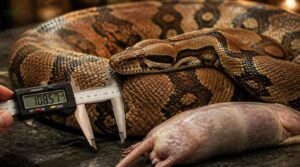
Think of prey width as a handshake — it should fit, not force. Measure your boa’s widest body point with a ruler or calipers before every feeding. The prey’s girth should sit slightly below that measurement. For hatchlings, aim 2–4mm narrower.
If you’re still learning your snake’s patterns, tracking boa growth stages and morph traits can help you anticipate size changes and adjust prey width accordingly.
Watch jaw alignment during swallowing. Log each meal in a feeding log to track sizing success as your boa grows.
Ten Percent Body Weight
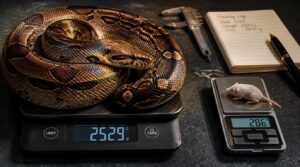
One simple rule keeps feeding precise: ten percent of body weight is your target prey mass. Weigh your boa every 2–4 weeks and apply the Weight Calculation Formula — body weight multiplied by 0.10. A 300g boa needs roughly 30g prey.
Never exceed 15 percent prey weight limit to avoid regurgitation and digestive strain.
Hatchling Feeder Sizes
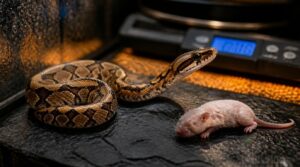
Hatchlings are tiny, but getting their feeder size wrong causes real problems fast.
For the first few months, target 1–4 grams per feeder. Match prey width to the snake’s neck — not the mid-body. Use weaned mice as your go-to; they’re the right size and easy to source frozen-thawed.
Here’s what to track:
- Prey girth must stay narrower than the hatchling’s widest neck point
- Prey temperature should hit 98–102°F before offering — cold prey gets refused
- Thawing duration of 12–24 hours in the fridge preserves scent and acceptance
- Weight gain tracking every 2 weeks confirms steady growth without overfeeding
- Post-feeding care means no handling for 24 hours to prevent regurgitation
If your hatchling refuses twice in a row, drop prey size by 10–15%. A smaller meal accepted beats a perfect-sized meal refused.
Juvenile Feeder Sizes
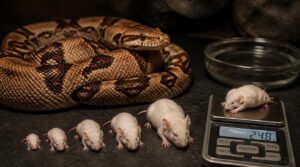
As your boa grows past the hatchling stage, prey sizing becomes a moving target.
Juvenile prey weight should sit around 10% of the snake’s body mass — so a 100g snake needs roughly a 10g feeder. Don’t exceed 12%. Stick to white mice in the 15–35g range, stepping up as girth increases.
| Juvenile Size | Target Prey Weight |
|---|---|
| Small juvenile | 15–25g mouse |
| Larger juvenile | 25–35g mouse |
| Fast growth phase | Up to 25% wider than hatchling prey |
| Refusal adjustment | Drop to equal or smaller size |
Match prey width to mid-body girth — never wider. If swallowing looks labored, go smaller. Feed every 7–14 days, adjusting for growth rate and appetite. Reassess prey size monthly to stay ahead of growth spurts without overfeeding.
Adult Feeder Sizes
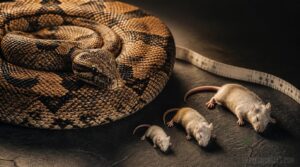
By the time your boa hits adulthood, prey sizing gets serious. Maximum prey girth should never exceed the widest body point — that’s your non-negotiable rule.
Target these three ranges:
- 200–350g for smaller adults
- 350–500g for mid-sized adults
- 500–600g for large specimens
Track growth monthly. Adjust boa constrictor feeders seasonally — metabolism slows in cooler months, so drop prey size slightly.
Build a Safe Feeding Schedule
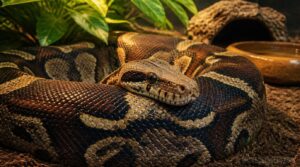
Feeding your boa on the right schedule makes a bigger difference than most new keepers expect. Get it wrong and you’re looking at obesity, regurgitation, or a snake that refuses to eat. Here’s how to time meals correctly at every stage of your boa’s life.
Hatchlings Every 7–10 Days
Wait for the first shed before offering any meals — it usually arrives 7 to 14 days after birth. After that, feed every 7 to 10 days, depending on how cleanly your hatchling digests. Choose prey near 10% of body weight. If a bulge is still visible on day 7, wait.
Weigh weekly to confirm steady growth.
Juveniles Every 7–14 Days
Once your hatchling is eating consistently, it graduates to juvenile status — and the schedule opens up a bit. Feed every 7 to 14 days, letting growth rate and digestion guide you. A fast-growing boa may need that shorter interval. A steadier grower does fine at 14 days.
- Weigh before every meal to track real gains
- Watch for a visible belly bulge before offering the next feeder
- Use frozen-thawed rodents sized to jaw width — no guessing
- Log appetite and weight each time to catch problems early
Sub-Adults Every 14 Days
By the time your boa hits the sub-adult stage — roughly 3.5 to 5 feet — a 14-day feeding schedule becomes your standard. Their metabolism slows compared to juveniles, so every two weeks strikes the right balance. It helps steady growth monitoring without overloading digestion.
Keep prey within 10% of body weight and log a body condition score at each feeding.
Adults Every 3–4 Weeks
Once your boa reaches full adulthood, every 3–4 weeks is all they need. Their metabolism has settled, so monthly meals match their actual energy demands. A steady rhythm also keeps apartment feeding logistics simple — predictable, low-odor, and easy to plan around.
Weigh your snake monthly. Consistent intervals support digestive health monitoring and flag early weight changes before they become serious.
Avoid Power Feeding
Power feeding is the fast track to a sick snake. Feeding too often — or too much at once — overloads digestion and drives rapid fat gain.
Stick to your age-appropriate feeding schedule and monitor weight monthly. If the scale creeps up fast, stretch the interval. Slow, steady growth beats quick bulk every time.
Prepare Feeders in Small Spaces
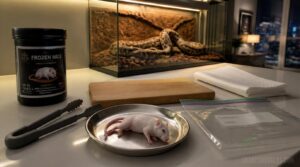
Feeding a boa in an apartment takes a bit of planning, but it’s completely doable with the right setup. The real key is keeping your prep clean, safe, and contained — no mess, no odors, no stress. Here’s what works.
Freezer Storage Tips
Your freezer is your feeder management headquarters. Set it to -18°C (0°F) and check it with an appliance thermometer regularly.
- Use vacuum-sealed bags to block freezer burn
- Label each package with species and date
- Don’t overload — frozen prey needs airflow
- Defrost frost buildup before it shrinks usable space
Organized, cold, and airtight keeps your prey items safe for months.
Safe Thawing Methods
Thawing frozen-thawed rodents the right way protects your boa from bacterial exposure.
Refrigerator thawing is safest — place sealed prey on a tray at 41°F overnight. Need it faster? Cold water thawing works in 20–60 minutes per pound; swap the water every 30 minutes.
Avoid room temperature entirely. It pushes prey into the bacterial danger zone fast.
Warm Prey Properly
Cold prey won’t trigger a strike. After thawing, warm your frozen-thawed prey in a warm water bath at 98–102°F for 20–25 minutes. Use an infrared thermometer for core temperature checks — target 35–40°C throughout.
Never microwave; hot spots burn tissue and kill feeding response. Confirm even warmth before presenting, or your boa may refuse entirely.
Use Feeding Tongs
Your hands are the target — keep them out of the equation. Stainless steel feeding tongs, 12–18 inches long, give you the reach to present prey without entering the strike zone. Angled tips improve aim, and rubber grip inserts prevent slippery thawed mice from dropping mid-presentation.
Move prey slowly, at head level, so your boa strikes clean and settles in.
Disinfect Prep Areas
Every prep surface touched by raw feeders is a contamination risk.
Clear away tongs, waste, and packaging first. Then wipe surfaces in a single direction using an EPA-approved disinfectant — let it stay wet for the full contact time on the label. Wear gloves throughout.
Log each session: date, product used, and area cleaned.
Prevent Feeding Problems Indoors

Even the best feeding routine can hit a wall when something goes wrong indoors. Knowing what to watch for makes the difference between a quick fix and a vet visit. These five problem areas are worth keeping on your radar.
Reduce Feeding Stress
Stress during feeding is quietly one of the biggest threats to your boa’s health indoors.
- Move slowly and speak softly when approaching the enclosure.
- Dim lights and reduce noise to create a calm feeding window.
- Use feeding tongs to present frozen-thawed rodents at head level.
Watch for tail flicking or gaping — those are your boa’s warning signs.
Skip Post-Meal Handling
Your boa just ate — now leave it alone. Don’t handle for at least 48 hours after a meal. Digestion takes serious effort, and any pressure on the abdomen can trigger regurgitation.
Keep the enclosure in quiet enclosure time: no tapping, no rearranging, no peeking. Stable temperatures between 88–92°F on the warm side support digestion fully.
Watch for Regurgitation
Even with perfect prep — the right frozen-thawed rodents, proper prey size, and careful feeding tongs technique — regurgitation still happens sometimes. Know what to watch for.
Regurgitation warning signs to catch early:
- Prey matter or fluid visible around the mouth or nostrils
- Breathing difficulty detection: wheezing, gaping, or nostril flaring after feeding
- Sudden lethargy or complete disinterest in movement
- Feeding refusal patterns: ignoring the next offered meal entirely
Aspiration risk is serious. If mucus appears near the nostrils, call a reptile vet immediately.
Monitor Boa Body Shape
Regurgitation tells you something went wrong. But your boa’s body shape tells you the whole story over time.
Body condition scoring is simple. Run your eyes from neck to cloaca. A healthy boa looks like a loaf of bread — rounded, consistent width, smooth taper toward the tail. No visible spine. No "snake hips."
A healthy boa should look like a loaf of bread — rounded, consistent, and spine-free
| Shape Signal | What It Means | Action Needed |
|---|---|---|
| Rounded, consistent width | Healthy body condition | Maintain current schedule |
| Visible spine or skin sag | Underfeeding or illness | Increase meal frequency |
| Fat deposits on ventral scales | Obesity risk | Reduce prey size |
Do monthly weigh-ins and track girth alongside weight. Weight alone misleads you. A boa can gain mass through fat without growing longer — that’s the weight vs girth gap that signals overfeeding. Apply the Ten Percent Rule: no single meal should exceed 10% of total body mass.
Watch seasonal shape changes too. Adults naturally slim slightly in fall and winter. That’s normal. What isn’t normal is abrupt bulking without length change — that warrants growth rate tracking and possibly ultrasound assessment from a reptile vet.
Call a Reptile Vet
Sometimes your boa sends signals no feeding chart can explain. That’s when you call an exotic veterinarian.
Find a reptile specialist before you need one. Ask about diagnostic imaging options — X-rays, ultrasound, even CT. Confirm they have anesthesia equipment suited for reptiles. Schedule a wellness exam annually. Good reptile health monitoring starts with a vet who knows the difference.
Frequently Asked Questions (FAQs)
What are the best practices for keeping a pet boa constrictor?
Like a well-tuned ecosystem, great boa care balances temperature gradient, humidity management, and feeding frequency. Use frozen-thawed rodents, match prey to body width, and track weight trends to keep your boa thriving long-term.
Can boas smell prey through freezer bags?
Yes — boas can detect frozen prey scent even through freezer bags. Their vomeronasal system picks up chemical cues that permeate most bag materials, especially after thawing triggers stronger odor release.
How do I feed my boa during vacation?
Schedule your pre-travel meal timing so your boa finishes digestion two days before you leave. A trusted keeper with frozen-thawed rodents covers the rest. Stick to normal feeding frequency — no skipping.
Should I feed my boa in its enclosure?
Feeding your boa in its enclosure is generally fine. It reduces relocation stress and keeps feeding consistent. Just use tongs, remove uneaten prey promptly, and avoid handling for 48 hours after eating.
Do boas need water before or after feeding?
Your boa doesn’t need special water timing around meals. Just keep a clean, fresh bowl available at all times. Boas drink when they’re ready — before, after, or between feedings.
Can stress from neighbors affect my boas appetite?
Like a cat that won’t eat near a loud washing machine, your boa picks up on apartment disturbances. Noise, vibrations, scent changes, and visual disruptions all suppress its natural feeding behavior.
Conclusion
Once you get the hang of it, managing boa constrictor feeders for apartment keepers becomes one of the easier parts of keeping a snake. Frozen-thawed prey covers the biggest indoor concerns right away.
Correct sizing and a steady schedule prevent overfeeding and chronic stress. Small spaces just require more intention—not more effort.
Thaw safely, store smart, and match every meal carefully to your snake’s current build. Do that consistently, and your boa will thrive.
- https://www.boa-constrictors.com/en/interesting_facts_about_boa_constrictor/boa_constrictor_care/feeding_boa_constrictor/proper_size_prey_specialized_feeders
- https://arachnoboards.com/threads/live-or-frozen-prey-for-a-snake-training-to-eat-frozen.246584
- https://titanpestandwildlife.com/keeping-mice-and-rats-out-of-your-apartment-building