This site is supported by our readers. We may earn a commission, at no cost to you, if you purchase through links.

The substrate you choose does more than line the bottom of an enclosure — it regulates humidity, encourages natural behavior, and can protect or quietly damage your snake’s respiratory health over time. Aspen works beautifully for corn snakes; pack it into a ball python’s enclosure and you’ll watch humidity crash below the 70% floor that species needs to shed cleanly.
That single mismatch explains why bedding choice trips up more keepers than almost any other husbandry decision. The differences between snake bedding types go well beyond texture and price — absorbency ratings, particle size, lignin content, and dust levels each play a direct role in whether your animal thrives. Knowing what each substrate actually does, and for which species, makes the right choice obvious.
Table Of Contents
Key Takeaways
- Substrate choice directly controls humidity levels, making species-specific selection the single most impactful husbandry decision you’ll make — aspen for dry-climate snakes like corn snakes, coconut husk or fiber for tropical species like ball pythons needing 70–85% humidity.
- Toxic woods like cedar and pine release aromatic hydrocarbons that damage your snake’s respiratory tract over time, so always source reptile-specific substrates and steer clear of any pressure-treated or exotic hardwood options.
- Maintenance schedules matter as much as material: aspen needs replacing every 2–4 weeks, coconut substrates every 4–6 weeks, and any post-feeding refresh should happen within 72 hours to prevent ammonia buildup.
- Substrate depth isn’t cosmetic — 4–6 inches of loose bedding lets burrowing species self-regulate temperature and humidity vertically, reducing stress behaviors like pacing and chronic shedding problems tied to surface exposure.
Snake Bedding Types Compared
The substrate you choose does more for your snake than just line the bottom of the enclosure — it directly shapes humidity levels, burrowing opportunities, and daily maintenance demands.
For a deeper look at how different materials stack up across all these factors, this snake terrarium substrate guide breaks down the best options for your specific species.
Each material on the market comes with a specific set of trade-offs, and matching those to your snake’s needs is what separates a tolerable setup from a genuinely good one. Here are the five most common substrate types worth knowing.
Aspen Shavings
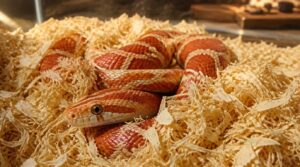
Aspen snake bedding earns its reputation honestly. Kiln drying removes excess moisture before it reaches your enclosure, and the dust-free processing keeps respiratory irritants low — a real advantage for snakes with sensitive airways.
Its hypoallergenic properties make it a safe pick for corn snakes and milk snakes, where moisture wicking keeps surfaces dry and burrowing behavior stays natural.
Coconut Husk Chips
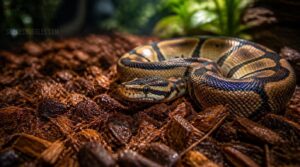
Where aspen keeps things dry, coconut husk chips do the opposite — they hold humidity steady for days. Chip sizes ranging 6–18 mm create an open, fibrous matrix that drains without waterlogging.
Three reasons keepers choose them:
- Burrow tunnel stability — coarse texture holds shape under daily movement
- Gradual moisture release maintains 70–85% humidity without constant misting
- Porosity prevents compaction, enabling natural microhabitat temperature regulation
Coconut Fiber
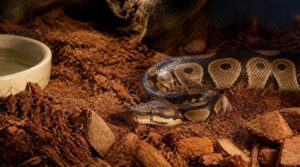
Coconut husk chips hold shape well, but coconut fiber works differently — it’s finer, softer, and far more absorbent. The high lignin content resists biological decay in humid enclosures, while its tubular fiber morphology helps regulate moisture without soaking through.
The trade-off? Fiber migrates into water dishes easily when used alone, requiring spot-checks daily. Its environmental footprint stays low, sourced renewably and fully biodegradable.
Cypress Mulch
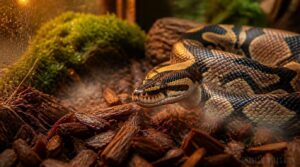
Where coconut fiber stays fine and soft, cypress mulch takes a rougher approach — and for many keepers, that’s exactly the point.
It retains moisture effectively, holding ambient humidity in the 40–60% range without constant misting, and its slow decomposition means fewer full replacements over time. The reddish-brown color also gives enclosures a clean, naturalistic look that’s hard to argue with.
Artificial Liners
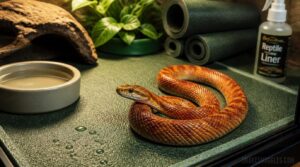
Not every keeper wants loose substrate at all. Artificial carpet liners built from polymer matrix composites resist compaction for 6–12 months, cut maintenance workloads by up to 70%, and provide a VOC barrier that natural bedding can’t match.
You simply wash, air-dry, and reuse — no weekly replacements, no mold risk, and no stray chips migrating into water dishes.
Humidity and Species Needs
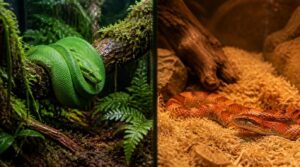
Not every snake wants to live the same way, and humidity is where those differences really start to matter. The right substrate does more than line the bottom of a tank — it either helps or fights against your snake’s natural environment. Here’s how different species stack up regarding moisture, movement, and what they actually need underfoot.
The right substrate doesn’t just line a tank — it either supports or fights your snake’s natural world
Dry-climate Snakes
Desert-dwelling species like corn snakes and hognose snakes have evolved to thrive with minimal moisture, so their enclosures should mirror those arid microhabitats closely. Aspen shavings are the go-to here — a 191% absorbency rating means they dry fast, preventing the damp conditions that trigger respiratory infections.
Pair that substrate choice with a consistent spot-cleaning routine — how often to change snake bedding matters just as much as which bedding you choose.
In arid environments, these snakes rely on metabolic hydration from prey rather than standing water, which is exactly why substrate selection matters so much.
Tropical Snake Species
Tropical species like ball pythons live in rainforests where humidity rarely dips below 70%, which means coconut husk or coco coir isn’t optional — it’s essential. These substrates retain moisture for 5–7 days and naturally break down ammonia.
Ball pythons are crepuscular hunters, active when humidity peaks. Coconut chips support that cycle by holding the 70–85% moisture levels their respiratory systems depend on.
Burrowing Snake Needs
Burrowing snakes aren’t just hiding — they’re engineering microclimates. Species like king snakes need 3–6 inches of loose substrate to tunnel fully and regulate temperature by moving vertically.
Aspen shavings or a coconut fiber mix holds tunnel walls without compacting. Deeper layers stay cooler and more humid, which prevents shedding issues. Aerate substrate weekly so burrows don’t collapse or trap moisture. Always select safe snake substrate to avoid hazardous materials like cedar or pine.
Arboreal Snake Setups
Arboreal snakes live vertically, so your substrate job shifts from depth to humidity retention. Species like Amazon tree boas need vertical climbing networks with bark-based surfaces offering textured grip, anchored securely so nothing shifts mid-climb.
Aim for 60–80% humidity using a moisture-diffusing substrate at the base, with misting timed to active periods. Place hides and perches at multiple heights to create genuine multi-level basking zones.
Juvenile Snake Safety
Young snakes are fragile — your snake bedding and handling choices matter from the start.
- Choose aspen or paper towels to prevent impaction
- Match humidity to species: 40–60% or 70–85%
- Never pull from a bite; let it release
- Watch for wheezing — it signals respiratory infection
- Use snug hides on all sides to cut stress
Spot clean daily to prevent bacterial buildup.
Top 5 Snake Bedding Products
Knowing the substrate types is one thing — finding the right product on the shelf is another. The options below cut through the noise and match real materials to real snake needs. Here are five worth your attention.
1. Zoo Med Natural Aspen Snake Bedding
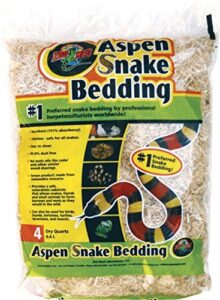
Zoo Med Natural Aspen Snake Bedding earns its reputation as a go-to for dry-climate species like corn snakes and milk snakes. Its 191% absorbency rating pulls moisture away from the surface quickly, keeping conditions in the 40–60% humidity range those species need.
The shavings are 99.9% dust-free and contain no added oils or chemicals, which directly reduces respiratory irritation risk. At 4 quarts per bag, it fits most standard terrariums — though large-scale breeders will notice the cost adds up fast.
| Best For | Reptile and small animal owners keeping dry-climate species like corn snakes, milk snakes, lizards, or tortoises who want a clean, natural bedding option. |
|---|---|
| Material | Paper/Wood Fiber |
| Volume | 4 quarts |
| Dust Level | 99.9% dust-free |
| Odor Control | Odorless composition |
| Burrowing Support | Yes |
| Humidity Control | Prevents excess humidity |
| Additional Features |
|
- Exceptional 191% absorbency keeps enclosures dry and helps maintain the low humidity dry-climate species need
- 99.9% dust-free and chemical-free formula reduces the risk of respiratory irritation for both animals and owners
- Supports natural behaviors like burrowing and nesting, making it a versatile choice across many species
- Higher price per volume compared to similar bedding options, which can get costly over time
- Not ideal for large-scale breeders managing multiple enclosures due to the expense
- Packaging can occasionally arrive damaged during shipping
2. Zilla Reptile Terrarium Bedding Substrate
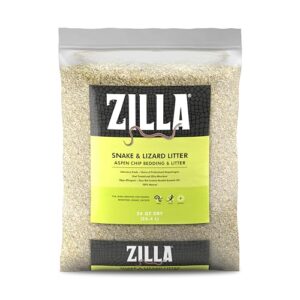
Where aspen keeps things dry, the Zilla Jungle Mix Bedding takes the opposite approach. This mix of aged Douglas fir bark and sphagnum peat moss holds moisture slowly and releases it as enclosure temperatures rise, keeping humidity stable without constant misting.
That makes it a practical pick for tropical and forest snake species that struggle with rapid humidity swings. At eight quarts, it suits small to medium enclosures well — though daily spot-cleaning remains non-negotiable regardless of how clean it looks.
| Best For | Reptile keepers housing snakes, monitors, skinks, or geckos that need a dry, naturalistic substrate supporting burrowing behaviors. |
|---|---|
| Material | Aspen Wood |
| Volume | 24 quarts |
| Dust Level | Low-dust formula |
| Odor Control | Aromatic oil-free |
| Burrowing Support | Yes |
| Humidity Control | Maintains dry habitat |
| Additional Features |
|
- Heat-treated and hypo-allergenic, making it safe for sensitive reptiles with no aromatic oils to worry about
- Ultra-absorbent and low-dust formula helps keep enclosures dry and reduces respiratory risks
- Large, easy-to-spot chips make waste removal quick and straightforward
- Small chips can cling to wet or soft food, which could lead to accidental ingestion
- Doesn’t hold burrow tunnels as well as shredded shavings, limiting enrichment for dedicated diggers
- May have a strong wood smell right out of the bag and need some time to air out before use
3. Natural Coconut Fiber Reptile Substrate
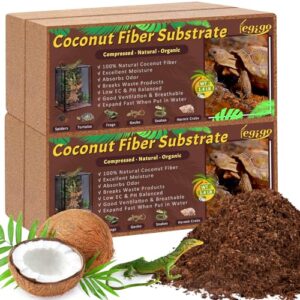
Coconut fiber takes a different angle than bark-based mixes. Rather than chunky structure, it offers a loose, fluffy matrix that holds humidity for tropical species while letting juveniles burrow and move without resistance. The compressed brick format expands readily with water, and each brick stays free of dyes or artificial additives.
One limitation worth knowing: used alone, fiber has a habit of migrating into water dishes. Pair it with a raised dish stand and that problem largely disappears.
| Best For | Reptile, amphibian, and invertebrate owners who need a natural, humidity-retaining substrate that supports burrowing behavior and doubles as a soil amendment for plants. |
|---|---|
| Material | Coconut Fiber |
| Volume | 4 bricks (~8 quarts expanded) |
| Dust Level | Low dust |
| Odor Control | Natural odor reduction |
| Burrowing Support | Yes |
| Humidity Control | High moisture retention |
| Additional Features |
|
- Holds moisture well, making it ideal for tropical species that need stable humidity and temperature
- Expands easily from compact bricks with just water, and comes free of dyes, chemicals, or artificial additives
- Supports natural behaviors like burrowing and tunneling, while odor-absorbing properties help keep enclosures fresh
- Bricks require soaking and manual expansion before use, adding a prep step compared to ready-to-use substrates
- Four bricks per pack may not stretch far enough for large enclosures or households with multiple tanks
- No printed instructions are included, which could be a hurdle for first-time reptile keepers
4. Medium Coconut Chip Reptile Substrate
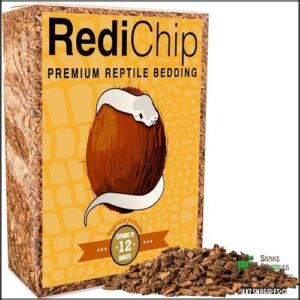
Where fiber gives you fine and fluffy, medium coconut chips give you structure with flexibility. Chips sized roughly 1–3 centimeters hold moisture steadily without waterlogging, absorb odors effectively, and resist compaction far longer than finer substrates — meaning your enclosure stays naturalistic between cleanings.
Ball pythons and similar species benefit most, getting a surface firm enough for confident movement yet loose enough for genuine burrowing. At 12 quarts and 2.68 lbs, it’s a practical size for mid-range enclosures.
| Best For | Reptile and amphibian keepers who want a natural, odor-controlling substrate that works well dry or humid — especially for ball pythons, burrowing snakes, and tropical species. |
|---|---|
| Material | Coconut Husk |
| Volume | 12 quarts |
| Dust Level | Meticulously dust-free |
| Odor Control | High odor absorbency |
| Burrowing Support | Yes |
| Humidity Control | Excellent humidity retention |
| Additional Features |
|
- Holds moisture steadily without waterlogging, making it ideal for humidity-dependent species
- Strong odor absorption keeps enclosures smelling fresh longer between cleanings
- Versatile enough to use dry, moistened, or mixed into bioactive setups
- Expands significantly when water is added, so the dry volume can be misleading
- May not stretch far enough for large enclosures without mixing in other substrates
- Higher cost per quart compared to some competing options on the market
5. BabiChip Coconut Chip Reptile Substrate Bedding
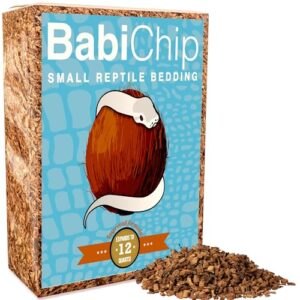
Think of BabiChip as the medium chip’s younger sibling — smaller, softer, and purpose-built for hatchlings and delicate juveniles. Triple-washed and dust-sorted, it protects sensitive lungs and fragile underbellies from abrasion without sacrificing humidity retention or burrowing depth.
At 12 quarts and 2.16 lbs, it suits compact setups well. Moisten it for tropical species, leave it dry for arid ones. Ready-to-use straight from the bag, it’s one of the few substrates that requires almost no prep before your animal moves in.
| Best For | Hatchlings, delicate juveniles, and small reptiles like geckos, frogs, and invertebrates that need a gentle, humidity-flexible substrate. |
|---|---|
| Material | Coconut Husk |
| Volume | 12 quarts |
| Dust Level | Refined to minimize dust |
| Odor Control | Natural odor absorption |
| Burrowing Support | Yes |
| Humidity Control | High humidity retention |
| Additional Features |
|
- Triple-washed and dust-sorted to protect sensitive lungs and delicate skin from irritation
- Works dry for arid species or moistened for tropical ones, making it genuinely versatile
- Ready to use straight from the bag with virtually no prep required
- Small chip size can be too sharp for larger snake species
- The 12-quart volume may look smaller than expected if you skip the hydration step
- A bit pricey given the quantity, especially for owners with larger enclosures
Safety and Maintenance Differences
Choosing the right bedding doesn’t stop at species compatibility — how you maintain it matters just as much as what you put in the enclosure. Some substrates hide problems until they’ve already caused harm, while others give you clear, early warnings. Here’s what you need to watch for across every major bedding type.
Toxic Woods to Avoid
Cedar and pine are the two you’ll encounter most often — and both are off the table. They release aromatic hydrocarbons that irritate a snake’s respiratory tract, sometimes triggering chronic infections.
Exotic hardwoods like rosewood carry toxic dust, while pressure-treated lumber offgasses chemicals that linger on surfaces. Stick to heat-treated, untreated naturals from reptile-specific suppliers every time.
Dust and Respiratory Risks
Substrate dust is a slow threat — fine airborne particles travel deep into lung tissue, triggering inflammation that can silently progress to fibrosis over time. Some organic dusts act as respiratory sensitizers, producing coughing, wheezing, and chest tightness.
For reptile respiratory health, choose a dustfree snake bedding to eliminate airborne microbial content that compounds respiratory irritation with every breath your snake takes.
Mold and Ammonia Signs
A musty smell isn’t just unpleasant — it’s your first warning sign. Watch for:
- Earthy, persistent odor that lingers even after spot cleaning
- Dark fuzzy patches appearing on substrate surfaces or enclosure walls
- Ammonia scent concentrated near waste-saturated areas
- Substrate discoloration or unusual clumping
- Eye or throat irritation during routine cage maintenance
Replace substrate immediately if any appear — microbial contamination accelerates fast in warm enclosures.
Spot-cleaning Routines
Daily spot cleaning is your first defense against bacterial buildup. Remove waste immediately — feces and urates left in place accelerate ammonia concentration fast, stressing your snake’s respiratory system.
| Task | Frequency |
|---|---|
| Feces and urate removal | Daily |
| Spill blotting | As needed |
| Water dish area check | Every 2–3 days |
Blot spills with a white microfiber cloth, working inward from the edges. Don’t oversaturate surrounding substrate — targeted cleaning controls odor and prevents mold between full replacements.
Replacement Schedules
Think of replacement schedules as your snake’s hygiene calendar — miss it, and ammonia does the damage before you smell it.
- Aspen: every 2–4 weeks
- Coconut husk/fiber: every 4–6 weeks
- Artificial liners: every 3–6 months
Post-feeding, refresh within 72 hours. High humidity shortens every interval — at 80%, weekly changes aren’t overkill.
Frequently Asked Questions (FAQs)
What’s the best bedding for snakes?
The best bedding depends on your snake’s species and humidity needs. Coconut fiber and aspen shavings suit most keepers — one excels in tropical setups, the other in drier enclosures.
Can snakes hear human voice?
Snakes don’t hear voices the way you do — they detect sound through jawbone vibration transmission to the inner ear. Loud, low-frequency speech registers most clearly, while normal conversation barely moves the needle.
This limited hearing pushes snakes to lean on vibration and heat-sensing instead, adaptations explored in this guide to how desert snakes survive extreme heat and drought.
What animal are snakes most afraid of?
Paradoxically, the creature that frightens snakes most isn’t a fearsome predator — it’s birds of prey. Eagles, hawks, and owls trigger immediate retreat responses, driving snakes to dense cover and burrows to escape aerial detection.
What not to use for snake bedding?
Avoid cedar, pine, and walnut substrates entirely — their oils and sharp fragments cause respiratory damage and GI injuries. Sand and calcium sand pose serious impaction risks, while scented or clay-based litters introduce harmful chemical additives.
Can snake bedding affect feeding response or appetite?
Yes, snake bedding can affect appetite. Dust-induced irritation, moisture imbalances, and scent trail confusion from clumping substrates can all reduce feeding response, while clean, inert bedding helps with consistent, stress-free feeding behavior.
How does substrate depth impact snake stress levels?
Substrate depth directly affects stress. Four to six inches lets burrowing snakes submerge fully, creating thermal and humidity zoning that reduces pacing, defensive posturing, and shedding problems tied to surface exposure.
Which bedding types work best for bioactive setups?
Coco coir leads bioactive setups by supporting beneficial microbial communities and detritivore habitat, while cypress mulch maintains humidity without compaction. Both sustain bioactive layer stability through substrate aeration balance and active microfauna nutrient recycling.
Conclusion
What’s the single most common reason snakes suffer poor sheds, scale rot, or chronic respiratory irritation? Almost always, it traces back to a substrate that was never right for that animal.
The differences between snake bedding types aren’t just a matter of preference — they’re functional variables that directly shape your snake’s health. Match the bedding to your species’ humidity range, burrowing behavior, and life stage. Get that right, and everything else becomes easier.
- https://www.kwikpets.com/blogs/reptiles/7-bedding-options-for-your-pet-snake
- https://www.krawlo.com/best/best-corn-snake-substrate
- https://www.animalsathome.ca/best-substrate-for-ball-pythons
- https://www.worksafe.qld.gov.au/safety-and-prevention/hazards/hazardous-exposures/hazardous-dusts
- https://www.healthywa.wa.gov.au/Articles/F_I/Health-effects-of-dust