This site is supported by our readers. We may earn a commission, at no cost to you, if you purchase through links.

A basking spot that reads 95°F at noon can drop to a dangerous 78°F by 9 PM, and most keepers never catch the swing until their snake stops eating. Reptiles can’t regulate their own body heat, so they depend entirely on the numbers you’re tracking to survive, digest, and avoid brumation shock. A single missed check during a cold snap or a failing heat mat can turn into a vet bill fast.
Knowing how often to check terrarium temperature readings isn’t guesswork, it’s a routine built around your animal’s biology and your equipment’s quirks. Morning and evening checks catch the daily swings, but new setups, power outages, and odd behavior all call for extra vigilance. Get the timing right, and you’ll catch problems while they’re still easy fixes.
Table Of Contents
Key Takeaways
- Check your terrarium’s temperature every morning and evening, since readings can swing 5-10°F between night and day without you noticing.
- Measure every zone separately (basking spot, cool end, and hides), because each area holds a different temperature and a single reading won’t tell you what’s really going on.
- Step up your checks to hourly or more during risky periods, like new setups, equipment swaps, power outages, or when your snake starts acting off.
- If a reading looks unsafe, confirm it with a second thermometer, adjust your thermostat, inspect your equipment, and recheck within 15 minutes to make sure things actually stabilized.
Check Terrarium Temperatures Twice Daily
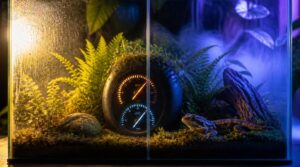
A single glance at your terrarium tells you almost nothing about what’s actually happening inside it. Temperature swings by 5-10°F between night and day, often catching keepers off guard when they only check once. Here’s how to build a twice-daily routine that actually catches those shifts.
Pair your morning and evening checks with a quick look at water levels, since choosing the right water bowl for desert species makes it easier to spot when refills are needed before humidity dips too low.
Morning Temperature Check
Every morning sets your baseline daily reading, so check within 15 minutes of light activation timing for stable results. Compare against species range ranges before feeding or basking begins.
Log any deviation over 2°F (1°C) using your thermometer and hygrometer. That single number guides gentle adjustment guidance to heaters or vents before problems compound. Outdoor climates show similar swings, since hourly temperature patterns reveal daily peaks and lows that mirror the fluctuations you’re tracking in your terrarium.
Evening Temperature Check
Once the sun dips, run your evening temperature check between 6 PM and 10 PM. Verify the evening range holds steady, watch for basking surface cooldown of 2-5°C, and confirm hide temperature balance stays 2-4°C cooler.
- Catching nighttime drift before it stresses a nocturnal species
- Preventing brumation shock from an unsafe nighttime drop
- Sleeping soundly knowing your reptile isn’t chilling unnoticed
Continuous Remote Monitoring
Two manual checks a day help, but they still leave gaps. A cloud-based dashboard paired with wireless sensors gives you realtime climate feedback around the clock.
| Feature | Benefit |
|---|---|
| Custom alerts | Flags threshold breaches within minutes |
| Battery backup | Reports up to 12 hours during outages |
| Encrypted data | Protects readings in transit |
Smart thermostats and climate controllers can even auto-adjust before you notice a problem.
Review Daily Highs and Lows
Alerts catch spikes in the moment, but a weekly glance backward reveals what daily checks miss. Log each day’s high and low, then compare them side by side for temperature swing analysis.
A basking zone swinging 15°F while your hide stays steady points to equipment, not ambient drift. Persistent zone-specific extremes signal it’s time to reposition heaters before fluctuations stress your reptile.
Monitor Every Terrarium Temperature Zone
A single reading from one spot won’t tell you what’s really happening inside your terrarium. Temperature can swing several degrees between the warm end, the cool end, and any hides your reptile tucks into. Here’s where you need to point that thermometer.
For accurate readings, place probes at the basking spot, the cool end, and near any hides, since understanding how reptile thermometers actually measure terrarium heat helps you avoid misleading placement mistakes.
Basking Surface Temperature
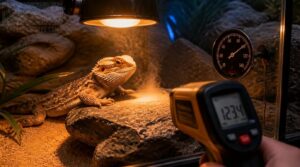
Basking spots run hotter than you’d think. Keep the surface between 28-34°C for most desert morphs, since ambient readings alone won’t reveal hot spots exceeding 40°C from underpowered thermostats.
Ceramic or slate holds heat far better than plastic. Place your probe at head height, right where your reptile actually basks, not just anywhere on the platform.
Inside-Hide Temperatures
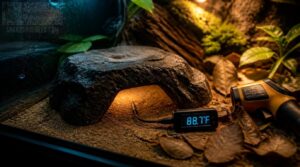
While basking spots grab attention, hides quietly matter just as much. Heater placement underneath creates a microclimate 2-6°F warmer than the floor, so don’t assume ambient readings apply inside.
Insulate gaps to prevent drafts and thermal shock. Calibrate your probe monthly, log readings every 5-15 minutes, and cross-check with an infrared gun for accurate in-situ temperature monitoring.
Species-Specific Target Ranges

No single number works for every animal in your collection. A tropical species wants daytime highs of 26-32°C dropping to 22-26°C at night, while desert dwellers push basking zones to 34-36°C with burrows near 26-28°C.
High-elevation species need cooler, narrower temperature gradient zones. Adjust these ideal temperature ranges seasonally, since breeding cycles often shift targets by 2-3°C.
Check More Often During Changes
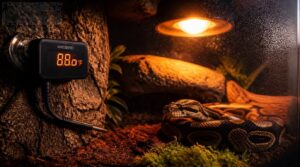
Your regular twice-daily checks work fine when conditions stay stable, but stable is exactly what your terrarium won’t always be. Certain situations push temperatures off track fast, and waiting until your next scheduled check can mean real trouble for your snake.
Here are the five moments when you’ll want to grab that thermometer more often.
New Terrarium Setup
A brand-new terrarium is unstable by nature, so check readings twice daily for the first two weeks. Verify substrate depth (2-3 inches), LED placement, and lid ventilation settings once plants and decorative layers are in.
- Morning and evening thermometer checks
- Hygrometer readings between 60-80%
- Watch for condensation buildup
- Confirm lighting sits 6-8 inches above foliage
- Adjust vents if fluctuations exceed 5°F
Heating Equipment Changes
Swapping heating equipment resets your terrarium’s thermal baseline entirely. After any heater wattage adjustment, thermostat recalibration, or element relocation, check readings hourly for the first day.
Upgrading to ceramic heat emitters changes infrared distribution patterns a lot. Don’t trust old thermostat settings with new equipment. Verify with a separate thermometer before leaving heating unattended overnight.
Seasonal Room Shifts
Your HVAC cycling on for winter changes ambient temperature and drift patterns around your terrarium. Check readings more often during seasonal changes, since insulation gaps matter more in extreme seasons. Watch for humidity shifts too, drier winter air and wetter summer months alter your thermal gradient. Adjust basking output 5-15% as daylight and room temps shift.
Power Outages
Room shifts are gradual, but power outages hit hard and fast. Basking bulbs and ceramic heaters go cold within minutes, and reptiles lose thermal stability quickly.
Check temps immediately once power returns, and keep a battery-powered backup thermometer on hand.
For outages over an hour, use insulated coolers with hot water bottles to prevent dangerous drift.
Unusual Snake Behavior
Not every warning sign comes from a faulty heater. Sometimes your snake tells you first.
- Rapid tongue flicking or head bobbing at ambiguous vibrations
- Ritualized threat displays like coiling or hood flattening
- Body rearing to appear larger than usual
- Defensive hissing or rattle sounds
- Open-mouth gaping signaling thermal stress
Grab your thermometer and hygrometer immediately. Behavior shifts often precede readable temperature fluctuations.
Use Reliable Temperature Monitoring Tools
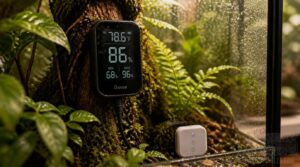
Even the best monitoring schedule falls apart if your equipment gives you bad data. You need tools that are accurate, easy to read, and built for the humidity swings inside a terrarium. Here’s what belongs in your setup.
Digital Probe Thermometers
Digital probe thermometers deliver the accuracy your terrarium demands, with thermocouple or thermistor sensors reading within ±0.4°C. Place probes at basking spots and hides for zone-specific data.
| Feature | Benefit | Why It Matters |
|---|---|---|
| Data logging | Tracks fluctuations | Prevents blind spots |
| Battery/USB power | Continuous readings | No monitoring gaps |
| Calibration checks | Sustained accuracy | Protects your reptile |
Infrared Temperature Guns
Probes stay put, but infrared temperature guns let you scan surfaces instantly, no contact needed.
Adjust emissivity to around 0.95 for accurate terrarium readings, since glass and metal skew results. Respect the distance ratio and spot size for tight targets like basking rocks.
Regular calibration methods and fresh batteries keep readings trustworthy.
Maximum-Minimum Thermometers
Rarely will one tool capture 24 hours of swings without you lifting a finger, but max-min thermometers do exactly that.
Two liquid columns track extremes; index markers freeze at the highest and lowest points reached since your last reset.
- Reset with a magnet or tap
- Alcohol-filled dual columns
- Displays °F or °C
- Weekly calibration recommended
- Reveals hidden fluctuations
Thermostat Versus Thermometer
Confusing these two devices causes real problems. A thermometer only measures temperature, while a thermostat actively controls it, cycling heaters on and off to hold your setpoint.
A thermometer only measures temperature; a thermostat actively controls it, cycling heaters on and off to hold your setpoint
Place sensors at habitat level for accuracy. Pair them: let the thermostat drive the heater, and use a separate thermometer to verify it’s actually working.
Regular Calibration Checks
Even the best thermometer drifts over time, so set a calibration frequency schedule, monthly for digital probes, and check readings against a traceable reference standard rated to plus or minus 0.2°C.
Log instrument ID, dates, and technician initials for traceability.
Store calibration tools in a dedicated case.
Any deviation beyond your threshold demands immediate recalibration or sensor replacement.
Respond Quickly to Unsafe Readings
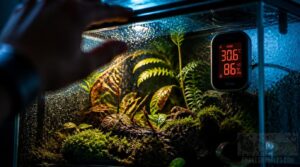
A number on your thermometer that looks off isn’t something to shrug at, since a few degrees can mean the difference between a healthy plant and a stressed one. When a reading falls outside your target range, you need a clear plan, not guesswork. Here’s how to work through the problem step by step.
Confirm Unexpected Measurements
A 78°F reading in a cool-zone hide that normally sits at 72°F isn’t proof of trouble, it’s a prompt for sensor verification. Place a second thermometer in that exact spot and check within 15 minutes. If it diverges beyond 0.5°C, or the drift exceeds 2°C from the prior hour, log it and compare against your daily average before deciding it’s a real trend.
Adjust Thermostat Settings
A confirmed reading means it’s time to work the thermostat, not guess at it.
- Heating mode: raise the set point 2°F, reassess in 15 minutes
- Cooling mode: lower it, expect results within 20 minutes
- Auto mode: let it balance both automatically
- Fan only: use for circulation, not temperature correction
Smart thermostats log these adjustments, helping you spot recurring fluctuations before they become real husbandry problems.
Inspect Heating Equipment
When adjustments don’t hold, the equipment itself needs a look. Start with a thermostat function check, then move to heating element inspection on your heat lamps or ceramic heaters.
Review wiring for fraying or exposed connections, since that’s a genuine fire risk. Measure heat output directly, and confirm placement and clearance haven’t shifted, causing fluctuations.
Watch for Temperature Stress
Hardware isn’t the whole story. Your snake’s behavior tells you plenty too.
Watch for lethargy and appetite loss, sluggish refusal to feed, or defensive displays and odd vocalizations. Rapid swings also worsen shedding and digestion. These signs mean thermal regulation has already broken down, so don’t wait on numbers alone, act on behavior first.
Recheck After Adjustments
Once behavior signals ease, don’t walk away yet. Recheck within 15 minutes to confirm stabilization across basking and hide zones. Watch for thermostat cycling past 10 minutes, that’s a feedback loop problem. Any swing above 2°C demands another check within the hour (temperature hysteresis matters here). Log the adjustment time and readings; documentation catches patterns single checks miss.
- Verify basking zone first
- Confirm hide-zone recovery
- Note cycle duration
- Flag swings over 2°C
- Record time and results
Frequently Asked Questions (FAQs)
What glass thickness works best for stable terrariums?
For most builds, 4 to 6 mm tempered glass balances thermal stability and durability. Thinner panes fluctuate faster; thicker glass resists bowing and holds heat steadier, reducing sudden temperature gradients that stress reptiles and plants alike.
How does insulation help regulate terrarium temperature swings?
Insulation slows conduction, so thermal mass buffering in substrate and walls stores heat and releases it gradually.
Reflective barriers block radiant gain, gap sealing stops drafts, and trapped air pockets add resistance, flattening daily temperature swings and improving thermal inertia.
Whats the difference between ceramic heaters and heat lamps?
Like choosing between a campfire and a heated blanket: heat lamps emit visible light with radiant warmth, while ceramic heaters provide glare-free, even heat.
Ceramic heaters suit nighttime use; heat lamps offer better spot-heating but risk hot spots.
Conclusion
A terrarium runs like a heartbeat, steady until something throws its rhythm off. Mastering how often to check terrarium temperature readings turns that rhythm into second nature, not a chore.
Twice-daily checks catch predictable swings, while extra vigilance during changes catches the dangerous ones. Your snake can’t tell you when it’s too cold. The numbers do. Trust the readings, act fast, and your reptile keeps digesting, basking, and thriving through every season ahead.