This site is supported by our readers. We may earn a commission, at no cost to you, if you purchase through links.

Breeding season ends, and most keepers shift their focus to the eggs or neonates—but the adult snakes that just ran the whole reproductive gauntlet often get the least attention precisely when they need it most.
female ball python coming off a clutch can drop 15–20% of her pre‑breeding body weight; a male that spent weeks cycling through multiple pairings may flat‑out refuse food for longer than you’d expect.
recovery window that follows breeding is where corners get cut, problems compound, and animals that looked fine suddenly aren’t.
Solid post breeding snake care tips don’t start with the next breeding season—they start the moment you pull those snakes apart.
Table Of Contents
- Key Takeaways
- Immediate Post-Breeding Recovery
- Feeding After Breeding
- Hydration and Enclosure Care
- Tracking Recovery Progress
- Warning Signs and Vet Care
- Frequently Asked Questions (FAQs)
- How do I care for a snake?
- How do I care for snake hatchlings?
- What should be considered when breeding a snake?
- How do you feed a breeding snake?
- Can a snake go 2 weeks without food?
- Is Dawn dish soap safe for snake enclosure?
- How can I prevent a snake from breeding?
- How do you handle a snake during mating season?
- How do you prepare a snake for breeding?
- How do I choose a mate for my pet snake?
- Conclusion
Key Takeaways
- Female ball pythons can lose 15–20% of their body weight after a clutch, so start them back on prey sized at 50–75% of normal and scale up only after consistent, strain‑free acceptance across several feedings.
- Males and females don’t recover on the same clock—males typically resume feeding within 1–3 weeks, while females may need 8–16 weeks to rebuild condition, and treating them identically is where most keepers go wrong.
- Don’t rebreed a female until she’s back to at least 90% of her pre‑lay baseline weight; rebreeding before full recovery compounds depletion and risks her long‑term reproductive health.
- Persistent feeding refusal past eight weeks post‑lay, vent swelling, abnormal discharge, or any tissue protruding from the vent are emergencies—contact a reptile vet immediately rather than waiting to see if things resolve on their own.
Immediate Post-Breeding Recovery

The hours right after breeding are critical — what you do next sets the tone for how well your snakes bounce back. Recovery isn’t one-size-fits-all, and the decisions you make in these early days carry real weight.
Knowing what to do after snakes breed comes down to observation and instinct, not just a fixed routine you follow step by step.
Here’s what to focus on first.
Separate Snakes to Reduce Stress
Once breeding wraps up, move each snake into its own solo enclosure setup immediately — cohabitation after breeding invites competition, defensive posturing, and stress that slows recovery.
Dedicated hide placement using familiar hides and your snake’s usual substrate facilitates behavioral stress monitoring by keeping variables consistent.
Scent isolation tactics and separate thermal zones eliminate disturbances, giving each animal the environmental stability it needs to settle.
Implementing a habitat in habitat transition can further reduce stress during enclosure changes.
Rest Before Offering The First Meal
Once the snakes are settled in their separate enclosures, hold off on offering food for at least 5–7 days. Post-breeding rest isn’t optional — it’s where recovery actually begins.
Watch for feeding readiness signs like active exploration and normal alertness before attempting that first meal. Minimal handling and environmental consistency during this window reduce stress and support a reliable feeding response when you do offer prey.
Expect Different Recovery Needs for Males and Females
Males and females don’t run on the same recovery clock, and treating them identically is where most keepers go wrong.
Sexual appetite variance and body condition disparity between sexes drive genuinely different timelines:
- Males usually resume feeding within 1–3 weeks.
- Females may need 8–16 weeks to rebuild condition.
- Cloacal stress differences and shed timing influence each sex’s readiness distinctly.
Adjust your protocols accordingly.
Allow Extra Recovery Time After Laying or Birth
Recovery timelines diverge even further once eggs are down or neonates are born. Hormonal reset doesn’t happen overnight — your female’s energy reserve replenishment demands an extended rest period with minimal enclosure disturbance.
Keep the layout unchanged, limit traffic near her rack or tub, and let gradual activity resumption guide your next steps.
Watch her body language before anything else.
Feeding After Breeding

Once your snakes are separated and resting, feeding becomes your next priority — and getting it right matters more than most keepers realize. Returning to a normal feeding schedule too quickly can set back a recovering snake considerably.
Here’s what to keep in mind as you work through the post-breeding feeding process.
Start With Smaller Prey for Recovering Females
Your post-lay female isn’t the same animal she was six weeks ago—she’s depleted, and her digestive system needs time to come back online.
Her gut and stress levels are both recovering, so treat her like a ball python that needs gentle reintroduction to handling—patience now pays off later.
Prey Size Benchmarking and Body Condition Scoring should guide every early feeding decision:
- Start at 50–75% of her normal prey size
- Use Swallowing Ease Assessment to confirm she takes it without strain
- Apply Feeding Interval Adjustment, spacing meals every 5–7 days
- Scale up only after consistent acceptance—Energy Intake Calibration prevents regurgitation
Return Males to Feeding as Appetite Improves
Unlike females, males don’t need weeks of waiting—once alert behavior returns and hunger cues appear, you can begin Feeding Cue Observation and offer the first meal within 24–48 hours post-separation. Prioritize Low-traffic Feeding, Enclosure Positioning at the warm end, and correct Prey Temperature to trigger a strike response.
A Prey Size Adjustment downward confirms whether appetite is genuinely returning during post‑breeding recovery protocols for snakes.
Increase Meal Size Gradually Over Several Feedings
consistent swallow success indicators confirm your snake is handling each meal cleanly—no prolonged mouthing, no hesitation mid‑swallow—you move to the next prey size step. digestive monitoring between feedings guides feeding response timing: don’t jump sizes until body condition scoring and weight gain benchmarks show improvement across two or three feedings.
gradual prey size adjustment, tied to weight monitoring and post‑lay shed as a feeding trigger, keeps recovery on track.
Avoid Oversized Prey to Prevent Regurgitation
Oversized prey is one of the fastest ways to derail post breeding recovery protocols for snakes. Matching prey to your snake’s body width measurement isn’t optional—it’s foundational to digestive load management and feeding stress minimization.
- Apply prey size guidelines strictly: prey mustn’t exceed the snake’s widest body section.
- Use prey type selection that prioritizes ease of swallowing over caloric density.
- Watch for prolonged mouthing or mid-swallow hesitation—early regurgitation warning signs.
- Treat prey size adjustment as a gradual progression, not a shortcut.
If swallowing seems difficult, review signs your snake’s prey is too large before offering another meal.
Regurgitation after a hard-won acceptance sets recovery back substantially.
Adjust Feeding Frequency for Thin Snakes
Thin snakes don’t follow a calendar—they follow their condition. Weight-based intervals guide feeding frequency more reliably than fixed schedules during post breeding recovery protocols for snakes.
If your snake is still underweight, tighten the interval to every 5–7 days, using digestive monitoring and individual appetite cues to confirm each meal fully clears before the next. Prey size scaling and monitoring body condition during post breeding period keep weight gain steady without overwhelming a recovering system.
Hydration and Enclosure Care

Once feeding is back on track, the enclosure itself becomes your next priority. A recovering snake is more sensitive to environmental stress than you might expect, so the basics — water, humidity, temperature, and setup — need to stay dialed in.
Here’s what to focus on during the recovery period.
Keep Fresh Water Available at All Times
Fresh water isn’t optional during post breeding recovery protocols for snakes — it’s a baseline requirement. Daily water replacement keeps contamination from shed skin or debris from becoming a health risk.
low-profile dish with shallow dish placement so even a weakened female can drink without effort. Room temperature water, free of chlorine, helps hydration management when appetite is still returning and hydration directly affects recovery pace.
Maintain Species-appropriate Humidity
Humidity works hand-in-hand with water access — getting one right while neglecting the other undermines your hydration management strategy entirely. Match your humidity range to the species, not a generic setting.
Humidity Gradient Design lets you maintain drier zones alongside a moist hide, reducing mold risk.
For Humidity Measurement Accuracy, use a calibrated hygrometer; readings near vents will mislead you.
Moisture-retaining substrates support Substrate Moisture Retention between misting cycles, while proper Ventilation and Mold prevention keeps bacterial growth from compounding a recovering snake’s stress load.
Provide a Stable Temperature Gradient
Getting humidity right means nothing if your thermal setup is off — temperature regulation is just as foundational to recovery.
heat mat through a thermostat, and dial in your thermostat probe placement carefully: too close to the heat source, and the warm zone underperforms; too far, and you’ll get dangerous hot spots.
For consistent environment stability, build your gradient monitoring routine around these four checkpoints:
- Verify warm-side surface temps daily with an independent thermometer, not just the thermostat readout.
- Confirm the cool side stays within species-appropriate range to support self-regulation.
- Avoid drafts, direct sunlight, and room temperature swings that destabilize your heat gradient.
- Maintain a backup heating plan with temperature alarm setup to catch failures before your snake pays the price.
Use Secure, Low-stress Enclosure Setups
Your enclosure setup directly facilitates everything thermal gradient is doing — so don’t undermine it with a stressful environment.
Escape-Proof Latches, Snug Hide Placement, and Visual Barriers aren’t optional extras; they’re the foundation of environmental stability and stress reduction.
Keep handling and enclosure disturbance minimal, maintain Secure Separation Barriers between individuals, and position hides consistently — a recovering snake needs predictability, not surprises.
Choose Substrate That Supports Recovery and Cleanliness
Substrate is part of the same environmental stability equation — and it’s one that breeders overlook more than they should.
During post lay recovery, choose Moisture-Controlled Bedding that matches your species’ humidity needs without staying wet.
Low-Odor Waste Substrate with Quick-Replace Layers lets you spot-clean daily without disrupting your snake. Keep it Low-Dust Particles with a Soft Healing Texture — a clean substrate with a comfortable surface keeps the enclosure environment working for recovery, not against it.
Tracking Recovery Progress

Recovery isn’t something you feel—it’s something you measure. Keeping consistent records throughout the post-breeding period is what separates guesswork from sound husbandry decisions.
Here’s what you should be tracking to stay ahead of problems and know exactly when your snake is ready for the next step.
Weigh Snakes Before and After Breeding
Your pre breeding weight is the foundation, everything else gets measured against. Take that baseline when the snake is in normal feeding condition, not right after a meal.
Use the same scale, the same container, and the same time of day every session — Scale Consistency and Container Standardization aren’t optional here.
Weight Trend Analysis only means something when your data is clean.
Record Feeding Attempts, Prey Size, and Acceptance
Log every feeding attempt the moment it happens — not later, not from memory. Your records only work when they’re accurate.
Each log entry should capture:
- Log Timing Details: exact date and time of the offer
- Prey Size Metrics: species and size category of whole prey items
- Acceptance Criteria: full take, interest-only, or outright refusal
- Feeding Attempt Patterns: spacing between attempts and food refusal streaks
- Data Driven Adjustments: prey size changes tied to acceptance history
Use the post lay shed as a feeding trigger, and let your record keeping drive every feeding schedule decision.
Watch for Return to Normal Body Condition
Body condition tells you more than weight alone — assess muscle tone along the midbody, watch for restored postural stability, and monitor energy levels through normal activity patterns.
Skin elasticity and a firm, even fill through the trunk confirm metabolic recovery is progressing.
Consistent weight tracking and record keeping, mapped against your pre-breeding baseline, define where your snake sits on its recovery timeline.
Track Post-lay Shed as a Recovery Milestone
The post-lay shed functions as a hard reset signal — track Shed Initiation Indicators like dull skin and cloudy eyes, then log the full Shed Interval Tracking timeline through Complete Skin Release. Use this post-lay assessment as your post-lay baseline for Post-shed Activity patterns and your post‑lay shed as feeding trigger.
Veterinary Shed Assessment applies if retained skin or incomplete release repeats.
Wait Until Females Regain Adequate Weight Before Rebreeding
Rebreeding before a female has genuinely recovered isn’t ambitious — it’s depletion compounded. Your Female Recovery Index depends on consistent weight tracking and record keeping, not a calendar date.
Rebreeding a female before she recovers isn’t ambition — it’s compounded depletion
Don’t reintroduce her to a breeding cycle until she hits 90% of her pre-lay baseline.
Hormonal Recovery Indicators, Metabolic Rate Assessment, and post-lay assessment together inform your Seasonal Cycle Planning — Energy Balance Modeling and metabolic demand determine readiness, not guesswork.
Warning Signs and Vet Care
Even with solid recovery protocols in place, things don’t always go smoothly — and catching problems early is what separates a minor setback from a serious loss. Post-breeding complications can escalate quickly if you’re not sure what to look for.
These are the warning signs that should put you on alert.
Monitor for Persistent Feeding Refusal

Feeding refusal after breeding isn’t automatically a red flag — but pattern matters. Appetite Trend Analysis means tracking refusal across multiple dated attempts using consistent prey size, type, and presentation.
Behavioral Observation Protocol should log Tongue Flick Frequency, strike attempts, and abandonment.
When food refusal persists beyond eight weeks post-lay with measurable weight loss, Veterinary Escalation Triggers apply and Metabolic Stress Indicators demand professional assessment.
Watch for Swelling, Lethargy, or Abnormal Discharge

Beyond food refusal, watch the body itself. Vent swelling detection means checking daily — mild early swelling can normalize, but expanding lumps over hours signal retained follicles or reproductive tract infections.
Lethargy duration beyond two days, especially with correct temperatures, demands attention.
Discharge color indicators matter: cloudy, green, or foul-smelling discharge, paired with behavioral activity monitoring showing reduced movement, means contact your reptile vet immediately.
Check for Retained Eggs or Reproductive Tissue
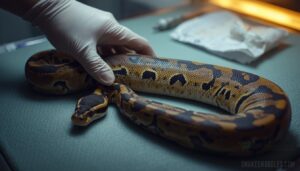
Retained follicles or egg retention won’t always announce themselves loudly. Vent palpation guidance matters here — gentle pressure near the cloaca can reveal persistent firmness that shouldn’t be there.
Watch for cloacal output changes like reduced urate passing or visible straining, and note behavioral discomfort signs such as restlessness or stalled recovery.
Post lay assessment, including imaging diagnostic options like radiographs, helps confirm tissue retention scoring before reproductive tract infections take hold.
Identify Prolapse Immediately as an Emergency

Prolapse detection isn’t a "wait and see" situation — exposed tissue at the vent demands immediate action. Unlike egg retention, where signs develop gradually, prolapse announces itself quickly and worsens faster.
Watch for:
- Pink, red, or darkening tissue protruding from the vent
- Tissue discoloration signs — purple or black coloring signals compromised blood supply
- A vent bulge observation that grows within hours
- Pain behavior indicators: restlessness, tense posture, reluctance to move
- Inability to pass waste normally
Immediate veterinary intervention is non‑negotiable here.
Contact a Reptile Veterinarian Early for Complications

Once prolapse is handled, don’t wait on other complications either. Early symptom reporting — feeding refusal past eight weeks, swelling, lethargy, abnormal discharge — gives your reptile vet a cleaner diagnostic window.
Share your baseline health data, feeding logs, and breeding timeline upfront. Many clinics now offer telehealth consultation for triage, and diagnostic imaging options like X-rays can confirm retained follicles before things escalate.
Frequently Asked Questions (FAQs)
How do I care for a snake?
Caring for a snake means mastering hydration, stress management, environmental stability, and temperature control during recovery, alongside shedding management, lighting requirements, seasonal temperature adjustments, enrichment activities, and proper handling techniques — especially post‑breeding care with calcium supplements.
How do I care for snake hatchlings?
Neonate care starts with species-specific prey sized correctly for each hatchling’s mouth, steady temperature gradients, proper humidity, enclosure ventilation, gentle handling, parasite screening, calcium supplements for nutritional supplementation, and growth rate charts to monitor progress.
What should be considered when breeding a snake?
Successful breeding starts well before pairing — genetic compatibility, pre-breeding health screening, nutritional conditioning, seasonal temperature cycling, and legal permit requirements all demand attention before the breeding season even begins.
How do you feed a breeding snake?
Feed smaller prey first, then scale up as appetite returns. Watch each session closely, keep water available, and let the post-lay shed signal when full feeding can safely resume.
Can a snake go 2 weeks without food?
Yes, most healthy adult snakes can go for two weeks without food, drawing on fat reserves and metabolic rate shifts — but age-related tolerance and species-specific fasting limits mean thin or juvenile snakes face real risk much sooner.
Is Dawn dish soap safe for snake enclosure?
Dawn dish soap isn’t reliably safe for snake enclosures. Residue risks from surfactants like sodium lauryl sulfate can cause skin irritation on contact.
Rinse thoroughly, dry completely, and consider alternative cleaners like diluted chlorhexidine instead.
How can I prevent a snake from breeding?
Keep males and females in completely separate enclosures year-round. Strict barrier installation, scent isolation between handling protocols, and lighting consistency prevent reproductive hormones from triggering seasonal breeding cycles entirely.
How do you handle a snake during mating season?
During mating season, minimize handling frequency, observe courtship behavior closely, and maintain temperature gradients and hydration.
A pre-mating health assessment and territorial enclosure design help reduce stress, supporting stable body condition throughout the breeding season.
How do you prepare a snake for breeding?
Start with a pre breeding baseline health screening, confirm proper body condition and hydration, complete parasite treatment, implement temperature cycling with gradients, adjust photoperiod changes, finalize habitat preparation.
Then time pairing once both snakes are fully ready.
How do I choose a mate for my pet snake?
Pair snakes of the same species that have reached sexual maturity, pass health screening, and come from unrelated bloodlines.
Size matching and genetic compatibility are your foundation for reproductive fitness and long-term breeding program sustainability.
Conclusion
The assumption that breeding success ends at the clutch has cost more than a few keepers their best animals.
Post breeding snake care tips aren’t optional maintenance—they’re the difference between a snake that rebounds strongly and one that quietly declines.
Track the weight, respect the feeding curve, and treat early warning signs as the emergencies they are.
The snakes that carry your next season forward depend entirely on how well you protect them through this one.