This site is supported by our readers. We may earn a commission, at no cost to you, if you purchase through links.
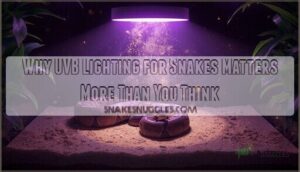
Most snake keepers focus on temperature gradients, feeding schedules, and humidity—and completely overlook the one environmental factor that quietly governs bone integrity, immune defense, and hormonal balance.
UVB lighting isn’t a luxury upgrade for snake enclosures; it’s a physiological requirement that mirrors what the sun delivers in the wild.
Without adequate UVB exposure, the cascade begins: vitamin D3 synthesis stalls, calcium absorption drops, and the skeletal system starts paying the price.
Understanding the importance of UVB lighting for snakes means understanding how their biology actually works—and what happens when a critical piece of that system goes missing.
Table Of Contents
- Key Takeaways
- Why UVB Lighting Matters for Snakes
- Differences Between UVA and UVB for Snakes
- Species-Specific UVB Needs in Snakes
- Setting Up UVB Lighting in Snake Enclosures
- Common Mistakes and Best Practices
- Frequently Asked Questions (FAQs)
- Do snakes benefit from UVB?
- Can a reptile get too much UVB?
- Can ball pythons live without UVB?
- Should I turn my snakes UVB light off at night?
- Can UVB lighting harm snakes if misused?
- How does UVB affect snake breeding behavior?
- Do wild snakes seek out UVB exposure naturally?
- What signs indicate a snake is getting too much UVB?
- Are there alternatives to UVB lighting for snake health?
- Can snakes get UVB through glass or plastic?
- Conclusion
Key Takeaways
- UVB light isn’t optional for snakes — it drives the full vitamin D3 chain from skin to kidney, and without it, calcium absorption collapses and bones pay the price.
- Different species need different UVB intensities based on Ferguson Zones, so a ball python and a diamond python can’t share the same lighting setup without one of them losing out.
- Bulbs keep glowing long after their UVB output dies, so replacing them on a fixed schedule — and verifying levels with a Solarmeter — is the only way to know your snake is actually getting what it needs.
- Both too much and too little UVB cause real harm, from metabolic bone disease on one end to skin burns and organ calcification on the other, making monitored gradients non-negotiable.
Why UVB Lighting Matters for Snakes
Most snake owners don’t realize how much UVB light affects their animal’s health beneath the surface. It’s not just about a bright enclosure — it touches everything from bone strength to immune function.
Getting the setup right makes all the difference, and this guide on how to set up UVB lighting for your snake’s enclosure walks you through exactly what your animal needs to truly thrive.
Here’s what you need to understand about why UVB matters and what it actually does for your snake.
UVB’s Role in Reptile Physiology
UVB does far more than support vitamin D synthesis.
In snakes, the UVB spectrum drives immune modulation at the skin barrier level, killing surface pathogens and reducing chronic inflammation.
It regulates circadian rhythm by stabilizing melatonin and serotonin cycles, aids hormone regulation tied to metabolism and breeding, and enhances coloration by boosting melanin production — benefits that go well beyond calcium absorption or metabolic bone disease prevention alone.
This is particularly important for maintaining proper calcium metabolism in snakes to guarantee overall health.
Vitamin D3 Synthesis and Calcium Metabolism
That physiology doesn’t stop at the skin.
When UVB lighting for snakes triggers the Skin Previtamin Pathway, 7‑dehydrocholesterol converts to previtamin D3, then moves through Liver Hydroxylation and Kidney Activation before becoming the active hormone driving Intestinal Calcium Transport. The full chain delivers real UVB benefits for reptile health:
- Previtamin D3 forms within epidermal cells
- Liver converts it to circulating storage form
- Kidneys activate the final hormone
- Intestinal absorption increases calcium uptake tenfold
- Bone Mineralization Process deposits hydroxyapatite in skeletal tissue
Recent studies highlight a serum calcium boost from UVB exposure.
Prevention of Metabolic Bone Disease
When that calcium pathway breaks down, metabolic bone disease follows — and it moves quietly at first.
Early Symptom Detection matters because soft jaw tissue, spinal kinks, and muscle tremors appear before permanent damage sets in. Maintaining proper Calcium‑Phosphorus Balance through UVB lighting for snakes, correct Feeding Frequency Monitoring, and an Enclosure UV Gradient provides calcium absorption and bone health a real foundation.
| Warning Sign | What It Signals |
|---|---|
| Rubbery jaw tissue | Active bone mineral loss |
| New spinal kinks | Vertebral weakening |
| Muscle tremors | Low ionized calcium |
| Reduced feeding interest | Early metabolic strain |
Regular Veterinary Screening confirms what home checks can miss.
A vet can also flag UV-related eye issues early, especially useful when you’re rethinking your setup with ideas from reptile habitat design inspiration.
Impact on Immune Health and Well-being
Bone health gets the headlines, but UVB lighting’s reach goes further. Vitamin D synthesis drives Immune Modulation at the cellular level — boosting White Blood Cell production, reinforcing Skin Barrier Strength against pathogens, and supporting Respiratory Infection Resistance.
There’s even a behavioral dimension: UVB triggers Beta-Endorphin Relief, reducing stress and improving appetite. Your snake’s immune system, it turns out, runs on light.
UVB doesn’t just build bones — it triggers endorphins, calms stress, and drives appetite, because a snake’s immune system runs on light
Differences Between UVA and UVB for Snakes
Most snake owners hear UV lighting and treat it as one thing — but UVA and UVB are actually two distinct wavelengths with very different jobs inside your snake’s body.
Getting them mixed up leads to real gaps in care. Here’s what each spectrum actually does and why both deserve a place in your setup decisions.
UVA Vs. UVB: What’s The Difference?
Think of UV light as two distinct tools, not one. UVA spans 320–400 nm — your snake can actually see it, using it to perceive color and navigate its environment. UVB sits at 290–320 nm, invisible to them but critical for vitamin D synthesis and bone health.
- UVA photons carry lower energy (3.1–3.94 eV); UVB photons hit harder at 3.94–4.43 eV
- UVB absorbs mainly in outer skin layers; UVA penetrates deeper tissues
- Snakes detect UVA as part of their visible spectrum — UVB remains invisible
- Atmospheric filtering removes most UVB before it reaches Earth’s surface
- Species-specific UVB requirements vary widely based on natural sun exposure
Effects of Each Spectrum on Snake Health
UVB spectrum triggers vitamin D3 synthesis through UVB‑Induced Hormones, directly supporting calcium metabolism and bone structure — corn snakes show a 211% plasma vitamin D3 increase within 28 days.
UVA Circadian Entrainment regulates sleep‑wake cycles, and UVA Stress Reduction lowers cortisol.
Together, they drive Spectrum‑Driven Metabolism and support UVB Skin Microbiome balance for long‑term reptile health.
Reptile Vision and Behavioral Impacts
Snakes don’t see the world the way you do — their reptile vision extends into ultraviolet wavelengths, enabling color discrimination, UV signaling between individuals, and precise prey detection along UV-reflective trails.
UVA facilitates spatial navigation and reinforces social hierarchy cues in diurnal species.
Without a proper photoperiod and UVB spectrum, these behavioral impacts accumulate quickly, leaving your snake visually impaired and chronically understimulated.
Species-Specific UVB Needs in Snakes
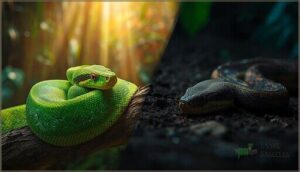
Not every snake needs the same amount of UVB — and getting that wrong can quietly cost your animal its health.
A sun-loving green tree python has very different requirements than a nocturnal ball python, and treating them the same is one of the most common mistakes keepers make.
Here’s what the research actually says about matching UVB exposure to your specific species.
Diurnal Vs. Nocturnal Snake Requirements
Not all snakes live by the same clock, and your lighting setup should reflect that.
Diurnal snakes depend on UVB lighting for vitamin D3 synthesis and proper basking timing, while nocturnal snakes like ball pythons need far less intensity.
Even so, low-level UVB aids circadian rhythm regulation and coloration changes across species.
Activity patterns and habitat temperature gradients should always guide your species-specific lighting needs.
Ferguson Zones and UVI Recommendations
Ferguson Zones give you a science-backed framework for matching UV index exposure to your snake’s natural habitat.
Zone 1 UVB suits shade-dwellers like Burmese pythons, targeting a basking UVI of 0.6–1.4. Zone 2 UVB fits partial-sun species like boa constrictors, while Zone 3 UVB helps open-baskers like diamond pythons at peak UVI of 7.4.
UVI gradient design — low in hides, higher at basking spots — is non-negotiable for species-specific UVB requirements.
Research on UVB Needs by Species
The science here is more nuanced than most keepers realize.
Corn snake data shows a 211% increase in vitamin D3 after just 28 days of UVB exposure. The Burmese python study recorded a striking 526% rise over 310 days.
Pairing proper UVB with a nutrient-rich snake diet for brighter coloration supports healthy pigment expression.
Ball python contrast is interesting — females showed minimal change, likely due to elevated baseline levels tied to reproduction.
Diurnal species variance is significant, while the nocturnal UVB role centers on behavior and immune support rather than vitamin synthesis alone.
Setting Up UVB Lighting in Snake Enclosures
UVB setup right inside your snake’s enclosure comes down to a few key decisions — and getting them wrong can undermine everything else you do.
There’s no one-size-fits-all approach here, because bulb type, placement, and light schedule all work together.
Here’s what you need to know to get each piece right.
For a deeper dive into its scientific name, natural habitat, and the glossy black scales that make it so distinctive, this Mexican black kingsnake care and identification guide covers it all.
Choosing The Right UVB Bulb Type and Strength
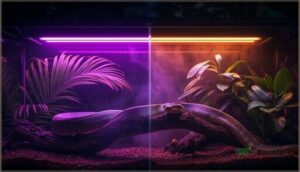
Picking the right UVB bulb comes down to your Ferguson zone. T5 vs T8 isn’t just a size debate — T5 high-output tubes deliver stronger UVB across taller enclosures, while T8 suits shade-dwelling species with gentler needs.
For compact coil selection in smaller tanks, lower-percentage bulbs work best. Reflector efficiency matters too — poor fixtures can slash usable UVB at basking level, undermining even a well‑matched bulb.
Placement, Distance, and Exposure Time
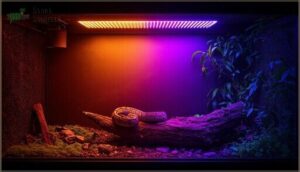
Once you’ve matched the right bulb to your species, placement does the heavy lifting. Lamp height directly shapes light intensity and snake health — mount T5s 10–15 cm above basking surfaces for Zone 1 species, 25 cm for ball pythons.
Mesh impact is real: it cuts UVB by 30 percent, so compensate with closer positioning or stronger output.
Build a basking gradient using enclosure zoning — high UVI on the warm end, zero on the cool end.
Run timers for 11–13 hours daily to maintain a consistent photoperiod your snake can actually use.
UVB Bulb Replacement Schedules
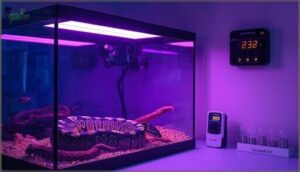
Even perfectly placed bulbs go silent on UVB long before they burn out. That’s why bulb lifespan tracking isn’t optional — it’s a core part of husbandry.
Follow this replacement schedule:
- Compact fluorescents — replace every 6–8 months
- Linear T5/T8 bulbs — swap at 10–12 months or 3,500 hours
- Mercury vapor bulbs — change every 8–10 months
Use hourly usage calculations and set replacement timing alerts via timer logs. Degradation monitoring methods like a Solarmeter confirm invisible UVB drop. Cost-effective bulk buying in 6-packs keeps schedules consistent without budget strain.
Maintaining a Natural Day-night Cycle
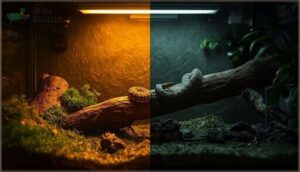
Replacing bulbs keeps the UVB effective — but the light schedule you set is just as important. Your snake’s circadian rhythm depends on consistent photoperiod timing: aim for a 12-hour light, 12-hour dark cycle as your baseline.
Use digital timers with Dawn Simulation and Dusk Ramping to ease transitions. Seasonal light adjustments — shifting to 13 hours in summer, 11 in winter — mirror natural light cycles your snake’s biology expects.
Common Mistakes and Best Practices
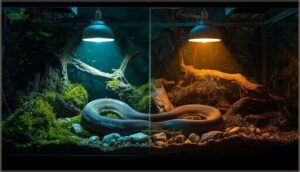
Even experienced keepers make lighting mistakes that quietly chip away at their snake’s health over time.
Getting UVB right isn’t just about having the bulb — it’s about placement, intensity, and knowing when something’s off.
Here are the most common pitfalls to watch for, and the best practices that actually make a difference.
Overexposure and Underexposure Risks
Too much UVB is just as dangerous as too little. Overexposure causes skin burns, eye damage, and Hypervitaminosis D — where excess vitamin D3 triggers organ calcification.
Poor UVB bulb placement or a missed UVB bulb replacement can flip the opposite risk: bone deformities, behavioral changes, and metabolic bone disease. Both extremes show up quietly, so don’t wait for obvious symptoms.
Monitoring UVB Intensity With Meters
Guessing at UVB levels isn’t a strategy — it’s a gamble. A Solarmeter 6.5R gives you real UVI readings matched to your snake’s species-specific UVB requirements.
Use gradient mapping techniques to check multiple enclosure points:
- Measure the basking zone first
- Move toward the cool end
- Log each reading with date and spot
Track trends through data logging best-practices, schedule meter calibration annually, and replace the 9V battery before it affects accuracy.
Adjust UVB lighting seasonally when output shifts.
Integrating UVB With Heating and Habitat Design
UVB lighting only works when it’s paired with the right thermal environment. Think of it as a two-part system: the Heat‑UVB Overlap at the basking spot temperature (85–90°F) drives both warmth and UV absorption simultaneously, while Shade Zone Placement gives your snake room to self‑regulate.
| Element | Recommended Setup |
|---|---|
| Overhead Heat Integration | Halogen bulbs flanking UVB tube |
| Thermal Gradient Design | 85–90°F warm end, 70–75°F cool end |
| Habitat Material Selection | PVC or mesh‑top enclosures for safe mounting |
Thermal Gradient Design and habitat replication aren’t optional — they’re how species‑specific UVB requirements actually get met.
Consulting Experts for Individualized Care
Even experienced keepers hit a wall when symptoms don’t resolve. That’s when vet assessment and herpetologist guidance become essential, not optional.
A custom lighting plan accounts for what general advice can’t:
- Morph-specific dosing for albinos or other light-sensitive variants
- Species-specific lighting needs tied to Ferguson Zone UVI targets
- UVB requirements for nocturnal reptiles using shaded gradient setups
Community troubleshooting helps, but reptile husbandry decisions affecting snake health and wellness deserve professional eyes.
Frequently Asked Questions (FAQs)
Do snakes benefit from UVB?
Yes, snakes genuinely benefit from UVB. It drives vit D3 synthesis, helps bone density, aids skin pigmentation, and improves stress reduction — all critical to their long-term health and reproductive health.
Can a reptile get too much UVB?
Ironically, the very light that protects your snake from metabolic bone disease can harm it.
A UVB overdose causes skin burns, eye irritation, and behavioral changes — always respect Ferguson zone limits.
Can ball pythons live without UVB?
Ball pythons can survive without UVB lighting, and Rack System Success stories confirm this — many thrive for 20–30 years on Dietary D3 Supply alone, maintaining Calcium Balance through whole-prey feeding.
Should I turn my snakes UVB light off at night?
Absolutely — turn it off. UVB lighting follows your snake’s photoperiod, not a 24/7 schedule.
Nighttime darkness helps circadian rhythm, stress reduction, and eye irritation risk drops substantially. Ceramic emitters as heat source alternatives instead.
Can UVB lighting harm snakes if misused?
UVB lighting can absolutely harm snakes when misused.
Eye Burns, Lamp Distance Errors, Albino Sensitivity, and Timer Misuse all create real risks — from corneal damage to chronic stress — making UV Index Monitoring non‑negotiable.
How does UVB affect snake breeding behavior?
Proper UVB lighting directly shapes courtship intensity, pheromone signaling, and seasonal hormone cycles in snakes.
Vitamin D3 synthesis triggered by photoperiod cues improves mate selection behavior, egg viability, and species-specific UVB requirements for successful reproduction.
Do wild snakes seek out UVB exposure naturally?
Yes — wild snakes actively seek UVB through deliberate basking site selection, balancing thermoregulation timing with predator avoidance trade-offs.
Their behavior in the natural environment reflects clear, species-specific UVB requirements hardwired into daily routine.
What signs indicate a snake is getting too much UVB?
Watch for skin darkening, scale peeling, eye swelling, excessive hiding, and lethargy. These signs point to UVB overexposure — thermal burns and eye damage follow quickly without adjustment.
Are there alternatives to UVB lighting for snake health?
For nocturnal snakes, a whole prey diet supplies sufficient vitamin D3 without UVB lighting.
D3 supplements, low strength fluorescents, full spectrum LEDs, and ceramic heat emitters can also support health effectively.
Can snakes get UVB through glass or plastic?
No — glass blocks UVB completely, and most plastics do the same. Your UVB bulbs must sit inside the enclosure with direct, unobstructed access to your snake.
Conclusion
Think of UVB as the invisible thread woven through every system in your snake’s body—pull it out, and the whole fabric weakens.
The importance of UVB lighting for snakes isn’t a debatable preference; it’s a physiological fact backed by measurable outcomes in bone density, immune response, and hormonal function.
Set it up correctly, maintain your bulbs on schedule, and monitor intensity with a meter.
Your snake can’t ask for what it needs—but now you can provide it.