This site is supported by our readers. We may earn a commission, at no cost to you, if you purchase through links.

Snakes don’t feel affection. Not because they’re cold-blooded in some emotional sense, but because their brains aren’t wired for it. The limbic structures tied to social bonding in mammals? Absent. So when your ball python sits calmly in your hands, that’s not love. That’s tolerance.
That distinction matters more than most owners realize. Do pet snakes like to be petted? The honest answer is: it depends less on the snake’s feelings and more on how well you’ve read its body. Comfort and distress look surprisingly specific in a snake, and knowing the difference keeps both of you safer.
Table Of Contents
- Key Takeaways
- Do Pet Snakes Like to Be Petted? Most Tolerate It
- How Do Snakes Sense Petting and Touch?
- How to Pet a Snake Safely
- How Can You Tell if a Snake is Comfortable?
- When Should You Avoid Petting Your Snake?
- Frequently Asked Questions (FAQs)
- Can snakes get attached to humans?
- What’s the friendliest snake to own?
- Do snakes feel when you pet them?
- How do you know a snake loves you?
- How do pet snakes react to unfamiliar faces?
- What are the primary emotions and feelings snakes experience?
- Can snakes bond with multiple people over time?
- How long should each handling session last?
- What age is best to start handling a snake?
- Do snakes behave differently with strangers versus owners?
- Conclusion
Key Takeaways
- Snakes don’t feel affection — what looks like coziness in your hands is learned tolerance built through calm, consistent handling, not any kind of emotional bond.
- Your snake reads every touch through pressure-sensitive scales that detect direction, force, and even the warmth of your skin, so how you pet matters just as much as whether you do.
- Relaxed muscles, a level head, and slow tongue flicking are your green lights; hissing, tight coiling, or a sudden lunge means stop immediately and give it space.
- Never handle your snake during shedding, within 48 hours of feeding, or when it’s sick — pushing through those windows adds stress and can set back any trust you’ve already built.
Do Pet Snakes Like to Be Petted? Most Tolerate It

Most pet snakes don’t seek out petting the way a dog or cat might — but that doesn’t mean they hate it either. What you’re really looking at is tolerance, not affection, shaped by repetition and how calm you keep the interaction. Here’s what’s actually going on when you reach into that enclosure.
Understanding how snakes actually experience touch and build trust with handlers can make every interaction feel less like a guessing game and more like a genuine conversation.
Tolerance Versus Enjoyment
There’s a meaningful difference between a snake that tolerates being handled and one that genuinely enjoys it.
Snakes lack the brain structures tied to positive social emotions, so what looks like contentment is really just calm acceptance. Think of it like a cat sitting perfectly still for a vet exam. Relaxed, maybe. Happy about it? That’s a different question entirely.
Snakes don’t feel contentment — they simply tolerate, the way a cat endures a vet exam with eerie calm
Learned Handling, Not Affection
What snakes build over time isn’t affection. It’s predictable handling routines that reduce stress and set clear expectations. Repeat the same calm approach, the same gentle movements, and your snake gradually learns that contact isn’t a threat. Calm movements prevent startle responses and strengthen that pattern. Tolerance, earned through consistent repetition. Not a bond formed through feeling.
Individual and Species Differences
Ball pythons are usually beginner-friendly for a reason. They’re slow, calm, and rarely skittish. Garter snakes, by contrast, can be quick to retreat even with gentle contact. Size plays a role too. Hatchlings under 200 grams respond very differently than adults over two kilograms. Individual temperament matters just as much as species, so read your specific snake, not the label. Just as researchers apply data-centered reading approaches to interpret complex patterns, observing your snake’s specific behavioral cues rather than relying on generalizations will lead to better understanding.
Petting Versus Being Held
Petting keeps the snake grounded, no lifting, no sudden shifts. That alone cuts stress more than a full hold does. Light, steady pressure along the body, head to tail, works better than gripping.
Relaxed muscles tell you it’s going well. Watch for exploratory tongue flicking as a calm signal, and stop immediately if a defensive posture forms.
Trust Through Predictable Handling
Consistency does more than calm a snake. It builds recognition.
Routine handling schedules held over two weeks show a documented rise in calm responses, because repetition cuts startle reactions a lot. Keep sessions short and predictable, same time, same grip, same motion. That gives the snake a rhythm it can settle into. Handle gently, never forcefully, and tolerance follows.
How Do Snakes Sense Petting and Touch?
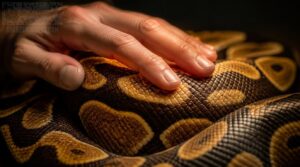
Snakes don’t sense touch the way you do, but that doesn’t mean they’re oblivious to your hands. Their skin is more complex than it looks, picking up pressure, texture, and even heat through structures built right into their scales. Here’s what’s actually happening when you pet your snake.
Mechanosensory Scales Detect Pressure
Every scale on a snake’s body is really a tiny pressure sensor. These mechanosensory scales have specialized channels that convert physical deformation into neural signals, reaching the brain almost instantly.
This remarkable sensitivity extends to detecting moisture too, as snakes use their mechanosensory scales to locate water sources with surprising accuracy.
What your snake reads from your touch:
- Light contact traveling from head to tail
- Vibration detection through scales
- Mechanical strain at each contact point
- Pressure threshold variation by body region
Texture and Force Perception
Your fingers don’t just press, they slide. That motion creates tangential force fluctuations the snake’s mechanosensory scales register like a tactile map. Scale direction sensitivity means a head-to-tail stroke reads completely differently than one moving against the grain.
| Touch Type | What the Snake Detects |
|---|---|
| Light, steady pressure | Subtle scale deformation |
| Head-to-tail sliding | Directional force and flow |
| Firm contact | Deep pressure mapping |
| Against scale direction | Elevated resistance signal |
Thermal Cues From Hands
Your hand’s temperature registers the moment you touch the snake. Snakes detect thermal cues through their scales, converting the heat from your skin into part of the overall touch signal. Cooler hands create a sharper thermal contrast, making each contact more perceptible. That temperature difference, combined with steady pressure, gives the snake a fuller read of what’s actually touching it.
Individual Scale Sensitivity
No two snakes read touch exactly the same way. Scale density variation and small nerve-ending zones create a personal sensitivity map.
- Midbody areas may respond best to light, steady pressure.
- Ventral scales can feel more sensitive when supporting weight.
- Moisture shifts perception, so damp scales may feel different.
Watch for relaxed muscles, then adjust your head-to-tail touch to your snake’s individual preferences.
Head and Body Sensitivity
The head is the most sensitive zone. Mechanosensory scales near the snout and forehead trigger small, rapid muscle adjustments under the lightest touch.
| Region | Tactile Sensitivity | Approach |
|---|---|---|
| Snout, lips | Highest | Avoid stroking |
| Neck | High | Slow, steady |
| Midbody | Moderate | Light pressure |
Thermal cues from your hands shape your snake’s perception. The warmer and steadier your grip, the safer that contact feels.
How to Pet a Snake Safely
Petting a snake safely comes down to five habits, and each one matters more than you’d think. Get them right, and handling becomes calmer for both of you. Here’s exactly what to do.
Wash Hands Before Handling

Before reaching into the enclosure, wash your hands with soap and warm water for at least 20 seconds. Snakes have molecular receptors that detect food residue on unwashed hands, and that confusion can trigger a defensive strike.
Soap removes salmonella and other common pathogens that hand sanitizer can’t fully eliminate. Clean hands also let your snake recognize your normal scent.
Approach From The Side

With clean hands ready, come at your snake from the side, never overhead. That top-down angle mimics a predator.
Before you reach in:
- Pick a quiet, low-traffic space
- Remove pets or fast-moving objects nearby
- Check the temperature is stable
Then place your hand softly where the snake can see it, and pause. Let the snake set the pace.
Stroke From Head to Tail
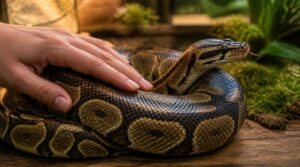
Once your snake acknowledges your hand, stroke slowly from head to tail. That direction matters. Snake scales overlap like roof tiles, smooth in the forward direction, rough in reverse. Stroking against them creates friction and stress.
Keep strokes slow and deliberate, about one to two per second, and maintain unbroken contact throughout. Lifting mid-stroke can startle even a calm snake.
Use Light, Steady Pressure
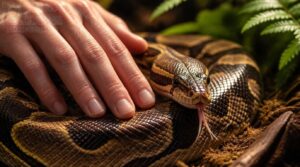
The pressure you apply matters as much as direction. Use finger pad contact, not fingertips, and keep it light enough that the snake doesn’t tense. A good test: press your own finger first to feel how gentle "gentle" needs to be.
Hold each stroke 10-15 seconds. Watch the tongue. Slow and steady tongue flicking means you’re in the right zone.
Support The Body and Tail

Your hand is a platform, not a perch. Use a two-handed lift from the mid-body, one hand near the midsection and one toward the tail. Never grip or squeeze.
Keep continuous contact as you move, no lifting and replacing hands. Ball pythons wrap naturally for balance; ground-dwelling species need more active support underneath. Relaxed muscles mean you’re doing it right.
How Can You Tell if a Snake is Comfortable?

Reading a snake’s body language isn’t complicated once you know what to look for. The signals are subtle, but they’re consistent — and your snake is giving them every time you interact. Here’s what comfortable (and uncomfortable) actually looks like in practice.
If behavioral patterns still confuse you, understanding whether hook training actually reduces snake biting can sharpen your eye for what stress signals to take seriously.
Relaxed, Unhurried Movement
A comfortable snake moves like water through your fingers. Watch for slow, steady body waves rippling from head to tail, with no sudden jerks or tight coiling against your palm.
Relaxed muscles allow even pressure distribution across your hands, and breathing stays shallow and regular throughout contact. That kind of unhurried flow tells you the handling is going well.
Steady, Level Head Position
A head that stays level and horizontal is one of the clearest body language cues you’ll see during handling. No sudden lifts, no tight neck coiling.
That steady head position tells you neck tension is low and defensive reflexes aren’t firing. Relaxed muscles do the work. Light, steady pressure from head to tail keeps that alignment and stress signals quiet.
Exploratory Tongue Flicking
Tongue flicking during handling is actually a good sign. Your snake is using its forked tongue to collect airborne molecules and route them to the Jacobson organ for scent analysis. That’s environmental mapping, not anxiety.
A calm snake flicks at a steady, unhurried pace, checking you out the way it would any familiar surface. Recognition builds through repeated calm contact.
Hissing and Defensive Postures
Hissing isn’t attitude. It’s a warning. Your snake pushes extra air out to create that sharp sound, and its body shifts into a full threat display:
- Raised head and neck, body partially coiled
- Puffed throat to appear larger
- Front portion elevated, hindquarters ready to retreat
- Closed mouth or bared fangs at the extreme
Don’t push through it.
Striking or Escape Attempts
A strike is the last message before a bite. If your snake pulls back and lunges, or bolts in a smooth path away from your hand, the session is done.
Smaller species escape fastest. Cornering one only intensifies handling-induced stress and raises the chance of a follow-up strike. Give it space, let it settle, and try again the next day.
When Should You Avoid Petting Your Snake?

Knowing when not to pet your snake matters just as much as knowing how. There are specific situations where handling adds stress rather than building trust, and reading them correctly protects both of you. Here’s when you should leave your snake alone.
During The Shedding Cycle
A shedding snake is basically off-limits. During a shed, skin grows looser and more reactive, and nerve endings near the old skin respond sharply even to gentle pressure.
You might notice hissing, body flattening, or retreating to a hide, all signs it wants to be left alone. Wait until the shed is fully complete before resuming any regular handling sessions.
Before or After Feeding
Feeding timing matters just as much as the shed cycle. A snake in feeding mode can stay primed to strike for up to 48 hours after eating, and your warm hand entering its space is all too easy to confuse for prey.
After any meal, wait at least 48 full hours before handling. Larger constrictors often need 72 or more.
When Sick or Injured
If your snake seems off, put the petting on hold completely. Skip handling entirely for at least 48 hours after symptoms first appear.
Respiratory infections and stomatitis make stress genuinely dangerous, suppressing immunity and slowing recovery. Watch for open-mouth breathing, visible swelling, or a reddish underside; those call for a vet visit, not a waiting game.
Let healing come first.
While Hiding or Resting
If your snake is tucked into its hide, leave it alone for now. Disturbing a resting animal can spike cortisol levels and extend the time it needs to fully settle back down.
When coiled quietly, head tucked slightly to one side, it’s basically offline. Don’t pull it out to handle it. Wait until it comes out on its own terms.
After Defensive Behavior
Hissing or coiling tight is your cue to stop. After a defensive display, give it 10-20 minutes before trying again.
Watch for these calm phase indicators before resuming:
- Head level, eyes forward
- Coils loosening slightly
- Tongue flicking slows to exploratory motions
- Movements become smaller and deliberate
Then try a gradual re-approach, with smaller contact and slower movements each session.
Frequently Asked Questions (FAQs)
Can snakes get attached to humans?
Think less Romeo and Juliet, more familiar scent and steady routine. Snakes lack the emotional capacity for true attachment. What builds is handling tolerance, driven by consistent contact and owner recognition via scent.
What’s the friendliest snake to own?
Corn snakes and ball pythons are your best starting point. Both are calm and beginner-friendly, tolerate regular petting and handling well, and rarely show defensive behavior when you move slowly and stay consistent with routines.
Do snakes feel when you pet them?
Yes, every single scale on a snake’s body is basically wired to feel you. Their mechanosensory scales pick up pressure, texture, and even the thermal cues your hands give off the moment you touch them.
How do you know a snake loves you?
Snakes don’t love, but they do recognize you. A relaxed body and steady tongue flicking during handling means trust is building. That calm tolerance, session after session, is the closest thing to affection you’ll get.
How do pet snakes react to unfamiliar faces?
Walk into the room for the very first time, and your snake clocks you as a threat before you touch the glass. Rapid tongue flicking, a raised head, and a fast retreat tell you everything.
What are the primary emotions and feelings snakes experience?
Fear, stress, and defensive aggression sit central to a snake’s emotional range. They can’t feel affection or enjoyment. What looks like calm is really learned tolerance, built through repeated, predictable handling over time.
Can snakes bond with multiple people over time?
Over time, they can. Through repeated, calm handling, a snake builds scent-based recognition of multiple caregivers, gradually learning to tolerate each one, not through affection, but through familiarity, routine, and a steady sense of safety.
How long should each handling session last?
For new snakes, keep sessions to 5 minutes. Once they’re comfortable with regular handling, 10-15 minutes is the sweet spot. One session per day is plenty, with a 30-minute daily cap to prevent chronic stress.
What age is best to start handling a snake?
Start after your snake’s first post-hatch shed, which usually happens within the first week or two. Keep early sessions short, around 3 to 5 minutes, gentle and calm, so the snake builds tolerance without stress.
Do snakes behave differently with strangers versus owners?
Yes. Snakes use scent to recognize their owner and often approach a familiar hand sooner. With strangers, you’ll notice more hesitation, brief retreats, and defensive postures before they settle.
Conclusion
Some owners push back at this point: "My snake seems happy with me." That’s not wrong. Learned comfort is real, and it shapes how your snake responds over time.
Do pet snakes like to be petted? The answer isn’t about love. It’s about reading what the body tells you, consistently and correctly. Handle with patience, step back when it signals stress, and what you build won’t be emotion. It’ll be something steadier, more reliable: trust.