This site is supported by our readers. We may earn a commission, at no cost to you, if you purchase through links.
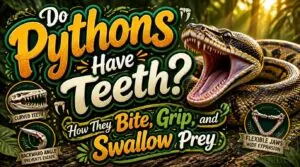
Sink your fingers into a python’s mouth and you’ll find rows of teeth curved backward like fishhooks, dozens of them, none built for cutting or chewing. Pythons have teeth, plenty in fact, but they serve a purpose most people never think about: gripping, not tearing.
That backward curve isn’t random. It’s a mechanical trap. Once prey pushes against those teeth, every twitch or struggle only drives the points deeper, turning a simple bite into a ratchet-like hold that barely loosens until the snake’s ready to swallow.
So how do you bite without chewing, and swallow something wider than your own head? The answer lies in teeth built for one job and jaws that do the rest.
Table Of Contents
- Key Takeaways
- Yes, Pythons Have Many Sharp Teeth
- How Pythons Use Teeth to Catch Prey
- How Python Teeth Help With Swallowing
- Python Teeth Vs. Venomous Snake Fangs
- Can Python Teeth Hurt Humans?
- Frequently Asked Questions (FAQs)
- Do python bites hurt?
- Why don’t they just shoot the pythons in the Everglades?
- Can you pull a snake’s fangs out?
- Which pet snake is least likely to bite?
- Do ball pythons have fangs?
- What are the differences between venomous and non-venomous python teeth?
- How frequently do pythons replace their teeth?
- Do the sizes of python teeth vary?
- Can you tell the age of a python by examining its teeth?
- Can pythons break the skin with a bite?
- Conclusion
Key Takeaways
- Python teeth curve backward like tiny hooks, so struggling prey only drives the points in deeper instead of loosening the grip.
- These snakes replace their teeth continuously throughout life, meaning even older pythons keep a sharp, reliable bite.
- Unlike venomous snakes, python teeth are solid with no venom canal, since they’re built purely for gripping while constriction does the actual work of subduing prey.
- Python bites can puncture skin and cause pain, but they’re rarely dangerous, so basic wound cleaning and calm handling are usually all you need.
Yes, Pythons Have Many Sharp Teeth
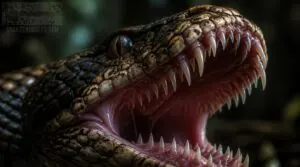
If you’ve ever wondered whether pythons have teeth, the answer is a clear yes. Their mouths hold dozens to well over a hundred sharp, curved teeth built for gripping, not chewing. Here’s what makes python dentition so effective at holding on to prey.
Arranged in multiple backward-curving rows, each tooth acts like a tiny hook, and this ball python teeth breakdown walks through exactly how that layout keeps prey from slipping free.
Small, Conical, Backward-Curving Teeth
Look closely and you’ll see each tooth is small and conical, tapering to a fine point. They curve backward, a design that channels prey toward the throat rather than letting it slip free. This curvature, paired with a smooth enamel edge, maximizes prey grip efficiency while keeping the tooth structurally sound during a strike.
Unlike humans, whose teeth feature complex cusp ridges and morphology, a python’s teeth remain simple, uniform points built solely for gripping rather than chewing.
Multiple Rows Across Both Jaws
A single tooth tells only part of the story. Python dentition relies on multiple rows lining both jaws, working together as one grip system.
- Rows align closely with the lower jaw at the joint
- Hidden tooth replacement bands feed new teeth into position
- Multirow grip mechanics resist prey struggling
- Jaw joint coordination repositions rows during swallowing
- Outer rows guide prey inward
Tooth Counts Vary by Species
That multirow system doesn’t look the same across species. Species tooth variation is significant, ranging from roughly 8-10 teeth to over 200 when counting active replacements.
| Species Type | Approximate Tooth Count |
|---|---|
| Smaller pythons | 25-35 |
| Larger species | 100+ |
| High-replacement jaws | 200+ (all rows) |
Jaw tooth rows and upper-lower tooth ratio shift too, correlating closely with prey size.
Lifelong Tooth Replacement
Those tooth rows don’t stay fixed for long. Pythons undergo polyphyodonty, continuously replacing teeth throughout life. Jawbone resorption loosens old teeth as replacements erupt beneath them, timed so gaps rarely last. Replacement rate increases after tough prey causes wear.
This continuous dental regeneration means even elderly pythons keep functional, sharp teeth, never losing their grip through worn-down dentition.
Species-Specific Tooth Size Differences
Body size drives tooth morphology in snakes more than most people expect. Larger pythons carry canines up to 3.5 cm, while smaller species stay under a centimeter, and curvature radius tightens in species retaining bigger, struggling prey.
- Tooth length correlates with body size and prey size
- Jaw tooth distribution varies across upper and lower rows
- Sexual dimorphism exists, with males sometimes bearing longer fangs
How Pythons Use Teeth to Catch Prey
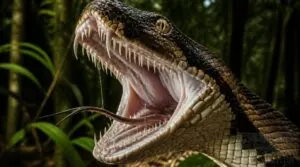
A python’s teeth aren’t just for show—they play a direct, mechanical role the moment prey comes within striking range. Each part of the bite works in sequence, from first contact to full-body constriction. Here’s what happens, step by step, when a python puts its teeth to work.
Those small, backward-curving teeth latch onto prey the instant contact is made, and this detailed look at ball python teeth structure and function breaks down how that initial grip sets up everything that follows.
Puncturing Prey During The Strike
A python’s strike is over almost before it starts. Jaws snap forward, teeth align with the prey’s body, and rapid jaw closure drives multiple puncture points into resistant tissue within a fraction of a second.
| Strike Phase | Function |
|---|---|
| Jaw closure | Maximizes penetration speed |
| Tooth alignment | Targets prey’s body axis |
| Puncture depth | Varies by prey resistance |
| Backward curve | Resists slippage |
Creating a Ratchet-Like Grip
Once teeth sink in, backward tooth curvature turns the bite into a one-way ratchet. Each curved point interlocks with tissue, so jaw closing force drives prey inward, never out. Struggling only deepens the hold, since movement presses more teeth into contact.
A python’s backward-curving teeth turn every bite into a one-way ratchet, where struggling only pulls prey deeper in
That’s the ratchet mechanism at work: your snake’s jaw structure ensures gripping and holding prey stays secure throughout.
Preventing Prey From Escaping
Escape isn’t really an option once contact is made. Prey Escape Prevention relies on multiple points of contact: upper and lower rows anchor simultaneously, so slippage becomes nearly impossible.
- Backward-curving points snag tissue
- Struggle deepens the anchor effect
- Jaw structure resists lateral movement
- Grip strength increases under pressure
- Multiple teeth share the load
That’s Struggle Resistance Control in action, locking prey in place before constriction begins.
Holding Firm During Constriction
A tightening coil doesn’t loosen the bite, it reinforces it. As pressure builds, progressive grip enhancement drives teeth deeper, while multi-row grip distribution spreads load across the jaw.
| Mechanism | Function | Effect |
|---|---|---|
| Ratchet lock | One-way hold | Blocks retreat |
| Angle-adjusted holding | Matches curvature | Deeper anchoring |
| Anti-rotation design | Resists twisting | Stable grip |
Controlling Large, Struggling Prey
A 150-pound animal thrashing mid-strike would overpower a weak grip fast. Instead, the struggle response mechanism kicks in: backward-curving teeth dig deeper as resistance increases, while tooth grip strength distributes force across multiple rows.
This connection between jaw flexibility and constriction force lets pythons stabilize prey without losing hold, even as the body twists or fights back.
How Python Teeth Help With Swallowing
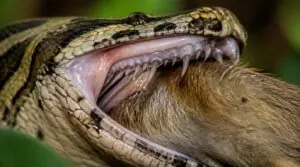
Gripping prey is only half the job; getting it down safely is the next challenge. Once a python has its meal secured, its teeth and jaws switch to a different kind of work. Here’s how that swallowing process actually unfolds, step by step.
Pulling Prey Toward The Throat
Once the strike lands, your python’s independent mandibles take over, each side walking forward in turns to drag prey inward. This jaw walking mechanism relies on tooth row coordination, backward-curving teeth hooking flesh while elastic jaw ligaments flex wide.
Peristaltic muscle pull then finishes the job, guiding prey steadily toward the throat before true swallowing begins.
Repositioning Prey Head-First
Why head-first, specifically? Fur and feathers lie flat that way, cutting resistance as prey slides down. Tooth guidance and the ratchet mechanism work together here, hooking the head and neck to lock proper orientation. Jaw elasticity lets ligaments stretch wide during repositioning, while prior prey size assessment ensures your python only controls what its jaw can realistically manage.
Walking The Jaws Over Prey
Once your python’s teeth lock onto prey, the real engineering begins. Each jaw half moves independently, alternating forward in a jaw walking process while the other holds firm, gradually advancing the meal inward.
The quadrate bone pivots nearly 90 degrees, widening the gape, while elastic ligament stretch lets jaw halves spread without dislocating, all while your snake breathes freely through its extended glottis.
Coordinating Teeth and Mobile Jaws
None of this jaw walking works without teeth and jaw acting as one system. Backward-curving teeth grip while each jaw half advances independently, and flexible ligaments allow controlled displacement without dislocation.
This jaw alignment coordination relies on precise timing, letting your python maintain a continuous hold. Even mid-cycle tooth replacement doesn’t interrupt the process, since new teeth erupt before old ones shed.
Keeping Slippery Prey Secure
Wet skin and scales make prey slippery, yet curved teeth grip tightly through puncture points spread across multiple tooth rows. This oral dentition structure distributes pressure evenly, so no single tooth bears all the strain.
Tooth spacing sliding lets prey inch toward the throat without loosening the hold, a hallmark of efficient constrictor feeding and steady prey gripping mechanism.
Python Teeth Vs. Venomous Snake Fangs
A python’s mouth might look intimidating, but it works nothing like a venomous snake’s. The two rely on entirely different tools to get the job done. Here’s how python teeth actually stack up against true fangs.
Solid Teeth Without Venom Canals
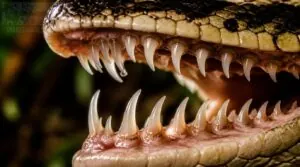
Every python tooth is a solid, backward-curving cone, no hollow canal in sight. Dentin center, thin mineralized enamel, anchored to the jawbone by ligaments and covered with gingival tissue.
| Python Teeth | Venomous Fangs |
|---|---|
| Solid | Hollow |
| Gripping | Injecting |
| Replaced constantly | Replaced periodically |
Polyphyodont replacement keeps this prey gripping mechanism sharp for life, no venom needed.
No Specialized Venom-Injecting Fangs
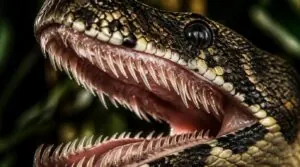
Search a rattlesnake’s mouth and you’ll find hollow fangs built for venom delivery. Pythons have none.
| Feature | Fangs | Python Teeth |
|---|---|---|
| Position | Anterior, few | Rows, both jaws |
| Purpose | Envenomate | Grip prey |
As nonvenomous constrictors, pythons rely on backward-curving teeth and constant tooth replacement, not injected toxins, to hold on.
Gripping Instead of Envenomating
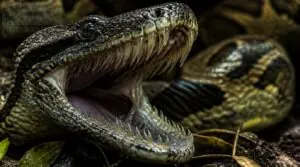
Why bother with venom when you can just hold on tight? Pythons rely on mechanical prey retention, using backward-curving teeth for gripping and holding prey while the constriction mechanism does the real work.
| Snake Type | Subdual Method | Tooth Role |
|---|---|---|
| Venomous | Toxin injection | Delivery only |
| Python | Constriction-based subdual | Ratchet-like grip |
| Nonvenomous constrictor | Physical force | Anchoring |
Constriction Subdues Captured Prey
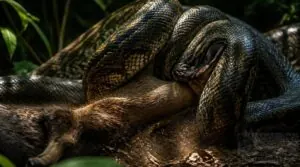
Grip is only half the job. Once backward-curving teeth anchor the prey, muscular constriction takes over: successive coils tighten, restricting blood flow and inhibiting respiration.
| Stage | Mechanism | Effect |
|---|---|---|
| Initial coil | Reduces rib expansion | Limits breathing |
| Sustained pressure | Impedes circulation | Causes hypoxia |
| Prolonged constriction | Halts gas exchange | Prey immobilization |
Teeth hold; coils subdue.
Why Some Teeth Look Fang-Like
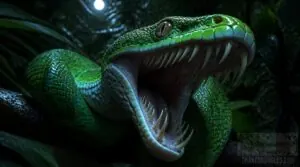
Not fangs, but close enough to unsettle you. Green Tree Pythons carry elongated, fang-like teeth for gripping arboreal prey, showing how oral morphology fits their hunting style.
| Species | Tooth Trait | Function |
|---|---|---|
| Green Tree Python | Elongated, curved | Arboreal prey grip |
| Ball Python | Small, blunt | Rodent capture |
| Reticulated Python | ~100 teeth | Large prey control |
Can Python Teeth Hurt Humans?
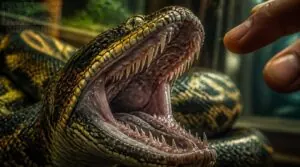
Python teeth aren’t built to inject venom, but they can still break skin and leave a mark you’ll feel. Whether that happens depends a lot on the situation and how you handle your snake day to day. Here’s what you should know about bites, from why they happen to when it’s worth a call to your doctor.
Defensive Versus Feeding Bites
Not every bite means the same thing.
Defensive bites happen fast, striking the head or neck when a snake feels cornered, then releasing quickly.
Feeding bites last longer, using backward-curving teeth to grip and hold before constriction begins.
Handling triggers, like sudden grabs, prompt defense; hunger prompts feeding.
Bite force and wound severity differ accordingly, defensive strikes usually causing shallower punctures.
Typical Bite Pain and Injury
What does a python bite actually feel like? First comes sharp puncture pain, then a throbbing ache as swelling sets in.
- Surface burning, stinging sensations
- Deep tissue pain in serious cases
- Needle-poking sensation from each tooth
- Inflammation from repeated bites
- Puncture wounds needing cleaning to avoid tooth infection
Bite severity in reptiles varies, but backward-curving teeth mean wounds often look worse than they feel.
Safe Handling to Prevent Bites
Since punctures often outpace the pain, prevention matters more than reaction. Use a snake hook for calm movement, keep two-handed support, and wear thick gloves.
Work in an escape-free workspace, clear of clutter. Run a quick pre-handling health check first.
Speak softly, move slowly, and avoid sudden jerks, since startled pythons bite faster than you can react.
Basic Care After a Bite
Even with careful handling, bites happen. Since pythons lack venom, a bite is a mechanical wound from backward-curving teeth, not a toxin threat.
- Rinse thoroughly with clean water
- Avoid ice or aggressive scrubbing
- Apply a pressure bandage if punctures are deep
- Immobilize the limb with a splint
- Monitor for swelling or unusual symptoms
Basic wound care and gripping-related punctures usually heal without complication, but watch closely.
When to Seek Medical Help
Most python bites heal fine with basic care, but watch for warning signs. Seek medical help if puncture wounds show spreading redness, warmth, or discharge, signs of bacterial infection or possible tooth infection.
Get emergency care immediately for breathing difficulty, chest pain, neurologic changes like confusion or fainting, or allergic reaction symptoms. When in doubt, call your doctor or 911.
Frequently Asked Questions (FAQs)
Do python bites hurt?
No, they won’t spray venom or curse your bloodline, but that needlepoking sensation stings. Bite depth and tooth count drive pain, so cleaning wounds and calm handling matter more than bravado.
Why don’t they just shoot the pythons in the Everglades?
Dense sawgrass, mangroves, and limited visibility make safe shots rare. Remote, waterlogged terrain slows crews, and heavy rain or heat hampers searches. Hunters often rely on hand capture instead, since python teeth pose less risk than gunfire near bystanders.
Can you pull a snake’s fangs out?
Picture yanking a nail from a beam, roots splinter and blood follows. That’s basically what happens: fangs are deeply anchored to the maxilla, so pulling them risks jaw fracture, severe bleeding, and lasting harm to the snake.
Which pet snake is least likely to bite?
Corn snakes and rosy boas rank among the calmest choices, tolerating handling well. Ball python temperament stays defensive rather than aggressive, and garter snakes and rosy headed pythons show similarly placid, docile temperament with infrequent biting.
Even the calmest snakes show trust differently than a dog or cat would, so it helps to read how pet snakes show affection toward their owners before expecting cuddles.
Do ball pythons have fangs?
No fangs here. Ball pythons carry 20 to 30 small, backward-curving teeth across both jaws, gripping rather than injecting venom. That bite feels more like a scratch. They rely entirely on constriction, not toxins, to subdue prey.
What are the differences between venomous and non-venomous python teeth?
Venomous fangs are hollow, injecting toxin before swallowing. Python teeth stay solid, with no venom canal, relying purely on backward-curving grip. As nonvenomous predators, pythons use tooth distribution and constriction, not envenomation, to subdue prey.
How frequently do pythons replace their teeth?
Your python’s mouth is basically a conveyor belt that never stops running. New teeth form beneath old ones every few months, and worn or lost teeth get replaced continuously, keeping its grip strength reliable from juvenile years through adulthood.
Do the sizes of python teeth vary?
Yes, considerably. Some measure nearly 2 cm long. Tooth size correlates with body size and prey, so larger species with tougher, bigger prey develop longer, more strongly curved teeth than smaller-bodied pythons feeding on modest rodents.
Can you tell the age of a python by examining its teeth?
Rings on a tree tell a story; a python’s teeth tell nothing. Continuous tooth replacement erases any wear patterns before they’d form growth-ring evidence.
Skip dental formula guesswork entirely. Length, mass, and health markers give far more reliable age approximation.
Can pythons break the skin with a bite?
Their small, backward-curving teeth easily cause skin puncture in a bite, leaving puncture wounds that bleed. Bite depth depends on snake size and strike force. Basic bite wound care and infection prevention keep you safe afterward.
Conclusion
Like a medieval jailer’s iron trap, a python’s mouth still runs on ancient engineering. So, do pythons have teeth, and if so, how do they use them? Yes, dozens of them, each curved to grip, not chew, holding prey firm while coils finish the job. Teeth start the capture; muscle completes it. Respect that mouth, handle pythons wisely, and you’ll understand why this ratchet-like bite has outlasted millions of years of prey trying to wriggle free.