This site is supported by our readers. We may earn a commission, at no cost to you, if you purchase through links.
Nathaniel Ward built the first one by accident. He sealed a moth cocoon in a glass jar back in the 1800s and found a fern sprouting weeks later, thriving on nothing but trapped moisture. That sealed jar became the blueprint for every closed terrarium since.
Learning how to make a terrarium isn’t complicated, but it does reward patience. Get the layers wrong, skip the drainage, or drown your moss, and you’ll watch things rot instead of grow.
Below, you’ll find the exact steps, from picking your container to keeping roots healthy months down the line.
Table Of Contents
- Key Takeaways
- Choose The Right Terrarium Type, Container, and Plants
- Gather The Essential Terrarium Materials
- Build The Terrarium Drainage and Soil Layers
- Plant, Decorate, and Seal The Terrarium
- Care for Your Finished Terrarium
- Frequently Asked Questions (FAQs)
- How do you make a terrarium for beginners?
- What are common terrarium mistakes to avoid?
- How long do terrariums typically last?
- What plants grow best in a terrarium?
- Can syngonium grow in a terrarium?
- How long do terrariums last in a jar?
- How do you make a simple self-sustaining terrarium?
- What not to put in a terrarium?
- What is the easiest animal to keep in a terrarium?
- Why don’t terrariums get moldy?
- Conclusion
Key Takeaways
- Layer your terrarium right from the bottom up: drainage stones or LECA, then activated charcoal, a sphagnum moss barrier, and finally your soil mix, since skipping any layer invites rot and mold.
- Match your terrarium type and plants to humidity needs, closed containers with tropical plants like fittonia trap moisture for a self-sustaining cycle, while open containers with succulents need drier air and more frequent watering.
- Check soil moisture with a skewer test before watering, since overwatering is the most common mistake that kills terrariums.
- A well-built closed terrarium with the right seal and slow-growing plants can thrive for 5 to 10 years with minimal upkeep, proving that good prep work upfront means less fuss later on.
Choose The Right Terrarium Type, Container, and Plants
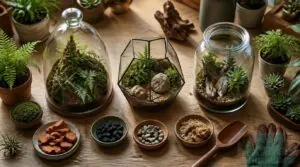
Every great terrarium starts with a few smart choices. Get the type, container, and plants right, and the rest falls into place. Here’s what to think about before you buy a single jar.
Before picking a container, take a look at this buyer’s guide to snake terrariums for a sense of how sizing rules shift once reptiles enter the picture.
Compare Open and Closed Terrariums
Before you buy a single plant, decide: open or closed?
Closed terrariums trap moisture, recycling water through condensation, perfect for ferns and moss. Open terrariums dry out faster, suiting succulents and air plants. This concept traces back to the Victorian era, when Nathaniel Ward accidentally created the first self-sustaining closed terrarium in a sealed jar.
Quick comparison:
- Humidity Control: closed traps it, open releases it
- Watering Frequency: closed rarely, open often
- Light Requirements: closed needs shade, open tolerates sun
- Mold Prevention: open airflow helps
- Plant Selection: match moisture needs
Select a Wide-Mouth Glass Container
Once you’ve picked open or closed, the container itself matters just as much.
Look for a wide mouth, at least 38mm across, so your hands fit for planting and cleanup.
| Feature | Look For | Why It Matters |
|---|---|---|
| Mouth Diameter | 38mm+ | Easy planting access |
| Glass Thickness | 3-5mm | Sturdy, not heavy |
| Volume Capacity | 500-2000ml | Room to grow |
Match Plants to Humidity Levels
Container’s picked. Now, what goes inside?
Match plants to your humidity zone. Tropical types like Fittonia want 60-80% RH, closed jars deliver that easily. Succulents crave dry air, 20-40%, so they belong in open containers instead.
Grouping three to five plants raises RH a few percent through shared transpiration. A hygrometer takes the guesswork out.
Plan Space for Plant Growth
Growth needs room, not guesswork.
Keep 2 to 3 inches between small plant tops for good light penetration. Push taller plants back, shorter ones front, that’s your plant layers sorted.
- Leave 1-2 inches from container walls for airflow clearance
- Try vertical arrangement to gain 20% more planting area
- Keep canopy height within your container’s diameter
Clean and Dry The Container
A dirty jar ruins good plants fast.
Rinsing and fully drying the jar before refilling it keeps mold at bay, and pairing it with a moisture-retentive substrate like sphagnum moss helps your enclosure stay balanced longer.
Rinse Pure Water first to clear soil, then wash with mild soap. Check Residue carefully, soap film attracts dust inside your glass container. Dry with a Lint-Free Towel, tossing in a Silica Gel Packet speeds things up. Air Dry Fully for several hours before planting your glass terrarium.
Gather The Essential Terrarium Materials
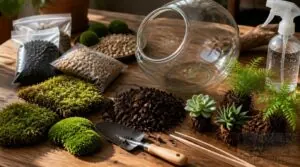
Got your container? Good. Now let’s talk supplies. Here’s everything you need before you start layering.
Drainage Stones or LECA
Every good terrarium starts from the bottom up. Your drainage layer stops roots from sitting in water, using horticultural gravel or LECA (lightweight expanded clay).
LECA wins for weight and uniform porosity. Sizes range:
- Fine (2-5mm) for small jars
- Medium (6-12mm) for standard depths
- Coarse (12-20mm) for airflow
Rinse, soak 24 hours, add 1-1.5 inches deep.
Activated Charcoal and Mesh
Once your drainage layer settles, add activated charcoal, about ½ inch thick, to filter odors and toxins. Its porous surface gives huge charcoal adsorption capacity.
| Layer Detail | Purpose |
|---|---|
| Charcoal (½ in) | Filters toxins |
| Fine mesh | Traps particles |
| Replace yearly | Restores adsorption |
| Food-grade only | Avoids contaminants |
Add mesh for mesh particle retention, keeping soil separate step-by-step.
Sphagnum Moss Barrier
Think of sphagnum moss as the peacekeeper between your charcoal and soil. Lay a thin, damp sheet right over the charcoal layer, covering it fully so nothing sneaks through.
This barrier does more than separate layers. It holds up to 20 times its weight in water, releasing moisture slowly instead of dumping it all at once. That steady release keeps humidity even and stops your substrate from swinging wet to dry.
Sphagnum moss holds twenty times its weight in water, releasing moisture slowly to keep humidity steady
It also creates a mildly acidic pocket, buffers mineral buildup from tap water, and leaves room for airflow between fibers.
- Keeps roots from sitting in soggy soil
- Slows mold before it starts
- Helps tiny beneficial microbes
- Makes maintenance simple, just lift and check
Terrarium Substrate Mix
Good soil is where your plants actually live, so get the ratio right. Mix two parts potting soil to one part coco coir, then add a handful of orchid bark and perlite for airflow. Toss in a spoonful of worm castings for slow-release nutrients.
Depth matters too, at least 1.5 inches, roughly a quarter of your container.
Tools, Hardscape, and Decorations
Right tools make this easy. Long tweezers, a small spoon, and a spray bottle handle most jobs.
For hardscape, pick goodlooking rocks and bits of driftwood that fit your container’s scale. Rinse them first.
Use mesh barriers to stop soil sinking into drainage.
Decorations? Go light. Tiny figurines or crystals work, nothing heavy or toxic to roots.
Build The Terrarium Drainage and Soil Layers
Now comes the fun part. Your materials are ready, so it’s time to layer them in the right order. Here’s exactly how to build it up, step by step.
Add The Drainage Layer
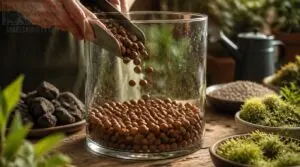
Every terrarium needs a water reservoir at the bottom. Add 1 to 2 inches of LECA, lava rock, or fine gravel. Rinse it first, dust causes cloudy water.
This layer stops roots from sitting wet. Small tumbled stones work too, just keep the depth consistent so water pools evenly, not just in one corner.
Spread Activated Charcoal Evenly

With drainage in place, add activated charcoal next. Sprinkle a thin, even layer, about 0.5 to 1.5 inches, using small handfuls while rotating the container. This charcoal layer thickness keeps filtration working across the whole base, not just one spot.
Don’t pack it down. Loose charcoal breathes better, and even distribution stops musty pockets from forming later.
Install The Moss Barrier
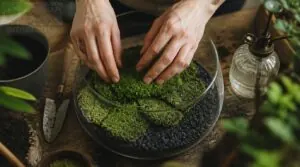
Now for the moss barrier. Lay damp sphagnum or sheet moss right over the charcoal, edges overlapping slightly so soil can’t sneak through. Press gently for a snug seal.
Barrier thickness should sit around 1 to 2 centimeters, thick enough to buffer, thin enough to breathe. Mist lightly to help it settle before adding substrate.
Add Proper Substrate Depth
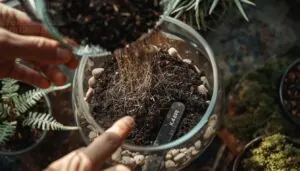
With your barrier settled, it’s time to build up depth. Add your soil mix in an even layer, at least 1.5 inches deep for most plants, up to 3-4 inches for tropical shrubs with bigger root zones.
Keep it consistent across the base. Uneven substrate depth means uneven moisture, and nobody wants soggy corners.
Position Rocks and Wood
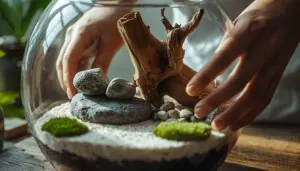
Now for the fun part: hardscape. Place large rocks at the back and one side for stabilizing rock foundations and natural shade zones. Use a flat base rock plus two smaller ones for three-point contact.
Wedge wood pieces (bark out) into corners, anchoring with stones to avoid root compaction. Balance light and shadow front to back.
Plant, Decorate, and Seal The Terrarium
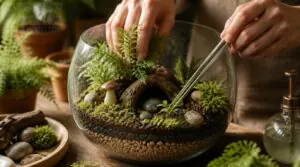
Now for the fun part. Your layers are ready, and your plants are waiting. Here’s how to get them in the ground and seal everything up right.
Arrange Plants Before Digging
Think of this as rehearsal before opening night.
Set your plants, still in their nursery pots, right on top of the soil.
Tallest ones go back, midheight anchors up front.
Check root spread, light needs, and humidity groups.
Leave 1-2 inches from the glass.
Sketch it.
Now you’ve got a real plan, not a guess.
Plant From Back to Front
Time to dig in for real.
Start at the back with your tallest pick, nestling roots deep so it won’t tip when you bump the glass. Work forward, tucking shorter plants close to the front pane. This height gradient layout builds visual depth, like a tiny landscape stretching toward you. Pat soil gently around each root ball as you go.
Space Plants for Airflow
Crowded plants trap stale air, and that’s when trouble starts.
Leave 1 to 2 inches between each plant. This airflow plant spacing keeps leaf canopy gaps open so air can actually move. Mix narrow leaves with broader ones to avoid dense overlap, and keep your vertical plant arrangement loose near the glass. Good air circulation means healthier roots and less mold down the road.
Add Moss and Decorations
Now for the fun part: dressing it up.
Tuck cushion moss or mood moss into gaps near rocks and wood, green side out. Mix textures: sheet moss for a carpet look, reindeer moss for height.
Add figurines or glass beads after planting. Keep decorations light so they don’t block airflow or trap too much moisture near your plants.
Mist Lightly Before Sealing
One last spritz before the lid goes on. Grab your plant mister, set it to a fine mist setting, and lightly dampen the glass and moss.
- Mist close, not heavy
- Let it settle 30-60 seconds
- Skip pooling water
Use distilled water. Watch for avoiding condensation buildup, then seal to lock in humidity control.
Care for Your Finished Terrarium
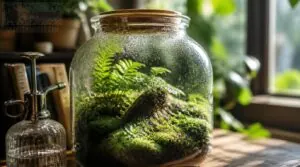
Your terrarium’s planted and sealed. Now the real job starts: keeping it alive. Here’s what to watch for.
Provide Bright, Indirect Light
Light makes or breaks your terrarium. Set it near an east-facing window for gentle morning sun, or pull it back several feet from south or west light. Bright indirect light should cast a soft shadow, not a harsh one.
No good windows? Full-spectrum LED grow lights, run 12-14 hours daily, work just fine.
Monitor Condensation and Humidity
Good light sorted, now watch the glass. Foggy droplets are your terrarium talking, showing its microclimate in action.
- Check dew point shifts
- Track humidity trends
- Scan glass fog patterns
- Note airflow effect
- Log condensation management steps
Constant fog signals mold risk. A quick vent or crack keeps that water cycle balanced without disturbing soil moisture.
Water Only When Needed
Condensation calmed, so now check soil moisture before grabbing that spray bottle. Use the skewer test method: push a wooden skewer 1-2 inches deep. Dry tip? Time to water. Damp? Wait.
| Season | Frequency | Dry Soil Signs |
|---|---|---|
| Warm | 7-14 days | Skewer dry |
| Cool | 2-4 weeks | Soil crumbly |
Avoid overwatering, always.
Prune and Remove Plant Debris
Watering sorted, now grab your shears. Prune debris the moment you spot decay, don’t wait around.
Snip yellowing leaves at healthy nodes weekly during growing season. Clear stems, matted moss, fallen bits, all of it.
Sanitize tools between cuts with rubbing alcohol. Schedule a full clean-out every 3 to 6 months for a low-maintenance terrarium that actually breathes.
Prevent Mold and Root Rot
Mold thrives on stagnant air and soggy roots, so stay ahead of it. Keep your drainage layer and activated charcoal working, and check the substrate for sour smells.
Do a monthly mold inspection routine: peek under moss, check foliage. Tug a plant occasionally for a root health check, slimy roots mean cut back terrarium watering and boost airflow enhancement.
Frequently Asked Questions (FAQs)
How do you make a terrarium for beginners?
Funny enough, most beginner terrariums fail from too much care, not neglect.
Build it step-by-step: drainage stones, charcoal, moss barrier, substrate, then easy plants like fittonia.
Skip overwatering.
Choose a wide, budget-friendly glass jar, and let the cycle run itself.
What are common terrarium mistakes to avoid?
Overwatering tops the list, closely followed by a wrong substrate mix, poor drainage layer, weak light, and pairing plants that need opposite humidity. Skip drainage or seal too soon, and mold moves in fast. Stay consistent with aftercare.
How long do terrariums typically last?
The less you touch it, the longer it lives. A sealed closed terrarium with slow growers and a tight seal can thrive 5 to 10 years, sometimes beyond a decade, while open setups need pruning and last just 1 to 3 years.
What plants grow best in a terrarium?
Fittonia, Pilea, and Polka Dot Plants love closed, humid terrariums. Tropical moss varieties and low light ferns fill shady corners well. For open setups, try succulent terrarium options or hardy groundcover picks instead.
Can syngonium grow in a terrarium?
Yes. Syngonium tolerates humidity tolerance levels from 60 to 90%, making it perfect terrarium material. Pick compact cultivars like Pixie, choose a container with room to grow, and prune regularly to maintain shape and healthy variegation.
How long do terrariums last in a jar?
Months, years, decades: a jar’s lifespan depends entirely on you. Closed terrariums with tight glass seal integrity and slow-growing plants can thrive 5 to 10 years, thanks to steady moisture retention and careful terrarium maintenance habits.
How do you make a simple self-sustaining terrarium?
Seal a glass container with drainage, charcoal, and substrate layered right. Add humidity-loving plants, mist lightly, then close the lid. Condensation creates a water recycling system, and springtails keep mold in check for years.
What not to put in a terrarium?
Picture roots strangling glass, leaves rotting in trapped moisture. Skip mint and bamboo, toxic Dieffenbachia, cacti, treated wood, silica dust, chlorinated water, metal fertilizers, household cleaners, and dyed crystals or marbles.
What is the easiest animal to keep in a terrarium?
For a truly easy terrarium animal, isopods win. They’re low-maintenance, thrive in a bioactive terrarium, and handle humidity without fuss.
Mourning gecko handling is gentle too, but for hands-off simplicity, springtail cleanup crews and isopods beat leopard gecko care every time.
Why don’t terrariums get moldy?
Honestly, they’re not mold-free, just well managed. Activated charcoal filters toxins, springtails clean up decay, and steady condensation control keeps humidity balanced. That balance, plus good air circulation, stops mold before it ever gets started.
Conclusion
The less you touch it, the more it thrives. That’s the paradox in learning how to make a terrarium: your best work happens before you seal the lid. Every layer you build, every plant you place, sets the stage for a world that runs itself.
Walk away for a month. Come back, and you’ll find roots settled, leaves glossy, moisture cycling on its own. Ward’s jar taught this lesson first. Build it right, then let it be.