This site is supported by our readers. We may earn a commission, at no cost to you, if you purchase through links.
A snake doesn’t swim to a volcanic island—it rides. Clinging to a tangled mass of uprooted trees and storm debris, carried hundreds of kilometers by ocean currents, it arrives on shores that didn’t exist a million years ago. Volcanic island snake colonization sounds like a rare accident, but the fossil and genetic record suggest it happened repeatedly, independently, across multiple ocean basins.
The Galápagos racer genus Pseudalsophis tells that story clearly: distinct species on distinct islands, each one shaped by isolation, local prey, and lava fields with nowhere to hide.
Table Of Contents
- Key Takeaways
- How Snakes Reach Volcanic Islands
- Galápagos Snakes as Colonization Models
- Adaptations to Volcanic Island Habitats
- Ecological Roles After Colonization
- Threats to Island Snake Populations
- Frequently Asked Questions (FAQs)
- Do humans live on Snake Island?
- How did P hoodensis colonize other islands?
- Can you visit Snake Island if you have a doctor?
- Who put the snakes on Snake Island?
- How did Snake Island get so many snakes?
- How many snakes are actually on Snake Island?
- What volcanic island is full of rattlesnakes?
- What is the snake infested volcanic island?
- How did all the snakes get to Snake Island?
- Are there still snakes on Snake Island?
- Conclusion
Key Takeaways
- Galápagos snakes like Pseudalsophis reached their islands by riding vegetation rafts and debris carried by ocean currents—not by swimming—and this has happened repeatedly across millions of years.
- Once isolated on an island, each snake population adapts independently, developing distinct body sizes, colors, diets, and behaviors shaped by local terrain and available prey.
- Modern threats like invasive predators, habitat loss from tourism, and climate change now hit these endemic species harder than any ocean crossing ever did.
- Conservation efforts combining port biosecurity, invasive species removal, and community education are the most effective tools for keeping these species from disappearing.
How Snakes Reach Volcanic Islands
Getting to a volcanic island when you’re a snake isn’t exactly a short trip. The Galápagos sit nearly 1,000 kilometers off the coast of Ecuador, yet snakes have been making that crossing for millions of years.
Here’s how they actually pull it off.
Overwater Dispersal on Vegetation Rafts
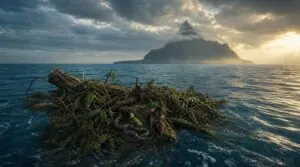
Floating to a new home sounds improbable, but it’s exactly how snakes colonize remote volcanic islands.
Once they arrive, these resilient travelers adapt surprisingly well, as seen in the island boa habitats across tropical regions where isolated populations have quietly carved out their own evolutionary paths.
Research on subantarctic kelp rafting demonstrates that buoyant kelp can drift hundreds of kilometers, proving the feasibility of long-distance vegetative mats. Over-water dispersal mechanisms for reptiles rely on dense vegetation mats that offer:
- Raft Buoyancy — plant matter stays afloat across open ocean
- Moisture Retention — humid microhabitats reduce desiccation
- Storm-driven Expansion — storms aggregate larger, more stable rafts
- Fragmentation Risks — splitting mats strand animals mid-crossing
Ocean currents then carry these natural rafts toward colonization routes of Galápagos snakes, shaping trait evolution over generations.
Driftwood, Root Mats, and Storm Debris Transport
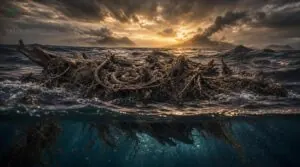
Vegetation mats aren’t the only ride available. Driftwood pieces and root mats also serve as natural rafts, and their buoyancy mechanisms are surprisingly effective. Dense root networks provide structural stability, keeping the raft intact through moderate swells.
Storm surge pathways push debris far offshore, dramatically expanding over-water dispersal mechanisms for reptiles. These debris microhabitats even shelter small snakes during crossings — a quiet advantage on the colonization routes of Galápagos snakes.
Ocean Currents From Mainland Source Regions
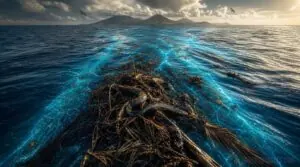
Those debris rafts don’t drift randomly — ocean currents do the steering. Warm pathways like the Gulf Stream, Kuroshio Current, East Australian Current, Brazil Current, and Agulhas Current move water across vast distances, creating natural highways.
For the Galápagos, the Humboldt Current runs directly from mainland Ecuador, making it one of the most reliable over-water dispersal mechanisms for reptiles and a key driver of the colonization routes of Galápagos snakes.
Survival Challenges During Long Sea Crossings
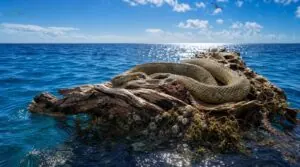
Riding a current is one thing — surviving it is another. Open-ocean crossings push snakes to their limits through hazards like Salt Dehydration, Thermal Overheating, and Predator Threats from seabirds and fish. Energy Depletion sets in rapidly when food is scarce, while Biofouling Drag slows debris, prolonging exposure to dangers.
Surviving an open-ocean crossing demands more than drift—salt, sun, predators, and hunger claim snakes long before land appears
Three hazards hit hardest:
- Saltwater damages skin and disrupts hydration.
- Sun exposure overwhelms thermotolerance.
- Hunger exhausts energy reserves quickly.
Accidental Human-assisted Transport by Ships and Cargo
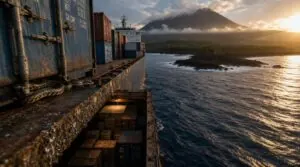
Nature isn’t the only travel agent getting snakes to volcanic islands. Modern shipping routes have quietly become colonization routes for Galápagos snakes, moving cargo stowaways, hull fouling organisms, and ballast water passengers across ocean gaps that once filtered out everything.
| Transport Method | How It Works | Invasion Risk |
|---|---|---|
| Cargo Stowaways | Snakes hide in containers or packaging | High |
| Ballast Water | Organisms released at destination ports | Moderate |
| Hull Fouling | Species cling to ship exteriors | Moderate |
| Port Inspection Gaps | Busy ports miss hidden animals | High |
| Crew Credential Fraud | Unauthorized access facilitates accidental release | Low |
These anthropogenic introductions bypass millions of years of natural overwater dispersal mechanisms for reptiles, delivering introduced species — and their invasive impact — almost overnight.
Once established, these invasive reptiles thrive in environments shaped by the same thermal principles behind heat lamps designed for desert snakes—precision warmth that accelerates metabolism, reproduction, and spread.
Galápagos Snakes as Colonization Models
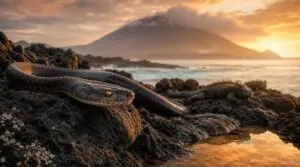
The Galápagos archipelago is one of the best natural laboratories on Earth for studying how snakes colonize and diversify across isolated islands. Nine recognized species in the genus Pseudalsophis have carved out distinct niches across the islands, each with its own story of arrival, adaptation, and survival.
Here’s a closer look at what makes these snakes such a compelling model for understanding colonization.
Pseudalsophis Diversity Across The Archipelago
The Galápagos archipelago hosts nine recognized Pseudalsophis species, and molecular phylogenetics reveals multiple ancient colonization routes of Galápagos snakes from mainland Ecuador.
Each species shows distinct morphometric variation and color polymorphism tied to local habitats.
Cryptic lineages detected through genetic diversity of Galápagos snake populations suggest that the radiation is still being untangled.
Microendemic patterns are common, with several species confined to just one or two volcanic islands.
Island-specific Endemism and Restricted Ranges
Once a snake lineage reaches a Galápagos island, island isolation effects take hold fast. Populations shrink, genetic bottlenecks reduce genetic diversity, and species lock into microhabitat specialization across lava fields and scrub zones. Alsophis dorsalis, for instance, is endemic strictly to Española.
Endemic hotspot mapping confirms these restricted ranges, and paleoendemic persistence shows some lineages have held their ground for millions of years despite habitat loss and shifting island conditions.
Colonization Timing on Older and Younger Islands
Older islands had a head start. Island emergence dates shaped which snake lineages arrived first, and founder event timing often aligned with paleo‑current cycles that pushed rafts toward newly exposed lava shores. Reproductive season alignment also mattered, since gravid females on a raft boosted founding success considerably.
Younger islands show a clear speciation lag — colonization routes of Galápagos snakes shifted as geography changed.
Genetic Evidence for Dispersal and Divergence
Mitochondrial haplotypes cluster neatly along island boundaries, confirming that colonization routes of Galápagos snakes followed ocean current pathways from mainland Ecuador.
Nuclear SNPs reveal isolation by distance patterns — genetic similarity drops sharply between distant islands.
Coalescent dating aligns divergence events with volcanic emergence timelines, while adaptive divergence loci and molecular phylogenetics of Galápagos snake radiation confirm that overwater dispersal mechanisms for reptiles shaped the genetic diversity of Galápagos snake populations over millions of years.
Differences Between Large and Small Island Species
Island size shapes everything. Large islands support bigger populations, broader niche breadth, and greater body size trends toward gigantism. Small islands show the opposite — dwarfism, tighter genetic bottleneck effects, and reduced adaptive potential.
For Galápagos snakes, island biogeography theory applied to reptiles explains why phenotypic variation among Galápagos snake species tracks island area so closely, and why extinction risk climbs sharply for small-island populations.
Adaptations to Volcanic Island Habitats
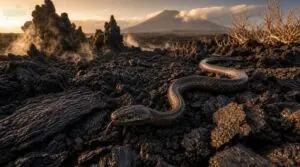
Volcanic islands are genuinely tough places to live — scorching soils, dry air, and sharp lava underfoot aren’t exactly welcoming conditions.
Yet Galápagos snakes have found ways to not just survive, but thrive here. Here’s a look at the key adaptations that make that possible.
Heat Tolerance on Lava Fields and Exposed Soils
Black lava surfaces can hit 60–70°C under direct sun—conditions that would cook most reptiles alive. That’s why Galápagos snakes rely on precise thermal activity windows, moving at dawn or dusk when temperatures drop.
Heat-shock proteins kick in when core temps spike, protecting tissues from extreme heat. This physiological adaptation allows them to survive brief exposure to lethal conditions.
Microclimate refuges in crevices, combined with radiative body orientation and strong cutaneous water retention, make these snakes true extremophiles of volcanic soil.
Burrowing Behavior in Volcanic Substrates
When surface heat becomes unbearable, these snakes go underground. Burrowing behavior as a survival strategy in volcanic soil is well-documented among fossorial reptiles here. Their tunnel architecture utilizes volcanic soil’s natural porosity:
- Substrate preference favors loose ash and pumice
- Thermal insulation stays several degrees cooler below ground
- Moisture microhabitat facilitates egg-laying in breeding chambers
- Soil aeration benefits the surrounding ecosystem
Water Conservation in Dry Island Environments
Burrowing solves the heat problem — but what about water? Volcanic islands are notoriously dry, and these snakes have developed notable physiological adaptations to cope. Specialized skin minimizes water loss, while their environmental stress response kicks in during extreme dry spells.
Rainwater harvesting, fog harvesting, and aquifer recharge shape their microhabitat choices too.
| Adaptation | Mechanism | Benefit |
|---|---|---|
| Skin impermeability | Reduced trans-epidermal loss | Retains body moisture |
| Thermal regulation | Behavioral shade-seeking | Lowers evaporation rate |
| Habitat specialization | Rock crevice sheltering | Accesses cool, humid air |
| Climate adaptation | Metabolic slowdown | Conserves water during drought |
| Greywater recycling | Metabolic water extraction | Supplements hydration internally |
Camouflage Among Lava Rock and Scrub Habitats
Staying hidden is just as essential as staying cool. Galápagos snakes have evolved striking color matching — charcoal and dark brown dorsal patterns that mirror basaltic lava almost exactly. Scale reflectivity mimics weathered rock surfaces, while blotches align with lava cracks for smooth pattern disruption.
Microhabitat selection matters too: snakes actively choose resting spots where substrate texture matches their own scales, a behavior that dramatically improves survival in open volcanic island ecology.
Diet Shifts Based on Local Prey Availability
Diet doesn’t stay fixed on volcanic islands — it flexes with the season, the terrain, and who else is hunting. Seasonal prey pulses drive microhabitat foraging shifts, pulling snakes toward insects after lava regrowth or ground-dwelling geckos on exposed lava.
Invasive rodents broaden the menu, while competition-driven partitioning keeps coexisting species from clashing.
Prey size selection even shapes reproductive outcomes, directly linking diet to clutch success.
Ecological Roles After Colonization
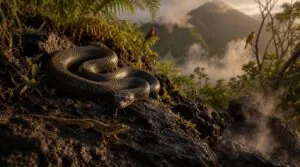
Once a snake species establishes itself on a volcanic island, it doesn’t just survive — it gets to work. These snakes slot into the food web quickly, filling roles that shape the entire ecosystem around them.
Here’s a closer look at how they do it.
Predation on Lava Lizards and Geckos
Lava lizards and geckos form the backbone of the Galápagos snake diet, with predation timing patterns playing a critical role. Snakes target juvenile lizards during peak basking hours and catch geckos at dusk as they move between rocks.
- Juvenile lizard vulnerability increases predation success rates
- Gecko tail autotomy buys escape time but signals predator pressure
- Ambush near lava tubes shapes prey behavior modifications
- Lizard population shifts skew toward older, warier individuals
- Predator-prey dynamics regulate the broader island reptile community
Juvenile Snake Reliance on Insects
Young Galápagos snakes can’t hunt lava lizards initially — gape limitation restricts juveniles to smaller prey. Insects like crickets, beetles, ants, and termite eggs fit this narrow window perfectly.
Microhabitat insect abundance dictates juvenile foraging locations, while their fossorial lifestyle positions them near soil invertebrate prey.
Through ambush foraging and chemo-sensory detection, they efficiently meet energetic growth demands.
Opportunistic Feeding on Introduced Rodents
As native lizard populations fluctuate seasonally, Galápagos snakes don’t pass up an easy meal. Rodent prey assimilation has given them real energetic gains — and a competitive advantage over species with rigid diets. Prey selection flexibility matters here. Introduced rodents now supplement traditional prey through:
- Expanding juvenile growth rates
- Buffering lean seasonal feeding patterns
- Reshaping predator-prey dynamics island-wide
Effects on Island Reptile Population Balance
When snakes settle into an island ecosystem, the ripple effects run deep. Predator-prey feedback reshapes how lava lizard and gecko populations grow and contract. Competitive release opens new space for species once suppressed by unchecked prey numbers.
These dynamics trigger trophic cascade effects, driving reptile community turnover and shifts in population stability. The interplay of these forces reveals that the ecological role of snakes in island ecosystems extends far beyond simple predator-prey relationships.
Niche Partitioning Among Coexisting Snake Species
When multiple snake species share an island, they divide resources in surprisingly precise ways. Species-specific diet differences, ontogenetic shifts in size-based prey selection, and activity partitioning across day and night all reduce overlap.
Microhabitat use separates species further, with some favoring lava fields and others scrub. Phenotypic variation among Galápagos snake species drives this ecological niche separation, stabilizing predator-prey dynamics even where habitat fragmentation intensifies pressure.
Threats to Island Snake Populations
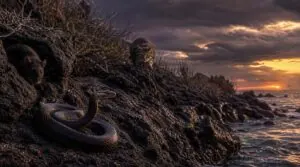
Island snakes have survived volcanic eruptions, ocean crossings, and fierce competition—but today, they face threats that are harder to outrun.
From invasive predators to shifting climates, the pressures closing in on Galápagos snake populations are varied and serious. Here’s what’s putting these resilient species at risk.
Invasive Cats, Rats, Dogs, and Predator Pressure
Introduced species dismantle the ecosystems Galápagos snakes depend on, extending beyond direct competition. Cat predation alone impacts over 430 bird species globally, with island endemics suffering disproportionately. Invasive rodents and predators trigger mesopredator cascade effects, disrupting entire food webs.
Consider the specific threats posed by rats, cats, and dogs:
- Rats devastate juvenile reptile survival rates
- Cat predation removes key prey species
- Dog disease transmission weakens stressed populations
However, rat eradication success stories demonstrate resilience: native lizard populations rebound within just a few breeding seasons, proving targeted interventions work. Despite progress, biosecurity against invasives remains one of the sharpest conservation challenges for Galápagos reptiles today.
Habitat Loss From Tourism and Development
Beyond tourism development carves deeply into the habitats Galápagos snakes rely on. Resort construction clears vegetation, while road fragmentation cuts through lava fields where endemic species forage and shelter.
Water extraction strains island aquifers, drying out nearby vegetation. Wastewater runoff and light pollution further degrade sensitive microhabitats.
Even well-meaning ecotourism and snake observation guidelines can’t fully offset habitat loss without serious conservation efforts and habitat restoration.
Human Fear, Persecution, and Misinformation
Habitat loss isn’t the only human-driven threat. Mythical snake lore and media sensationalism have shaped how communities respond to endemic species—often with fear-driven policy rather than evidence. People kill snakes based on exaggerated venom myths or misidentification. Community education programs and citizen science trust can shift that.
Human perception and persecution of snakes remain real conservation challenges for Galápagos reptiles.
Climate Change Impacts on Island Ecosystems
Climate change is quietly reshaping the Galápagos. On a volcanic archipelago already defined by extremes, shifting conditions hit hard.
- Sea-level rise and freshwater lens loss shrink usable habitat
- Coral bleaching and ocean acidification disrupt the food web
- Species range shifts push reptiles into smaller, fragmented zones
Effects of climate change on island reptiles compound every other threat snakes already face.
Conservation Strategies for Galápagos Snakes
Conservation strategies for Galápagos snakes work on several fronts at once. Captive breeding programs preserve genetic diversity before reintroduction, biosecurity at ports blocks new invasive arrivals, and management of invasive rodents and predators protects vulnerable populations directly.
| Strategy | Focus |
|---|---|
| Education outreach initiatives | Reducing human persecution |
| Citizen science monitoring | Population monitoring and distribution mapping |
| Habitat restoration | Recovering cover and foraging zones |
Legal protection enforcement and public education tie everything together.
Monitoring, Habitat Restoration, and Legal Protection
Protecting Galápagos snakes requires a multifaceted approach. SMART Indicators and Adaptive Management provide frameworks for monitoring and adjusting conservation efforts, while Citizen Science initiatives address data gaps across remote islands.
Key strategies include:
- Restoration Benchmarks guide habitat recovery efforts
- Permit Compliance enforces legal protections for native wildlife in the Galápagos
- Invasive species impact assessments inform targeted removal programs
- Conservation management integrates community stewardship into long-term plans
Frequently Asked Questions (FAQs)
Do humans live on Snake Island?
Snake Island has no civilian residents. Naval personnel briefly maintain its lighthouse, but access bans, absence of medical care, and legal restrictions make permanent settlement impossible.
How did P hoodensis colonize other islands?
P. hoodensis most likely rode vegetation rafts across open water, using stepping-stone islands as waypoints.
Founder bottleneck effects shaped each population after arrival, with raft composition and voyage duration determining who survived.
Can you visit Snake Island if you have a doctor?
Yes, but only with strict conditions. Permit Requirements include a Doctor Certification, authorized transport, and Emergency Evacuation plans. Virtual Access Options exist if you can’t meet these standards.
Who put the snakes on Snake Island?
Nobody put them there. Rising sea levels around 11,000 years ago cut the island off from the mainland, stranding the golden lancehead’s ancestors.
Nature handled the snake colonization of volcanic islands long before any lighthouse crew arrived.
How did Snake Island get so many snakes?
Rising seas cut off Ilha da Queimada Grande roughly 11,000 years ago. No mammalian predators followed. With predator-free advantage and abundant avian prey, the golden lancehead thrived — and never left.
How many snakes are actually on Snake Island?
Density estimates put the golden lancehead population at roughly 2,000 to 4,000 individuals across 43 hectares. Access limitations make precise survey techniques difficult, so population size figures reflect ongoing research and conservation efforts.
This isolation has driven remarkable genetic divergence, and exploring the golden lancehead’s evolutionary journey and island adaptations reveals just how uniquely this species evolved.
What volcanic island is full of rattlesnakes?
Isla Tortuga, a lava-born volcanic island in the Gulf of California, is defined by its extreme geological origins.
This remote habitat hosts dense Tortuga rattlesnakes, which thrive in the volcanic soil. Their presence demonstrates impressive adaptation of reptiles to harsh, volcanic environments.
What is the snake infested volcanic island?
Ilha da Queimada Grande, off Brazil’s coast, holds between 2,000 and 4,000 golden lancehead vipers in roughly 106 acres — one of Earth’s highest extreme snake density concentrations anywhere.
How did all the snakes get to Snake Island?
Before sea levels rose at the end of the Pleistocene, mainland corridors connected the region.
Pre-isolation mainland populations were simply trapped by rising water, creating a classic founder-effect bottleneck from the start.
Are there still snakes on Snake Island?
Yes, snakes still inhabit Snake Island. Population surveys confirm this, and recent sightings back it up.
Conservation initiatives now protect these endemic species, ensuring they persist despite invasive predators and habitat loss.
Conclusion
It’s no coincidence that every volcanic island with stable prey populations eventually becomes home to a snake—chance and biology conspire toward the same result. Volcanic island snake colonization isn’t a fluke; it’s a pattern written in genetics, geography, and deep time. Pseudalsophis didn’t just survive the odds—it rewrote them, island by island.
Protecting these species now means preserving that story before invasive predators, habitat loss, and a warming climate write a very different ending.