This site is supported by our readers. We may earn a commission, at no cost to you, if you purchase through links.
A boa constrictor that’s fed too often becomes obese before it hits three years old—and obesity in boas kills quietly, through fatty liver disease that shows no obvious symptoms until serious damage is done. Most keepers overfeed because boas are enthusiastic eaters.
They strike, coil, and swallow with the kind of confidence that makes you think they need another meal already. They don’t.
Getting the frequency right comes down to three variables: your boa’s age, the prey size you’re offering, and the temperature inside the enclosure. Nail those three, and you’ve got a feeding schedule that keeps your snake lean, healthy, and thriving for decades.
Table Of Contents
Key Takeaways
- Overfeeding is the #1 silent killer of captive boas — match meal frequency to your snake’s age (every 5–7 days for hatchlings, monthly for adults over five) and you’ll avoid the fatty liver disease most keepers never see coming.
- Prey size should never exceed 10% of your boa’s body weight and must fit within its widest body girth — get both wrong and you’re risking regurgitation, not just discomfort.
- Temperature runs the show: digestion slows in winter and speeds up in summer, so your feeding intervals need to shift with the seasons rather than staying locked to a fixed calendar.
- Skip the guesswork — log every feeding date, prey weight, and your boa’s body weight regularly, because trends in that data will catch problems (obesity, underfeeding, illness) long before your eyes do.
Boa Feeding Schedule by Age
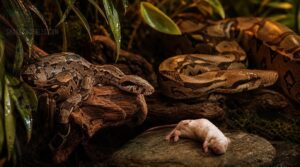
Age plays the biggest role in how often your boa needs to eat. A hatchling’s needs look nothing like a five-year-old adult’s, and getting that timing right makes a real difference in long-term health.
Hatchlings typically eat every 5–7 days, while adults stretch comfortably to every 10–14 days—a gap that mirrors the broader age-related factors shaping boa health and longevity.
Here’s how feeding frequency breaks down across each life stage.
Neonates: Every 5–7 Days
Neonate boas — those tiny hatchlings fresh out of the egg — need to eat every 5 to 7 days. That consistent rhythm helps the rapid growth happening in their first six months. A hopper mouse, sized right to match their girth, is usually the go-to prey item at this stage.
Watch for feeding interest indicators like active tongue-flicking and alert posturing before each offering. If your neonate is in shed, hold off — cloudy eyes mean digestion timing is off, and forcing a meal risks regurgitation. Resume your normal feeding schedule once shedding is complete.
Juveniles: Every 10–21 Days
Once your boa hits the six-month mark, the feeding pace naturally slows down. Juveniles do well on a 10–21 day interval, and that range exists for good reason — warmer temps push digestion faster, cooler temps slow it right down.
A few things to keep in mind:
- Skip handling for 24–48 hours after each meal to avoid regurgitation
- If your juvenile refuses a meal, wait for the next window rather than pushing early
- Watch for steady weight gain — a rounded midbody means it’s time to space meals out
Adults: Every 2–5 Weeks
By the time your boa reaches adulthood, the frantic early growth phase is behind it. Feeding every 2–5 weeks becomes your new rhythm.
Most keepers settle on a four-week interval as a reliable middle ground. If your snake is actively building mass, push closer to two weeks. Maintaining weight comfortably? Stretch it toward five.
Mature Boas: Monthly or Longer
Once your boa passes five years, everything slows down — and that’s actually a good thing. Monthly feeding intervals become the norm, with some keepers stretching to 37 days in summer. Winter? You can pause even longer.
A healthy mature boa can fast up to 90 days without concern. Watch body condition, not the calendar.
A healthy mature boa can fast up to 90 days — trust body condition, not the calendar
Breeding Season Feeding Adjustments
Breeding season flips the usual script. Instead of maintaining regular intervals, most keepers practice reduced feeding frequency — pulling back slightly so females don’t carry excess fat into reproduction.
Female appetite changes are natural here; if she ignores a meal, don’t stress it. For males, keep nutrition steady but avoid overfeeding.
After mating, allow a post-mating feeding delay before resuming her normal schedule. Consider raising protein levels by a few percent during breeding, as livestock experts recommend raising protein levels.
Choose The Right Prey Size
Getting prey size right matters just as much as how often you feed. Too big, and you’re stressing your boa out — too small, and you’re leaving them underfed over time. Here’s what you need to know to nail it every time.
Getting the prey size right also ties into digestion — and that means temperature matters too, so make sure your setup includes a properly regulated reptile heat mat to keep things moving smoothly.
Follow The 10% Rule
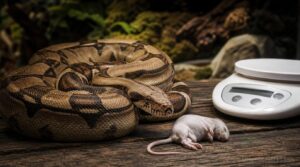
Think of the 10% rule as your built-in guardrail. A single prey item should never exceed 10% of your boa’s total body weight. It’s a proportional system, so it naturally scales as your snake grows — no guesswork needed.
Here’s why it matters in practice:
- Oversize meals stress digestion and can cause regurgitation
- Gradual prey increases let your boa adapt without metabolic strain
- Weekly weight checks confirm whether your current prey size is working
- Adjust prey size only after two or three consistent feedings confirm stable weight gain
Match Prey to Body Girth
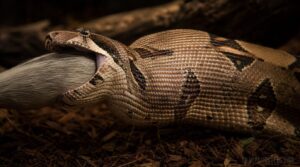
Weight tells half the story — girth tells the other half. Even if a prey item clears the 10% weight limit, it still needs to fit comfortably within your boa’s widest body girth. A prey item that’s too thick forces the jaw and throat to overstretch, which stalls the swallow and stresses your snake.
Watch the feeding in real time. A clean, continuous swallow with no repeated stopping means the girth match is right.
Mouse and Rat Size Guide
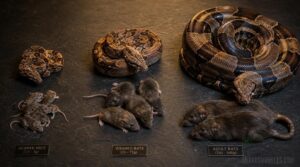
Here’s a quick size comparison to keep on hand:
- Hopper mice (8–12 g) suit boas weighing 67–155 g
- Weaned rats (35–45 g) work for boas in the 333–455 g range
- Larger rats (120–140 g) match boas approaching 1 kg
Adult mice rarely exceed 30–45 g, while even young rats push past 200 g — so don’t mix them up.
Safe Frozen-Thawed Feeding
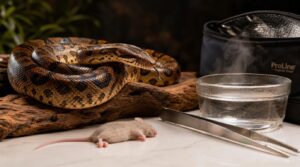
Frozen-thawed prey is the preferred method for boa feeding — no bite risk, no parasites, and easy to store in bulk. Thaw overnight in the fridge, then warm to 98–100 °F in a sealed bag placed in warm water.
Always clean your tongs and wash your hands after handling. Never refreeze thawed prey.
Avoid Fatty Prey Items
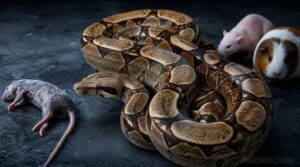
Not all prey is created equal. Pink rats and guinea pigs sit at the fatty end of the spectrum — avoid making them regulars.
Stick to lean feeders like appropriately sized frozen‑thawed mice or rats. Rotating feeder types keeps fat intake balanced.
If muscle definition starts fading, check your feeding frequency guidelines and swap to leaner options fast.
Adjust Meals for Seasonal Temperatures

Your boa’s feeding schedule doesn’t stay the same year-round — and it shouldn’t. Temperature drives everything, from how fast your snake digests a meal to how often it actually needs one. Here’s what you need to know about adjusting meals through the seasons.
Summer Feeding Intervals
Summer heat quietly shifts your boa’s appetite, so cool-hour feeding matters more than you’d think. Aim for early morning or late evening when temperatures drop. This keeps digestion smoother and reduces stress.
Remove uneaten prey within two hours — warm weather spoils food fast. If your boa skips a meal, extend the interval rather than pushing another attempt the same day.
Winter Feeding Slowdowns
Winter flips the script on your summer routine. Your boa’s Winter Metabolic Rate drops naturally as temperatures fall, meaning digestion slows and hunger signals fade. That’s not a problem — it’s biology working exactly as it should.
Here’s what a slowed winter system actually means for your feeding routine:
- Feeding Frequency Reduction is expected — extend intervals to 4–5 weeks for adults
- Temperature-Driven Digestion means meals take longer to process, so rushing the next feeding causes real harm
- Cold Stress Nutrition risks rise if you overfeed — slower guts struggle harder
- Winter Water Access matters too — dehydration quietly reduces appetite and worsens digestion
Adjust your winter feed schedule gradually, never all at once.
Heat and Digestion Speed
Think of your boa as a living thermometer — its temperature digestion rate rises and falls with the heat around it. As ectotherms, boas rely entirely on external warmth to power digestion.
A heat metabolism boost kicks in when the enclosure stays consistently warm, helping enzymes break down prey faster. Feed too soon after a cold spell, and that meal just sits there.
Safe Daytime Temperature Gradient
Getting digestion right starts with the enclosure itself. Temperature gradient setup is straightforward: keep the basking zone between 90–95 °F and let the cool side settle around 82–85 °F. That spread lets your boa self-regulate — moving between zones to control its own metabolic rate and temperature.
Key things to lock in:
- Basking zone design should sit on one side only, never centered
- Heat source placement matters — too close creates hot spots above 95 °F
- Thermostat calibration keeps everything within a 2–3 °F window automatically
Good microclimate management means hiding spots stay cooler than the basking surface, giving your boa real choices.
Nighttime Temperature Limits
Once the sun goes down, your boa’s enclosure needs to stay above 70°F minimum — let it dip below 65°F, and digestion stalls completely, raising regurgitation risk after meals.
Keep nights between 72–78°F for steady metabolism.
A drop greater than 5°F from daytime levels is too much.
Use a ceramic heat emitter and a digital probe thermometer to monitor your boa’s actual sleeping zone nightly.
Check Your Boa’s Body Condition
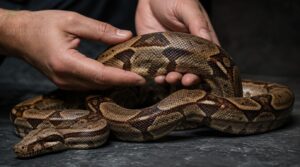
Your feeding schedule means nothing if you’re not checking how your boa actually looks and feels. A quick body condition check tells you whether your current routine is working — or needs a tweak. Here’s what to look for.
Signs of Healthy Weight
A healthy boa constrictor should look evenly filled along its length — no sharp hollows, no sunken sides, no ribs poking through when you look down from above.
Run your hand gently along its body; the muscle should feel firm, not bony.
The belly line stays consistent between feedings, and the thickness changes gradually from midbody to tail without any slack or swollen pockets.
Overweight Boa Constrictors
Overfeeding is one of the most common mistakes in boa care, and the signs sneak up on you.
Watch for these red flags:
- Midbody visibly wider than the head
- Fat rolls near the head or cloaca
- Scales wrinkling or skin appearing stretched
- Soft, squishy feel during handling instead of firm muscle
A bloated feeding schedule — ignoring age-based intervals — drives snake obesity fast. Cut back before organ damage sets in.
Underweight Boa Constrictors
An underweight boa is hard to miss once you know what to look for. Visible spine and ribs, a triangular body profile instead of square, and noticeably thin midbody are your clearest warning signs.
If your boa is refusing meals repeatedly or gaining nothing after feedings, increase frequency slightly and check prey size matches the 10% body-mass rule.
Internal Fat Health Risks
Internal fat is the hidden consequence of poor body condition scoring and ignoring meal frequency guidelines. When a boa carries excess internal fat, it faces fatty liver disease — one of the most serious overfeeding consequences in captivity.
That extra fat doesn’t just sit there quietly. It strains the liver, disrupts metabolism, and cuts lifespan short.
Shedding and Growth Clues
Your boa’s shedding cycle tells you more than most keepers realize. Healthy juveniles shed every 4–6 weeks; adults every 6–8. When growth is on track, sheds come out in one clean piece — eye caps and all.
If you’re seeing stuck patches or cloudy skin that lingers, revisit your meal frequency guidelines and humidity before adjusting feedings.
Track Feedings and Growth Changes
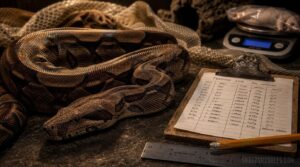
Feeding your boa is only half the job — knowing what’s working takes a little record-keeping. The good news is it doesn’t have to be complicated. Here’s what to track so you can fine-tune your schedule with confidence.
Record Every Feeding Date
Every feeding deserves its own entry — date, time, and a quick yes or no on whether your boa accepted the meal. Consistent date logging removes guesswork completely.
Use the same time format every day, note any skipped sessions, and assign a unique session ID when you feed twice in one day.
Your vet will thank you when patterns need tracing fast.
Log Prey Type and Weight
Dates get you started, but prey type and weight are what make your Feeding Log actually useful. Write down exactly what you offered — a medium mouse, a small rat, a hopper — plus the weight in grams.
Here’s what a solid Boa Constrictor Feeding Chart entry covers:
- Prey item grade (e.g., weaned rat, hopper mouse)
- Prey weight in grams, ideally re-weighed after thawing
- Whether the meal was accepted or refused
Keeping your Weight Log consistent lets you spot when prey size needs adjusting before your boa’s condition drifts.
Weigh Your Boa Regularly
Knowing exactly what your boa eats only tells half the story. Regular weigh-ins fill in the rest.
| Weigh-In Factor | Best Practice |
|---|---|
| Timing consistency | Same time of day, every session |
| Post-feeding wait | At least 48 hours after a meal |
| Scale accuracy | Digital scale precise to ±1 g |
| Handling duration | Brief, calm, fully supported |
| Room conditions | Stable temperature, no drafts |
Weekly weigh-ins catch gradual changes before they become problems. A single number means little — the trend is everything.
Use a Feeding Chart
A feeding chart turns scattered notes into a system. Your Boa Constrictor Feeding Chart should log the date, prey item, prey weight, and days between meals so interval drift is obvious at a glance.
Add color-coded status markers and a "next prey step" field, and you’ll always know exactly where you stand — no guessing, no gaps.
Adjust Intervals Safely
When your chart reveals a pattern shift — fewer meals accepted, slower weight gain, or more days between meals than planned — that’s your cue to adjust.
Change intervals in small, gradual steps. Digestive recovery, stress management, and seasonal feeding all affect timing.
Trust your log. Let weight tracking and body condition, not guesswork, lead every decision.
Frequently Asked Questions (FAQs)
Can boa constrictors eat fish or amphibians?
Technically, boas are carnivorous in the wild, but fish and amphibians aren’t ideal prey selection for boas. They carry parasites and lack proper nutrition. Stick to rodents for safe, reliable dietary management for boas.
How long should I wait after feeding to handle?
Wait 48 hours minimum before handling your boa after a meal. Early digestion is when regurgitation risk peaks. Keep it warm, leave it alone, and let its gut do the work.
What signs indicate my boa is about to shed?
Your boa’s pre-shed signs are hard to miss. Cloudy, blue-white eyes, dull skin, increased soaking, and reduced appetite all point to one thing — shed day is roughly 7–10 days away.
Should I feed my boa during or after illness?
Don’t feed your boa when it’s sick. Give it a 14-day feeding break after any regurgitation, then offer a small prey item — about half the usual size — before easing back to normal.
How do I transition a boa to frozen-thawed prey?
Thaw frozen prey in a sealed bag submerged in warm water, warm it to 100–105°F, then present it with tongs using natural movement. Add scenting or braining if your boa hesitates.
Conclusion
Picture a boa stretched out, relaxed and lean, moving with that slow, liquid confidence that only a well‑kept snake has. That’s what your boa constrictor meal frequency guide builds toward — not just a feeding schedule, but a blueprint for a snake that lives long and stays healthy.
Track the feedings, watch the body condition, and trust the data over your boa’s enthusiastic strikes. A hungry look doesn’t always mean a hungry snake.