This site is supported by our readers. We may earn a commission, at no cost to you, if you purchase through links.

Feed a juvenile boa too often, and you get a snake that looks fed but grows soft, with weak muscle tone and a body that never quite fills out right. Feed too rarely, and growth stalls. Juvenile boa constrictor feeding times aren’t guesswork, they follow patterns tied to weight, age, and body condition that you can track with a kitchen scale and a notebook.
Get the timing right between 10 and 14 days, matched to prey sized correctly, and you’ll watch steady, healthy growth month after month. Get it wrong, and you’re troubleshooting refusals, regurgitation, or a boa carrying more weight than its frame should hold. Here’s the schedule, the math behind it, and what to do when things don’t go as planned.
Table Of Contents
- Key Takeaways
- Juvenile Boa Feeding Schedule by Age
- Adjust Feeding Frequency as Your Boa Grows
- Choose The Right Prey Size
- Follow a Safe Feeding Routine
- Fix Feeding Schedule Problems
- Frequently Asked Questions (FAQs)
- How often should I feed a juvenile snake?
- How big should a 1 year old boa be?
- How to tell if a boa is hungry?
- How long can a juvenile snake go without food?
- How often should I feed my juvenile snake?
- How long can a pet boa go without eating?
- Can juvenile boas safely eat in community enclosures?
- How do I switch my boa to a new prey type?
- Should I feed my juvenile boa at night?
- Do juvenile boas need supplements added to their prey?
- Conclusion
Key Takeaways
- Feed neonate boas every 7–10 days and most juveniles every 10–14 days, then adjust gradually using weight gain, appetite, and body condition rather than the calendar alone.
- Size prey to the snake’s mid-body width and roughly 10–15% of juvenile body weight, increasing prey size only in small steps after successful meals.
- Weigh your boa weekly and track monthly trends, aiming for firm muscle tone and a squared body profile rather than rapid gains, fat rolls, or a rounded body.
- Prevent feeding problems by maintaining proper enclosure temperatures, using safely thawed warmed prey with tongs, avoiding handling for 24–48 hours after meals, and pausing or seeking veterinary care after repeated refusals or regurgitation.
Keeping a simple log of each meal and monthly weight makes it much easier to spot trends early — you can find feeder sizing and scheduling guidance for juvenile boa constrictors to help dial in the right prey size as your snake grows.
Juvenile Boa Feeding Schedule by Age
Your boa’s feeding schedule isn’t fixed—it shifts as your snake ages, and getting the timing right matters for healthy growth. Every stage, from that first post-acclimation meal to the slower rhythm of a near-adult snake, calls for its own approach. Here’s how the schedule breaks down by age.
For a closer look at what to feed your boa at each stage and how often, this boa constrictor feeding schedule by age breaks it all down clearly.
First Meal After One-Week Acclimation

Wait a full seven days before that first meal, letting your boa settle into its new enclosure undisturbed.
Offer one prey item, roughly 10% of estimated adult weight, presented on tongs at a stable 88-92°F basking zone. Keep handling minimal.
Confirm swallowing within 24-48 hours; a strong feeding response signals successful acclimation and readiness for regular scheduling.
Neonates: Every 7–10 Days
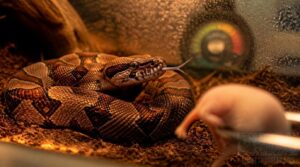
That first successful meal is only the start. From here, settle into a 7-10 day feeding interval, adjusting for weight gain, appetite, and growth spurts.
- Feed prey at 5-10% body weight
- Track weekly gains for steady growth
- Watch appetite consistency, not just calendar days
- Keep temps stable at 82-86°F for digestion
Younger neonates often need the shorter end of that window.
Juveniles: Every 10–14 Days
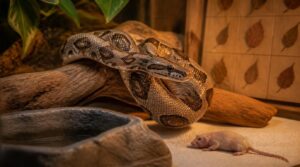
Once your boa clears six months, that 7-10 day rhythm starts stretching out. Shift to feeding every 10-14 days, adjusting for weight trends and appetite, not just the calendar.
Prey should stay at 10-15% body weight. Check warm-side temps (85-88°F) before each meal, and log growth weekly, steady gains beat rushed ones every time. Consistent record-keeping mirrors the value of a data-centered tracking approach, which has been shown to sharpen observation habits and improve pattern recognition over time.
Lengthen Intervals Near Subadult Size
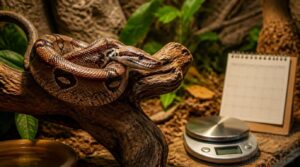
As your boa nears subadult size, stretch intervals to 9-11 days, watching weight gain over calendar dates. Growth spurts may shorten this by 2-3 days temporarily, then revert after 2-4 weeks.
Track weekly weight, body condition, and appetite consistency, not just the schedule. Individual variation up to two days is normal; adjust gradually, never abruptly.
Choose a Consistent Feeding Time

Snakes thrive on routine. Pick a 1 to 2 hour feeding window in late afternoon, when juveniles show peak activity, and stick to it daily.
Align timing across caregivers to avoid mixed schedules. In cooler months, shift earlier; always verify basking temps hit 88-92°F first.
Log each feeding time. A consistent feeding schedule sharpens feeding response and simplifies tracking frequency over weeks.
Adjust Feeding Frequency as Your Boa Grows
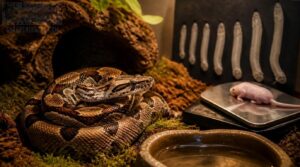
A fixed schedule only gets you so far — your boa’s body tells the real story. Growth isn’t a straight line, so your feeding plan shouldn’t be either. Here’s what to watch each week to know when it’s time to adjust.
Using a well-designed set of stainless steel feeding tongs for small apartment snake keepers makes it easier to safely gauge your boa’s response and appetite as its growth patterns shift week to week.
Track Weight Every Week
A scale doesn’t lie, even when your eyes do. Weigh your boa at the same time each week, on a hard, flat surface, and log the exact date and number every time.
A scale doesn’t lie, even when your eyes do—so weigh your boa at the same time each week
This consistency cuts out diurnal variation and builds a real record, so you catch unexpected gain or loss before it becomes a problem.
Monitor Monthly Growth Trends
Weekly numbers only tell part of the story. Zoom out monthly, and you should see 30 to 60 grams gained, plus 2 to 5 centimeters added in length during early growth spurts.
Sum your daily intake logs each month too. That total, correlated against size increase, flags when it’s time to shift age categories, from neonate to juvenile to subadult.
Check Body Condition Regularly
Numbers alone won’t tell you if your boa is thriving. Run your hands along the body: you want a square profile, not round, with no spine ridges or fat rolls.
- Flat sides, slight central back groove
- No visible spine from above
- Firm muscle tone, mid-body wider than neck
- Clean, complete sheds with no retained caps
Adjust for Growth Spurts
Some boas hit the gas pedal overnight. If weekly weigh-ins show gains above the normal 5-10% monthly baseline, you’re watching a growth spurt in action.
Bump feeding frequency by 10-20%, don’t double portions. Scale prey weight to 8-12% of body mass, then taper back to your standard feeding schedule once weight gain and appetite settle back to baseline.
Avoid Routine Overfeeding
More food doesn’t mean faster, healthier growth, it usually means the opposite. Cap energy intake at 2% of body weight weekly and keep meal sizes consistent, even during growth spurts.
Use body condition scoring (1-5 scale) alongside weight checks to catch early fat pads. Overfeeding risks include obesity and organ strain, so stick to your established feeding frequency rather than adding extra meals.
Choose The Right Prey Size
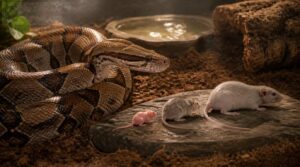
Prey size matters just as much as timing. Get it wrong, and you risk regurgitation, stunted growth, or a snake that loses interest in eating altogether. Here’s how to size each meal correctly, from your first hopper mouse to your first weaned rat.
Use Prey Weight Percentages
A simple formula keeps meals safe: divide prey weight by your boa’s body weight, times 100. Neonates need 8–10%, juveniles 10–15%. A 150g juvenile eats 15–22g prey.
Weigh both on a gram scale, log each feeding, and increase percentages gradually every few months, never past 18% without vet guidance.
Match The Widest Body Section
Percentages get you close, but girth seals the deal. Measure your boa’s widest body section, usually midbody, with a flexible tape every two to four weeks.
Prey diameter shouldn’t exceed that circumference by more than 10%, and never past 1.5 times the snake’s girth. Track trends; steady circumference with proportional length gain signals a well-tuned feeding schedule.
Progress From Mice to Rats
Girth trends set the stage for the next shift: mice to rats. Start juveniles on hopper mice, then move to rat pups before graduating to weaned rats (60–120g) once your boa hits 60–90cm.
Rats pack more caloric density per meal, fueling faster growth. Time this prey size progression to body width, not the calendar.
Increase Prey Size Gradually
Never jump more than 5-10% in prey weight between meals; patience beats speed here.
- Log each size progression step and digestion outcome
- Allow two successful feeds before scaling up
- Match increments to your boa’s actual girth
- Skip a size if refusals or lethargy appear
- Reassess every 4-6 weeks alongside growth spurts
Slow prey scaling protects a juvenile boa constrictor’s digestive comfort and long-term feeding schedule.
Avoid Oversized Meals
A single oversized meal won’t hurt much, but a pattern of them will. Keep portions at 2-3% of body weight for juveniles, never exceeding one-third of girth when swallowed.
| Warning Sign | Action |
|---|---|
| Visible waist bulge | Reduce next portion |
| Weight jumps weekly | Reassess prey size |
| Prolonged digestion | Delay next feeding |
| Reduced strike response | Check for overfeeding |
| Loose stools | Consult a vet |
Portion regulation protects long-term body condition.
Follow a Safe Feeding Routine

Feeding your boa is more than dropping in a rat and walking away. Every step, from checking temperatures to handling the prey itself, affects how safely your snake eats and digests. Here’s the routine to follow, in order, every time.
Check Temperatures Before Feeding
Warm prey, cold prey, a burned mouth or a refused meal: temperature makes or breaks feeding times. Test with a clean thermometer or the wrist check, aiming for 38 to 40°C. Recheck if prey sat out over a minute.
Skip feeding if warm-side temps drop below 85°F, since your juvenile boa constrictor won’t cooperate in a cold enclosure.
Thaw and Warm Prey Safely
Frozen-thawed prey needs a slow, controlled thaw, never a countertop shortcut. Use the refrigerator method when time allows, or a sealed lukewarm water bath under 70°F for less than two hours. Avoid refreezing once thawing starts.
For prey warming, bring items to 85–95°F, checking with a thermometer to prevent contamination or a scalded mouth on your feeding tongs.
Offer Prey With Tongs
Bare hands don’t belong near a feeding boa. Use blunt-tipped feeding tongs, gripped firmly behind the prey’s head for control.
Keep your angle steady, your hand still, and the distance respectful, this keeps stress-free feeding intact and protects your fingers from a mistimed strike.
Sanitize tongs after each use to prevent cross-contamination between feedings.
Present Prey Head-First
Why does orientation matter so much? Head-first presentation guides your boa’s jaw and neck alignment naturally, speeding swallowing and reducing mid-swallow pauses.
Position prey at mouth height, steady in your tongs. This prey presentation technique limits shoulder catch on teeth and curbs regurgitation risk.
Watch feeding response closely; sluggish swallowing signals you should adjust prey size next time.
Avoid Handling After Meals
Your boa just ate. Its body now needs quiet, not attention.
Handling risks regurgitation, so give it space for 24–48 hours of post-feeding rest.
- Skip lifting or repositioning
- Keep the enclosure quiet for digestion
- Watch from outside, no contact needed
Stress raises metabolic rate and disrupts digestion timeline. Stick to observation without contact, and your feeding schedule stays on track.
Fix Feeding Schedule Problems

Even with a solid routine, feeding problems still pop up now and then. Most of them trace back to timing, temperature, or a missed warning sign your boa gave you. Here’s how to spot the issue and get things back on track.
Pause Feeding During Shedding
When cloudy eyes signal the shedding cycle has begun, stop offering meals entirely. Feeding during this window risks regurgitation and added stress.
Wait until the shed skin peels free, then give it 1-2 weeks before feeding resumes. Watch appetite for the true cue, not the calendar, since shedding recovery varies between individual boas.
Remove Uneaten Prey Promptly
Once your snake settles back into its feeding schedule, remove uneaten prey within 30 minutes. Left longer, it draws odor, invites mold, and stresses your boa.
- Seal leftovers before disposal
- Use sanitized tongs, never bare hands
- Clean enclosure surfaces to protect humidity
Reassess prey size if refusals repeat, this often signals your current portions no longer fit.
Check Temperature and Humidity
Refusals often trace back to the enclosure, not the meal. Before troubleshooting further, confirm warm side ambient air sits at 85-88°F and humidity holds 60-75% on your digital hygrometer.
Check sensor placement, one probe per zone, and pull daily reading logs to catch drift early. Stability matters more than getting everything exactly right here.
Wait After Regurgitation
Even with stable temperature and humidity, regurgitation sometimes happens. Give your boa a full recovery period of 5 to 14 days, ideally 10 to 14 days, before offering food again.
Skip handling for 24 to 48 hours, keep the enclosure calm, and offer only a small reassessment meal. Repeated regurgitation warrants a vet visit.
Log Refusals and Digestive Changes
A weekly log turns guesswork into pattern recognition. Record date, prey type, and outcome, since refusal documentation flags trends fast.
Watch digestive indicators: stool consistency, bloating, delayed transit. Note temperature impact and growth-related shifts too.
Three consecutive refusals trigger your Multiple Refusal Protocol: check temps, pause, then reassess body condition scoring before resuming your feeding schedule.
Frequently Asked Questions (FAQs)
How often should I feed a juvenile snake?
Funny how two keepers can own the same species and feed on totally different clocks. Neonates eat every 7-10 days, juveniles stretch to 10-14 as growth slows, and weight-based intervals should always guide adjustments, not the calendar.
How big should a 1 year old boa be?
By 12 months, expect 300–900g and 0 to 5 feet, females running larger. Growth trajectory should stay steady, body condition firm, no visible ribs. Track weight monitoring against feeding schedule and prey size for accurate growth rate monitoring.
How to tell if a boa is hungry?
Picture a coiled spring easing toward its target: that’s your boa reading the room for prey. Watch for pacing near the front glass, rapid tongue flicking, head lifting, and sharp strikes at movement.
How long can a juvenile snake go without food?
Most healthy juveniles tolerate two to four weeks fasting, sometimes six if temperatures drop. Don’t let weight loss exceed 10% body weight. Cooler enclosures, low humidity, or handling stress can extend or complicate fasting, so monitor hydration and activity closely.
How often should I feed my juvenile snake?
Feed a 6- to 18-month-old boa every 10–14 days. Weigh weekly, track monthly gains, and keep meal timing consistent. If weight rises too quickly or prey looks oversized, lengthen the interval.
How long can a pet boa go without eating?
A healthy pet boa may fast 2–3 weeks because of its slow metabolism. For juveniles, check temperatures, shedding, prey size, and weekly weight trends; after regurgitation, wait 10–14 days. Seek veterinary advice at three weeks.
Can juvenile boas safely eat in community enclosures?
No. Feeding competition causes stress, bites, and missed meals. Use a separate feeding enclosure for each juvenile boa constrictor, controlling prey availability, reducing enclosure stress, and allowing accurate appetite, swallowing, and post-meal health monitoring.
How do I switch my boa to a new prey type?
Switch prey types gradually over two to four weeks. Match the accepted prey’s girth and weight, warm it to 98–100°F, and offer head-first with tongs. If refused, resume familiar prey for one or two meals.
Should I feed my juvenile boa at night?
Offer prey after lights out, ideally 8 PM to midnight. This aligns with circadian rhythm alignment, when tongue flicking increases and a modest temperature drop triggers hunting. Maintain temperature stability, then avoid handling for 48–72 hours.
Do juvenile boas need supplements added to their prey?
Most juvenile boas need no routine supplements when varied whole rodents meet nutrient requirements. Provide UVB for vitamin D3 metabolism. Avoid calcium or D3 dusting unless a reptile veterinarian identifies poor growth, deformities, or deficiency.
Conclusion
One young boa I treated gained 40 grams in a month, yet its soft body revealed the problem: meals were arriving faster than muscle could develop.
Juvenile boa constrictor feeding times work best when your scale, feeding log, and the snake’s body condition agree. Feed for measured growth, not speed. A firm, steadily developing boa is the result of patient intervals, appropriate prey, and husbandry that lets digestion finish its work without strain or setbacks.