This site is supported by our readers. We may earn a commission, at no cost to you, if you purchase through links.

A rodent bite won’t just startle your snake—it can puncture an eye, carve a facial laceration, or introduce Salmonella into a wound that festers for weeks. That’s not a fringe outcome; it’s a documented occupational hazard of live feeding, and it happens to both snake and keeper.
Frozen-thawed prey eliminates the retaliation risk entirely, yet many owners hesitate, convinced it sacrifices nutrition or triggers refusal. The data tells a different story. Understanding the real trade-offs between live versus frozen prey—across safety, pathogen load, nutrient retention, and cost—changes how you approach every feeding session.
Table Of Contents
Key Takeaways
- Frozen-thawed prey eliminates bite injuries, reduces pathogen exposure, and costs 20–40% less than live feeders—making it the safer and smarter default for nearly every feeding situation.
- Live rodents carry Salmonella, Campylobacter, and parasites even when they look healthy, posing real disease risks to both your snake and anyone in your household.
- Frozen prey retains over 90% of its protein and matches live prey’s calcium-to-phosphorus ratio, though fat-soluble vitamins A and E degrade after six months of storage without vacuum sealing.
- Most snakes that refuse frozen prey can be converted through proper thawing to 95–105°F, tong-mimicked movement, and scenting—live feeding should only remain a last resort for genuinely unresponsive individuals.
Live Vs Frozen Prey: Quick Comparison

Choosing between live and frozen prey isn’t just a preference — it’s a decision that affects your snake’s health, your budget, and your own safety. The differences come down to five core areas worth understanding before you commit to either approach. Here’s how the two options stack up.
Your comfort level matters just as much as the facts, so it’s worth reading up on how to feed live prey to snakes safely before making the call.
Safety Differences
The single biggest difference between live and frozen-thawed prey comes down to injury risk reduction. Live rodents fight back — biting a snake’s face, eyes, and gums during feeding. Frozen-thawed prey eliminates that threat entirely.
| Factor | Live Prey | Frozen-Thawed |
|---|---|---|
| Mouth wound prevention | High risk | Minimal risk |
| Pathogen load | Elevated | Reduced |
| Bacterial contamination control | Difficult | Manageable |
| Biosecurity | Variable | Consistent |
| Thermal injury | None | Possible if microwaved |
Nutrition Differences
Injury risk is only half the picture. Nutritional equivalence between live and frozen prey is close — but not perfect.
| Nutrient Factor | Live Prey | Frozen-Thawed |
|---|---|---|
| Protein Quality Loss | Minimal | Moderate with thaw |
| Fat Oxidation Effects | None | Increases over storage |
| Micronutrient Stability | Intact | Declines gradually |
Disease Risk
Nutrition tells part of the story — but disease risk changes the decision entirely.
| Risk Factor | Live Prey | Frozen-Thawed |
|---|---|---|
| Salmonella exposure | High | Low |
| Zoonotic diseases | Present | Substantially reduced |
| Parasite transmission | Active risk | Eliminated by freezing |
Live rodents carry pathogens like Salmonella, Campylobacter, and hantavirus. Freezing at -18°C eliminates most parasites, though thawing microbial growth remains possible without proper handling hygiene.
Cost Differences
Disease risk aside, cost is where the gap widens fast.
| Factor | Live Prey | Frozen-Thawed |
|---|---|---|
| Unit price | ~$1.20 per mouse | ~$0.75 per mouse |
| Storage overhead | Minimal | Freezer energy costs |
| Bulk savings | Limited | 20–40% discount available |
Frozen feeder supplier bulk purchases consistently outperform live feeder rodents on price.
Best Overall Choice
When you weigh every factor — safety, nutrition, cost, and convenience — frozen-thawed prey wins on nearly all fronts.
| Factor | Verdict |
|---|---|
| Injury risk | Frozen-thawed is safer |
| Nutritional value | Comparable with supplements |
| Pathogen load | Lower in frozen prey |
| Cost efficiency | Frozen saves 20–40% |
| Long-term health | Favors frozen-thawed |
Expert consensus is clear: frozen-thawed is your best default choice.
Which Option is Safer?

Safety is the first question most keepers ask — and it’s the right one. Live prey might seem more natural, but the risks it carries are real and well-documented. Here’s what the evidence shows across five key safety considerations.
From bite injuries to stress responses, the documented risks paint a clear picture — explore the full breakdown of snake food types and their trade-offs to see how live prey stacks up against safer alternatives.
Live Prey Injuries
Live prey doesn’t just resist — it fights back. Rodents target the most vulnerable areas first, and facial lacerations, deep punctures, and mouth lacerations are well-documented consequences. Eye trauma is particularly serious; even a small bite near the head can permanently impair vision.
Open wounds carry a real infection risk, and without prompt wound management, prey-inflicted injury can escalate quickly. Many owners suggest using frozen-thawed prey to minimize these risks.
Frozen-Thawed Safety
Switching to frozen-thawed prey removes the most immediate threat in any feeding enclosure: a live animal that can and will fight back. From a food safety standpoint, frozen prey offers three clear advantages:
- Bacterial growth control is easier — proper thawing keeps prey out of the danger zone.
- Pathogen control improves markedly when prey comes from biosecure frozen suppliers.
- Cross contamination prevention is simpler with no live animal handling involved.
Thaw prey in the refrigerator first, then finish in a warm water bath targeting 95–105°F. Never thaw at room temperature — that’s where bacteria multiply fastest. Following these biosecurity protocols consistently makes frozen-thawed the safer, more manageable choice.
Eye and Facial Wounds
Eye trauma from live prey isn’t rare — it’s a documented, preventable consequence. Eyelid lacerations from rodent bites can penetrate multiple tissue layers, and wounds near the lid margin risk functional impairment, not just cosmetic damage.
Corneal injury evaluation becomes essential when periorbital trauma occurs, since even minor-looking wounds can involve the globe itself, permanently affecting your snake’s strike behavior and visual acuity.
Supervised Feeding Rules
Supervision isn’t optional — it’s the standard of care. Keep yourself within immediate reach throughout the entire feeding event, from the first tong presentation to the moment your snake finishes swallowing. Log each session with the date and whether prey was accepted, so your feeding interval record reflects actual digestive cycles, not guesswork.
Use long feeding tongs exclusively. This keeps your fingers outside strike range and prevents your snake from associating hands with food — a behavioral problem that’s far harder to correct than it is to avoid. Move the prey slowly at mouth level, pause when the snake commits to the bite, and never tug.
Clean feeding surfaces and tongs after every session. Residual odors and microbial buildup affect prey acceptance and introduce unnecessary contamination risk.
Veterinary Safety Consensus
The veterinary consensus is clear: frozen-thawed prey is safer. Documented injury rates, zoonotic pathogen exposure, and contamination risks all tilt decisively against live feeding. Five principles guide this position:
- Injury risk reduction is primary
- Zoonotic risk management protects you and your snake
- Surface disinfection practices limit pathogen transfer
- PPE protocol standards apply during all prey handling
- Hazard communication systems keep feeding protocols consistent
Nutrition: Live Versus Frozen Prey

Nutrition is where most of the real debate lives. Frozen prey gets a bad reputation, but the science tells a more nuanced story — one worth looking at closely before you make a feeding decision. Here’s what actually matters when comparing the two options nutritionally.
Protein Retention
Protein doesn’t degrade the same way in live prey as it does in frozen-thawed prey. Freezing forms ice crystals that rupture muscle cells, which alters protein and amino acid availability before digestion even begins. Proper thawing largely preserves nutrient bioavailability, but slow thawing or extended sitting time increases degradation.
Your snake’s digestive efficiency and physiological state ultimately determine how much protein is retained.
Calcium and Phosphorus
Mineral balance picks up where protein leaves off. Frozen prey maintains a calcium-to-phosphorus ratio of 1.5:1, which closely mirrors what your snake’s body needs for healthy bone mineral formation and hormonal regulation.
Key nutritional points to keep in mind:
- Calcium and phosphorus work together to form hydroxyapatite, the compound that gives bone its rigidity
- Parathyroid hormone and vitamin D regulate both minerals jointly, not independently
- Live prey offers no measurable advantage in nutrient bioavailability here
Vitamin Loss Risks
Minerals hold steady in frozen prey, but vitamins tell a different story. Fat-soluble vitamins A and E are vulnerable to lipid oxidation during storage — and oxidation doesn’t need much invitation. Once packaging is opened or compromised by freezer burn, air contact accelerates nutrient degradation quietly and consistently.
Thawing temperature control matters just as much. Leaving prey warm too long before feeding increases both heat vitamin degradation and oxidation nutrient loss simultaneously.
Storage Time Matters
Vitamin degradation doesn’t stop the moment prey enters your freezer — time keeps working against you. Frozen-thawed prey stored beyond six months begins losing nutritional stability, even at -18°C. Vacuum sealing meaningfully extends shelf life by cutting air and moisture exposure, delaying spoilage by up to 60 percent. Without it, freezer burn quietly degrades both texture and nutrient availability before you ever notice.
Batch rotation practices — labeling packages with collection dates and feeding oldest stock first — are your simplest defense against cold chain management failures at home.
Supplementing Frozen Diets
Supplementing frozen diets is less complicated than most keepers expect. Frozen-thawed prey retains over 90% of its protein, but fat-soluble vitamins A and E degrade during storage — calcium dusting closes that gap reliably.
- Dust prey with plain calcium carbonate every feeding for juveniles
- Use calcium with D3 every other feeding for adults without UVB
- Apply supplements lightly and evenly — excess causes toxicity
- Match supplement timing to your regular feeding schedule
- Discard uneaten, thawed prey immediately — never re-supplement and reuse
One practical rule: treat frozen diets as nutritionally strong but not invincible. Strategic supplementation covers the rest.
Disease and Parasite Risks

Live prey doesn’t just bite — it can carry pathogens your snake has no defense against. From bacterial infections to external parasites, the disease risks are real and worth understanding before you make a feeding decision. Here’s what you need to know across five key areas.
Before committing to a snake, reviewing beginner-friendly small pet snake species can help you choose one with hardier immune resilience and simpler feeding requirements.
Live Rodent Pathogens
A live rodent isn’t just a meal — it’s a potential pathogen delivery system.
Every live rodent you feed is a potential pathogen delivery system in disguise
| Risk Category | Live Rodent Threat |
|---|---|
| Bacterial | Salmonella, Campylobacter |
| Parasitic | Giardia cysts, pinworms |
Rodents shed pathogens through feces even while appearing completely healthy. That asymptomatic carrier threat makes visual inspection unreliable. Mixed infections mean one feeding event can expose your snake to multiple organisms simultaneously.
Zoonotic Disease Concerns
The threat doesn’t stop with your snake. Zoonotic disease transmission runs in both directions — from prey to snake, and from handling session to you.
- Rat-bite fever from Streptobacillus moniliformis
- Hantavirus via respiratory exposure to rodent droppings
- Monkeypox through direct skin contact
- Salmonella cross-contamination onto prep surfaces
Immunocompromised individuals, children, and pregnant household members face heightened pathogen exposure risk through even indirect contact.
Parasite Reduction by Freezing
Freezing doesn’t just preserve prey — it actively kills parasites, but only when done correctly.
| Parameter | Requirement | Risk if Missed |
|---|---|---|
| Temperature | -18°C to -20°C | Parasites survive |
| Duration | 48–72+ hours | Incomplete kill |
| Penetration | Core must freeze | Viable warm pockets |
Parasite kill duration depends on cold penetrating the prey’s core, not just its surface. Pinworm eggs die within 48–72 hours, but freezing temperature thresholds must hold continuously — any partial thaw compromises the entire process. Frozen-thawed prey sourced from validated facilities gives you the most reliable parasite control available.
Biosecure Frozen Suppliers
Not all frozen prey is equal — the supplier you choose determines how much disease risk you’re actually eliminating.
Reputable biosecure facilities operate under certified food safety systems like ISO 22000 or HACCP, verified through regular third-party audits. Lot traceability links every shipment to its origin, processing date, and batch-specific pathogen test results. Vacuum-sealed, temperature-controlled packaging maintains -18°C to -20°C integrity from facility to your door.
Look for suppliers who provide:
- Documented microbe and pathogen testing per batch
- Tamper-evident seals with barcoded lot tracking
- Real-time temperature monitoring throughout transit
- Corrective action records and audit compliance history
That paper trail isn’t bureaucratic noise — it’s proof the cold chain held.
Safe Prey Handling
Even the safest prey source becomes a hazard if you mishandle it. Wash hands thoroughly before and after every feeding session. Use dedicated feeding tongs — never fingers — to present prey and control movement. Remove uneaten prey within 30 minutes to eliminate ongoing injury and disease risk.
| Handling Step | Live Prey | Frozen-Thawed |
|---|---|---|
| Tong use required | Always | Recommended |
| Post-feed removal | Immediate | Within 30 min |
| Pathogen exposure risk | High | Low |
Cost and Storage Differences
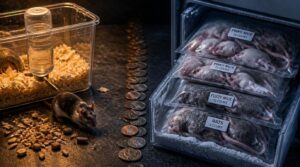
The price difference between live and frozen prey is bigger than most keepers expect. Beyond the per-prey cost, there are hidden expenses—housing, food, bedding—that quietly add up when you’re maintaining live rodents long-term. Here’s a breakdown of what actually affects your wallet and your storage space.
Live Prey Expenses
Most reptile owners underestimate how quickly live prey expenses add up. A single live mouse costs $0.60–$0.90 for hatchling sizes, climbing to $2.50 for larger feeders. Weekly budgets can hit $10 per animal.
Three costs that quietly drain your budget:
- Shipping and delivery fees — $5–$15 monthly from distant suppliers
- Protective equipment — gloves and tongs running $5–$15 monthly
- Seasonal price fluctuations — spikes during high-demand months
Frozen Bulk Savings
Switching to frozen prey isn’t just safer — it’s substantially cheaper at scale. Bulk purchase savings of 20–40% are standard, with frozen mice averaging $0.75 per unit versus $1.20 for live. Suppliers offer tiered volume discounts that grow with order size, and combined shipping on large orders cuts freight costs considerably.
| Purchase Type | Cost Per Unit | Monthly Savings |
|---|---|---|
| Single frozen | $0.75 | Baseline |
| Bulk frozen (case) | $0.52 | ~30% |
| Live feeder | $1.20 | None |
Inventory rotation benefits improve further when you buy in standardized case sizes, making FIFO tracking straightforward and reducing waste.
Shelf Life Benefits
Bulk savings compound quickly when your freezer works as a proper storage system. Frozen prey stored at -18°C carries a 6–12 month shelf life — compare that to live rodents, which demand daily care regardless of feeding schedules.
Vacuum packaging and modified atmosphere methods extend that window further, with cold chain integrity preserving both texture and nutritional value throughout.
Feeding Schedule Flexibility
Frozen prey hands you something live feeding never can: scheduling control.
Build a thaw window plan around your day — start thawing before work, feed that evening. Stagger your meal rotation strategy across the week so you’re never scrambling. Keep a thawed backup ready for missed windows.
Anchor feeding to consistent routine times, and gaps simply don’t happen.
Size Consistency
Matching prey to your snake’s gape isn’t guesswork — it’s precision. Prey diameter targets and batch size uniformity are where frozen feeding pulls clearly ahead. Every labeled size stays consistent across orders, letting you nail gape matching without the variability livestock brings.
Thaw shrinkage effects aside, feeding size repeatability makes frozen the smarter long-term choice for species-specific feeding behavior.
When Live Feeding May Happen

Frozen prey is the industry standard — but there are a few situations where live feeding is genuinely hard to avoid. Some snakes simply won’t respond to anything that isn’t moving, and certain life stages make that refusal even more stubborn. Here’s when live feeding becomes a legitimate consideration rather than a default choice.
Hatchling Feeding Challenges
Hatchlings are perhaps the most demanding feeders you’ll encounter. Their margin for error is almost nonexistent. Prey size fit is critical here — offer anything wider than the hatchling’s body and you’re risking refusal or, worse, a regurgitation event that can trigger a multi-week feeding reset.
- Use slightly undersized prey to build early confidence
- Maintain correct enclosure temperatures before every feeding attempt
- Apply tong-feeding movement to trigger the strike response in hesitant hatchlings
Picky Eater Cases
Some snakes simply won’t budge on live vs frozen prey. Sensory aversions — cold texture, stillness, unfamiliar scent — are usually the culprit. Gradual introduction through structured feeding routines converts most holdouts. A persistent picky eater creates a genuine nutritional tradeoff and cost analysis problem worth correcting early through selective acceptance strategies and deliberate behavioral triggers.
| Strategy | Purpose | When to Apply |
|---|---|---|
| Scenting frozen prey | Counters olfactory aversion | First conversion attempts |
| Tong movement | Activates behavioral triggers | Stillness-related refusal |
| Smaller prey size | Builds selective acceptance | After repeated rejection |
| Live prey (last resort) | Resets feeding response | Prolonged nutritional tradeoff risk |
| Consistent feeding routines | Reduces novelty stress | Every change feeding session |
Species-Specific Needs
Not every species plays by the same rulebook. A green tree python‘s behavioral feeding triggers differ sharply from a hognose snake’s dietary requirements — the former hunts by movement, the latter by scent.
Species-specific prey size, metabolic rate alignment, and calcium-phosphorus balance all shape whether live feeding becomes genuinely necessary rather than merely convenient.
Last-Resort Feeding
Sometimes, a snake simply won’t eat — and you’re left with a narrow window to act before the situation becomes a medical emergency.
Emergency Thawing Protocol starts in the refrigerator, then moves to a warm water bath until the prey’s core reaches 95–105°F. Never microwave. Use forceps to mimic movement, and discard anything that smells off.
Supervision Requirements
Never leave a live feeding session unattended — not even briefly.
- Handler oversight means staying within arm’s reach throughout the entire session
- Monitoring sessions lets you intervene the moment hesitation or prey retaliation occurs
- Safety checks confirm the enclosure is sealed and prey is removed if uneaten
- Veterinary consensus is clear: unsupervised live feeding is where most injuries happen
Switching Snakes to Frozen-Thawed
Switching a snake from live to frozen-thawed isn’t always smooth, but most will convert successfully with the right approach. The process comes down to a few key techniques that work together — not just one magic fix. Here’s what you’ll want to work through.
Proper Thawing Steps

Thawing frozen-thawed prey correctly is non-negotiable. Start by placing the frozen prey inside a leak-proof sealed bag, then submerge it in cold tap water — changing the water every 30 minutes.
Room temperature thawing creates dangerous bacterial growth windows and must be avoided entirely. Once thawed, feed immediately; refreezing or holding prey after thawing compromises both safety and quality.
Safe Feeding Temperature
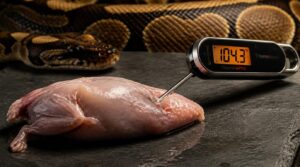
Once your prey is fully thawed, temperature becomes the next variable to control. Target a surface temperature of 95–105°F before offering it to your snake. Anything above 105°F risks oral burns; anything below 85°F often triggers outright refusal.
A calibrated probe thermometer confirms you’re in the safe feeding window — guesswork here isn’t good enough.
Tong-Feeding Movement

Once the prey hits that 95–105°F window, how you present it matters just as much as temperature.
- Tong grip control — hold prey at the body, keeping it steady so it doesn’t rotate unpredictably mid-strike.
- Head-path alignment — approach from the front, matching the snake’s natural strike trajectory.
- Post-insertion stillness — once the snake clamps, pause all motion and let swallowing progress naturally.
Scenting Frozen Prey

Movement gets a snake interested — scent gets it to commit.
Scenting frozen prey starts with rubbing the thawed item lightly against familiar bedding or another prey item to layer on a recognizable odor background. Natural prey scents — mouse, quail, or stored nesting material — outperform synthetic alternatives consistently. Warming prey to around 20–25°C briefly maximizes scent volatility without distortion.
Avoiding Refreezing

Refreezing thawed prey is one of the most common — and dangerous — mistakes in frozen-thawed feeding. Once prey exits the freezer, bacterial growth begins. The temperature danger zone (roughly 40–140°F) accelerates spoilage fast.
Portion prey into single meal amounts before freezing. If you miss the feeding window, discard it — never refreeze.
Frequently Asked Questions (FAQs)
Do ball pythons prefer live or frozen mice?
Ball pythons don’t really "prefer" in the way we might think. They respond to thermal and movement cues. Most accept frozen-thawed prey readily when it’s warmed correctly and presented with intention.
How does prey size impact digestion and health?
Prey size directly shapes digestive load. Oversized meals slow enzyme breakdown and gut motility, reducing nutrient absorption and risking regurgitation. Match prey width to your snake’s widest body point.
How often should adult snakes be fed prey?
Most adult snakes thrive on one prey item every 10–14 days. Match prey size to the snake’s widest girth, and let body condition guide adjustments.
Does prey color or appearance affect snake interest?
Color matters less than you’d think. Snakes rely far more on scent, heat, and movement than fur shade. Their dichromatic vision prioritizes contrast and outline over color differences.
Conclusion
The safest meal you can offer your snake is the one that never fights back. That paradox sits at the heart of the live versus frozen prey debate—and the evidence consistently lands on one side.
Frozen-thawed prey doesn’t compromise nutrition, reduce feeding success, or shortchange your animal. It removes the bite, the bacteria, and all the unpredictability.
Once you make the switch, you won’t wonder why you waited—you’ll only wonder why you hesitated.