This site is supported by our readers. We may earn a commission, at no cost to you, if you purchase through links.

A snake doesn’t shiver when it’s cold—it shuts down. Digestion stalls, immunity drops, and a snake sitting on an undersized heat mat with no thermostat is quietly suffering through all of it. Most new keepers focus on the enclosure size or the substrate, and the heating setup becomes an afterthought. That’s exactly when things go wrong.
Getting the thermal gradient right isn’t complicated, but the details matter—specific temperatures, probe placement, the right equipment for your species. Nail those, and your snake eats well, moves confidently, and stays healthy for years.
Table Of Contents
- Key Takeaways
- Create The Right Temperature Gradient
- Choose Safe Heating Equipment
- Install Heaters Step by Step
- Top 6 Snake Terrarium Heaters
- Monitor and Troubleshoot Temperatures
- Frequently Asked Questions (FAQs)
- What is the best way to heat a snake enclosure?
- How hot should my snake enclosure be?
- How do power outages affect snake terrarium temperatures?
- What substrate materials retain heat most effectively?
- How does enclosure size impact heating equipment requirements?
- Are there energy-efficient ways to heat a terrarium?
- Conclusion
Key Takeaways
- A snake can’t shiver to warm up, so, without a proper thermal gradient—a warm basking zone (88–95°F) and a cool retreat (75–85°F)—its digestion stalls and its immune system weakens.
- Always pair any heat source with a thermostat, since unregulated heat mats, emitters, or bulbs can either underheat your snake or cause dangerous hotspots.
- Skip heat rocks entirely—they create unpredictable temperature spikes and burn risk with no reliable way to control them.
- Check your setup regularly: calibrate thermostats monthly, verify surface temps with an infrared thermometer, and watch for warning signs like open-mouth breathing or restless climbing that signal something’s off.
Create The Right Temperature Gradient
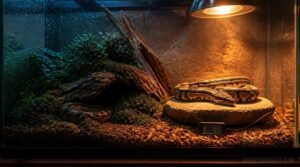
Getting the temperature gradient right is the foundation of everything else in your snake’s setup. Your enclosure needs to offer two distinct zones — a warm side for basking and a cool side for retreating — so your snake can regulate its own body temperature throughout the day.
Nailing this balance matters more than most keepers realize — learn how small shifts in your setup can silently affect health with this guide to maintaining consistent heat for corn snakes.
If you notice your snake constantly shifting spots, this guide on why snakes move between temperature zones can help you fine-tune the gradient until they’re truly comfortable.
For a deeper dive into heat mats, ceramic emitters, and thermostat pairing, the snake enclosure heating system guide walks you through building that gradient from scratch.
Here’s what each zone should look like and how to dial in the numbers for your specific species.
Warm Basking Zone
The warm basking zone is where digestion actually happens.
Keep it between 88 and 95 °F — that range drives the enzyme activity your snake needs to break down prey.
Place your heat source at one end, make it the brightest, most exposed spot in the enclosure, and run it through a thermostat to hold temperatures steady within a 2–4 °F window.
Make sure proper thermostat placement is near the basking surface for accurate temperature control.
Cool Retreat Zone
The cool retreat zone is your snake’s off-switch.
Keep the cool side between 75–85 °F — far enough from the basking end to create a real temperature differential. Dense substrate moisture, shaded microclimate vegetation, and thermal mass from rocks or décor all help hold that chill naturally. Without this zone, your snake can’t regulate its own body temperature — and that’s when problems start.
Without a cool retreat zone, your snake loses the ability to self-regulate — and that’s when problems start
Daytime Temperature Targets
Your snake’s daytime thermal environment isn’t one-size-fits-all.
Large arboreal species need a basking temperature of 90–93 °F, while most constrictors do well with a warm-side range of 84–89 °F. Keep ambient air between 77–82 °F to support digestion without stress.
A well-calibrated thermostat holds these targets steady — letting your snake move through a smooth, continuous gradient all day.
Nighttime Temperature Drop
Your terrarium doesn’t run the same schedule at night. A controlled night temperature drop of 5–10 °F helps maintain your snake’s circadian rhythm while mirroring natural nocturnal cooling. Don’t skip it.
- Set your thermostat’s night mode
- Watch for temperature fluctuations after midnight
- Maintain thermal stability across both zones
- Keep nighttime heating consistent and reliable
- Never let cool end breach species tolerance
Species-specific Ranges
Every species runs its own internal clock — and its own thermal environment. Species-specific temperature ranges aren’t optional; they’re hard survival requirements. Corn snake targets sit noticeably lower than ball python requirements, and juvenile metabolism needs push temperatures 2–4 °F higher than adult conspecifics. Arboreal vertical gradients add real complexity for climbing species. Use this table to set things up accurately.
| Species | Basking Temperature | Cool-Side Thermoregulation Zone |
|---|---|---|
| Corn Snake | 82–86 °F | 72–75 °F |
| Ball Python | 88–92 °F (hide) | 74–78 °F |
| Crested Gecko (Tropical) | ~82 °F | 70–75 °F |
| Bearded Dragon (Desert) | 104–107 °F | 80–85 °F |
| Arboreal Species | +40–60% radiant output | Vertical temperature gradient required |
Choose Safe Heating Equipment

The heating equipment you choose will make or break your temperature gradient — and not all options work the same way. Each type has a specific job, a safe use case, and real limits you need to know before buying. Here’s what’s actually worth using:
Heat Mats and Pads
Heat mats offer steady belly warmth — the ground-up heat snakes naturally seek.
- Always pair under tank heating with a thermostat for safe temperature regulation
- Your mat placement strategy: one end only, substrate under 1 cm for substrate heat transfer
- Check waterproofing safety features and perform a mat durability inspection monthly
Never fold your reptile heating pad — flat contact prevents hotspots.
Ceramic Heat Emitters
Unlike heat mats, ceramic heat emitters push infrared radiation straight into basking spots — no visible light, no sleep disruption.
| Feature | Detail |
|---|---|
| Wattage range | 60–100 W |
| Surface temperature | 120–180 °F |
| Socket requirement | Ceramic or porcelain only |
| Thermal shock resistance | Withstands rapid on/off cycling |
| Thermostat pairing | Required — always |
Mount one above the warm end, plug it into a digital thermostat, and you’ve got round-the-clock reptile heating. Ceramic element durability outlasts most alternatives — but inspect monthly for discoloration.
Radiant Heat Panels
Mounted on the ceiling, radiant heat panels push infrared radiation straight down — warming your snake directly, not just the surrounding air. That’s cleaner, more efficient reptile heating.
- Target a 104–140 °F basking temperature surface range
- Use 100–150 W for standard tall enclosures
- Build a reliable vertical temperature gradient top to bottom
- Always pair with a thermostat for precision control
- High emissivity surfaces cut energy use considerably
Heat Projector Bulbs
For nocturnal activity support, a heat projector bulb is among the best reptile heating equipment you can choose. Its quartz base resists thermal shock and withstands high humidity well. The infrared beam pattern delivers focused warmth to a defined basking spot — no mess. Match wattage for reliable temperature control.
| Wattage | Use Case |
|---|---|
| 60W | Small |
| 75W | Medium |
| 100W | Large |
| 125W | Tall |
Avoiding Heat Rocks
Skip heat rocks entirely — they’re one of the few pieces of reptile gear that causes more harm than good.
- Localized hotspots can burn your snake without warning
- Temperatures spike unpredictably, blocking natural thermoregulation
- Uneven heat draws moisture from substrate, risking dehydration
- No reliable thermostatic control means no safe belly heat
Stick to mats, emitters, or panels — and always verify surface temps with an infrared thermometer.
Install Heaters Step by Step
Buying the right heater is only half the job — where and how you install it determines whether your snake actually benefits from it. Getting the placement wrong can mean cold spots, burns, or a thermostat reading that doesn’t reflect what your snake is actually feeling. Here’s exactly how to set each component up correctly.
Warm-end Placement
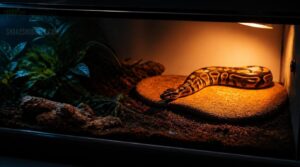
Place your heat source at one end only — never centered. That single decision creates the thermal gradient that your snake depends on.
This placement mimics the natural temperature variation reptiles seek in the wild, and understanding exactly why it matters starts with knowing how ambient and surface temperatures differ for reptiles.
Young snakes are especially sensitive to temperature stress, so getting that gradient right matters even more — ball python hissing and stress signals can help you recognize when your setup needs adjusting.
Keep basking spots clear of rocks or heavy decor so heat distributes evenly across the warm side. A non-slip basking surface lets your snake stretch out fully and stay put while absorbing heat comfortably.
Proper Substrate Depth

Depth matters more than most keepers realize. Aim for 1 cm or less above an under-tank heater — thin substrate transfers belly heat efficiently. Go thicker and you’re insulating the heater, not your snake.
Burrowing species need 4 – 6 inches of loose substrate for natural digging. Bioactive setups benefit from similar depth to support invertebrates.
Thermostat Probe Position

Your thermostat is only as accurate as where you stick the probe. Substrate interface placement is the sweet spot — 2–3 cm beneath the warm end, not directly under the heater itself.
- Avoid hotspots by keeping the sensor away from the heat mat’s center edge
- Use a clip to prevent shifting during cleaning
- Protect sensor wires from chewing with a cable sleeve
- Run a dual probe strategy — warm end and cool end simultaneously
Guarded Heat Fixtures

Once your probe is locked in, the fixture itself matters just as much. Guarded heat fixtures wrap a protective metal guard around bulbs and heating elements — cutting burn risk by 60–80% and reducing hotspot formation by up to 30%. They also promote one-dimensional heat flow, preventing edge losses that throw off your gradient. Always use ceramic or porcelain sockets — never plastic. Plastic melts under load, creating a serious electrical fire risk.
| Guarded Fixture Feature | Practical Benefit |
|---|---|
| Metal guard enclosure | Blocks direct snake contact with hot surfaces |
| One-dimensional heat flow | Delivers even heat, eliminates edge losses |
| Automatic shutoff | Cuts power when temps exceed safe limits |
| Guard zone stability | Prevents radial heat bleed into surrounding areas |
| Sensor calibration accuracy | Keeps readings within ±0.5°C of true temperature |
Secure Cord Routing
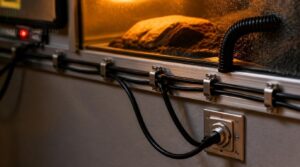
Once heaters are secured, cord routing deserves the same care. Run cables along the terrarium frame using clips every 20 cm — keeping them off the substrate and clear of heat sources.
- Wrap cords in split loom tubing near moisture zones
- Form a drip loop before each plug
- Add strain relief fittings at entry points
Label both ends to prevent unplugging mistakes.
Top 6 Snake Terrarium Heaters
With the installation basics covered, the next step is picking a heater that actually fits your setup. These six options cover a range of budgets, tank sizes, and heating styles — so there’s something here whether you’re housing a corn snake or a ball python. Here’s what’s worth considering.
1. iPower 8×12 Reptile Heat Pad
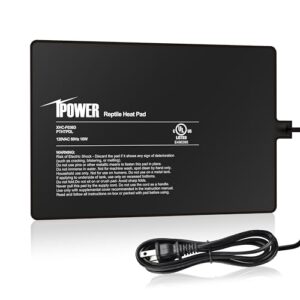
The iPower 8×12 heat pad punches above its weight for small to mid-size tanks. At 16 watts and 120V, it delivers steady, localized warmth — enough to establish a defined warm zone in enclosures up to 40 gallons.
The PTC heating film distributes heat evenly across its 8×12-inch surface, and the 3M adhesive keeps it locked in place.
One non‑negotiable: pair it with an external thermostat, because this pad has no built-in temperature control.
- Even heat distribution from PTC film keeps warm zones consistent without hot spots
- 3M adhesive holds firmly and removes cleanly, making installation and repositioning hassle-free
- At 16W, it costs less to run than higher-wattage alternatives without sacrificing performance for small to mid-size tanks
- No built-in thermostat means you’ll need to buy an external temperature controller separately
- Bottom-mounting under solid surfaces is a fire hazard, so placement options are limited to sides or elevated positions
- Won’t cut it for tanks over 40 gallons without adding supplemental heat sources
2. Aiicioo Under Tank Heater Thermostat
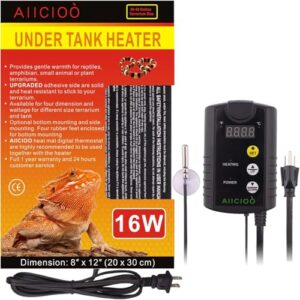
If the iPower is the heat source, the Aiicioo Under Tank Heater Thermostat is the brain behind it — and it pairs naturally with that 8×12 pad.
The digital display shows both current tank temperature and your target setpoint simultaneously, so you’re never guessing. Its external probe monitors the warm end directly, keeping output steady without overshoot.
Setup is plug-and-play. The 3-button interface keeps adjustments simple, and it accommodates both Fahrenheit and Celsius — useful when following species-specific guides that mix units.
- Displays current and target temperature at the same time, so you always know exactly what’s happening in the tank
- External probe gives accurate real-time readings at the warm end, preventing dangerous temperature swings
- Supports both °F and °C, making it easy to follow care guides without mentally converting units
- In cooler rooms, the 16 W heater may struggle to hit higher setpoints, and the thermostat can lag behind actual temps
- Adhesive bond to glass can become permanent, so placement needs to be decided carefully from the start
- Only compatible with glass tanks — plastic, acrylic, and water-filled enclosures are off the table
3. Tikaton Adjustable Reptile Heat Pad
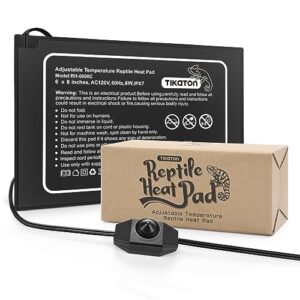
The Tikaton takes a simpler approach — no digital display, no external probe — just a manual dial that lets you nudge warmth up or down directly.
It comes in three sizes: 8 W at 6×8 in, 16 W at 8×12 in, and 24 W at 8.5×18.5 in. The flexible PVC surface bends cleanly around tank corners, and the IPX67 waterproof rating manages humidity without issue.
One honest note: always pair it with a separate thermometer. The dial alone won’t tell you exact temperatures.
- Three size options cover a range of enclosures, and the flexible PVC surface makes installation straightforward
- IPX67 waterproofing handles humid setups without worry
- Runs on very little power, so ongoing energy costs stay minimal
- The dial isn’t a true thermostat, so you’ll need a separate thermometer to know what’s actually happening inside the tank
- Adhesive can be hit or miss — surface prep matters more than you’d expect
- Struggles to keep up in larger tanks (30 gal) or cold rooms, where you may need additional heat sources
4. BNLINK Reptile Heater Thermostat
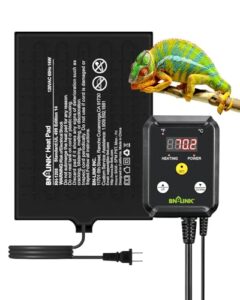
The BNLINK bundles a digital thermostat and heat mat together — so you’re not hunting for compatible parts separately. The 8×12 in pad runs at 16 W and suits 30–45 gallon tanks well.
Set your target anywhere between 40–108 °F using the simple 3-button interface, and the LED indicators confirm the heater is actually running.
One thing to watch: position the probe at least 3 inches from the pad or you’ll get false readings.
- Digital thermostat and heat mat come bundled together, saving you the hassle of sourcing compatible parts
- Simple 3-button interface with LED indicators makes monitoring and adjusting temperatures straightforward
- Flexible, adhesive-backed pad works on a variety of glass tank shapes and sizes
- Adhesive backing can stick unevenly and may damage the pad or tank surface when removed
- A built-in 2–3 °F buffer before the heater kicks back on can cause slight temperature fluctuations
- Only safe for glass tanks — using it on wood or other surfaces creates heat transfer issues and safety risks
5. Pymeter Reptile Heating Pad
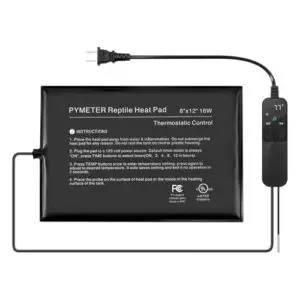
The Pymeter stands out with its built-in PID thermostat and timer — a combo most pads in this range don’t offer. The 8×12 in pad draws just 16 W and fits 30–40 gallon tanks comfortably.
The integrated 12-hour timer lets you automate day/night cycles without a separate controller. Set your target between 40–131 °F and the PID holds it within ±1 °F.
Keep the probe inside the regulated zone — not directly on the pad surface — for accurate readings.
- Built-in PID thermostat holds temps within ±1 °F, so you’re not constantly adjusting
- Integrated 12-hour timer automates day/night cycles right out of the box
- Nano adhesive bonds cleanly to glass and leaves no residue if removed
- Thick substrate or glass walls reduce heating efficiency
- May not produce enough heat for larger or heavily insulated enclosures
- Probe placement matters — wrong positioning throws off temperature readings
6. Aiicioo Under Tank Heater
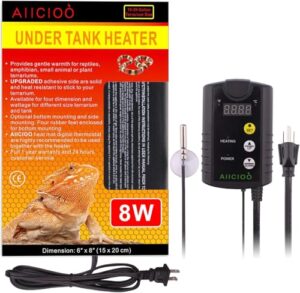
The Aiicioo rounds out this list as a straightforward, no-frills option. The 8×12 in pad runs at 16 W and mounts to the outside bottom of glass tanks up to 60 gallons. Its digital thermostat targets 68–108 °F — enough range for corn snakes and ball pythons alike.
Setup is plug-and-play. Use the included rubber feet to raise the tank slightly and keep airflow moving under the pad — skipping this step risks localized overheating fast.
- Built-in digital thermostat with a wide 32–140 °F display range makes it easy to dial in precise temperature zones for heat-sensitive animals
- Flexible mounting options (bottom or side) plus included rubber feet give you more placement versatility than most basic heat mats
- Plug-and-play setup with no extra wiring means it’s genuinely beginner-friendly right out of the box
- Only compatible with glass tanks — plastic, acrylic, and water-filled enclosures are off the table entirely
- Adhesive backing can degrade over time, leading to poor contact and uneven hot spots across the pad
- Some users find the thermostat programming unintuitive, which can be frustrating when you need precise temperature control
Monitor and Troubleshoot Temperatures

Getting the heat right is only half the job — keeping it right is what actually protects your snake. A few simple habits will help you catch problems before they turn serious. Here’s what to check and watch for.
Digital Thermometer Checks
Even a small temperature spike can throw off your snake’s digestion — so check readings daily. Place your probe 2–3 cm beneath the substrate at both ends.
Most digital thermometers respond within 2–10 seconds; wait for the reading to stabilize. Calibrate monthly against ice water.
Low battery voltage skews accuracy, so replace batteries every 1–2 years.
Infrared Temperature Readings
Digital probes tell you what’s happening beneath the substrate — but an infrared temperature gun shows you the actual surface your snake touches.
Point it at the basking spot, not through glass — glass distorts infrared transmission entirely. Keep your distance consistent and aim at matte, non-reflective surfaces for the most reliable reads. Shiny plastic skews readings by several degrees.
Monthly Thermostat Calibration
An infrared gun catches surface temps — but your thermostat needs to be accurate too, or every reading lies.
Once a month, run this quick check:
- Place a reference thermometer beside the probe
- Take three readings at 5-minute intervals
- Calculate the average offset
- Adjust using your device’s calibration control, then recheck after 15 minutes
Log the date and offset every time. Drift beyond ±1°F signals a sensor placement error worth investigating.
Cold Enclosure Fixes
When your snake’s enclosure drops below 75°F minimum, act fast — cold disrupts digestion and can trigger dangerous hibernation stress.
Keep emergency heat packs nearby as backup power sources during outages. Seasonal warmth adjustments matter too — winter drafts quietly erode your thermal gradient, collapsing temperature zones without warning. Check your cold side regularly and insulate glass panels with foil to stabilize temperature monitoring year-round.
Overheating Warning Signs
When thermal runaway sets in, your snake reacts well before the thermometer does. Watch for open-mouth breathing, a darkened mouth color, or erratic movement — all classic thermal stress indicators.
Climbing persistently toward vents signals evaporative seeking behavior; refusing warm hides points to clear substrate avoidance.
Don’t ignore sudden temperature spikes — they compromise heat source safety and demand immediate thermostat correction.
Frequently Asked Questions (FAQs)
What is the best way to heat a snake enclosure?
The best approach combines a heat mat for belly warmth with a thermostat for precise control — creating a clear thermal gradient your snake can move between freely and safely.
How hot should my snake enclosure be?
Your enclosure needs a warm basking zone of 88–95 °F and a cool retreat of 75–85 °F — giving your snake room to regulate its own body temperature naturally.
How do power outages affect snake terrarium temperatures?
When the lights go out, your terrarium loses heat faster than you’d expect. Ambient room temperature pulls the warm side down first — thermal drift follows quickly, impairing digestion and stressing your snake within just a few hours.
What substrate materials retain heat most effectively?
Dense natural stones like basalt and soapstone absorb heat slowly and release it for hours. Fired clay tiles and ceramic bricks work similarly. Coco coir retains latent warmth through moisture — aspen dries faster and cools quicker overnight.
How does enclosure size impact heating equipment requirements?
Bigger tanks are heat sinks — surface area losses scale fast. Scale heat output accordingly, use zoned heating, and boost insulation R-values to cut wattage needs without cold spots forming across the gradient.
Are there energy-efficient ways to heat a terrarium?
Yes — ceramic heat emitters and radiant panels use 35% less electricity than standard bulbs. Pair them with a smart thermostat and LED lighting under 10W to cut energy consumption without sacrificing gradient control.
Conclusion
Like a thermostat locked onto its target temperature, your snake has no way to compensate when the setup fails—it simply shuts down and quietly suffers.
That’s why knowing how to heat a snake terrarium properly matters beyond equipment choices alone.
Verify your probe placement, run monthly calibration checks, and never trust feeling the glass over a real thermometer reading.
Get the gradient right, and everything else—feeding, shedding, and long-term health—falls into place.