This site is supported by our readers. We may earn a commission, at no cost to you, if you purchase through links.
Most snakes in captivity spend their lives in enclosures that technically keep them alive but offer nothing close to what their instincts expect. A bare glass box with a paper towel substrate and two hides isn’t enrichment—it’s a waiting room.
Wild snakes navigate layered environments: shifting temperatures, textured ground, the faint humidity beneath leaf litter, and the psychological cover of dense foliage. When you recreate those conditions instead of approximating them, something shifts.
Your snake moves with purpose, feeds more reliably, and shows none of the restless glass-surfing that signals chronic stress. Making a snake terrarium feel natural isn’t about aesthetics—it’s about building a system that works the way the wild does, layer by layer.
Table Of Contents
Key Takeaways
- A naturalistic terrarium isn’t just about looks — layered substrate, proper thermal gradients, and live plants work together as a functioning system that mirrors how wild environments actually operate. naturalistic terrarium
- Snakes in barren setups glass-surf up to 70% of their active hours, so matching enclosure design to your specific species’ lifestyle (arboreal vs. terrestrial, burrower vs. surface-dweller) is the single most impactful welfare decision you’ll make. glass-surf up
- Substrate depth, drainage layers, and a cleanup crew of isopods and springtails turn the enclosure floor into a self-maintaining microecosystem that manages humidity, waste, and microbial balance with minimal intervention. self-maintaining microecosystem
- Consistent weekly enrichment rotation, seasonal climate adjustments, and daily behavioral checks are what keep a natural setup actually working long-term — a thriving snake shows it through steady feeding, calm movement, and zero stress behaviors. steady feeding
Start With a Natural Habitat Plan
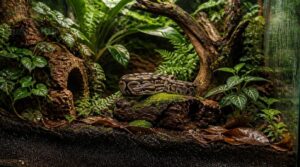
Before you buy a single plant or place one hide, you need a clear picture of what your snake actually needs. Every good terrarium starts with a plan that mirrors the animal’s natural world — and that means thinking through a few key decisions before anything else. Here’s where to begin.
A solid starting point is this guide to building snake terrariums, which walks through materials, layouts, and species-specific needs before you spend a dime.
Match Your Snake’s Species
Before you buy an enclosure or pick a substrate, you need to know exactly what species you’re keeping. A corn snake’s needs look nothing like a green tree python‘s.
- Arboreal vs. terrestrial lifestyle shapes every design decision
- Feeding schedule and prey size vary considerably by species
- Temperament and handling tolerance determine enrichment needs
Match the habitat to the animal first.
Choose Terrestrial or Arboreal
Once you know your species, the next decision shapes everything else: terrestrial or arboreal.
Terrestrial snakes need wide, horizontal floor space for ground exploration.
Arboreal species need vertical climbing structures and tall enclosures — their slender bodies and prehensile tails are built for branches, not floors. Match the orientation to how your snake naturally moves. Arboreal snakes benefit from strong limbs and grasping digits for climbing.
Map Warm and Cool Zones
With your setup’s orientation decided, it’s time to map your thermal gradient. Place your heat source at one end to create a basking spot of 88–92 °F, leaving the opposite end at 75–80 °F.
Use digital thermometers in both zones — guessing temperatures risks your snake’s health. Snakes self‑regulate by moving between zones, so both sides matter equally.
Plan Hides and Pathways
Once your thermal zones are mapped, hides and pathways give that gradient real purpose.
Place cork bark hides at multiple vertical levels — ground, mid, and elevated — to mirror natural shelters. Design pathways in a looped, maze-like layout connecting warm and cool zones. Rotate hides seasonally to maintain novelty:
- Add burrowing retreats partially buried under substrate
- Use visual barriers along paths for perceived security
- Choose non-toxic, easy-to-clean materials throughout
Prioritize Escape-Proof Security
Every escape starts with a flaw you overlooked. Lid latch reliability is your first line of defense — snap-locked lids with tamper-resistant latches prevent even the strongest coils from forcing an opening. Pair that with silicone seal integrity along the inner rim, keeping all edge gaps under 2 millimeters.
Run daily security inspections after every handling session without exception.
Choose a Properly Sized Enclosure
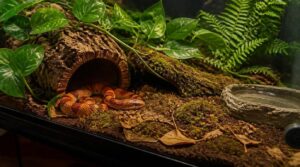
Getting the enclosure size right is the foundation everything else builds on. Before you add substrate, plants, or hides, you need a setup that actually fits your snake and keeps it secure. Here’s what to look for when choosing the right enclosure.
Since a snake’s size and behavior patterns naturally shape its space requirements, learning more about carpet python size and temperament traits can help you pick dimensions that match your specific snake.
Full Body-Length Minimum
Start by measuring your snake snout to tail tip, then add 2–3 inches of movement clearance. That final number is your minimum enclosure length.
For most species, one and a half times body length gives enough room for a full thermal gradient, comfortable linear ambulation, and space for hides and climbing structures without crowding your snake.
Secure Locking Lid
Lid failure is responsible for roughly 70% of snake escapes — and most are entirely preventable. Choose enclosures with double-door locking mechanisms and solid grommets that eliminate gap points where pressure builds.
Pairing a secure lid with proper nighttime heat management for snakes ensures your setup supports both escape prevention and healthy thermal rhythms.
- Install wire locks on sliding doors
- Inspect grommet seals monthly
- Use secure vivarium latches on every access point
- Test lid resistance before every feeding
Safe Ventilation Flow
Good ventilation is the silent backbone of a healthy enclosure.
Aim for 5–10 air changes per hour, positioning intake vents near the cool zone and exhaust near the warm side to encourage natural convective flow. This cross ventilation keeps CO₂ and moisture from pooling.
Avoid placing vents directly above basking spots — you’ll lose heat and humidity fast.
Glass, PVC, or DIY
The material you build with shapes everything — visibility, humidity retention, and long-term durability.
Glass enclosures offer crystal-clear observation and are easy to seal with fish-safe silicone. PVC panels retain heat more evenly, resist moisture, and weigh less. DIY builds let you match exact species requirements. Whatever you choose, use non-toxic sealants at every joint.
Room for Natural Movement
A cramped enclosure isn’t just uncomfortable — it actively stresses your snake. Keep ground pathways continuous and obstruction-free to support slithering path continuity. Add elevation changes through ramps and branches for climbing behavior. Clear sightlines between hides reduce anxiety:
- Open floor zones for full-body flattening
- Varied branch diameters for climbing opportunities
- Gentle ramps supporting microhabitat navigation
- Multiple hide access angles
- Unobstructed sightlines for stress reduction
Build Natural Substrate Layers
What’s underneath your snake matters more than most keepers realize. The substrate layers you build determine how well your enclosure holds humidity, facilitates burrowing, and stays clean over time. Here’s how to layer it right, from the ground up.
Species-Appropriate Substrate Depth
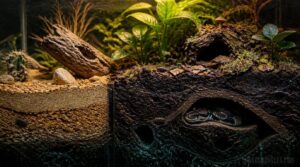
Every snake species digs, rests, or climbs differently — and your substrate depth needs to reflect that.
| Species Type | Recommended Depth | Key Purpose |
|---|---|---|
| Surface-dwelling | 2–3 inches | Humidity buffering, easy cleaning |
| Arboreal | 3–5 inches | Anchor stability, occasional burrowing |
| Medium burrowers | 4 inches | Burrowing tunnel stability, thermal gradient |
| Large fossorial | 4–6 inches | Full submersion, multiple tunnel levels |
| Desert species | 2–3 inches | Shallow escape routes, impaction prevention |
Substrate depth directly affects how well your snake thermoregulates. Deeper beds create a vertical thermal gradient inside burrows, letting snakes choose their preferred temperature without breaking cover. For burrowing species, going shallower than four inches collapses tunnels and forces your snake into stressful open exposure.
Shallow substrate collapses tunnels and forces burrowing snakes into stressful open exposure
Moisture retention also depends on depth. A two-inch bed dries fast after misting, causing humidity swings that stress sensitive species. Four inches or more slows those fluctuations, giving your microfauna — isopods and springtails — stable conditions to thrive and process waste effectively.
Impaction risk rises when substrate is too shallow and snakes accidentally ingest loose particles while feeding. Maintaining appropriate depth for your species reduces that risk and keeps the enclosure functioning naturally.
Drainage Layer Setup
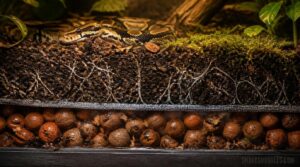
Once your substrate depth is locked in, the layer beneath it becomes just as important. A drainage layer — commonly 1–2 inches of expanded clay pellets (LECA) or coarse gravel — sits at the enclosure’s base, pulling excess moisture away from roots and microfauna. Without it, water pools, oxygen disappears, and anaerobic zones develop fast, producing toxic gases that harm your snake.
- Use 8–20 mm aggregate — coarse enough to move water quickly without trapping fine particles.
- Lay a geotextile barrier on top to stop substrate from migrating down and clogging drainage paths.
- Slope the layer slightly toward one corner to encourage gravity-driven water movement rather than standing puddles.
- Keep the drainage layer separate from your main substrate; mixing them undermines the whole system.
A mesh screen over the aggregate reinforces that separation. Together, these layers keep moisture where it belongs — in your substrate, not pooling at the bottom and rotting everything above it.
Soil, Sand, and Bark
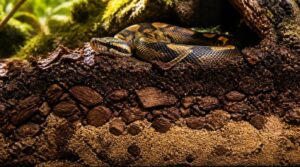
With your drainage layer in place, the real composition work begins. What fills the space above it determines how well your snake thrives day to day.
Soil, sand, and bark each serve a distinct role. The recommended blend — 40% organic topsoil, 30% play sand, 20% orchid bark, and 10% activated charcoal — balances moisture retention with drainage and microbial support.
| Component | Primary Benefit |
|---|---|
| Play sand | Fast drainage, burrowing support |
| Orchid bark | Air pockets, slow decomposition |
| Organic topsoil | Moisture retention, microbial life |
Sand particles between 0.05 and 2 mm move water quickly without compacting under your snake’s weight. Orchid bark decomposes slowly, continuously releasing organic matter that feeds your cleanup crew and keeps the substrate structure open. Together, they create a living foundation — not just filler.
Leaf Litter Coverage
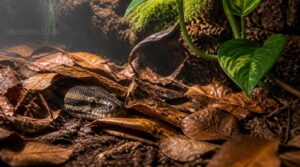
With your substrate blend set, leaf litter is the finishing layer that ties everything together. Scatter 1–2 inches of organic leaf litter — oak and maple work well — across the surface.
It slows evaporation, buffers temperature swings, shelters isopods, and feeds the microbial community below, completing your naturalistic substrate layer and supporting a self-sustaining microhabitat.
Burrowing Space Requirements
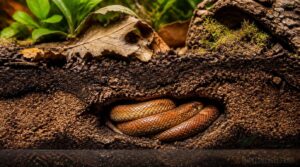
If your snake burrows, depth matters more than floor space.
Burrowing species need 4–6 inches of sandy-soil mix — roughly 60% play sand to 40% organic topsoil — loose enough to excavate safely without collapsing.
Pack it too firmly and you’ve built a wall, not a habitat. Test compaction by pressing two fingers in: soil should give easily to mid-knuckle depth.
Add Plants, Branches, and Hides
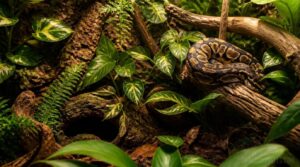
Once your substrate layers are down, it’s time to build the world your snake will actually live in. What you add next — plants, hides, and climbing structures — shapes how safe and stimulated your snake feels every single day. Here’s what to include and why each piece matters.
Snake-Safe Live Plants
Live plants do more than look good — they actively regulate humidity and give your snake places to feel hidden and secure. Pothos and spider plant are reliable choices: non-toxic, low-light tolerant, and nearly indestructible. Snake plant navigates drier conditions well and offers vertical structure.
Quarantine new plants for two to three weeks before introducing them. Always root-wash to remove chemical residues from fertilizers or systemic pesticides.
Cork Bark and Rock Hides
Cork bark and rock hides are your two most effective sheltering options.
Cork bark insulates naturally, buffering both temperature swings and humidity without becoming waterlogged. Hollow cork rounds mimic forest crevices snugly. Rock hides conduct heat and create cave-like microclimates.
Together, they break sightlines, reduce stress, and give your snake genuine security on both warm and cool sides.
Sterilized Branches and Logs
Branches bring a terrarium to life — but only if they’re safe. Sterilize hardwoods like oak, beech, or maple by heating them above 71°C internally. Avoid chemically treated lumber entirely.
- Remove loose bark before sterilizing
- Cool branches completely before placing them
- Inspect regularly for cracks or soft spots
Natural curves create climbing variety and thermal refuges that genuinely reduce stress.
Visual Barriers for Security
A snake that can’t see out feels safer than one on display. Dense pothos, snake plants, and Boston ferns create natural visual barriers that break sightlines and lower stress considerably. Position taller plants toward the back and sides, leaving clear pathways through the center.
| Barrier Type | Security Benefit |
|---|---|
| Pothos vines | Drapes naturally, concealing movement |
| Snake plant | Vertical coverage, stable humidity |
| Cork bark slabs | Solid concealment, thermal refuge |
| Boston fern | Soft masking, humidity indicator |
Rotating plant arrangements weekly increases activity by up to 30% while preventing your snake from habituating to a static layout.
Climbing Structures for Arboreal Snakes
For arboreal snakes, vertical space is the habitat. Arrange branches at 15–30 cm intervals, using diameters between 2–6 cm so your snake can grip comfortably without overcrowding.
Cork bark and untreated driftwood climbing structures provide the friction needed on steeper angles. Connect bottom to top with no dead ends, letting your snake navigate continuous 3D pathways naturally.
Balance Heat, Light, and Humidity
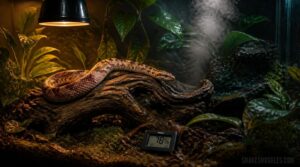
Getting the climate right inside your terrarium is what separates a snake that thrives from one that just survives. Every variable — heat, light, and humidity — works together, and adjusting one almost always affects the others. Here’s what you need to set up each element correctly.
Warm and Cool Sides
Think of your snake’s enclosure as a thermal highway — one end warm, one end cool, and your snake deciding which lane to travel based on its needs. Aim for 28–32 °C on the warm side and 22–26 °C on the cool side, maintaining a 6–10 °C gradient that drives natural thermoregulation movement patterns.
Place digital thermometers at mid-level in both zones so you’re reading actual habitat temperatures, not guesses. Shield your heat source to prevent direct contact, and keep the cool zone free of direct heat to preserve consistent conditions — this promotes your snake’s circadian rhythm and long-term health.
Safe Basking Spot Placement
Once your thermal gradient is set, the basking spot is where that warmth becomes actionable. Position your heat lamp directly above a flat, non-porous surface — sealed cork or untreated stone works well — placing it within your snake’s natural travel path. Keep the surface temperature between 88–92 °F, verified with an infrared thermometer, and always make sure a quick retreat is inches away.
- Use roughened, grip-friendly materials like sanded lava rock or cork bark to prevent slipping during basking transitions.
- Space the heat source dimensionally above the platform to buffer against temperature spikes — a shallow ramp helps here.
- Position the platform away from enclosure edges to eliminate tipping risks and accidental falls.
Never use glossy or porous surfaces near the heat zone — they either overheat the snake’s underside or absorb bacteria. Keep the basking platform removable for easy cleaning, and recheck surface temperatures after every bulb replacement.
UVB and Day-Night Cycles
Once your basking surface is dialed in, lighting becomes the next layer of control. Install a UVB 5.0 bulb covering two-thirds of the enclosure, positioned 20–30 cm above the basking zone. This distance ensures adequate UV irradiance for vitamin D synthesis and calcium metabolism.
Run it on a strict 12-hour on, 12-hour off schedule using a digital timer — consistent light cycles regulate your snake’s circadian rhythm, directly influencing feeding, shedding, and activity patterns. Replace UVB bulbs every 6–12 months, as output fades invisibly long before the visible light does.
Hygrometers and Thermometers
You’ve set the light schedule — now make sure your readings are just as precise.
Use digital thermometers placed in both the warm and cool zones, and mount a calibrated hygrometer at mid-level on each side.
Most consumer hygrometers carry ±3–5% RH accuracy, so recalibrate periodically using a salt solution to keep your humidity control reliable.
Misting and Water Bowls
Misting and maintaining water bowls serve two distinct but equally important roles — one drives ambient humidity, the other ensures direct hydration.
Mist one to three times daily for 5–15 minutes, adjusting frequency by species. Place a shallow, non-slip bowl on the cool side. Clean it daily with reptile-safe soap, and rinse thoroughly before refilling.
Maintain a Living Natural Setup
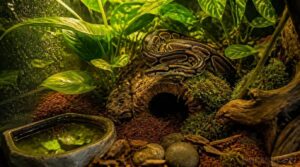
Once you’ve dialed in the climate, keeping that natural environment thriving takes consistent, manageable habits. A living setup runs on a few key routines that work together to maintain balance without overwhelming your schedule. Here’s what to stay on top of.
Bioactive Cleanup Crew
Think of your substrate’s cleanup crew as a self-regulating sanitation team working around the clock. Start with 20–30 dwarf white isopods (Trichorhina tomentosa) and roughly 100–300 springtails per gallon.
Isopods break down decaying matter; springtails target mold. Together, they cycle nutrients back into your soil.
Quarantine new cultures briefly before introducing them to avoid importing pests.
Spot Cleaning Routine
Even with an active cleanup crew handling routine waste, spot cleaning is non-negotiable. Inspect the enclosure daily and remove visible waste within 24 hours of noticing it.
- Use a soft microfiber cloth and a reptile-safe cleaner or plain water
- Apply minimal liquid to avoid soaking deeper substrate layers
- Replace any contaminated substrate immediately to prevent odor buildup
- Monitor residual moisture afterward, as damp spots affect enclosure humidity
Weekly Enrichment Rotation
Rotate enrichment items on a seven-day cycle to keep your snake mentally engaged. Swap scent cues, textures like bark or smooth stone, and foraging elements across three to five distinct groups.
Never repeat the same item pair in back-to‑back weeks. After each rotation, log activity and appetite — stress signals mean: simplify immediately.
Seasonal Habitat Adjustments
Your snake’s enclosure doesn’t exist in a vacuum — the outside world shifts, and so should the habitat inside.
As ambient temperatures drop in autumn, reduce basking spot heat slightly to mirror natural cooling. Shorten UVB cycles from 12 hours toward 10. Scale back misting frequency to manage humidity fluctuation without causing respiratory issues. These gradual adjustments ease your snake through each seasonal acclimation period safely.
Stress and Health Checks
A healthy snake tells you everything — if you know how to look.
Check body condition score weekly by feeling for fat coverage along the ribs and spine.
Watch for respiratory stress signs like open-mouth breathing or gaping at rest.
Monitor waste quality, noting stool form and urate color.
Consistent behavioral shifts often surface problems before physical symptoms appear.
This is especially true when you’re navigating housing snakes and lizards together, where stress from an incompatible setup can trigger subtle behavioral changes long before illness sets in.
Frequently Asked Questions (FAQs)
Can you make a snake enclosure bioactive?
Yes — a bioactive setup turns your enclosure into a living microecosystem. A cleanup crew of isopods and springtails drives organic waste decomposition, while a proper drainage layer and substrate mix sustain long-term ecosystem stability.
How often should I feed my terrarium snake?
Feeding frequency depends on your snake’s age, size, and species. Hatchlings eat every 5–7 days, adults every 10– Adjust prey size to match girth — and watch body condition closely.
Before settling on a feeding routine, it’s worth checking which snakes actually stay small enough for a 20-gallon tank, since enclosure size and growth potential shape how much and how often you’ll be feeding.
Because larger species can safely fast much longer than small hatchlings, it’s worth checking how long a snake can go without eating before assuming a skipped meal is cause for concern.
Can snakes recognize their owners over time?
Your snake won’t remember your face, but it remembers your scent. Through consistent handling and feeding routines, it learns you’re safe — a recognition built on chemistry and repetition, not emotion.
What signs indicate my snake is about to shed?
Your snake is getting ready to shed when its eyes turn cloudy or milky, colors fade dull, appetite drops, and it hides more while rubbing against rough surfaces.
How do I introduce a second snake safely?
Rushing two snakes together is a recipe for stress or injury. Quarantine both for 4 weeks, swap bedding for scent familiarization, then allow brief visual exchange sessions before any contact.
When should I take my snake to a vet?
Take your snake to a vet if it refuses food for 2–3 months, shows breathing trouble, limp behavior, mouth swelling, or fails to shed completely.
Conclusion
Studies show captive snakes in barren setups, glass‑surf up to 70% of their active hours—a clear sign the environment is failing them. captive snakes When you learn how to make a snake terrarium feel natural, that number drops dramatically.
Layered substrate, live plants, real hides, and dialed‑in temperatures don’t just look better—they function better.
Your snake won’t tell you it’s thriving, but steady feeding, calm movement, and zero‑stress behaviors will.