This site is supported by our readers. We may earn a commission, at no cost to you, if you purchase through links.
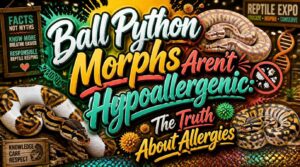
I’ve had the conversation a dozen times at reptile expos. Someone walks up, mentions their allergies, and asks which morph they should buy to keep symptoms at bay. The honest answer surprises them every time: none of them.
After 15 years of breeding ball pythons, I can tell you that morph genetics affect color, not allergens. A $3,000 designer morph sheds the same allergy-triggering proteins as a $30 normal. The genes controlling pigment and pattern have nothing to do with the proteins in shed skin, saliva, or waste.
The good news? Allergen exposure depends far more on how you keep your snake than which one you keep. Here’s what actually matters.
Table Of Contents
- Key Takeaways
- Are Ball Python Morphs Hypoallergenic?
- Why “Hypo” Doesn’t Mean Hypoallergenic
- Do Morphs Affect Allergy Risk?
- What Triggers Ball Python Allergies?
- Reduce Allergens Around Your Ball Python
- Frequently Asked Questions (FAQs)
- Which ball python morphs to avoid?
- What’s the rarest ball python morph?
- What are the healthiest ball python morphs?
- What is a holy grail ball python?
- How often should ball python enclosures be deep cleaned?
- What are common early allergy symptoms in handlers?
- Are juvenile ball pythons different in allergen risk?
- Can I be allergic to my ball pythons urates?
- Do ball python mites affect human allergies?
- Are ball pythons safe for asthma sufferers?
- Conclusion
Key Takeaways
- No ball python morph — regardless of price or rarity — produces fewer allergens than any other, because color genes control pigmentation only, not the proteins that trigger immune reactions.
- Your real allergen sources are shed skin, saliva, waste, and rodent dander from feeders, none of which change based on the morph you keep.
- Husbandry decisions like switching to frozen-thawed prey, using low-dust substrate, running a HEPA filter, and damp-wiping enclosures weekly do more for your symptoms than any gene combination ever could.
- How sensitive you already are matters more than what’s in your snake’s genetics — two people owning the same morph can have completely opposite reactions.
Are Ball Python Morphs Hypoallergenic?
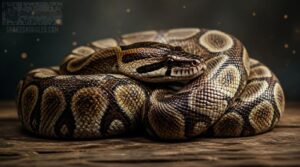
Ball pythons sit at the low end of the allergen scale, but low-allergen isn’t the same as allergen-free. The morph you pick changes the color and pattern, not the biology behind how your snake triggers reactions. Here’s what actually matters about morphs and allergy risk.
The health side of genetics matters just as much as the looks, so it’s worth reading up on ball python genetic mutations and health conditions before you commit to a morph.
Low-Allergen, Not Allergen-Free
Some ball python morphs shed less than wild-types, which can mean slightly less dander floating around your setup. That’s a real difference.
But don’t mistake lower allergen levels for zero allergens. Every python still produces skin proteins, saliva, and waste. You’re managing exposure, not eliminating the source entirely.
Species Matters More Than Morph
Regarding allergies and captive-breeding lineage, species matters more than morph. Python regius produces the same proteins whether it’s a pastel or a wild-type, regardless of ball python genetics.
Every morph shares:
- Identical shed skin protein composition
- The same saliva allergen profile
- Consistent waste byproducts
No morph is hypoallergenic. You’re reacting to the species, not the color.
The Morph-Specific Allergy Myth
The myth started somewhere in online forums: certain morphs like albino or clown trigger fewer allergic reactions.
That’s not how Ball Python Genetics works. Hypo, caramel albino, and other light-pattern morphs affect pigmentation only. They don’t alter shed protein composition, saliva chemistry, or waste byproducts. No color gene in existence rewrites how your immune system reacts to the species.
Why “Hypo” Doesn’t Mean Hypoallergenic
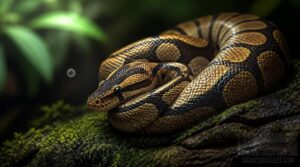
The word "hypo" trips up a lot of keepers for allergies. In ball pythons, it’s a genetic term tied to pigmentation, not allergen levels. Here’s what that distinction actually means for your morph choices.
Hypo Refers to Pigmentation
The word "hypo" in ball python breeding is strictly a pigmentation term. It describes reduced melanin, nothing more.
Albino and caramel albino produce their colors through codominant trait expression, giving breeders predictable phenotypic ratios. Those color genes don’t touch the proteins your snake secretes through skin, saliva, or waste. Your immune system doesn’t care what color the snake is.
Ghost Morph Genetics
A ghost morph is co-dominant in expression, so heterozygous animals show subtler shading than homozygous ones.
Breeders chasing that ghostly look often cross ghosts into other lines, and this guide to ball python morphs with unique patterns breaks down how those combos stack.
Unlike axanthic or albino, which follow straightforward recessive gene inheritance with clean phenotypic ratios, ghost interacts additively across multiple color alleles. That complexity makes clutch outcome prediction harder in multi-morph pairings.
Fundamentally, ghost reduces melanin contrast across the pattern and nothing else.
Color Genes Don’t Reduce Allergens
Even if you’re working with morph combinations built on recessive gene inheritance, your allergen load won’t drop. Color genes don’t reduce allergens; they only change pigment.
No captive breeding lineage or genetic compatibility pairing changes these four allergen sources:
- Saliva protein output
- Shed skin proteins
- Waste exposure
- Immune response sensitivity
Your morph appearance and allergen risk are completely separate systems.
Do Morphs Affect Allergy Risk?
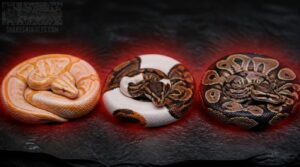
The morph you pick doesn’t change what your immune system reacts to. Whether you’re looking at an albino, a pied, or a high-end designer combo, allergen levels stay consistent across the species. A few things are still worth checking before you commit to a specific animal.
Albino, Pied, and Pastel
Three of the most popular morphs – Albino, Pied, and Pastel – look stunning in any collection, but none reduce allergen proteins.
| Morph | Allergen Impact |
|---|---|
| Albino | No reduction |
| Pied | No reduction |
| Pastel / Super Pastel | No reduction |
| Banana | No reduction |
Color genes change pigmentation, not shed proteins. Your Banana or Super Pastel still produces the exact same allergens as any standard ball python.
Designer Morph Allergen Levels
Some breeders, including those at Royal Constrictor Designs, have explored whether combining traits like axanthic and piebald reduces allergen output. It doesn’t. Designer morphs stack visual genes, not biological ones.
Whether you’re working with an axanthic pastel or a multi-gene albino, the shed proteins stay consistent. No designer combination has tested allergen-free in controlled conditions.
Choosing Health Over Appearance
Pick the snake that fits your health situation, not just your wishlist. An albino or piebald might look stunning, but if you’re already sensitive to reptile proteins, morph choice won’t protect you. Axanthic, pastel, or Spider genetics control pattern and color — nothing else. Your immune system doesn’t read morph names.
Your immune system doesn’t read morph names—choose a snake for your health, not your wishlist
Prioritize handling frequency and clean husbandry over gene combinations.
Individual Reactions Can Vary
Two people can own the same pastel or piebald and get completely different results. One keeper experiences daily with zero reaction. Another gets itchy eyes after ten minutes with an albino.
Your sensitivity baseline determines your outcome, not the morph. Existing conditions like rhinitis can make even an axanthic or Spider feel like a problem no one warned you about.
What Triggers Ball Python Allergies?
Ball pythons don’t produce fur or mammalian dander, but that doesn’t make them completely allergen-free. Several specific triggers can still cause reactions, and they’re often things keepers overlook. Knowing what they are puts you ahead of the problem before it starts.
Shed Skin Proteins
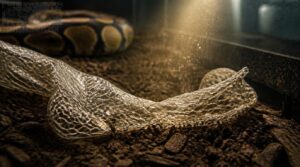
Shed skin proteins are real allergens. They cling to enclosure walls and substrate after every cycle, and when you disturb that debris during cleaning or handling, particles go airborne fast.
This holds true regardless of captivebreeding lineage, bloodline variation, or gene interaction complexity. Morph genetics don’t reduce what a snake sheds.
Environmental acclimation affects shedding frequency, not overall protein output.
Saliva and Waste Exposure
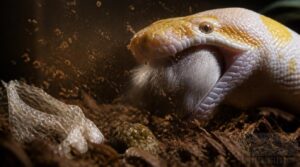
Proteins don’t stop at shed skin. Saliva and dried waste transfer during feeding and handling, then stick to surfaces.
Five exposure sources:
- Saliva deposited during feeding
- Feces and urates on substrate
- Cloacal secretions from handling
- Airborne particles from bedding
- Exhaled respiratory droplets
Your albino, piebald, pastel, Spider, or Super Pastel all produce the same proteins.
Rodent Dander and Proteins
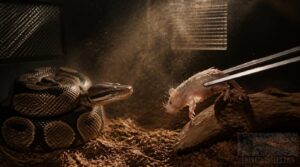
Ball pythons eat rodents, so rodent dander and proteins land on your substrate, tongs, and walls every feeding. Frozen-thawed prey still carries dander. In rack system housing, limited airflow traps particles fast. A naturalistic display cage with ventilation panels disperses them better.
| Source | Exposure Risk | Control |
|---|---|---|
| Frozen prey thawing | Moderate | Feed in separate bin |
| Dried urine residue | High | Wipe enclosure weekly |
| Live prey handling | High | Switch to frozen-thawed |
Your snake’s captive-breeding lineage won’t lower allergen output. Environmental acclimation — airflow, cleaning schedule — does the real work.
Substrate Dust and Mold
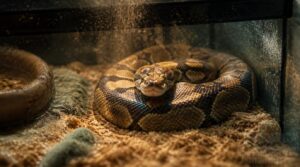
The substrate you pick carries its own allergen load. Aspen shavings and Carefresh go airborne during spot cleaning; coconut fiber isn’t far behind.
Humidity above 60% turns aspen and reptile carpet into mold fast. Freeze organic substrate 24 hours before use to kill spores. Coconut husk (coco chip) resists mold naturally and stays one of the cleaner long-term choices.
Cleaning Chemical Irritants
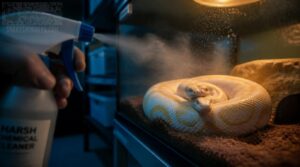
When bleach hits the air, caustic fumes travel fast. Your albino, piebald, pastel, Spider, or Super Pastel can develop labored breathing from exposure. Move them to a separate room first.
Use only reptile-safe products:
- Chlorhexidine solution — broad-spectrum, no harsh fumes
- F10SC disinfectant, diluted per label
- White vinegar (1:1 with water)
- Enzyme-based reptile enclosure cleaner
- Plain hot water for light wipes
Reduce Allergens Around Your Ball Python
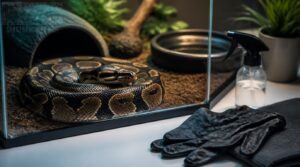
You can’t eliminate every allergen, but you can cut your exposure a lot with a few targeted changes to your setup. Most of these adjustments are simple, low-cost, and already part of solid husbandry. Here’s what to focus on.
Feed Frozen-Thawed Rodents
Frozen-thawed prey cuts live rodent dander immediately. Albino, piebald, or Super Pastel — the morph doesn’t change your allergen exposure. Thaw prey to 99°F to boost hatchling acceptance and keep your setup cleaner.
| Prey Type | Allergen Risk | Key Note |
|---|---|---|
| Live rodents | High | Dander and urine linger |
| Fresh-killed | Moderate | Still introduces proteins |
| Frozen-thawed | Low | Best allergen control |
| Improperly thawed | Moderate | Mold growth risk |
| Body-temp thawed | Lowest | Boosts hatchling acceptance |
Choose Low-Dust Substrate
Dust hits your lungs before you notice it. Corncob and pine shavings produce more respirable particles than coconut husk, even when labeled dust-free. Whether you keep an albino, piebald, or Super Pastel, coconut husk or paper bedding cuts your particulate load a lot.
Disturbing substrate during cleaning launches fine particles airborne, where they stay suspended longest. Work in a ventilated space when changing it out.
Control Humidity and Mold
Mold doesn’t need standing water. Sustained surface dampness is enough to colonize your enclosure. A Spider or Bumblebee keeper should target 60–80% relative humidity, not higher.
- Use a digital hygrometer daily
- Avoid misting glass or walls directly
- Replace damp substrate before it smells
- Check Coral Glow and Black Pastel hides for trapped moisture
- Let Super Pastel enclosures dry between mistings
Clean and Ventilate Regularly
Settled particles don’t stay settled for long. Every time you wipe down your albino or Black Pastel enclosure, you push shed debris into the air.
Damp wipe surfaces weekly, never dry. Open a window or run a HEPA unit during and after cleaning. Cinnamon and Super Pastel snakes shed frequently, so don’t let old shed fragments build up between sessions.
Wash Hands After Handling
Residual proteins from your Albino or Piebald don’t disappear when you set them down. Wash hands after handling with soap and water, scrubbing between fingers and under nails where shed material collects. Thorough scrubbing and rinsing removes more than a quick rinse alone.
Ball python morphs aren’t hypoallergenic, and the truth about allergies starts with what stays on your skin.
Frequently Asked Questions (FAQs)
Which ball python morphs to avoid?
Every week, someone asks me which morph to skip for allergies. Here’s the honest answer: none of them. Albino, piebald, pastel, Spider, Coral Glow all carry identical allergen risk.
What’s the rarest ball python morph?
The rarest verified ball python morph is the Russoline Het Leucistics lineage, with only a handful of confirmed animals worldwide. Most "ultra-rare" claims online are marketing, not documented genetics.
What are the healthiest ball python morphs?
Here’s a twist: the healthiest ball python morph isn’t a morph at all. Albino, piebald, pastel, or Super Pastel, genetics decide looks, not health. Husbandry, clean enclosures, and low-stress care matter most.
What is a holy grail ball python?
What is a holy grail ball python? It’s a dream morph combination breeders chase, like a Super Pastel Spider albino Killerbee. These pair multiple genes, costing $2,000 to $10,000, sometimes more.
How often should ball python enclosures be deep cleaned?
Spot cleaning happens daily. Deep cleaning is a monthly job. For most enclosures, deep clean every 30 days. With larger setups and consistent spot cleaning, you can safely push that schedule to every 60–90 days.
What are common early allergy symptoms in handlers?
Early symptoms often hit fast: itchy skin or hives, watery eyes, sneezing, and a runny nose. Some handlers also develop throat irritation or mild wheezing within just minutes of any direct contact with a snake.
Are juvenile ball pythons different in allergen risk?
Juveniles shed more often than adults, raising allergen exposure per cycle. Smaller enclosures also concentrate proteins faster. You’ll handle hatchlings constantly during early setup, increasing your skin flake and waste contact more than with adults.
Can I be allergic to my ball pythons urates?
Yes, and here’s the real irony: the morph never matters here. Urate proteins from your piebald or pastel transfer directly to your skin during cleaning, triggering real immune responses in sensitized individuals just as easily.
Do ball python mites affect human allergies?
Ball python mites add arthropod proteins and fecal particles to bedding and surfaces. If you’re already sensitive, that extra exposure can trigger or worsen reactions — completely separate from anything morph-related like albino or pastel genetics.
Are ball pythons safe for asthma sufferers?
Whether ball pythons are safe for your asthma depends entirely on your personal sensitivity. Shed skin, substrate dust, and enclosure mold can all trigger symptoms. Some people with asthma handle it fine; others simply don’t.
Conclusion
It’s no coincidence that the keepers with the fewest allergy complaints aren’t hunting for ball python morphs that are hypoallergenic. They already understand those don’t exist.
They’re managing shed removal, frozen-thawed feeders, and enclosure ventilation instead. The morph you choose shapes what your snake looks like. Your husbandry shapes how your body reacts. One matters for aesthetics. The other matters for your long-term health.
Build the right routine first, then pick the animal you love.