This site is supported by our readers. We may earn a commission, at no cost to you, if you purchase through links.
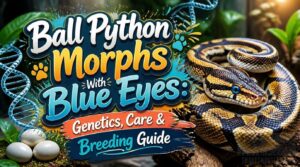
A Lesser × Butter pairing gives you blue-eyed babies in 60–70% of the clutch. That’s not luck. That’s genetics you can plan around.
Most breeders assume ball python morphs with blue eyes are a lottery ticket. They’re not. The BEL complex runs on seven independently segregating genes, and once you understand how incomplete dominance shapes those 1:2:1 ratios, the odds stop being mysterious and start being math.
Two carriers might hand you 6–20% blue-eyed offspring. A careless seven-gene cross? You’re down to 1–5%. The difference between those numbers is the difference between guessing and breeding with intent.
Here’s everything that separates a true blue-eyed leucistic from a washed-out lookalike, and how to raise one right.
Table Of Contents
- Key Takeaways
- BEL Combinations That Produce Blue Eyes
- Blue-Eyed Ball Python Genetics
- Identifying Healthy Blue-Eyed Morphs
- Blue-Eyed Ball Python Care
- Cost, Buying, and Ethical Breeding
- Frequently Asked Questions (FAQs)
- What’s the rarest ball python morph?
- Why are my ball python eyes blue?
- Is a blue-eyed lucy ball python rare?
- What are blue eyed pythons?
- Do blue eyes indicate any genetic health problems?
- How long does shipping take for blue-eyed morphs?
- Whats the lifespan difference between morphs and wild types?
- Can blue-eyed morphs be bred with other species?
- Do blue-eyed ball pythons have different temperaments?
- Conclusion
Key Takeaways
- The BEL complex runs on seven independently segregating genes, so blue-eyed leucistic ball pythons come from deliberate pairing and math, not luck.
- Lesser × Butter is the most reliable cross, producing blue eyes in 60–70% of offspring, while two carriers yield just 6–20% and complex seven-gene crosses drop to 1–5%.
- Because incomplete dominance governs expression, single-gene animals show intermediate blue tones and only homozygous pairings deliver the full sky-blue, so genotype testing beats visual guessing.
- A healthy blue-eyed morph shows clear, symmetric irises that stay stable across three sheds, a body condition of 3.0–3.5/5, and no ocular deformities like macrophthalmia.
BEL Combinations That Produce Blue Eyes
Not every white snake with blue eyes comes from the same pairing. Seven genes in the BEL complex can combine in dozens of ways, and each cross leaves its own fingerprint on the final animal.
The super lesser cross, for instance, is what produces those completely white snakes with brilliant blue eyes, as covered in this guide to the lesser ball python morph.
Below, you’ll find the proven combinations breeders rely on, from Lesser and Butter classics to the rarer Special gene pairings.
Lesser and Butter BELs
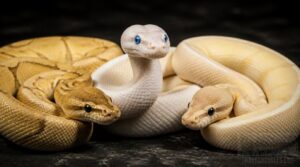
The Lesser × Butter pairing is your most reliable route to a Blue Eyed Leucistic Ball Python. Expect blue eyes in 60–70% of offspring.
The Lesser allele dilutes black pigment while Butter lightens the iris background, producing pale sky-blue eyes with white sclera.
Because incomplete dominance governs this cross, track heterozygous expression across two generations before calling any line stable.
Mojave-Based BELs
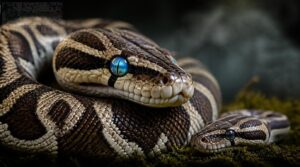
Where Lesser × Butter gives you predictability, Mojave-based BELs trade consistency for punch.
Pair Mojave Lesser with Phantom or Mystic and you’ll hit blue eyes in roughly 25% of clutches, not 60–70%. Zygosity matters here: heterozygous expression often yields muted steel-blue, while homozygous pairings push toward that celestial blue collectors pay premiums for.
Watch incubation temperatures too, since stress can shift expressivity.
If you’re new to pairing and clutches, this guide to breeding ball pythons for beginners covers the incubation basics in more detail.
Russo and Mocha BELs
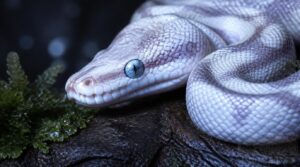
If Mojave combos trade consistency for punch, Russo Mocha BELs trade it for depth. This two-gene interaction shifts pigment toward cooler blue hues, producing uniform light-blue irises with reduced scleral patterning. Incomplete dominance means heterozygous animals show intermediate blue, not the full celestial shift. Vividness peaks in juveniles and can fade with age, so use genetic testing and track eye color across generations before committing breeders.
Bamboo BEL Combinations
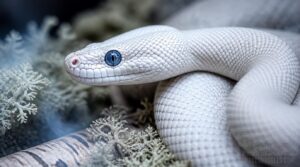
Russo Mocha combos trade punch for depth, but Bamboo BEL combinations trade it for stability. The Bamboo allele acts as a stabilizing modifier, spreading diffuse blue iris shading uniformly across the eye, regardless of pattern. Expect deeper blue with higher bamboo density, and intensity peaking after three to four sheds. Use genetic testing to confirm parents before investing in these Blue Eyed Leucistic Ball Python candidates.
Phantom and Mystic BELs
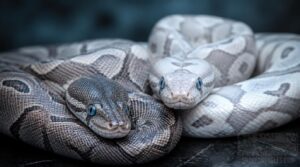
The Phantom and Mystic pairing is your sleeper hit. Phantom ball pythons add gray-base shading with reduced red factor, cooling down your blues beautifully. Stack Mystic ball pythons on top and you get pale iris backgrounds with heavier white-scale dilution, so eyes read electric. Thanks to incomplete dominance, expect intermediate blue intensity, not full Blue Eyed Leucistic Ball Python sky.
Special Gene BELs
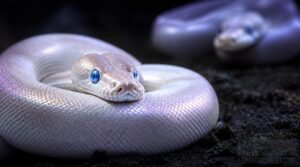
The Special gene stands alone in the BEL complex because it can push your ball python toward blue eyes with fewer partners than most combos. Pair it with compatible modifiers, and melanin suppression deepens enough for blue.
You’ll need homozygous offspring or precise heterozygous pairings, since incomplete dominance leaves singles at intermediate tones. Genotype fully; phenotypic guessing fails here.
Blue-Eyed Ball Python Genetics
Those white snakes with the blue eyes aren’t luck. They’re the product of a specific genetic system that you can learn to predict. Here’s what happens when seven allelic genes collide, and how the math plays out in your clutches.
The Seven-Gene BEL Complex
Think of the BEL complex as a seven-dial lock. Each dial is an independently segregating gene, and only the right combined haplotype clicks open into blue-eyed leucistic ball pythons. Pair a Mojave Lesser with another BEL carrier and you’re stacking dials deliberately.
The BEL complex works like a seven-dial lock, and only the right combined haplotype opens into blue-eyed leucistic ball pythons
- Seven genes, each inherited separately
- Combined haplotypes, not single genes, open blue eyes
- Super Lesser proves two copies intensify expression
Master the lock, predict the phenotype.
Incomplete Dominance
Picture a dimmer switch, not an on/off toggle.off toggle. That’s incomplete dominance at work. Each allele in the BEL complex adds pigment-reducing "volume," so a Mojave Lesser single-gene snake glows softly while two doses push toward a Blue Eyed Leucistic Ball Python. Because these are allelic genes, crossing two heterozygotes yields that classic 1:2:1 split: light, intermediate, super.
Breeding Odds
Here’s the honest math: most breeding combinations won’t give you a Blue Eyed Leucistic Ball Python on the first try.
- Two BEL carriers: expect 6–20% blue-eyed offspring.
- Mojave Lesser pairings: roughly 6–20%, depending on zygosity.
- Seven-gene complexes: a brutal 1–5% without selection.
Because incomplete dominance governs phenotypic expression, track every litter. Numbers improve when you backcross into proven BEL lines.
Identifying Healthy Blue-Eyed Morphs
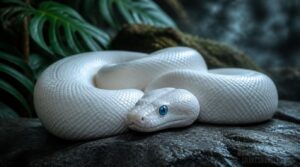
A gorgeous blue eye means nothing if the snake behind it is struggling. Start your reptile health monitoring with the eyes themselves. You want clear, uniform blue with no cloudiness or milky cornea, and pupils that snap briskly to light. Sluggish dilation? Walk away. Watch for ocular deformities too, especially macrophthalmia (abnormally enlarged eyes), which shows up in some BEL complex lines.
Then check symmetry. Left eye should match the right in size and color. Stability matters as well: iris color holding firm across three consecutive sheds signals a dependable trait, not fading pigment. A quality shedding care kit for ball pythons makes tracking each shed cycle easier, so you can confirm that iris color stays consistent.
Behavior seals the deal. A healthy Blue Eyed Leucistic Ball Python strikes food readily, moves with purpose, and tolerates handling without drama. Aim for a body condition score of 3.0–3.5/5, moist mucous membranes, and skin that snaps back when pinched. Lethargy or glass-surfing isn’t a color quirk. It’s a red flag.
A reptile body condition scale takes the guesswork out of scoring, so you’re judging ribs and spine by the book rather than by feel.
Blue-Eyed Ball Python Care
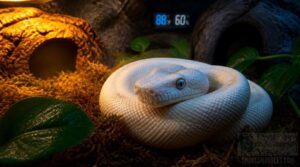
You’ve vetted the snake. Now build the environment that keeps those eyes clear. Start with your temperature gradient: 88–92°F on the warm side, 78–82°F on the cool side, with a nighttime drop under 5°F. Stability beats flawlessness every time.
Humidity matters more for BELs than most keepers realize. Hold humidity 50–60% baseline, and bump to 60–70% during sheds. Dry air dulls iris clarity and invites superficial eye ulcers that can mimic color loss.
Your enclosure setup should include opaque hides on both ends. Light glare through translucent hides distorts how you read eye color, so keep them solid.
Cost, Buying, and Ethical Breeding
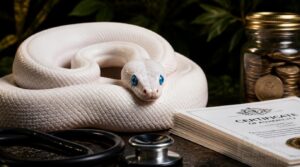
Your environment’s dialed in. Now the wallet work. A Blue Eyed Leucistic Ball Python runs $1,500–$2,500 for starter combos, and rare pairings push past $5,000. Males cost less than proven females, and premium queens add 20–40%. Shipping and insurance tack on 5–15%, so local pickup saves real money. If you do opt for shipped animals, a solid live reptile shipping box kit keeps your snake safe in transit.
When buying, demand genotype confirmation for BEL status, recent health checks, and clean lineage paperwork. Cross-check any seller against two independent breeders. If someone advertises "100% guaranteed" without genetic testing, walk away.
Ethical breeding isn’t optional. Wait until females hit 2+ years with medical clearance, cap clutches per year, and build rest periods between them. Analyze pedigrees to keep inbreeding coefficients low. Healthy animals and honest practices protect the entire hobby, and they’re what serious buyers pay for.
Frequently Asked Questions (FAQs)
What’s the rarest ball python morph?
The Blue Eyed Leucistic Ball Python tops the rarity list. Specifically, seven-gene BEL complex combos like the White Diamond and Super Russo lines. You’re looking at odds of roughly 1 in 16,384 eggs.
Why are my ball python eyes blue?
Your snake likely carries BEL genetics. Certain combos, like Lesser or Mojave, reduce eye pigmentation, producing that blue tint. If it’s stable across sheds with clear lenses, it’s healthy leucism in snakes, not disease.
Is a blue-eyed lucy ball python rare?
Yes, quite rare. A Blue Eyed Leucistic Ball Python needs specific combos like Mojave Lesser within the BEL complex, so odds stay low. That scarcity makes this rare morph genuinely pricey.
What are blue eyed pythons?
A blue eyed python is a ball python carrying Blue Eyed Leucistic genetics, like Lesser, Mojave, or Russo combinations. Unlike albinism, leucism removes pigment while leaving stunning, solid blue irises.
Do blue eyes indicate any genetic health problems?
Usually, no. Blue eyes themselves aren’t genetic health problems; they’re cosmetic. Risk comes from specific gene combos, not eye color. Watch for respiratory issues, kinked spines, or duckbills, and buy from breeders tracking genotypes carefully.
How long does shipping take for blue-eyed morphs?
Expect 1–3 business days in transit, though overnight shipping cuts it to one. Add 1–2 days for processing and heat-pack prep. Weather or carrier delays can stretch arrival by another day or two.
Whats the lifespan difference between morphs and wild types?
Here’s the honest answer: no verified gap exists. Wild types average a 20–30 year lifespan, and ball python morphs match that with solid husbandry. Care quality drives reptile lifespan, not color genes.
Can blue-eyed morphs be bred with other species?
A locked door, and behind it, a species that never invites guests. The answer is no. Blue-eyed leucistic ball pythons can’t breed across species; reptile genetics forbid it. Stick to selective breeding within your BEL complex.
Do blue-eyed ball pythons have different temperaments?
Do blue-eyed ball pythons have different temperaments? No. Peer-reviewed evidence shows no consistent link between eye color and behavior. Temperament reflects handling, enclosure stress, and individual history, not the BEL complex or incomplete dominance.
Conclusion
Picture it: a clutch box at midnight, and one hatchling staring back with eyes like glacier ice. That moment isn’t chance. Among ball python morphs with blue eyes, your results trace straight back to the genes you paired months ago.
Track your ratios, keep records honest, and select carriers deliberately. The math rewards patience. Breed with intent, and that white, blue-eyed snake stops being a lottery win and becomes your plan, realized.