This site is supported by our readers. We may earn a commission, at no cost to you, if you purchase through links.
Your boa hasn’t moved in six hours. Then dusk hits, and that "sleepy" noodle turns into a climbing, tongue-flicking explorer that owns the whole enclosure.
Reading boa constrictor behavior patterns isn’t guesswork. A snake that coils in the cool zone, flares into an S-shape, or refuses meals for two months is giving you data. Miss it, and a small problem becomes a vet bill. Catch it, and you’ll know when your boa feels safe, hungry, or headed into a shed.
Here’s what a herpetologist watches for: the daily rhythm, hunting habits, stress signals, and the handling tweaks that keep your snake calm.
Table Of Contents
- Key Takeaways
- Daily Boa Constrictor Behavior Patterns
- Hunting and Feeding Behaviors in Boas
- Boa Body Language and Stress Signals
- How Shedding and Breeding Change Behavior
- How Genetics and Habitat Influence Boa Temperament
- Handling Your Boa While Minimizing Stress
- Frequently Asked Questions (FAQs)
- What are the typical behaviors of a boa constrictor?
- Do boas enjoy being held?
- Which boa species is the friendliest?
- Are boas meaner than pythons?
- What do boa constrictors look like?
- Are boa constrictors good pets?
- Are boa constrictors aggressive?
- Are boa constrictors nocturnal?
- Are boa constrictors docile?
- How do boa constrictors Hunt?
- Conclusion
Key Takeaways
- Your boa is mostly nocturnal, so expect her to hide by day and explore, climb, and hunt after dusk, with a temperature gradient of roughly 75-90°F that lets her pick her own comfort zone.
- A relaxed boa moves slowly, feels loose in your hands, and flicks her tongue at an even pace, while stiffness, an S-coil, and hissing mean she’s defensive and you should back off right away.
- Repeated striking, refusing food for more than a couple of months, lethargy, wheezing, mucus around the mouth, or head tremors point to pain or illness, so call a reptile vet instead of blaming attitude.
- Hiding, cloudy eyes, and skipped meals usually signal shedding or breeding season, and the best response is extra humidity, no handling, and short, calm sessions the rest of the time so your boa learns to trust you.
Daily Boa Constrictor Behavior Patterns

Often, your boa’s day looks like nothing at all. That’s normal. Most of daylight, she’s tucked inside a hide keeping cool or warm.
Since a quiet boa is usually just a comfortable one, it helps to understand what affects boa constrictor temperament, from habitat setup to how gently you handle her.
Dusk shifts her body signals. Watch for slow tongue flicking as she tests the air, then steady exploring and climbing. Juveniles move more; adults prefer lounging.
Offer a temperature gradient with a basking spot near 88-90°F and cooler zones of 75-85°F. Your boa will shuffle between them, coiling up where she feels right. Time handling behavior accordingly. Heating devices should be turned off at night so the enclosure can have a natural nighttime temperature drop down to about 68°F.
Hunting and Feeding Behaviors in Boas

Once dusk settles, your boa switches into hunter mode. She’s an ambush predator, so she’ll park herself motionless and let dinner wander past. Tongue flicking gathers scent, and heat pits spot warm bodies in the dark. Then she strikes, grips with her teeth, and coils.
Feed prey roughly as thick as her widest body part. Juveniles eat small mice every 7 to 10 days. Adults do fine with rats every two to four weeks. Don’t panic if she skips meals.
Boa Body Language and Stress Signals
Your boa talks all day long, and it never says a word. You just have to learn the silent language of tongue flicks, coils, and tail twitches. Let’s start with how to tell a relaxed snake from a defensive one, then cover the changes that mean it’s time to call your vet.
Once you can read those warning signs, pairing them with the right gear makes handling calmer for you both, and this snake handling hook size guide shows how to match a hook to your boa’s size.
Your boa speaks all day without a word, through tongue flicks, coils, and tail twitches, once you learn to read it
Relaxed Versus Defensive Behavior

A calm boa drapes. A nervous boa grips. That’s temperament in miniature, and you’ll learn to spot it quickly.
In a relaxed state, your snake moves slowly, feels loose in your hands, and flicks its tongue at a steady, curious pace. Breathing stays even.
A tense state looks different. The body goes stiff, almost spasmy, and the front third pulls back into a tight S-coil. That’s defensive behavior in action. Listen for a loud hiss, then expect a closed-mouth bluff before any real strike.
Smart body language interpretation means backing off right away.
Behavioral Changes That Need Veterinary Attention

Sometimes a bad mood isn’t a mood at all. If your usually docile boa starts repeated striking at you, think pain, not attitude.
If the strikes keep coming, a vet visit is wise, and the best snake care books for ball python owners can help you spot early signs of pain or illness.
Watch the other signals too. Refusing food for more than a couple of months in an adult is a red flag. So is lethargy, where your snake barely reacts when you touch it.
Check the face and chest. Wheezing, open-mouth breathing, or mucus around the mouth that lasts over a day means infection, and antibiotics come from a vet.
Head tremors, stargazing, or lost balance? Isolate your snake and call a reptile vet today.
How Shedding and Breeding Change Behavior
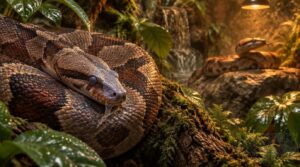
Most boas turn into different snakes when they’re about to shed. Shedding behavior is easy to spot once you know it: your boa hides more, eats less, and looks dull and cloudy-eyed. Give it extra humidity and leave it alone.
Breeding season shakes up your boa’s usual behavior patterns too. Watch for:
- Restless roaming at night
- Refusing meals
- Tongue-flicking more than usual
- Males getting twitchy and pushy
- Females basking longer
Temperament can get prickly, so skip handling. Add enclosure enrichment.
How Genetics and Habitat Influence Boa Temperament

Some boas just come out feisty. That’s genetics and environment teaming up, and you’ve got a front-row seat. Your snake’s temperament starts with inherited traits, then habitat conditions shape the rest.
Picture three scenes:
- A rainforest boa, nocturnal and semi-arboreal, settling into the dark.
- A savanna boa, vigilant and quick to react.
- A calm captive boa kept at 82-90°F and 60-80% humidity.
Juveniles bite more, but most mellow with age. Watch your boa’s behavior patterns, because individual temperament varies wildly.
Handling Your Boa While Minimizing Stress
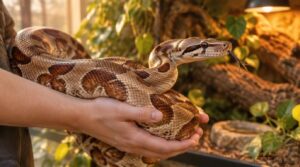
Think of handling like a handshake: it only works when both sides agree.
Wash your hands first, and skip handling for 48 hours after a meal. Support your boa’s whole body with both hands and let it crawl onto your arm. Never grab its tail. These handling techniques keep panic low.
Watch for stress signals like hissing, throat puffing, or tight coiling. Those defensive strategies mean it’s time to end the session. Proper enclosure size and temperature gradient help too.
Frequently Asked Questions (FAQs)
What are the typical behaviors of a boa constrictor?
You’ll catch your boa mostly after dark, when it’s roaming and tongue flicking to read the air. By day, it’s tucked away. Hunting? It waits, strikes, then coiling tightens. Annoyed? Expect hissing and defensive strategies.
Do boas enjoy being held?
Holding a boa is like asking a cat to a party: some show up thrilled, most just tolerate it. Temperament decides everything. Watch for slow, even breathing and calm tongue flicks. Hissing or stiffness means put them down.
Which boa species is the friendliest?
You’ll find Colombian boas friendliest overall. Their calm temperament suits regular handling techniques, especially captive-bred ones. Hog Island and Peruvian long-tailed boas rival them. Socialization helps, but reptile temperament and reptile behavior vary by individual.
Are boas meaner than pythons?
Not really. Boas aren’t mean, they’re just honest. Their temperament leans defensive when they feel exposed, and you’ll see more aggression from wild-caught or young ones. Most pythons are calmer, but a nervous one bites too.
What do boa constrictors look like?
Picture a living blanket stitched in cream and rust. It wears tan or gray with dark saddle bands reddening toward the tail.
Adults stretch 6 to 10 feet, with a dark triangle by each eye.
Are boa constrictors good pets?
A boa constrictor can be a great pet if you’re ready for it. Their calm temperament and manageable handling techniques reward patient owners, but you’ll need a big enclosure, steady heat, and a long-term commitment.
Are boa constrictors aggressive?
Not really. Boas aren’t aggressive by nature, but they’re defensive when scared. Your snake’s defensive behavior starts with a hiss, then maybe a closed-mouth strike. Calm bloodlines and secure enclosures keep temperament mellow.
Are boa constrictors nocturnal?
Mostly, yes. Your boa’s nocturnal hunters instincts kick in at dusk, when it uses ambush tactics and steady tongue flicking to find rodents. Cool days change things, though. Basking helps thermal regulation, so daytime coiling behavior isn’t unusual.
Are boa constrictors docile?
Docile or dangerous? Honestly, it’s both, and neither. A captive-bred boa’s temperament usually runs calm, especially from handled lineages.
Still, watch for stress signals: hissing, tight coiling, defensive posture. Respect that body language, and your handling techniques improve.
How do boa constrictors Hunt?
You’re watching an ambush predator at work. Its hunting techniques start with waiting near burrows, tongue-flicking for chemical sensing, then heat-sensing pits and vibrations guide the strike.
Hooked teeth grip, then coiling stops blood flow.
Conclusion
Your boa is an open book, and every coil, flick, and flare is a page. Once you understand boa constrictor behavior patterns, you’ll catch hunger, stress, and shedding before they turn into problems. Keep handling sessions short, calm, and predictable.
Do that, and something shifts. Your snake stops merely tolerating you and starts trusting you. So pay attention daily. Learn your snake’s baseline, and everything else falls into place.