This site is supported by our readers. We may earn a commission, at no cost to you, if you purchase through links.

You’ve seen the video. A snake gets cut in half, and both pieces keep writhing like they’re plotting a comeback. It’s unsettling enough that people swear the animal survived, maybe even split into two snakes. It didn’t.
Can a snake survive being cut in half? Find out first before you trust what your eyes are telling you, because that movement is your last clue, not proof of life. Reflex arcs keep firing long after the spinal cord, blood supply, and organs stop working together as one system.
What actually happens biologically explains why the myth persists and why it’s dead wrong.
Table Of Contents
- Key Takeaways
- No—a Snake Cannot Survive Being Cut in Half
- What Happens When a Snake is Cut in Half?
- Why Can’t Either Half Survive Independently?
- Why Does a Cut Snake Still Move?
- Can Veterinary Care Save The Snake?
- Frequently Asked Questions (FAQs)
- How long will a snake survive if cut in half?
- Can a snake still be alive after being cut?
- Do snakes feel pain when cut?
- What happens to a snake when you cut it in half?
- Can a snake survive if cut in half?
- What happens if a snake is cut in half?
- How long does a snake’s body last after being cut in half?
- Can a rat snake survive being cut in half?
- Should you sever a snake in half?
- Can a snake survive without medical intervention?
- Conclusion
Key Takeaways
- A snake cut in half can’t survive—complete bisection destroys the nervous system, blood supply, and organs beyond any chance of recovery.
- The writhing you see afterward isn’t the snake fighting to live; it’s just leftover nerve signals firing on their own as the body shuts down.
- Neither half stands a chance alone, since the front holds all the vital organs while the back loses circulation and both halves lose brain-body connection.
- Partial wounds can sometimes be treated by a vet, but a fully severed snake is beyond saving, and even a detached head can still bite, so keep your distance.
No—a Snake Cannot Survive Being Cut in Half

The short answer is no, and the biology behind it is unforgiving. Cutting a snake in half sets off a chain reaction that no animal can walk away from. Here’s exactly why that answer holds up, point by point.
Why Complete Bisection is Fatal
When you sever a snake’s body, you inflict catastrophic physical trauma no reptile survives. Nervous system failure hits instantly as the spinal cord tears apart. Circulatory collapse follows within minutes from massive blood loss. Essential organs lose function fast, triggering irreversible organ failure. This isn’t survivable injury, it’s immediate death dressed up as movement.
Even snakes that survive severe trauma face similar risks, since untreated signs and treatment of bacterial infections in snakes can trigger the same kind of organ failure.
A severed snake doesn’t survive the cut, it simply keeps moving while its body shuts down for good
Movement Does Not Mean Survival
That twitching after the cut doesn’t mean the snake is alive in any meaningful sense. Reflex arcs in the spinal cord fire off nerve impulses on their own, causing muscle contractions without a working brain.
Nerve signals persist briefly, then fade as cells die. Movement is just biology winding down, not recovery.
Severe Cuts Versus Full Severing
Not every wound is a death sentence. A deep gash exposing muscle differs completely from complete bisection severing the spine, major vessels, and organs.
Vets weigh three factors:
- Wound severity and depth
- Blood loss differential (seepage vs. arterial loss)
- Nervous system impact
Partial cuts allow survival time for treatment. Full severing means immediate death from massive trauma, no exceptions. This distinction mirrors how literal physical severing is described elsewhere, where a clean, complete cut produces an outcome entirely different from a partial one.
What Happens When a Snake is Cut in Half?
When you cut a snake in half, its body doesn’t just stop working—it shuts down through a specific chain of biological failures. Each step happens fast, and understanding the sequence shows you exactly why survival isn’t possible. Here’s what actually happens inside the snake, moment by moment.
Spinal Cord Disruption

Cutting a snake in half means a complete severed spinal cord, instantly blocking every nerve impulse between brain and body. Signals below the cut vanish; a spinal reflex arc may still fire, producing movement without control.
Axonal regeneration limits prevent reconnection, while secondary injury cascades and disrupted sensory motor pathways guarantee permanent, unsurvivable nerve damage.
Massive Blood Loss and Shock
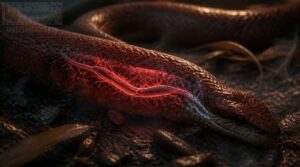
When you sever a snake’s body, blood loss becomes catastrophic within seconds. Hypovolemic shock sets in as circulatory volume plummets, starving tissues of oxygen.
If a tourniquet or constriction concentrates venom in the wound site rather than letting it spread, the trapped toxins can accelerate tissue death, sometimes making amputation the only way to stop the damage from spreading further.
Without circulatory volume restoration, hemodynamic instability spirals fast. Cardiovascular collapse follows, then respiratory arrest. This hemorrhagic shock progression drives organ system failure and irreversible organ damage within minutes, not hours.
Damage to Vital Organs
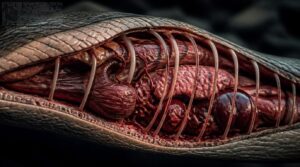
A blade through a snake’s midsection doesn’t just wound, it wipes out essential organs with one stroke.
- Heart damage halts circulation instantly
- Lung failure stops oxygen exchange
- Liver rupture floods tissue with toxins
- Kidney shutdown poisons the blood
Losing heart and lungs together guarantees rapid blood loss and respiratory collapse within moments.
Rapid Organ System Failure

Once the heart and lungs stop, the rest of the body follows fast. Hypovolemic shock sets in as blood pressure collapses, starving tissue of oxygen. This shock-induced hypoxia triggers a circulatory failure cascade: kidneys shut down, the liver stops filtering, and cells begin dying within minutes. It’s multi-system collapse, not a single injury, that kills the snake.
Wound Contamination and Infection

An open wound is a highway for bacteria, and a bisected snake has two gaping entry points.
Gut and oral flora invade fast, tipping contamination into colonization within hours.
Expect three things: purulent discharge, spreading erythema, and rising heat at the wound edge.
Left untreated, this local infection risks sepsis long before healing ever starts.
Why Can’t Either Half Survive Independently?

You might assume one half stands a better chance than the other, but neither does. Each piece is missing something it can’t live without, whether that’s a heart, a working nervous system, or the ability to heal what’s lost. Here’s exactly why both halves are doomed the moment the cut happens.
Back Half Lacks Vital Organs
The tail end of a severed snake is running on empty. Snake anatomy packs every essential organ into the front half: heart, lungs, liver, and stomach all sit anterior to mid-body.
Posterior organ absence means there’s nothing left to filter waste, process nutrients, or pump blood. That’s why the back half lacks essential organs entirely, guaranteeing organ failure and mortality rates near 100% within minutes.
Front Half Loses Circulation
Cutting through the aorta doesn’t just wound the front half, it disconnects it entirely. Arterial pressure loss collapses vessels within seconds, triggering vascular collapse and hypovolemic shock.
Below the brain pressure threshold, cerebral flow stops. Even temperature vasoconstriction can’t compensate. Oxygen deprivation sets in fast, guaranteeing organ failure before you’d even finish counting to sixty.
Nervous Systems Cannot Function Independently
Blood loss isn’t the only problem. Every nerve cell relies on brain-body connection for coordinated function, and severing splits that link permanently.
What separation causes:
- Neural signal interruption below the cut
- Reflex arc dependence replacing true control
- Spinal isolation limits sensory processing
- Independent nerve failure in both halves
- No electrical impulse reaches the brain
Neither half regains coordinated neural reflexes again.
Regeneration Cannot Restore Missing Organs
Some readers assume time might heal what the cut destroyed. It won’t. Snakes lack the stem cell hierarchy needed to rebuild essential organs, and organ connection failure blocks any real recovery.
Vascular mismatch, poor innervation, and immune rejection all stand in the way. This is biological irreversibility: once severed, the survival timeline ends in organ failure, not regrowth.
Why Does a Cut Snake Still Move?

You’ve probably seen the videos: a snake’s body keeps moving long after the cut. It looks alive, but that’s not what’s happening. Here’s what’s really driving that motion.
Residual Nerve Impulses
Watch a severed section closely and you’ll notice something eerie: the muscle keeps firing. That’s residual nerve impulses at work, lingering ion flux across the membrane after the action potential ends.
Membrane depolarization delay keeps the neuromuscular junction active briefly. Nerve signal decay isn’t instant, so twitch triggers persist for seconds before impulse persistence finally fades.
Spinal Reflexes After Death
Those twitches don’t stop at the membrane. They’re reflex arc activation, spinal cord circuits firing without any brain input at all.
This happens in brain death cases too: reflexes persist after higher function ends. What you’re seeing is:
- Sensory input hits the cord
- Motor neurons respond
- Muscles contract
- No brain involved
Temperature Affects Movement Duration
Room temperature matters more than you’d think. Heat increases speed of postmortem muscle contractions, while cold slows movement dramatically.
| Condition | Effect on Twitching |
|---|---|
| Warm (75°F+) | Extended, vigorous |
| Cool (60-70°F) | Delayed, weaker |
| Cold (<50°F) | Minimal or none |
| Freezing | Halted entirely |
Chill delays contractions by slowing nerve reactions and metabolic processes governing spinal reflexes.
Movement is Not Consciousness
When you see a severed snake body writhing, your brain wants to call it alive. Don’t. That’s unconscious motor control, not awareness.
- Spinal reflex arcs fire independently
- Nerve reactions continue briefly postmortem
- No brain involvement required
Post mortem movement relies on involuntary reflexes, the same reflex action mechanisms that twitch a decapitated lizard’s tail. Movement isn’t survival.
Severed Heads May Still Bite
If you think decapitation ends the danger, think again. A severed snake head retains nerve impulses that trigger the bite reflex for several minutes postmortem, longer in warm temperatures.
Venom glands stay active too. Fangs on a venomous head can still inject venom, so keep your distance and never handle a freshly severed head, alive or not.
Can Veterinary Care Save The Snake?
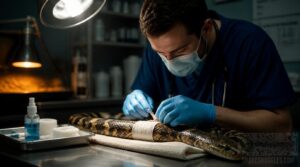
When you’re staring at an injured snake, your instinct is to call for help immediately. But not every cut carries the same odds, and knowing what to do next matters more than you might think. Here’s what determines whether veterinary care can actually make a difference.
Complete Bisection is Unsurvivable
No vet on earth can undo fatal organ separation. Once a snake is fully bisected, blood vessels rupture beyond repair, triggering irreversible blood loss and hypovolemic shock within minutes.
Nervous system collapse follows fast, and respiratory function shuts down. What you’re left with is complete bisection unsurvivable by any medical standard, only post-mortem movement in tissue that’s already dying.
Partial Cuts May Be Treatable
Not every cut is a death sentence. When the injury is partial, sparing the vent and cloaca, partial amputation becomes a real option.
Vets pair surgery with REAC-TO therapy to speed wound healing. Species like iguanas and geckos even manage tail regeneration, giving genuine rehabilitation potential when tissue repair and survival duration allow proper medical intervention.
Avoid Handling The Head
A snake’s head stays dangerous even after severe trauma. Keep a head safety distance of at least six inches, approach from the side, and never grip it bare-handed.
Wear thick gloves and use tools like hooks or tongs for control. This isn’t just about rapid blood loss near the front half, it protects you while the animal’s nervous system remains reactive.
Prevent Further Movement
Beyond the head itself, restrict all movement using dorsal recumbency, full body support that limits thrashing.
- Tube restraint for the front half
- Warm compress at 28-30°C
- Gentle sedation if reflexes persist
- Padded, ventilated transport box
- Continuous monitoring every five minutes
Muscle contractions and postmortem reflex action don’t mean pain. They’re nerve-driven, not conscious, but stillness protects tissue and you.
Seek Emergency Reptile Care
Once the halves are stabilized, get to a vet fast. Complete bisection has no medical fix, but emergency transport to exotic care matters for partial injuries. Use a ventilated carrier, keep temperature steady, and call ahead.
| Step | Action | Why |
|---|---|---|
| 1 | Contact vet | Confirms readiness |
| 2 | Load carrier | Limits stress |
| 3 | Drive calmly | Protects wounds |
Frequently Asked Questions (FAQs)
How long will a snake survive if cut in half?
Death arrives fast. Hypovolemic shock sets in within one to three minutes as blood pressure crashes. Organ failure follows within minutes to hours. Reflex twitching can persist longer, but that’s nerve activity, not survival.
Can a snake still be alive after being cut?
No. What looks like life is just nerve reflex activity, not survival. The front half suffers rapid blood loss and can’t sustain the heart and lungs. Without essential organs, both segments face fatal organ failure within minutes.
Do snakes feel pain when cut?
Like a live wire snapping, a snake’s nerves fire instantly on impact. Nociceptor activation triggers pain response behaviors and stress hormone release. Severity varies by species, tissue type, and injury context, but the reaction is real, not reflex alone.
What happens to a snake when you cut it in half?
Cutting triggers instant spinal shock, a sharp blood pressure drop, and organ exposure to bacteria. Nerve reflexes fire for minutes, but hypovolemic shock and organ failure follow fast. Survival without a head, or a functioning body, isn’t possible.
Can a snake survive if cut in half?
Could a snake beat those odds? It can’t. You’ll see hypovolemic shock, organ failure, and respiratory collapse within minutes. Nerve reactions may cause twitching, but mortality approaches 100% without emergency reptile first aid.
What happens if a snake is cut in half?
When you cut a snake in half, hypovolemic shock sets in within minutes. Spinal cord severing halts nerve control instantly. Organs fail fast, and any twitching afterward is just dying nerves firing, not survival.
How long does a snake’s body last after being cut in half?
A dying candle flickers longest at the wick, not the base, and a severed snake works the same way. Blood loss triggers shock within minutes, reflex twitching lasts up to an hour, but organ failure seals death fast.
Can a rat snake survive being cut in half?
A rat snake won’t survive full bisection. Severing destroys essential organs, blood flow, and nerve pathways, triggering rapid blood loss and shock. The front half dies within minutes; any twitching afterward is reflex, not survival.
Should you sever a snake in half?
Treating a snake like a loaf of bread you can slice apart is a fatal myth. Never sever a snake: it guarantees organ failure, massive blood loss, and near-100% mortality, not survival.
Can a snake survive without medical intervention?
Without emergency care, survival is impossible. Blood pressure collapses, oxygen delivery stops, and reflexes fade within minutes. No snake, no matter its size or species, recovers from bisection without a vet’s intervention.
Conclusion
Slithering, spasming, splitting: the spectacle fools your eyes, but not biology. Can a snake survive being cut in half? Find out first before trusting what looks like survival, because reflexes aren’t recovery.
Both halves fail within minutes. No circulation, no shared organs, no real chance. Respect that reality instead of testing it.
If you ever face this scenario, act fast, call a reptile vet, and remember: movement after trauma is a warning, not a miracle.