This site is supported by our readers. We may earn a commission, at no cost to you, if you purchase through links.
A neglected snake enclosure doesn’t fail all at once—it drifts. A damp corner here, a forgotten urate there, and suddenly you’re dealing with a bacterial bloom that threatens your animal’s respiratory health before you’ve noticed anything looks wrong.
Snakes are remarkably tolerant creatures, but that tolerance masks problems until they become serious.
The good news is that a consistent cleaning routine takes less time than most keepers expect, and it eliminates the guesswork entirely. Knowing exactly when to spot-clean, when to swap substrate, and when to strip the whole enclosure down keeps your snake healthy and your habitat under control.
Table Of Contents
- Key Takeaways
- When to Clean The Habitat
- Daily Spot Cleaning Steps
- Deep Cleaning The Enclosure
- Choosing Substrate and Safe Cleaners
- Reducing Stress During Cleaning
- Top 5 Cleaning Essentials
- Frequently Asked Questions (FAQs)
- What cleaning solution to use for snake enclosure?
- What does a snake habitat need?
- How long can substrate be reused?
- Can tank plants be cleaned with disinfectant?
- How to manage enclosure odors naturally?
- When to replace water bowl completely?
- How to clean bioactive setups properly?
- Can snakes recognize their enclosure after cleaning?
- How does feeding schedule affect cleaning needs?
- Should hatchlings and adults be cleaned differently?
- Conclusion
Key Takeaways
- Snake enclosures don’t fail suddenly—bacterial buildup, damp spots, and waste accumulation drift in slowly, so daily spot-cleaning is your first and most important line of defense.
- Match your substrate to your snake’s humidity needs: coconut fiber for tropical species, aspen shavings for desert species, since the wrong choice undermines every cleaning routine you build.
- A full deep-clean every three to six months follows a strict sequence—secure your snake first, disinfect with proper contact time, rinse completely, and only return your snake once the habitat is fully dry and reset.
- Snakes navigate by scent, so preserve hide placement and familiar substrate patches during cleaning to help your snake reorient quickly and stay calm after maintenance.
When to Clean The Habitat
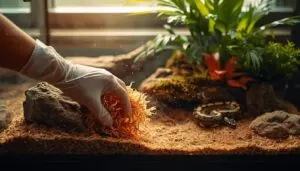
Cleaning your snake’s habitat isn’t about following a rigid schedule — it’s about reading the enclosure and responding to what it needs. The right timing depends on your snake’s size, habits, and the type of substrate you’re using.
A good guide to how often you should change snake bedding can help you build a baseline routine while you learn to spot the signs that a cleanout is overdue.
Here’s a breakdown of when to clean and what to watch for.
Daily Spot-cleaning Schedule
Every morning sets the tone for your snake’s day. A quick daily spot cleaning routine — done consistently — keeps bacterial buildup from ever getting a foothold.
Follow this simple Glove Protocol and Cleaning Timer approach:
- Morning Routine — Scan for feces, urates, and shed skin
- Remove waste immediately into a labeled Waste Bin
- Wipe spills near the water dish
- Evening Review — Check for damp spots or mold
Weekly Partial Substrate Changes
Daily spot checks catch the obvious messes, but weekly partial substrate changes handle what you can’t see. Swapping out 10–25% of the substrate dilutes nitrates and ammonia buildup without wiping out beneficial biofilm.
Focus on high-traffic zones — under hides and near the water dish. This staged approach also helps humidity stabilization, preventing sudden moisture swings that stress your snake.
Full Deep-clean Timing
Beyond weekly upkeep, a full deep-clean timing target lands every three to six months on a seasonal schedule — think spring and fall resets.
Jump to an unscheduled full cleaning procedure for reptile habitats whenever a contamination trigger appears, like heavy waste buildup or persistent dampness.
Smart downtime planning and a quick post-clean recheck of temperature timing confirm the habitat is truly ready before your snake returns.
Factors That Change Cleaning Frequency
Your set schedule isn’t always enough — several real-world factors affect how often cleaning actually needs to happen.
- Water Drainage issues let pooled moisture accelerate mold and ammonia buildup quickly
- Feeding Spill Rate rises with messy thawed prey, pushing spot cleans sooner
- Substrate Absorption capacity determines how quickly waste saturates the bedding
- Population Waste Load and Temperature Microbial Growth both climb in warm, humid conditions
Signs The Enclosure Needs Immediate Cleaning
Some signs don’t wait for your schedule. Foul odor, cloudy water in the dish, or greasy glass are immediate red flags.
Visible urates piling up, moldy substrate, or musty ammonia-like smells signal that waste control has already fallen behind. Pest activity — small flies or mites — confirms something organic is festering. These are classic signs of an unhealthy habitat that needs attention right now.
Regular professional enclosure cleaning can prevent mold buildup and extend the habitat’s lifespan.
Daily Spot Cleaning Steps

Daily spot cleaning is the foundation of a healthy snake habitat, and it doesn’t take long once you know what to look for. A quick daily check keeps small problems from turning into bigger ones.
Here’s exactly what to do each time you open that enclosure.
Removing Feces, Urates, and Shed Skin
Start at the far end of the enclosure and work toward you — this keeps clean areas clean. Pick up feces with a paper towel, then discard it immediately.
Crusted urates need softening first; press a damp cloth over them for thirty seconds before wiping edge-to-center. Gather shed skin fragments gently to avoid grinding them into substrate.
Always sanitize your tools after each session.
Cleaning Spilled Water and Food
Spills happen fast, and wet substrate left sitting even a few hours starts growing bacteria.
Designate Spill Containment Zones by placing the bowl on a flat tile or tray — your Bowl Placement Strategy cuts cleanup time in half.
Use paper towels and rubber gloves to pull wet bedding immediately, then apply Rapid Drying Techniques like gentle airflow before resetting the area.
Checking for Damp Spots and Mold
Damp patches are the slow leak that ruins everything — you won’t always smell trouble before it spreads.
Run daily Humidity Hotspot Detection and Condensation Mapping checks with these five Mold Visual Indicators:
- Dark, clumped substrate signals a Substrate Moisture Testing failure
- Fuzzy or discolored patches confirm active mold
- Musty odor near hides indicates poor ventilation
- Condensation on cool walls reveals humidity imbalance
- Peeling décor surfaces warn of persistent dampness
Refreshing High-traffic Substrate Areas
Think of your enclosure like a kitchen floor — the busiest spots get dirty fastest.
Use Traffic Flow Mapping to identify hotspots: feeding stations, water dish corners, and hide entrances. Refresh these zones daily with Wear-Resistant Blends and a Moisture-Wicking Top layer to block dampness. Color-Coded Zones make it easy to track which areas need attention, while Odor Absorbing Layers keep smells under control between full changes.
| Zone | Refresh Frequency | Priority Reason |
|---|---|---|
| Feeding Station | Daily | Waste and food residue accumulate quickly |
| Water Dish Area | Daily | Spills create damp patches quickly |
| Hide Entrance | Every 2–3 days | Heavy movement compacts substrate |
| Basking Spot | Weekly | Moderate traffic, drier conditions |
| Far Corners | Weekly | Low traffic, slower buildup |
This spot cleaning routine and benefits approach helps your partial substrate changes by reducing how much substrate replacement you need at full deep cleans. Consistent substrate absorption management and mold prevention start here.
Washing and Refilling The Water Dish
Your water dish is one of the fastest places for bacteria to take hold. Rinse and scrub it daily with hot water and unscented soap using a dedicated brush — that’s your Sanitizing Tools rule.
Ceramic or stainless steel makes Dish Material Choice easy since both sanitize cleanly.
Refill Timing matters too: refill immediately after drying with room-temperature fresh water for proper Temperature Control and Water Quality Monitoring.
Deep Cleaning The Enclosure
Deep cleaning goes beyond the daily tidying — it’s a full reset that protects your snake’s health from the ground up. Done right, it follows a clear sequence that keeps both you and your snake safe throughout the process.
Here’s exactly how to work through each step.
Preparing a Safe Temporary Holding Container
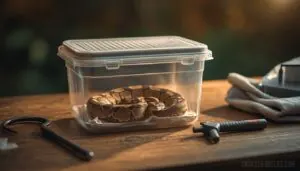
Before moving a single piece of décor, you need a secure container ready. Choose a temporary holding habitat with a rigid escape-proof design, food-grade materials, and ventilation mesh sized so your snake can’t push through.
Ergonomic grips make transport safer when handling reptiles safely with a snake hook.
humidity control liner keeps conditions stable while you work.
Removing Substrate, Hides, and Decor
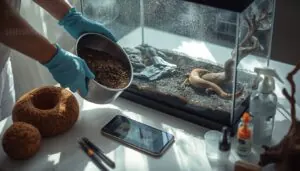
Once snake is secured, start removing items methodically. Photograph the layout first — your Enclosure Layout Mapping reference makes resetting familiar hide boxes much easier later.
- Use Selective Substrate Extraction, scooping out sections gradually.
- Remove decorations one at a time, following your Hides Labeling System.
- Apply your Tool Sanitization Protocol to every scoop and brush.
- Rotate out worn pieces using Decor Material Rotation before replacing substrate.
Scrubbing Enclosure Walls and Surfaces
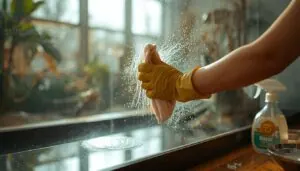
With the enclosure emptied, Wall Material Choice shapes everything here. Nonporous Surface Benefits are real — glass and sealed acrylic wipe clean without harboring bacteria in micro‑scratches.
Put on your gloves, grab your scrub brushes, and work top to bottom using a mild bleach solution or reptile‑safe disinfectant. Soft microfiber cloths protect coatings. Your cleaning supplies mean nothing without proper Drying Techniques — air dry completely before resetting.
| Scrubbing Tools | Agent Compatibility | Surface Type |
|---|---|---|
| Microfiber cloth | Mild bleach solution | Glass |
| Soft scrub brush | Reptile-safe disinfectant | Sealed acrylic |
| Sponge applicator | Vinegar rinse | Plastic backdrop |
Disinfecting With Proper Contact Time

Scrubbing gets the visible grime off, but disinfecting the enclosure is where pathogens actually die — and that only happens if you respect Label Dwell Time.
A chlorhexidine solution or diluted bleach solution needs to stay visibly wet on every surface for the full contact period. Surface Wetness Monitoring matters here: if it dries early, reapply.
Organic Soil Impact is real too — heavy residue blocks your reptile-safe disinfectant from working properly, so scrub first, then disinfect.
Rinsing, Drying, and Resetting The Habitat
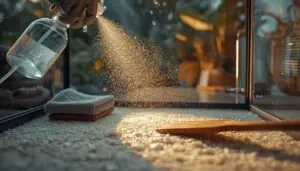
Once disinfecting the enclosure is done, rinsing is your next critical step — use a Gentle Spray Technique across all corners and drainage areas for 30 to 60 seconds per section.
Wipe surfaces dry, then apply Airflow Optimization with a quiet fan nearby.
Distribute fresh substrate using even, flat layers for Substrate Even Distribution.
Choosing Substrate and Safe Cleaners
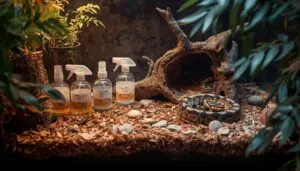
What goes inside snake’s enclosure matters just as much as how often you clean it. The substrate you choose and the products you use can either support a healthy habitat or quietly work against it.
Here’s what you need to know about each option.
Best Substrate Types for Hygiene
Your substrate choice is the foundation of a clean habitat — get it wrong, and no cleaning routine will save you.
- Coconut fiber excels at moisture management and mold prevention, keeping humidity stable without soaking through.
- Cypress mulch resists mold naturally and dries fast after cleaning cycles.
- Aspen shavings offer solid dust control and absorb watery urates efficiently.
- Reptile carpet stays antimicrobial when washed regularly, with no odor-binding minerals needed.
Humidity-retaining Vs Dry Substrates
Which substrate wins — moisture or dry? It depends entirely on your snake’s needs.
| Substrate | Moisture Retention | Mold Risk |
|---|---|---|
| Coconut fiber | High | Low with ventilation |
| Cypress mulch | Medium | Very low |
| Aspen shavings | Low | Low, dries fast |
Humidity management directly impacts snake health — tropical species need coconut fiber’s stable moisture, while desert snakes thrive on aspen’s quick-drying properties.
Always match species compatibility with temperature interaction and ventilation needs.
When to Replace All Substrate
Think of substrate like a sponge — once it’s past its limit, spot cleaning won’t save it.
Replace all substrate when odors persist after routine cleaning, when compaction levels restrict airflow, or when humidity saturation creates damp, anaerobic pockets.
Visible mold detection is a hard stop.
An enclosure renovation or substrate type switch also calls for a full reset of your substrate maintenance and cleaning schedule.
Reptile-safe Disinfectants and Soaps
Not every cleaner on the shelf is safe for your snake.
Stick to reptile-safe disinfectants like diluted chlorhexidine solution or products with quaternary ammonium compounds — following dilution ratio guidelines precisely matters.
Hypochlorous acid solutions rinse clean easily.
For light debris, a castile soap rinse or baking soda paste works well.
Always rinse thoroughly, since mild detergents and snake-safe cleaning products still leave residue.
Reducing Stress During Cleaning
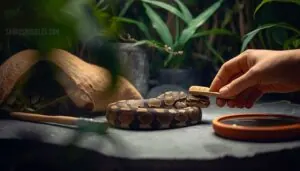
Cleaning day can be genuinely stressful for your snake — even if you handle everything perfectly. The good news is that few simple habits go a long way toward keeping your snake calm before, during, and after maintenance.
Here’s what you need to know to make the whole process easier on both of you.
Minimizing Handling During Maintenance
Handling snakes during cleaning should happen as rarely as possible. The less you pick up your snake, the less stress it experiences overall.
- Use Access Point Consolidation — enter through one spot only
- Rely on Pre-Staged Supplies so everything’s ready before you open the enclosure
- Apply One-Pass Cleaning to finish without interruption
- Use the Quiet Transfer Method when moving is unavoidable
- Do Tool Warm-Up before starting to avoid delays
Preserving Familiar Scents and Layout
Scent consistency matters more than most keepers realize. Your snake maps its enclosure through smell and touch, so preserving scent markers — old substrate patches, familiar hide placement, consistent terrarium landmarks — keeps that mental map intact.
Your snake navigates its world by scent, so preserving familiar smells keeps its mental map intact
Spot cleaning and partial substrate changes help here: swap sections, not everything at once.
This approach to layout memory and substrate texture retention is the heart of minimizing stress during snake enclosure cleaning.
Avoiding Noise and Sudden Disruption
Sound travels through glass and wood faster than you’d expect. That’s why quiet tool handling matters as much as scent preservation — slow your movements, practice soft lid placement on a folded towel, and keep a predictable cleaning path so nothing feels sudden.
Stable lighting and temperature consistency throughout the session complete the picture of stress reduction during cleaning.
Stress Behaviors to Watch For
Even with careful stress reduction during cleaning, your snake may still signal discomfort. Watch for hissing lunging postures, frequent hiding, and body tightening — these are clear behavioral stress indicators.
Rapid breathing and tongue flick changes that persist after you’ve finished are signs your snake is experiencing stress.
Recognize these signals early so you can adjust your approach before patterns worsen.
Post-clean Monitoring and Record-keeping
Once snake settles back in, your job isn’t quite done. A quick post-cleaning monitoring and care check catches problems early.
Run through a simple verification checklist — confirm drying confirmation, note disinfectant timing, and flag any mold odor tracking concerns. Your snake care logbook ties it all together, linking photo log comparisons, health checks, and your cleaning diary into responsible, long-term recordkeeping and health checks.
Top 5 Cleaning Essentials
Having the right tools on hand makes every cleaning session faster, safer, and less stressful for both you and your snake. You don’t need a cabinet full of supplies — just a few reliable essentials that cover the basics.
Keep a dedicated scoop, gloves, and enzyme cleaner within reach, since removing snake waste from substrate safely depends on grabbing the right tool the moment you spot a mess.
Here are the five items worth keeping in your reptile care kit.
1. Van Ness Litter Scoop

The Van Ness Litter Scoop ($6.15) is a surprisingly practical pick for reptile keepers. Its high-impact plastic construction and slotted head make quick work of scooping out feces, urates, and soiled substrate without dragging clean bedding out with it.
At just 11 inches long and 32 grams, it’s light enough to maneuver inside tight enclosures.
The polished, odor-resistant surface wipes clean easily between uses.
Just note that the larger slots can miss fine debris, so pair it with a daily visual sweep.
| Best For | Reptile keepers who want an affordable, easy-to-clean scooping tool for maintaining enclosures with granular or loose substrate. |
|---|---|
| Material | High-impact plastic |
| Primary Use | Litter scooping |
| Odor Control | Stain/odor-resistant finish |
| Ease of Cleaning | Polish resists sticking |
| Size/Capacity | 11 x 4.88 x 2.25 in |
| Price (Retail) | $6.15 |
| Additional Features |
|
- High-polish surface resists odors and cleans up fast — no litter or debris clinging to it between uses.
- At just 32 grams and 11 inches long, it’s light and easy to work with inside tighter enclosures.
- Slotted head sifts through substrate quickly, leaving clean bedding behind.
- Larger slot openings can miss fine debris, so you’ll still need to do a visual sweep.
- The handle can bend or snap under heavy, dense substrate — not ideal for deep digging.
- Low-cost plastic may get brittle or discolor over time, so don’t expect it to last forever.
2. Exo Terra Terrarium Mister
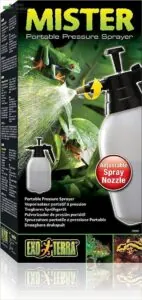
The Exo Terra Terrarium Mister (PT2491, around $15) earns its spot in any serious keeper’s toolkit.
Its 67.5 fl oz reservoir means fewer refills during multi-tank maintenance, and the adjustable nozzle lets you switch between a fine mist and a direct stream in seconds.
No batteries, no cords — just pump, lock, and spray.
One thing to remember: release the pressure after each session to protect the seals and extend the sprayer’s life.
| Best For | Reptile and amphibian keepers managing large enclosures or multiple tanks who want a hands-free, battery-free misting solution. |
|---|---|
| Material | Durable plastic |
| Primary Use | Terrarium misting |
| Odor Control | Humidity regulation |
| Ease of Cleaning | Rinse before use |
| Size/Capacity | 67.5 fl oz reservoir |
| Price (Retail) | Not listed |
| Additional Features |
|
- Big 67.5 fl oz tank means fewer refills, even during full multi-tank maintenance sessions.
- Adjustable nozzle switches between fine mist and direct stream — works for everything from delicate frogs to larger tropical setups.
- No batteries or cords needed; just pump, lock, and you’re good to go.
- Takes several pump strokes to build pressure, which gets old fast if you’re in a hurry.
- Seals can leak or wear out over time, especially if you forget to release pressure after use.
- A bit bulky — not ideal if you’re working in tight spaces or only need to mist a small tank.
3. Bounty Select A Size Paper Towels
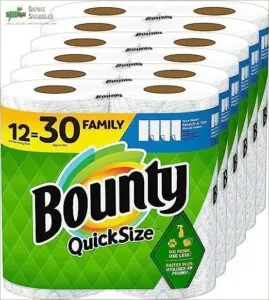
Few supplies earn their place faster than a reliable paper towel, and Bounty Select A Size delivers where it counts. The 2-ply construction holds together when wet, so you’re not fighting a disintegrating sheet while scrubbing a hide or soaking up a spill.
The perforated sizing lets you tear exactly what you need — no waste, no guessing.
Keep a roll within arm’s reach during spot-cleans for quick feces removal, surface wipes, and drying surfaces after rinsing decor.
| Best For | Anyone who wants a dependable, no-fuss paper towel that handles everything from greasy kitchen messes to delicate glass surfaces without falling apart. |
|---|---|
| Material | Double-ply paper fiber |
| Primary Use | Surface cleaning |
| Odor Control | Absorbs pet accidents |
| Ease of Cleaning | Lint-free, no residue |
| Size/Capacity | 12-roll family pack |
| Price (Retail) | $39.98 |
| Additional Features |
|
- Double-ply construction stays strong when wet, so one sheet actually does the job
- Select-A-Size perforations let you cut down on waste by tearing only what you need
- Lint-free and scratch-free on delicate surfaces like mirrors and electronics
- Pricier than store-brand alternatives, which can add up over time
- Only 12 rolls per pack, which feels light given the cost
- Listed as an older/discontinued version, so availability or packaging may have changed
4. Clorox Splashless Bleach Regular
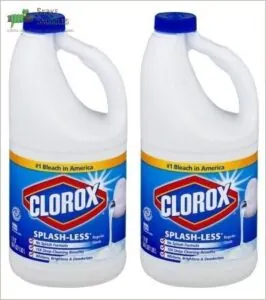
Bleach sounds harsh for a reptile enclosure — but used correctly, it’s one of the most effective disinfectants you have. Clorox Splashless Bleach works well here because the thicker formula pours in a controlled stream, reducing the risk of accidental skin or surface contact.
Mix one part bleach with ten parts water, apply it to enclosure walls and decor, and let it sit for 10–15 minutes.
Rinse thoroughly until no chemical smell remains before your snake goes back in.
| Best For | Anyone who wants a reliable, no-fuss bleach for laundry, disinfecting surfaces, or even cleaning reptile enclosures without worrying too much about splashing. |
|---|---|
| Material | Sodium hypochlorite liquid |
| Primary Use | Disinfecting/whitening |
| Odor Control | Deodorizes surfaces |
| Ease of Cleaning | Dilute and wipe |
| Size/Capacity | 2 x 55 fl oz bottles |
| Price (Retail) | Not listed |
| Additional Features |
|
- The thicker, splash-less formula makes pouring way less messy — great if you’ve ever ruined a shirt reaching for regular bleach.
- Two 55 fl oz bottles give you plenty to work with, and the 10× deep cleaning claim holds up on tough stains like grass and blood.
- Works with both standard and HE washers, so no compatibility headaches.
- Buying two bottles at once isn’t ideal if you just need a small amount or have limited storage space.
- It’s bleach — you still need gloves, ventilation, and to keep it far away from colored fabrics, despite the gentler pour.
- "Splash-less" doesn’t mean splash-proof, so you’ll still want to pour carefully over sinks or covered surfaces.
5. Zoo Med Aspen Snake Bedding
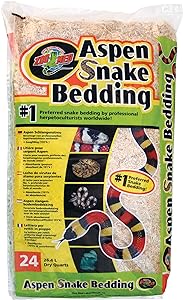
Zoo Med Aspen Snake Bedding is the substrate that pulls its weight in every cleaning routine. Made from natural aspen fiber — no toxic cedar oils — it absorbs roughly 191% of its weight in moisture, keeping your enclosure dry between cleanings.
That high absorbency means fewer damp spots and slower bacterial buildup. It’s low-dust, helps burrowing behavior, and swaps out easily during spot-cleaning.
Just remember: it’s not ideal for high-humidity tropical species or aquatic setups.
| Best For | Reptile and small animal owners who want a clean, natural bedding that’s easy to maintain and safe for a wide range of species. |
|---|---|
| Material | Aspen fiber |
| Primary Use | Reptile substrate |
| Odor Control | Odorless formula |
| Ease of Cleaning | Spot-clean friendly |
| Size/Capacity | 24-qt / 5.4 lb bag |
| Price (Retail) | $22.98 |
| Additional Features |
|
- Absorbs nearly twice its weight in moisture, keeping enclosures dry and hygienic between cleanings
- Low-dust formula reduces respiratory irritation for both pets and their owners
- Encourages natural burrowing behavior, which is great for animal wellbeing
- Not suited for desert reptiles, aquatic setups, or species that need constant high humidity
- Needs full replacement periodically to avoid mold buildup in saturated areas
- Bulkier and heavier than thinner shaving alternatives, which can be a hassle to store
Frequently Asked Questions (FAQs)
What cleaning solution to use for snake enclosure?
Ironically, the "safest" choice is often the simplest: diluted white vinegar for routine cleaning, chlorhexidine for deeper disinfection, and F10 veterinary disinfectant when you need broad-spectrum coverage without harsh residues.
What does a snake habitat need?
A snake habitat needs a warm side (25–32°C) and a cool side (22–28°C), proper humidity, secure hides on both ends, and clean substrate that facilitates your species’ natural behaviors.
How long can substrate be reused?
Substrate stays serviceable for two to three cycles before nutrients deplete and texture breaks down.
Past that point, yields drop and contamination risk climbs — fresh bedding is the smarter, safer swap.
Can tank plants be cleaned with disinfectant?
Yes, but carefully. Live plants are sensitive — disinfectants can damage tissue.
Rinse plastic or silk plants thoroughly after any chemical exposure. For live plants, stick to plain running water and gentle scrubbing instead.
How to manage enclosure odors naturally?
Like a well-ventilated kitchen, fresh airflow does most of the heavy lifting.
Remove waste promptly, swap damp substrate weekly, and clean the water dish daily to stop odors before they start.
When to replace water bowl completely?
Replace the water bowl the moment you spot a crack, chip, or sharp edge.
Persistent odor after washing, rough pitted surfaces, or staining that won’t scrub clean are equally clear signals.
How to clean bioactive setups properly?
Bioactive setups need lighter intervention than bare enclosures. Skip full substrate swaps — your cleanup crew manages waste naturally. Focus on spot-removing feces, revitalizing damp zones, and checking for mold weekly.
Can snakes recognize their enclosure after cleaning?
Snakes use both spatial memory and chemical cues to recognize their home. If you keep hides and landmarks in the same spots, your snake will reorient quickly after cleaning.
How does feeding schedule affect cleaning needs?
More meals mean more waste. Bigger portions mean faster buildup. A consistent feeding schedule makes defecation predictable, so you know exactly when to spot-clean instead of guessing every day.
Should hatchlings and adults be cleaned differently?
Yes — hatchlings need more frequent spot cleaning and water dish changes than adults. Their smaller spaces concentrate waste faster, and their immune systems are still developing, making hygiene especially critical.
Conclusion
Think of your enclosure as a living system—one that rewards attention and punishes neglect quietly, in the background. Cleaning and maintaining your snake habitat isn’t a chore you manage when things look bad; it’s a rhythm you build before they do.
Daily checks, weekly refreshes, and periodic deep cleans aren’t just good practice—they’re the difference between a thriving animal and a slow-developing problem.
Stay consistent, and your snake will show you exactly what that care looks like.