This site is supported by our readers. We may earn a commission, at no cost to you, if you purchase through links.

Your corn snake stopped eating five days ago and now spends most of her time pressed belly-first against the warm side of her enclosure. Is she sick, stressed, or something else entirely? For keepers who breed or simply house males and females together, that question carries real weight.
Knowing how to tell if your snake is pregnant starts with reading her body, not guessing. A gravid female often reveals herself through a firm midbody lump, a shift toward hotter basking spots, and a shed cycle that runs 20 to 40 days ahead of schedule. Spot these signs early, and you’ll know exactly how to prepare her enclosure, her diet, and her care for what comes next.
Table Of Contents
- Key Takeaways
- How to Tell if Your Snake is Pregnant
- Physical Signs Your Snake is Gravid
- Behavioral Signs Before Eggs or Birth
- How Veterinarians Confirm Snake Pregnancy
- How to Care for a Pregnant Snake
- Frequently Asked Questions (FAQs)
- How long can a snake be pregnant?
- What month is breeding season for snakes?
- How do female snakes behave when pregnant?
- What do snakes look like when they are pregnant?
- How do I know if my snake is pregnant?
- How can one know if they are pregnant after having unprotected sex before having their period?
- What does it mean when a snake is pregnant?
- Can a snake be palpated to confirm pregnancy?
- How long is a snake pregnant?
- Can snakes get pregnant without a male?
- Conclusion
Key Takeaways
- Watch for a firm midbody lump, noticeable weight and girth gain, and a shift toward hotter basking spots—these physical and behavioral changes together are the clearest early clues your snake is gravid.
- A pre-lay shed happening 20 to 40 days ahead of schedule is one of the most reliable warning signs that eggs or babies are on the way soon.
- Appetite loss, restlessness, nesting behavior, and increased defensiveness are all normal parts of pregnancy, but lethargy or weight loss over 10% means it’s time to call your vet.
- Only a veterinarian can truly confirm pregnancy, using tools like ultrasound (96% accurate around day 17-19), palpation, or X-rays, so home observations should guide care, not replace professional diagnosis.
How to Tell if Your Snake is Pregnant
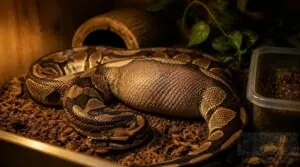
Your snake’s body and behavior start telling the story weeks before any eggs or babies show up. The trick is knowing which changes actually mean something versus which are just an ordinary Tuesday for a snake. Here’s what to watch for, how egg-layers differ from live-bearers, and what timeline you’re working with once you spot the signs.
If you notice that telltale pre-lay shed, it’s a good time to brush up on how to properly care for a pregnant snake before the eggs actually arrive.
Weeks before eggs appear, a snake’s body and behavior quietly reveal whether she’s pregnant
Common Pregnancy Signs at a Glance
Six clues tend to show up together: visible swelling, appetite reduction, temperature shifts, nesting behavior, shedding patterns, and handling sensitivity. Your snake may bask more at 90°F, refuse meals, or shed dully days before laying.
None of these alone confirms pregnancy, but together they paint a fairly clear picture worth watching closely.
Egg-Layers Versus Live-Bearers
Before reading signs, know which mode your snake follows. Oviparous snakes like corn snakes lay 6-20 eggs externally; viviparous snakes like boas birth 2-12 live young internally. Egg-layers produce larger clutches but lower survival rates; livebearers carry fewer offspring with better odds. Gravid females of live-bearing species also show restricted mobility during gestation, unlike egg-layers before nesting.
This tradeoff reflects a broader pattern of reptile reproductive modes, where internal development trades brood size for offspring protection.
Species-Specific Gestation Timelines
Timelines vary widely by species, so knowing yours matters. Ball pythons run 44–54 days; boa constrictors roughly 6–8 weeks; corn snakes and gopher snakes 60–70 days; king snakes 40–60 days. Larger pythons can stretch to 6–9 months.
Breeding season timing and temperature both shift these windows, so gestation timing varies even within one species.
Physical Signs Your Snake is Gravid
Your eyes and hands can catch a lot before any vet visit is needed. A gravid snake’s body changes in specific, predictable ways as those eggs or babies develop. Here’s what to actually look for, starting with her midsection.
Midbody Swelling and Firm Lumps
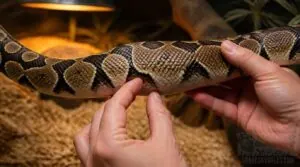
Run your fingers gently along her sides: a firm, symmetrical lump near midbody signals egg mass palpation, not gas or a stuck meal.
- Appears roughly 40% down from snout to vent
- Feels firm, unlike soft abscesses
- Reflects oviduct enlargement from developing eggs
- Confirms reproductive tract swelling, not fecal buildup
That palpable bulge is your first real clue something’s cooking.
Increased Girth and Weight Gain

A tape measure tells you what your fingers only suspect.
Precise measurements matter, but so does watching for cloudy eyes signaling an approaching shed, a cue your fingers might miss entirely.
Weight gain and girth expansion often move together: gravid females average 330 grams gained, a 15-20% jump over baseline, with girth swelling 15-25% at the widest point. That’s abdominal swelling you can track weekly.
Females need 1500 grams minimum before laying, so consistent gains toward that threshold, plus visible midsection swelling, strongly support gravidity.
Rounded Belly Shape
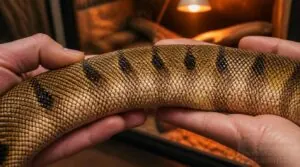
Run your hand along her sides, not just underneath. Gravid pythons develop midbody uniformity, a cylindrical shape instead of the usual taper.
Check for the ventral scale curve: flat near the head, rounded toward the tail.
You may even feel a subtle egg bulge pattern, distinct lumps spaced evenly beneath firm, tight skin.
Pre-Lay Shed
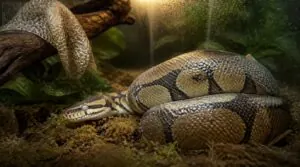
Before eggs appear, gravid snakes usually shed 20 to 40 days out, a pre-lay shed signaling the final push toward laying.
Watch for milky eyes, dull skin along the flanks, and reduced appetite. Duration runs 5 to 17 days.
Keep humidity at 70-90% and temps 82-85°F. Eggs usually follow 30 to 50 days after shed completes.
Color and Scale Changes
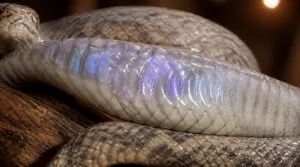
Your snake’s skin often tells the story before her belly does. Watch for:
- Thicker, opaque scales, especially ventral ones
- Blue-purple ventral iridescence as hydration rises
- Pre-ovulation brightening (corn snakes glow vividly)
- Visible scale spacing where skin stretches around eggs
Ball pythons often turn washed-out and pale, a hormonal, species-specific shift, not just basking-zone lighting at 90°F.
Behavioral Signs Before Eggs or Birth
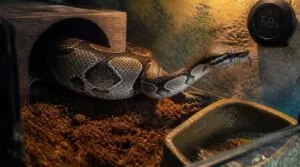
Physical changes tell part of the story, but your snake’s behavior often speaks just as loudly. Gravid snakes act differently, shifting habits in ways that can catch first-time owners off guard. Here’s what to watch for as your snake’s body gets ready for eggs or birth.
Appetite Loss or Food Refusal
Watching a full food bowl go untouched, week after week, unsettles most keepers. It’s normal: 85-95% of gravid females show reduced feeding or refusal, driven by rising progesterone and estradiol suppressing appetite hormonally.
Timeline varies by species. Stable weight, alertness, and activity mean it’s typical fasting. Lethargy or over 10% weight loss? That warrants a vet call, not just watchful waiting.
Shifting Temperature Preferences
Ever notice her camped by the heat lamp for days? That’s thermoregulation shifting into high gear.
- Basking zone near 90°F
- Cool-seeking early on, warmth-seeking later
- Thermal gradient use becomes deliberate
- 2-4°C above baseline preference
This precision matters: embryos need stable warmth. Microhabitat choices change too, snakes favoring hotter spots than usual.
Nesting and Restlessness
That warmth-seeking phase soon gives way to something more purposeful. Pre-lay movement starts 5-10 days after shedding, with circling and belly-pressing against glass. Ball pythons dig test holes in vermiculite, seeking damp, dark nesting sites. This restless behavior peaks 24-48 hours before laying, sometimes lasting 72 hours straight. Provide a proper nest box, moist substrate matters.
Unusual Resting Positions
Body language often says more than a bulging belly. Gravid snakes shift between odd postures: belly-up resting, side-lane tilts, tight coils, even a hip elevation shift that angles the tail downward. Each helps reposition eggs.
This position restlessness intensifies alongside nesting behavior, body thickening, and visible swelling, usually appearing together as birth or laying nears.
Handling Sensitivity and Defensiveness
That restlessness often comes with a shorter fuse. Gravid females show roughly three-fold increased agitation and 40% higher stress sensitivity, so tail guarding, tight coiling, and defensive striking readiness become more common. Handling sensitivity spikes fast.
Give her space. Slow, predictable movement and safe grip distance keep body language threat displays from escalating during this normal but touchy phase.
How Veterinarians Confirm Snake Pregnancy
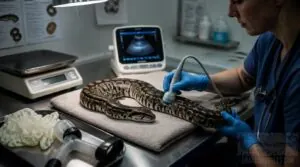
Spotting the signs at home is a great start, but guessing only gets you so far. Your vet has a handful of tools that turn "maybe" into a confirmed answer, each suited to a different stage of gestation. Here’s what that diagnostic process actually looks like.
Professional Abdominal Palpation
A trained reptile veterinarian’s hands can often tell more than a scale ever will. Abdominal palpation works best 30-45 days post-ovulation, when eggs feel like firm, smooth spheres versus soft, irregular follicular cysts.
Vets first assess stress level, since a tense snake masks findings. Muscle tone, visible swelling, and consistent documentation round out a reliable exam for gravid snakes.
Ultrasound for Early Detection
When fingers reach their limit, sound waves take over. Ultrasound provides 96% sensitivity for early detection, using ventral scanning with transducer frequency selection matched to your snake’s size.
Preovulatory follicle monitoring spots impending ovulation early. Later scans reveal gestational sac detection and embryonic heartbeat timing, sometimes alongside progesterone blood tests, giving your reptile veterinarian a clearer picture than X-ray or abdominal palpation alone can offer.
X-Rays for Shelled Eggs
Once follicles calcify into true eggs, X-rays earn their keep. Shells show up as thin, radio-opaque outlines, giving clear egg count detection and confirming a gravid snake in egg-laying species.
- Clustered eggs signal egg binding
- Overlapping shapes suggest dystocia
- Folded margins mean fractured eggs
- Dense bands indicate retained eggs
Limitation: soft shells resemble follicles, so ultrasound may still confirm.
Species-Specific Hormone Testing
When physical exams stay ambiguous, a reptile veterinarian may turn to hormone testing, though it isn’t one-size-fits-all. Each species needs its own assay validation since metabolite structures differ.
Faecal sample analysis works well for ball pythons, showing progesterone rising 2-3 fold during pregnancy. Blood-based progesterone level validation catches hormonal changes too, but timing and species-specific hormone metabolite ratios both matter for accuracy.
Best Time for Diagnosis
Timing changes everything in diagnosis. Ultrasound works best around day 17-19, hormone testing needs day 18-25, and palpation hits its accuracy window at day 20-30.
- Best ultrasound timing: day 17-19, 96% sensitivity
- Hormone threshold period: day 18-25
- Palpation accuracy window: day 20-30
- Radiographic detection day: 58+
Pre-lay shed timing (10-14 days before birth) offers another reliable marker.
How to Care for a Pregnant Snake
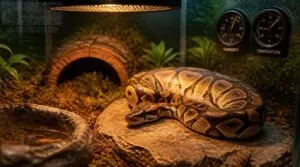
Once you’ve confirmed your snake is gravid, your job shifts from detective to caretaker. A pregnant snake has specific needs, and getting them right can make the difference between a healthy clutch and a stressed-out mom. Here’s what deserves your attention over the coming weeks.
Species-Appropriate Heat and Humidity
Gravid snakes get picky about heat. Keep the basking zone at 90°F, cool side 75-82°F, so she can shift as needed.
Tropical species need 65-75% humidity; deserts stay drier.
Use ceramic heat emitters, not heat rocks, and check both zones daily with a hygrometer and dual thermometers for thermal precision.
Nest Box for Egg-Layers
Egg-laying species need a proper nest box, not just a hide. Build it at least 12x12x12 inches, using moist vermiculite topped with sphagnum moss for humidity balance. Add mesh vents for airflow, keep the entrance predator-proof, and place it on the thermal gradient’s cooler end so she can nest without overheating.
Fresh Water and Feeding Changes
Once her nest box is ready, shift focus to her bowl. Swap in a dish 30% larger, and change water daily using tap, not distilled, at 78–82°F.
- Expect appetite loss weeks before laying
- Offer meals every 7–10 days if she’s eating
- Reduce prey size 10–15% to avoid regurgitation
Mist during pre-lay shed to support hydration and thermal regulation.
Limiting Handling and Stress
Once feeding routines settle, ease off handling too. Limit contact to once daily, capping sessions at 30 minutes, starting with just 5.
Watch for hissing, musking, or rapid tongue flicking (over 5 flicks/minute) and stop immediately. Use a hook for defensive females.
Afterward, give her a hide and 2 hours undisturbed to resettle.
Warning Signs Requiring Veterinary Care
Some signs mean it’s time to call your reptile veterinarian, not wait it out. Watch for dystocia (egg binding): firm swellings past 24 hours, straining over 30 minutes, or cloacal bleeding.
Respiratory symptoms like persistent clicking may also signal an emergency, so reviewing corn snake clicking and breathing warning signs can help you decide when to act fast.
Acting quickly matters more than getting every detail perfect, so keep this post-breeding care and warning signs guide handy while you monitor her.
Also flag open-mouth breathing, tremors, seizures, or fever above 102°F. Calcium supplementation helps with proper contractions and aids in dystocia prevention, but retained eggs still need prompt professional care.
Frequently Asked Questions (FAQs)
How long can a snake be pregnant?
Gestation runs 44 to 120 days, depending on species. Ball pythons average 54-60 days, boas 90- Viviparous and ovoviviparous species carry young internally, while temperature, humidity, and nutrition all shift the exact timeline.
What month is breeding season for snakes?
Most snakes enter their mating season between March and May, driven by rising temperatures and photoperiod shifts. Regional climate, sperm storage, and species vary this window, and climate change is gradually nudging breeding season earlier across many populations.
Because egg-layers and live-bearers need different incubation temperatures and humidity levels, snake reproduction and care guidance can help breeders prepare well before the season begins.
How do female snakes behave when pregnant?
You’ll notice appetite reduction, restlessness, and temperature shifts toward the basking zone near 90°F. Handling sensitivity rises too. These behavioral changes, paired with nesting behavior and prior contact with a male, strongly suggest gravidity.
What do snakes look like when they are pregnant?
Picture a rounded belly profile with visible midsection swelling two-thirds down the body. Gravid snakes develop a lumpy midsection, palpable eggs, and noticeable body thickening around the middle, with girth increasing well beyond their pre-mating shape.
How do I know if my snake is pregnant?
Watch for visible midsection swelling, appetite loss, and a prelay shed two to three weeks before laying. Behavioral changes like restlessness or nesting behavior often appear too, but only veterinary confirmation via ultrasound or X-ray gives you certainty.
How can one know if they are pregnant after having unprotected sex before having their period?
Two roads diverge here: human biology and reptile biology don’t overlap. For people, watch for implantation bleeding, breast tenderness, or missed periods, then confirm with a home test. This snake guide covers gravid signs like lumps and shedding instead.
What does it mean when a snake is pregnant?
A gravid snake carries developing eggs or embryos after internal fertilization. Roughly 70% of species are oviparous egg-layers; the rest are viviparous, bearing live young. Either way, expect body thickening and other pregnancy symptoms in reptiles as embryo development progresses.
Can a snake be palpated to confirm pregnancy?
Yes, but only skilled hands should try it. Experienced vets can detect eggs by feel, though palpation accuracy stays limited. Ultrasound provides 96% sensitivity, making it a far safer, more reliable choice for confirming gravid snakes.
How long is a snake pregnant?
Timing varies by species: oviparous snakes carry eggs 28–45 days before laying, while viviparous snakes stay gravid 70–105 days. Temperature speeds or slows development, and clutch size can shift gestation length too.
Can snakes get pregnant without a male?
Female boas and pythons occasionally reproduce through parthenogenesis, producing eggs without male contact via automixis. Offspring end up as near genetic clones. The Brahminy Blind Snake, sometimes called the Flowerpot Snake, does this routinely, no males required at all.
Conclusion
Picture the enclosure now: a firm midbody lump, restless pacing, a shed that arrived thirty days early. That’s your snake writing you a letter in body language, and it’s yours to read.
Learning how to tell if your snake is pregnant means trusting these small, physical clues instead of guessing. Confirm with your vet, adjust the heat, add the nest box, then wait. Nature takes care of the rest. Your job isn’t to rush her. It’s simply to notice.