This site is supported by our readers. We may earn a commission, at no cost to you, if you purchase through links.

A rattlesnake’s tail can shake up to 50 times per second, faster than your eye can register each individual muscle contraction. That buzzing warning, built from hollow keratin segments, gives away a predator that would rather avoid you than strike you.
You’ll find these pit vipers from the shores of southern Canada down to Argentina, tucked into deserts, grasslands, and Andean forests, using heat-sensing pits to hunt in near-total darkness. Their fangs deliver venom in under a tenth of a second, a mechanism refined over millions of years of evolution.
These rattlesnake facts cover everything from newborn fang length to the real steps for surviving a bite, the kind of knowledge that turns fear into respect.
Table Of Contents
- Key Takeaways
- Rattlesnake Species and Physical Characteristics
- Where Rattlesnakes Live
- How Rattlesnakes Hunt and Behave
- Rattlesnake Reproduction and Life Cycle
- Venom, Human Encounters, and Conservation
- Frequently Asked Questions (FAQs)
- What are fun facts about rattlesnakes?
- What is rattlesnakes’ biggest enemy?
- How long does a rattlesnake live?
- What are rattlesnakes afraid of?
- How long do rattlesnakes live?
- How to identify a rattlesnake by its rattle?
- Are rattlesnakes venomous?
- How big do rattlesnakes get?
- What are 5 interesting facts about rattlesnakes?
- How long can a rattlesnake live?
- Conclusion
Key Takeaways
- Rattlesnakes rely on heat-sensing pits between their eyes and nostrils to detect prey by temperature in total darkness, striking with remarkable precision in under a tenth of a second. Because warm evenings draw rattlesnakes out to hunt, it helps to know when rattlesnakes come out during the day and night.
- Their rattle, made of hollow keratin segments that build up with each shed, isn’t a sign of aggression, it’s a warning meant to help you both avoid a confrontation.
- These snakes range from southern Canada to Argentina, adapting to deserts, grasslands, and mountains through behaviors like burrowing for heat regulation and brumation during colder months.
- Most rattlesnake bites are preventable through simple precautions like clearing brush near paths and staying alert outdoors, and if a bite does happen, getting to a hospital quickly for antivenom is what matters most.
Rattlesnake Species and Physical Characteristics
Rattlesnakes carry a lot of identity in their build, from the shape of their head to the sound trailing behind them. Knowing these traits helps you recognize what you’re looking at and why it matters. Here’s what sets these snakes apart, feature by feature.
For a broader look at how they stack up against copperheads, cottonmouths, and coral snakes, this rundown of venomous snake types across North America offers useful context.
Classification: Crotalus and Sistrurus

A rattlesnake family tree splits into two branches: Crotalus and Sistrurus, both pit vipers within Viperidae and Crotalinae, order Squamata. Crotalus, larger and more diverse, ranges from the US to Argentina. Sistrurus stays smaller, confined mostly to North America. Genus Crotalus alone encompasses various rattlesnake species types, from the heavy-bodied eastern diamondback to the widespread prairie rattlesnake.
Key distinctions you’ll notice:
- Body size and robustness
- Rattle prominence
- Geographic overlap
- Skull and scale traits
- Ongoing taxonomic revisions
Size, Weight, and Color Patterns
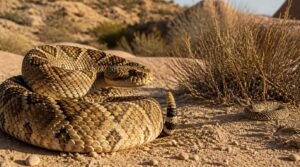
Body size varies widely across genera, from petite pygmy species to heavy-bodied giants. Eastern diamondbacks reach 2.5 metres and 6.8 kilograms, while newborns measure just 25 to 35 cm. Most adults settle around 90 to 110 cm.
Color morphs range from tan to dull red, with diamond or hexagon blotches you’ll recognize instantly against variable terrain.
Triangular Heads and Keeled Scales
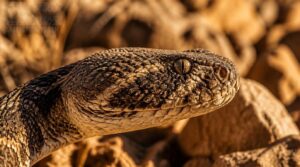
That coloring means little without the head shape backing it up. You’ll spot the triangular head shape first, broader than the neck, a wedge that houses venom glands and jaw muscles for powerful strikes.
Run a finger against dry skin (carefully, from a photo) and you’d feel keeled scales, ridged for glare reduction and camouflage in every pit viper, Crotalus included.
Fangs and Venom Delivery
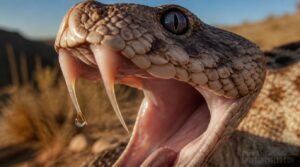
Under that wedge-shaped skull sit hollow fangs, hinged and folding back against the roof of the mouth until a strike swings them forward. Each fang connects to a venom duct running from the venom gland, delivering venom under pressure the instant the jaw closes. A beveled fang tip concentrates flow into tissue, while ongoing fang replacement keeps delivery reliable as old fangs wear down.
How The Rattle Works
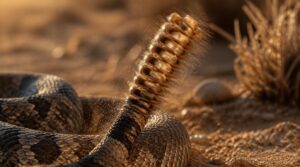
Shake that tail and you’ll hear loose granules rattling inside hollow keratin segments, each one interlocking with the next. Muscle contractions up to 50 times per second drive the sound production, adding a fresh segment with every shed.
This tail vibration and rattle sound acts as a clear warning signal: back off, now.
Where Rattlesnakes Live

Rattlesnakes occupy a surprising range of landscapes, from desert basins to mountain slopes, and where you find them depends heavily on species and region. Their survival hinges on specific environmental conditions, from temperature regulation to seasonal shelter. Here’s a closer look at the geography, habitats, and dens that shape their world.
Beyond dry terrain, many species are surprisingly capable in water, and understanding whether rattlesnakes can swim reveals just how adaptable their habitat range really is.
Range Across The Americas
From southern Canada’s pockets near the Great Lakes down to Argentina, rattlesnakes span nearly the full length of North and South America. Mexico holds the greatest species diversity, while Central America and Caribbean islands add further range. Along the way, they cross:
- Deserts
- Grasslands
- Andean foothills
Habitat fragmentation increasingly threatens this broad geographic distribution.
Common Rattlesnake Habitats
Across their vast habitat range, rattlesnakes settle into five main environments.
In desert ecosystems like Arizona’s, they bask on sun-warmed rocks. Forests offer log cover; grasslands provide burrow shelter for thermoregulation. Rocky crevices span mountains to plateaus. Wetlands support hunting of amphibians and fish along riverbanks and marshes throughout North and South America.
Climate and Habitat Adaptations
How does a cold-blooded animal survive 110°F sand? Through precise microhabitat selection. Desert ecosystems push soil temperatures far beyond safe limits, so rattlesnakes burrow into loose earth, gaining thermal stability unavailable at the surface.
Grasslands and elevated terrain, up to 9,000 feet, demand different strategies. Reptile thermoregulation here depends on rock crevices, shielding you’d find from cold winds while snakes await warmer conditions.
Seasonal Activity and Brumation
Winter dormancy isn’t hibernation exactly, it’s brumation, and you’ll see it kick in once daytime highs stay below 60°F. Feeding stops first; drinking continues. Fat reserves built all summer fuel the 2 to 6 month dormancy.
Spring emergence follows warming spells, sometimes staggered by microclimate. Rattlesnakes stay most active spring through fall, hunting nocturnally when temperatures moderate, then slowing again as shedding cycles and metabolism recalibrate for the next season.
Shelters and Communal Dens
Ever wonder where a rattlesnake goes when the temperature drops? It finds a den, often the same one year after year. Rock crevices, rodent burrows, and log piles offer stable microclimates for shelter.
Communal denning lets multiple snakes brumate together, sharing warmth during winter dormancy.
- Newborns curling beside seasoned survivors
- Generations returning home each fall
- Quiet crevices sheltering fragile life
How Rattlesnakes Hunt and Behave

A rattlesnake’s survival hinges on patience, precision, and a set of senses built for the dark. You’re about to see how these traits work together, from the first ambush to the final warning rattle. Here’s what defines its hunting style and behavior.
Ambush Hunting Strategies
A rattlesnake doesn’t chase, it waits. As a patient ambush predator, it selects travel corridors where prey habitually pass, then relies on concealment, downwind positioning, and scent and noise control to stay hidden.
Stillness matters most. Settled for hours, often nocturnal, it tracks prey behavior patterns and times its strike to that single, unhurried moment when patience finally pays off.
Heat-Sensing Pit Organs
Between each eye and nostril sits a heat-sensing pit, a narrow cavity spanned by a thin, vascular membrane packed with trigeminal nerve branches. This infrared detection system reads temperature shifts in warm bodies at a distance, functioning like built-in thermal sensing.
Which means you’re dealing with a predator that "sees" heat, not shape, timing strikes with impressive precision even in total darkness.
A rattlesnake sees heat, not shape, striking with deadly precision even in total darkness
Tongue-Flicking and Chemical Detection
Heat gives direction, but scent confirms the story. You’ll notice the forked tongue flick rapidly, tasting the air and ferrying particles to the Jacobsons organ for chemical reception.
- Chemical trail tracking
- Prey scent detection
- Mate pheromone sensing
- Predator odor recognition
- Environmental scent sampling
That’s olfactory foraging at its finest, precise, patient, deadly.
Prey, Predators, and Ecological Role
Once that chemical trail leads to a meal, what’s actually on the menu? Mostly rodents, along with lizards and smaller snakes. As a classic ambush predator, you occupy a midlevel trophic niche, checked by hawks, weasels, and larger snakes.
Juveniles hunt too, targeting tiny prey near burrows, quietly shaping rodent populations across the food web.
Defensive Displays and Warning Rattles
Approach one too fast and you’ll hear it: a dry, buzzing alarm. That’s tail vibration mechanics at work, rapid muscle contractions producing a rattle sound audible from 5 to 20 meters.
Posture matters too. A coiled body, raised head, and lifted tail signal genuine agitation. The warning signal escalates with proximity, shifting from slow shakes to rapid buzzing before any strike occurs.
Rattlesnake Reproduction and Life Cycle

A rattlesnake’s life follows a rhythm shaped by seasons, hormones, and instinct, from courtship rituals to the moment newborns strike out on their own. You’ll find that reproduction here looks nothing like it does in most reptiles, with live birth replacing eggs and combat replacing simple mating. Here’s what that cycle actually looks like, stage by stage.
Courtship and Male Combat
Rattlesnake courtship runs on signals, not sweet talk. Males in both Crotalus and Sistrurus genera lift their heads, rattle while circling females, and read chemical cues on her skin to gauge readiness.
Rival males settle disputes through ritualized combat:
- Coiled body postures and tail sway
- Non-lethal wrestling and head thrusts
- Rattle-based dominance displays
- Territorial patrols along breeding grounds
Winners earn access to receptive females nearby.
Live Birth and Litter Size
A single birthing event marks the end of the snake reproductive cycle. Gestation runs four to six months, with litter size tied closely to maternal body size, ranging from 6 to 25 ovoviviparous young born late summer into autumn.
Juvenile mortality remains steep, so even broods reaching sixteen offspring don’t guarantee strong neonate survival rates.
Newborn Fangs, Venom, and Buttons
Born ready to bite: neonates emerge with hinged fangs, 6 to 8 mm long, fully wired to venom glands. Venom potency favors small prey, not humans, giving efficient neonatal hunting from day one.
Each hatchling also sports a single tail button, the seed segment for future rattles. Fang development and shedding cycles begin almost immediately after birth.
Growth, Shedding, and Rattle Segments
Each shed adds a fresh keratinous ring to the tail. That single tail button becomes a chain, growing fastest in juveniles as they molt every 1 to 3 months.
Segment structure matters too:
- Hollow plates interlock loosely
- Wear dulls older tips
- Fresh segments look pale
- Breakage often occurs at the base
Wild and Captive Lifespans
How long does a rattlesnake actually live? In the wild, most survive 10 to 20 years, though threats like disease, drought, and food scarcity shorten that window.
Captivity tells a different story: with steady meals and veterinary care, individuals often reach 10 to 25 years. That gap reflects protection from predators, not a different life cycle altogether.
Venom, Human Encounters, and Conservation
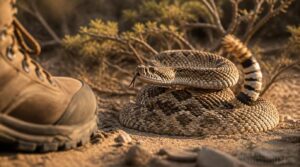
Understanding a rattlesnake’s venom changes how you think about the risk it poses and the respect it deserves. Most encounters end without incident when you know what triggers a strike and how to avoid one in the first place. Here’s what you need to know about venom, safety, and the conservation challenges these snakes face today.
Venom Types and Effects
Not all rattlesnake venom works the same way. Depending on species, your body may face:
- Neurotoxic effects causing paralysis
- Hemotoxic damage to blood vessels
- Cytotoxic necrosis at the bite site
Myotoxic weakness and proteolytic degradation often compound venom toxicity. Because venomous bites vary so widely, prompt antivenom treatment remains essential after any encounter.
Strike Mechanics and Defensive Bites
A strike happens in under a tenth of a second, driven by explosive head and neck thrust. Hollow fangs pierce at a shallow angle, opening a venom duct for rapid injection.
Defensive bites follow the same mechanism, fast strike, quick retreat, sometimes repeated if you corner the snake. Warning rattles usually precede contact.
Preventing Rattlesnake Encounters
Given that a fast strike is a snake’s last resort, not its first choice, most encounters are preventable through simple yard maintenance. Cut grass short within 10 feet of paths, secure pet food and garbage to limit rodent prey, and seal gaps under sheds.
Contain compost piles away from foot traffic, and stay alert on trails where snakebite epidemiology shows most bites occur.
Responding to Rattlesnake Bites
Even with good prevention, bites happen. Call emergency services immediately, then move away from the snake.
Once you’re safe, our snake handling frequency guide can help you figure out what may have gone wrong before the bite.
Wash the wound with soap and water; skip ice, tourniquets, suction, and cutting. Remove rings and watches, keep the person calm and still, and get to a hospital fast, since antivenom remains the mainstay treatment for envenomation.
Conservation Status and Major Threats
Because most species occupy limited geographic ranges, localized threats hit hard. Habitat loss from urbanization, road mortality, and human persecution top the list, alongside pesticide-driven prey disruption and climate change.
Three species carry threatened conservation status, pressured further by invasive predators like feral cats.
Corridors, restoration, and community-led programs offer the clearest path toward reducing these threats to survival.
Frequently Asked Questions (FAQs)
What are fun facts about rattlesnakes?
Newborns arrive with working fangs and venom, no rattle button forms until the first shed. As a pit viper, this venomous predator uses infrared vision to hunt, and its venom speeds digestion once prey is swallowed whole.
What is rattlesnakes’ biggest enemy?
Humans remain the biggest threat, through habitat fragmentation and killings, but natural predators matter too. Hawks, eagles, coyotes, and kingsnakes (immune to venom) hunt rattlesnakes, while invasive predators like feral cats disproportionately threaten vulnerable juveniles.
How long does a rattlesnake live?
In the wild, you’ll find most rattlesnakes living 10 to 20 years, with larger species like the eastern diamondback pushing past Captive individuals often reach 20 to 30 years, thanks to steady food and no predators threatening juvenile survival.
What are rattlesnakes afraid of?
Like David facing Goliath, even a coiled rattlesnake reads the room before it fights. They fear larger predators like coyotes and herons, sudden human approach, extreme heat or cold, and unfamiliar vibrations, favoring retreat and cover over confrontation whenever possible.
How long do rattlesnakes live?
Most rattlesnakes survive 10 to 20 years in the wild, though larger species like western diamondbacks sometimes pass Captivity often stretches lifespan past 30, since snakes escape predators, harsh winters, and the daily risks tied to hunting.
Body length tends to track with age too, so a snake creeping toward that 3-foot average has likely already logged several years, a pattern explored in this guide to rattlesnake growth rates and adult size.
How to identify a rattlesnake by its rattle?
Look for a segmented rattle of hollow, keratin buttons at the tail tip, worn or textured from habitat contact. Rapid tail vibration produces an audible buzzing frequency, distinct from any nonvenomous snake’s tail-shaking mimicry.
Are rattlesnakes venomous?
You don’t need a herpetology degree to grasp this: yes, they’re venomous, delivering it through hollow fangs like a syringe. Venom potency varies, and some bites are dry bites, injecting no venom at all.
How big do rattlesnakes get?
Size swings widely by species, from 18-inch pygmy rattlesnakes to eastern diamondbacks near 8 feet. Climate, prey, and genetics all shape growth. Most adults settle between 3 and 5 feet, though record individuals push well past that average.
What are 5 interesting facts about rattlesnakes?
These "living rattles" pack surprises: heat-sensing pits guide strikes in total darkness, hollow fangs deliver venom mid-bite, and litters range from 1 to 60 young. Males even perform combat dances, wrestling rivals without ever biting.
How long can a rattlesnake live?
In the wild, most rattlesnakes reach 10 to 20 years, though larger species like the eastern diamondback often live longer. Predation and habitat quality drive survival challenges, while captive lifespan frequently stretches past 25 years with steady care.
Conclusion
A single rattlesnake can add a new rattle segment with each shed, molting three or four times a year, yet segments snap off so often that age can’t be judged by counting them. That detail says something larger about these animals: built for precision, not display.
These rattlesnake facts trace a creature shaped by millions of years of refinement, from heat-sensing pits to fangs striking in under a tenth of a second. Give it space, and it gives you the same.