This site is supported by our readers. We may earn a commission, at no cost to you, if you purchase through links.
A boa doesn’t growl, bark, or paw at the glass to tell you it’s unhappy. Its language lives in the coils: a subtle tightening of muscle, a shift from lazy S-curves to rigid loops, a tongue flick that suddenly slows and pauses mid-air. Miss those cues, and you’ll find out the hard way, with a strike or a defensive hiss you never saw coming.
Understanding boa constrictor body language means learning to read tension the way a sailor reads wind: through small, physical signals that build before the storm hits. Posture, breathing rhythm, head position, and tongue behavior all shift together, forming a pattern you can learn to recognize with practice.
Master that pattern, and handling stops feeling like guesswork. It becomes a conversation you’re finally equipped to understand.
Table Of Contents
- Key Takeaways
- How to Read Boa Constrictor Body Language
- Signs of a Relaxed or Curious Boa
- Boa Constrictor Stress and Defensive Signals
- Context, Health, and Hormonal Behavior Changes
- Handling a Boa Based on Its Signals
- Frequently Asked Questions (FAQs)
- Do boa constrictors like to be held?
- What to do if a boa is constricting you?
- How do I tell if my boa is male or female?
- How to read snake body language?
- How often should you handle adult boas?
- Can boas recognize their handlers scent?
- What lighting conditions reduce boa stress levels?
- Do boas display territorial behavior in captivity?
- How does shedding affect boa temperament?
- How can I tell my boa apart from other snakes moods?
- Conclusion
Key Takeaways
- A boa’s stress builds gradually across five connected signals—posture, tongue flicks, head position, movement speed, and breathing—so reading the whole pattern together tells you far more than watching any single cue in isolation.
- Relaxed boas show loose, evenly spread coils, steady rhythmic tongue flicks, and slow deliberate movement, while stressed ones tighten into rigid loops, flatten their bodies, freeze before striking, or escalate to hissing and tail vibration.
- Not every behavior change signals distress—feeding, shedding, temperature swings, and breeding season each produce their own distinct patterns that can look like stress but actually reflect normal biology.
- Safe handling depends on timing and pacing: approach slowly, support the body evenly, keep sessions short and consistent, and stop the moment calm signals shift toward tension.
How to Read Boa Constrictor Body Language
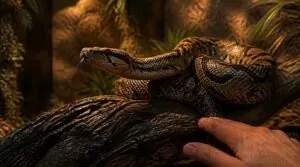
A boa’s body speaks before it ever strikes or settles, and learning that language starts with watching five key signals working together. Each one—posture, tongue, head, pace, and breath—tells you something different about what’s going on beneath the scales. Here’s what to look for in each.
Body Posture and Muscle Tension
Run your eyes down the length of your boa, and its coils tell you everything: loose, evenly draped loops mean relaxed muscle tone, while tight, rigid sections signal rising tension. Watch for subtle wave patterns forming as alertness builds.
If you notice the loops tightening into a springy, compact coil, it’s worth learning to read what different snake coiling patterns actually mean before pushing any closer.
Flattened sides paired with firm, unyielding loops often precede defensive inflation, freezing, or a strike, so read posture before you reach.
Tongue Flicking Patterns
Beyond posture, the tongue does the real talking. Steady, rhythmic flicking frequency signals calm substrate scent sampling, while rapid flick assessment or sudden tongue flick pauses mark shifting focus.
Flicks feed the vomeronasal organ, building olfactory memory and scent recognition. Short, infrequent flicks? That’s nervousness, not curiosity.
Head Position and Movement
Watch the head once the tongue settles, since it tells you where attention is going next. Regular head alignment with the body means calm attention. Forward gaze paired with soft, unrigid muscles shows deliberate movement, not threat. Lateral scanning turns stay small and gradual when curious. Abrupt turns or a sudden elevated head posture signal rising alertness, worth watching closely.
Describing these cues clearly for readers unfamiliar with reptile behavior follows the same principle writers use when they write for naive readers, defining signals plainly rather than assuming prior knowledge.
Movement Speed and Direction
Head position tells you what’s coming next, but speed and direction tell you the full story. Boas shift pace to match terrain and prey distance: gliding with low muscle tension on smooth surfaces, then engaging lateral muscles to accelerate when closing in on a target. Front-body elevation aids that propulsion.
- Slow, deliberate movement signals comfort during exploratory movement
- Sudden freezes often precede strikes or heightened alertness
- Rapid, chaotic motion suggests fear or escape drive
- Smooth direction changes reflect calm body language
- Rigid alignment warns of imminent defensive behavior
After a fast burst, expect a brief recovery period, reduced respiration, relaxed coils. Reading these shifts sharpens your handling technique and timing.
Breathing Rhythm and Effort
Since a boa can’t tell you it’s stressed, its ribcage does the talking. Easy breathing signs, chest and abdomen moving in sync, mean calm.
| State | Breathing Pattern |
|---|---|
| Resting | Slow, regular |
| Active | Faster, deeper |
| Stressed | Shallow, irregular |
Temperature drives rhythm too, warmer enclosures raise rate. Watch for respiratory rate variation signaling stress hormones before handling.
Signs of a Relaxed or Curious Boa
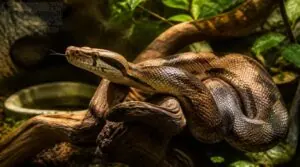
A relaxed boa doesn’t hide what it’s feeling—its body tells the story plainly, if you know where to look. Once you’ve learned the warning signs, it’s just as important to recognize the opposite end of that spectrum: calm, unbothered, curious behavior. Here are five clear signals that your boa feels right at home.
If you want to compare notes on the flip side of that ease, this guide to decoding a snake’s body language and warning signs breaks down cues like hissing so you can spot stress before it escalates.
Loose Coils and Even Alignment
A relaxed boa reads like a well-balanced scale. Its coils fall into parallel rows, weight spread evenly, no bunching or twisting anywhere along the body.
- Even coil symmetry
- Balanced weight distribution
- Full substrate contact
- Minimal twisting
- Consistent alignment
That visual balance signals low stress, unlike tense, defensive coiling pressed against enclosure walls.
Smooth, Unhurried Exploration
A curious boa never rushes. It advances in short, deliberate strokes, roughly 0.2 to 0.4 meters per minute, arching smoothly around obstacles without sudden twists.
Watch for gentle surface contact: ventral scales stay evenly pressed against substrate, turns stay wide, and the snake pauses briefly near new stimuli before resuming its unhurried path across the temperature gradient.
Steady, Rhythmic Tongue Flicks
That flickering tongue is a chemical readout, and rhythm tells you everything. Steady, alternating flicks, unhurried and evenly paced, show active chemical sensing without alarm.
This environmental sampling rhythm often syncs with breathing, forming a calm, automated pattern. Compare that to a stressed animal’s rapid, irregular flicking. Watch tempo closely: consistent cadence signals a relaxed, curious boa, not one bracing to defend itself.
Calm Resting Stillness
Stillness in a boa isn’t emptiness, it’s quiet resting posture: broad, symmetrical coils, soft shoulders, no gripping. Breathing stays slow and inaudible, jaw loose, tail barely shifting.
Watch for:
- Even substrate contact, no sudden shifts
- Minimal, occasional tongue flicks
- Relaxed, open gaze, not pinned
This calm reptile behavior, paired with environmental comfort, tells you handling can begin safely.
Consistent Substrate Contact
Watch the belly, not just the head. Even substrate contact along the full length, no dragging or lifted sections, signals a secure environment feeling. Substrate texture affects coil formation and heat distribution stability.
| Contact Type | Behavior Meaning | Substrate Factor |
|---|---|---|
| Even | Calm | Soft, clean |
| Dragging | Discomfort | Abrasive |
| Lifted | Alert | Odor buildup |
| Gripping | Stress | Unstable |
Boa Constrictor Stress and Defensive Signals
A calm boa can shift into defense mode in seconds, and knowing the warning signs keeps both you and your snake safe. These signals build in intensity, from subtle muscle changes to unmistakable threat displays. Here’s what to watch for, starting with the body itself.
Defensive Inflation and Body Flattening
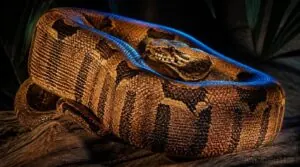
When a boa feels cornered, it doesn’t just tense up, it performs. Defensive inflation pulls in rapid, deep breaths that raise the ribcage, swelling lateral diameter by 20 to 30 percent in seconds. Body flattening follows, compressing scales and squaring off that boxy, rigid silhouette.
Read this defensive display early and step back. Crowding an inflated boa only sharpens the threat it’s already showing you.
Rigid Muscles and Tight Loops

Once the swell subsides, run your hands along its length: muscle tension assessment starts here. Rigid muscles resist gentle pressure, holding loops tight and compact instead of loose and springy.
Flexibility loss between coils, slowed turnover, minimal give at the belly. These body rigidity indicators mean stress hasn’t passed.
Recognize it, and give the enclosure space before handling again.
Freezing Before a Strike
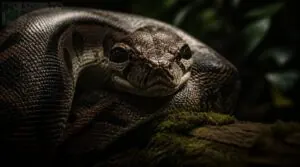
Rigidity that lingers often escalates into a full freeze, the boa’s most deliberate defensive behavior. Muscle tension buildup locks the spine; eyes fix on target focus indicators, unblinking.
Watch for:
- Pre-strike stillness lasting seconds
- Shallow, rhythmic breathing
- Head tilted toward target
- Zero body movement
Freeze duration analysis helps predict strike preparation cues before they happen.
Hissing and Tail Vibration
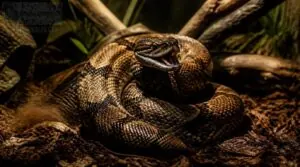
Once the freeze breaks, sound often follows. Air forced through the glottis builds into a hiss that starts soft and climbs in volume, paired with tail vibration at the base that quickens as arousal grows.
| Signal | Cue | Meaning |
|---|---|---|
| Hiss | Rising volume | Escalating arousal |
| Tail | Rapid tremor | Threat proximity |
| Combo | Synchronized | Coordinated defense |
Give the boa distance immediately.
Elevated Head and S-Coil
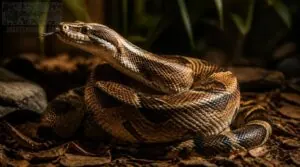
Watch the head lift 20–40 degrees off the body while coils tighten into a narrow S shape. This pairing signals strike readiness, not curiosity.
- Head angle assessment: sharp versus gentle rise
- Coil tightness check: loose versus compact loops
- Eyes and tongue stay active
- Tail anchors, ready to thrust
- Posture threat distinction guides handling response timing
Back off slowly if this holds.
Context, Health, and Hormonal Behavior Changes

Not every shift in your boa’s posture points to fear or aggression—sometimes biology and environment are running the show.
Feeding schedules, shedding cycles, temperature swings, and even seasonal hormone changes all leave their own fingerprints on behavior.
Here’s what to watch for so you can tell a passing phase from a real problem.
Enclosure and Routine Changes
Your boa reads routine the way you’d read a familiar road: predictably. Keep hide box placement fixed, substrate depth consistent, and introduce new decor one piece at a time. Adjust humidity gradually, never in sharp swings.
Scheduled changes at consistent times build trust, letting you spot genuine stress recognition instead of confusing it with normal caution.
Feeding and Post-Meal Behavior
Digestion Phase Indicators show up fast: your boa settles into meal-related stillness, staying partially coiled for 15 to 60 minutes. Head position after feeding stays neutral, never aggressive. Early digestion movement is minimal and slow.
Post-feeding basking may follow if temps run low, supporting healthy body condition. Avoid handling, this feeding response deserves a settled recovery window before your next feeding schedule.
Pre-Shed Sensitivity
Cloudy eyes and dulled, darkening scales signal the preshed period has begun, a shedding cycle stage demanding gentler handling.
Preshed period
Appetite drops, movement slows and turns deliberate, and environmental sensitivity spikes, your boa lingers over substrate scents while tolerating touch less.
Environmental sensitivity spikes
Recognize this stress window: minimize handling, support the body lightly, and let the slough separate undisturbed.
Stress window
Temperature-Driven Breathing Changes
Basking spots above 88°F push respiration rate up within seconds, deeper breaths driving heat exchange during activity. Cooler zones bring breathing back toward resting levels within minutes.
Watch for rapid, shallow gulping when enclosure temps climb too high, a thermal stress indicator distinct from relaxed, even breathing. Ambient shifts, not emotion, often explain sudden breathing pattern changes.
Illness Versus Reproductive Behavior
Two behavior shifts look alike but demand opposite responses: courtship and sickness. Illness symptoms bring reduced appetite, lethargy, irregular breathing, and disrupted shedding cycles, often with dulled environmental responsiveness.
Breeding season behavior shows the reverse: courting postures, frequent tailing visits, pheromone trails, and elevated activity level with normal shedding intact. Track these behavioral cues closely for accurate health monitoring.
Handling a Boa Based on Its Signals
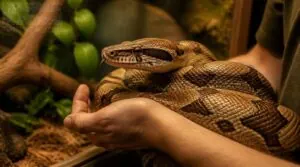
Reading your boa’s body language means nothing if you don’t act on what it’s telling you. Every hiss, coil, and tongue flick is a cue that should shape how—and when—you approach handling. Here’s how to turn that awareness into safer, more confident sessions with your snake.
Every hiss, coil, and tongue flick is a cue meant to guide how and when you approach handling
Safe Approach and Acclimation
Before you touch a boa, let it see you coming. Approach from the side, staying an arm’s length away, and offer a 10 to 20 second visual inspection on clean, unscented hands. Choose a stable, vibration-free surface for this first contact.
Start with 1 to 2 minute intervals, watching closely for stress recognition cues before extending trust building sessions.
Supporting The Body Properly
Once your boa accepts your presence, proper body support becomes the next test of trust. Cradle the mid-section and tail with both hands, distributing weight evenly to avoid strain.
- Even pressure distribution across the length
- Slow, steady lifting support, never abrupt movements
- Watch for stress cues like darkening or rapid breathing
Stop immediately if tension replaces the calm you built during acclimation.
Choosing Calm Handling Times
Timing matters as much as technique. Reach for your boa during late afternoon or early evening, never right after feeding or mid-shed. Low ambient noise and stable room temperature keep stress cues at bay.
Track each snake’s individual preferences and hold a consistent daily window, since predictable timing builds the trust acclimation started.
Short, Consistent Handling Sessions
Once your window is set, keep sessions short and predictable: 5 to 15 minutes, 2 to 3 times weekly. Signal handling with a consistent tap, never feeding cues, and hold the same order each session.
Add 1 to 2 minutes only after calm body language appears. Log duration, then end on a relaxed note, letting your boa retreat to its resting spot.
Knowing When to Stop
Read the retreat, not the clock. Stop cues include loose coils, calm head lowering, tail settling, and steady breathing returning to baseline, all signaling withdrawal.
- Irregular or paused tongue flicks (2+ seconds)
- Head turning away from the handler
- Full-body substrate contact resuming
Resting return marks true interaction end. Recognizing these thresholds builds trust faster than pushing limits.
Frequently Asked Questions (FAQs)
Do boa constrictors like to be held?
Not exactly affection, but tolerance built on trust. A calm, acclimated boa accepts gentle holding, especially in quiet settings, showing relaxed body language rather than genuine enjoyment, the hallmark of successful trust building.
What to do if a boa is constricting you?
Stay still, don’t fight the coils, and use a hook to tap its head, signaling release, not prey. Call emergency services immediately; circulatory arrest can bring unconsciousness within seconds during constriction.
How do I tell if my boa is male or female?
Where males flaunt thicker tail bases and pronounced pelvic spurs, females stay slender and subtle. Check tail length proportion and spur visibility, but for certain sex determination, trust hemipenes probing or veterinary confirmation over guesswork.
How to read snake body language?
Focus on body cues together, not isolated signals: loose coils, slow tongue flicks, and even breathing mean calm. Tense muscles, rapid flicking, hissing, or sudden stillness signal stress, watch the whole pattern, not one cue alone.
How often should you handle adult boas?
Less can mean more: adult boas thrive on 1 to 2 sessions weekly, not daily attention. Watch for hissing or rapid tongue flicks, signs to pull back, and always honor the 48-hour post-feeding wait before handling.
Can boas recognize their handlers scent?
Yes. Through chemoreception, your boa builds a scent profile of you, using tongue flicks and Jacobson’s organ to log handler odor familiarity.
This scent memory formation helps quicker recognition, calmer approaches, and genuine scent-based trust building over repeated handling sessions.
What lighting conditions reduce boa stress levels?
Keeping ambient light levels between 20 and 40 lux, with brighter basking zones, calms boas noticeably. Warm spectrum quality, gradual shift timing, proper fixture placement, and dim nighttime lighting all support natural photoperiod control and genuine stress reduction.
Do boas display territorial behavior in captivity?
Solitary boas rarely defend fixed territory. Most territorial aggression triggers trace back to space resource competition in shared enclosures rather than location itself, though prolonged conspecific proximity stress can still surface, especially around feeding or mating context.
How does shedding affect boa temperament?
Ironic, isn’t it: the boa about to shed its own skin turns skittish and withdrawn. This temperament shift brings shedding sensitivity, reduced appetite, cautious movement, lower handling tolerance, and dulled senses, easing once the shed cycle completes.
How can I tell my boa apart from other snakes moods?
Boas rely less on hissing and striking than defensive species do; their mood signals center on muscle tone, tongue flicking rhythm, and coil tightness rather than dramatic threat displays other snakes commonly show.
Conclusion
Test the theory yourself: does your boa really tense before you touch it, or only after? Watch closely for a week and you’ll likely find the signals arrive earlier than you assumed. That’s the real payoff of understanding boa constrictor body language. It rewards patience, not guesswork.
Coils, tongue, breath, and head position aren’t separate signs; they’re one language, spoken in unison. Learn to listen, and your snake will finally feel understood, not just handled.