This site is supported by our readers. We may earn a commission, at no cost to you, if you purchase through links.
Pair two amelanistic corn snakes and you’ll get amelanistic offspring, guaranteed, every time. Pair an amelanistic with an anerythristic, though, and you’ll hatch a clutch of ordinary-looking snakes hiding a genetic surprise for their entire lineage. That gap between what you see and what’s actually encoded in the DNA trips up even experienced keepers planning their first project pairing.
Corn snake morph compatibility breeding isn’t guesswork. It runs on predictable inheritance rules that dictate exactly which alleles combine, which stay hidden, and which produce entirely new visual combinations in the following generation. Once you understand the mechanics behind genotype and phenotype, you’ll stop hoping for specific hatchlings and start producing them by design.
Table Of Contents
- Key Takeaways
- Corn Snake Morph Genetics Behind Compatibility
- How to Check Corn Snake Morph Compatibility
- How to Predict Hatchling Morph Percentages
- Preparing Compatible Corn Snakes for Breeding
- Responsible Pairings and Long-Term Genetic Diversity
- Frequently Asked Questions (FAQs)
- What snakes can corn snakes breed with?
- What can cohabitate with a corn snake?
- Can I put a male and female corn snake together?
- Can you breed different types of snakes together?
- How do you calculate morph outcomes in breeding pairs?
- What percentage of offspring inherit each parents morph?
- Can you breed different morph generations together safely?
- How do you test for hidden recessive genes?
- Whats the minimum clutch size for morph variety?
- How does temperature during incubation influence morph appearance?
- Conclusion
Key Takeaways
- Two snakes can look identical but carry completely different genetics, so you need Punnett squares—not visual guesswork—to know what’s really hiding in their DNA before you pair them.
- Compatibility doesn’t guarantee predictable looks: modifier genes, epistasis, and incubation conditions can still produce unexpected patterns or colors even from a genetically sound pairing.
- A "possible het" only becomes confirmed through test breeding against a known homozygous recessive partner, since offspring outcomes are the only real proof of hidden alleles.
- Responsible breeding goes beyond genetics—it means quarantining and conditioning your snakes properly, keeping detailed pedigree records, and lining up homes for every hatchling before you ever produce a clutch.
Corn Snake Morph Genetics Behind Compatibility
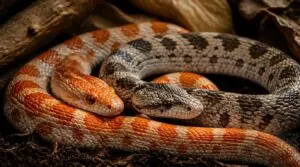
Before you pair two corn snakes, you need to understand what’s actually driving their appearance at the genetic level. Every morph combination you’re considering comes down to a handful of fundamental concepts working together, from how traits get passed down to how genes interact with each other.
If you want the full breakdown of dominant, recessive, and co-dominant traits before picking a pairing, this guide to corn snake color genetics walks through each concept clearly.
Here’s what you need to know before making any breeding decision.
If you want a deeper dive into how dominant, recessive, and co-dominant genes interact, this guide to ball python genetics and visual traits breaks it down clutch by clutch.
Genotype Versus Visible Phenotype
Before you pair any two snakes, understand this: genotype is the allele set hiding in the DNA, while phenotype is what you actually see. Two corn snakes can look identical yet carry different genotypes, since hidden alleles ride along unseen.
This distinction was first formalized through the genotype-phenotype distinction introduced by biologist Wilhelm Johannsen in 1908.
That’s why a Punnett square beats guesswork, exposing recessive traits before they surprise you in the clutch.
Dominant, Recessive, and Incomplete-Dominant Traits
Once genotype and phenotype click, the next question is how alleles actually behave. Dominant traits need one copy to show; recessive traits hide behind two. Incomplete-dominant and codominant pairings mix instead, producing intermediate looks.
Punnett squares predict these ratios before you commit two snakes to a clutch, turning genetic inheritance patterns into usable numbers.
Pigment and Pattern Mutations
Color comes down to two pigment engines: melanin pathway activity for black and brown, and carotenoid pigmentation for yellow-orange tones. Amelanistic and anerythristic mutations knock out one engine each, while pigment cell migration errors during embryogenesis create pattern boundary sharpness variations.
- Amelanistic: no black, reds pop
- Anerythristic: grayscale only
- Snow: both suppressed
- Pigment cell mutations: patchy mosaics
Alleles, Loci, and Gene Interactions
Behind every pigment mutation sits a locus, the exact chromosomal address where that gene lives, with two alleles occupying it. Alleles at the same locus interact directly (dominant, recessive, or codominant), while genes at separate loci coordinate through networks.
Understanding this positioning explains why some morphs combine freely and others clash through hidden epistatic masking.
Modifiers, Epistasis, and Variable Expression
Once you move past single-locus math, modifier genes complicate the picture, shifting penetrance and expressivity without creating a phenotype themselves.
Epistasis adds another layer: one gene masking another, producing non-additive results your Punnett square won’t predict.
Add temperature, stress, or genetic background, and identical genotypes yield variable expression.
That’s why documented outcomes beat theoretical ratios.
How to Check Corn Snake Morph Compatibility
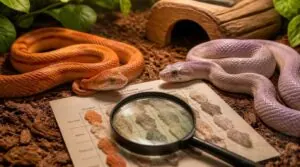
Knowing the genetics behind a morph is only half the job—checking compatibility is where you put that knowledge to work. Before pairing two snakes, you need a clear process for spotting risks that don’t show up until eggs are in the incubator. Here’s what that process looks like in practice.
Running genetic tests alongside a proper breeding setup and lighting schedule gives you a fuller picture of whether a pairing is truly set up for success.
Compatibility Versus Visual Outcomes
Two compatible snakes can still surprise you. Compatibility means the pairing is genetically sound, not that visuals are guaranteed. Hidden allele carriers, modifier genes, and environmental incubation factors cause phenotype-genotype mismatch:
- Muted saddle patterns emerging from clean lineages
- Amber undertones appearing unexpectedly in offspring
- Pattern breaks nobody predicted
- Dulled pigment intensity
- Carriers hiding recessive traits for generations
Allelic Morphs at Shared Loci
When two morphs share a locus, allele dominance hierarchy decides what shows up, and shared locus incompatibility can produce patchy or unexpected phenotypes. Locus interaction effects and epistasis at loci sometimes mask traits entirely.
Before pairing, map out genotypes with Punnett squares, since corn snake morph compatibility hinges on knowing exactly which alleles occupy the same genetic real estate.
Multi-Gene Pairing Risk Checks
Stack three or more genes and simple Punnett squares stop being enough. Epistasis modeling and allele mapping accuracy matter now, since one locus can mask another entirely.
Run test breedings to isolate interactions, weight outcomes with conditional probabilities, and flag lethal combinations early.
Document sparse-data pairings honestly. Genetic diversity and clear risk communication protect both your clutches and your reputation.
Documented Defects Versus Breeder Rumors
Forum panic spreads faster than pedigrees. Before you rule out a pairing, separate documented defects from hearsay: verified cases show vet confirmation, breeder records, and repeat clutch outcomes, like tracked lethal combinations or Palmetto eye defects and shedding issues in certain lines.
Responsible breeding means trusting hereditary tracking and confirmed records over anecdotal claims circulating online.
Morph Pairings Versus Species Hybrids
Staying within one species isn’t a limitation, it’s the whole point. Morph pairings work within corn snake genetics, preserving genetic purity standards and predictable trait stability.
Interspecific hybridization risks unknown health issues, reduced hybrid viability, and murky inheritance patterns. Skip a morph compatibility chart built for hybrids. Reputable breeders uphold species barrier ethics over novelty appearance.
How to Predict Hatchling Morph Percentages
Once you’ve confirmed a pairing is genetically sound, the next step is figuring out what actually hatches. That means moving past guesswork and into real math, tool by tool. Here’s how you calculate those odds with precision.
Single-Gene Punnett Squares
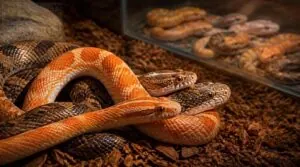
A single-gene Punnett square is your fastest tool for predicting genotype ratios before a single egg drops. Cross two amelanistic hets and you’ll see a 25% homozygous recessive outcome, expressed visually, against 50% heterozygous carriers and 25% normal.
If you want to see how these hidden recessive traits differ from morphs that express right away, this codominant vs recessive ball pythons guide breaks it down clearly.
That 1:2:1 genotype probability ratio underlies every monohybrid cross outcome you’ll plan for corn snake morphs.
Multi-Gene Probability Calculations
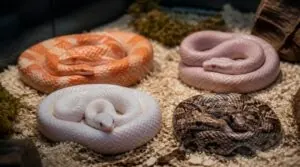
Once you’re pairing for two or more traits, that single 1:2:1 ratio expands fast.
Amel het-hypo x amel het-hypo? Apply the product rule: multiply each gene’s independent probability. Two heterozygous traits yield a 9:3:3:1 ratio, roughly 6.25% double-homozygous offspring, unless the loci are linked, in which case recombination frequency skews those expected percentages considerably.
Homozygous, Heterozygous, and Possible Hets
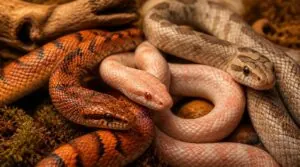
Those ratios only mean something once you know what each genotype label represents. Homozygous animals carry two identical alleles, so their trait expression is fixed and predictable every clutch.
Heterozygous individuals pair two different alleles, often masking one visually.
Possible hets carry genetic variability you can’t confirm outright, since the unknown allele’s partner determines actual trait predictability in offspring.
Revealing Hidden Alleles Through Test Breeding
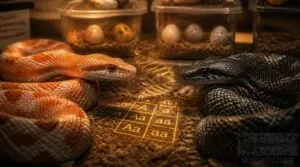
Possible het" only stays possible until you test it. Test breeding crosses your unproven animal with a known homozygous tester, exposing recessive alleles through offspring phenotypes.
- Confirms genotype behind masked traits
- Verifies Punnett square predictions
- Strengthens pedigree tracking accuracy
- Flags linkage issues marker assisted checks catch
Skip it, and you’re guessing at your breeding program’s genetic inheritance patterns.
Clutch Size and Probability Variance
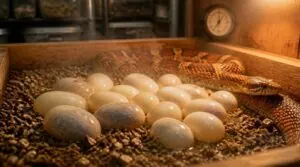
Even a perfect Punnett square only predicts ratios, not raw numbers. Clutch size runs 6 to 24 eggs, driven by maternal weight, gestation history, and nutrition.
| Factor | Effect | Variance Window |
|---|---|---|
| Maternal condition | Egg yield | 10-30% |
| Incubation temp | Hatch timing | 70-90% success |
| Genetic compatibility | Hatchling ratios | Case-dependent |
Plan buffers, not certainties.
Preparing Compatible Corn Snakes for Breeding
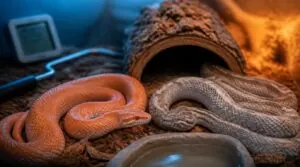
Matching genotypes on paper means nothing if the animals themselves aren’t ready to breed. Compatibility checks only pay off when you pair them with sound physical condition, proper quarantine, and a safe brumation cycle. Here’s what that preparation actually looks like, step by step.
Breeder Age, Weight, and Condition
Age tells you more than a calendar ever could. Peak production runs 3 to 6 years, with ovulation failure common under 2. Assess condition, not just weight, checking:
- Firm muscle tone along the spine
- Visible but not sharp ribs
- Solid nutritional reserves post-brumation
Readiness means proper habitat, healthy weight, and real reserves, not just a birthday.
Quarantine and Prebreeding Health Checks
Before pairing goes anywhere near your calendar, run a full 30-day quarantine in a separate enclosure with independent gear. Screen for mites, protozoa, and cryptosporidium via fecal testing, and schedule a vet exam within that window.
Assess nutrition, weight gain, and stool consistency throughout. Skipping this step risks disease transmission that no genetic pairing plan can offset.
Temperature Cycling and Brumation Safety
Cooling triggers reproductive readiness, but rush it and you’ll trade fertility for illness. Ramp no faster than 5-10°F per hour, hold 60-90 days at 50-60°F, and boost humidity gradually as brumation ends.
Watch for:
- Labored breathing
- Retained shed
- Weekly weight loss
- Sluggish response to warmth
Warm gradually afterward; feeding resumes only once activity normalizes.
Supervised Courtship and Mating
Once daylight cycles simulate spring, place your pair together and watch closely: males arch and coil, tail-flicking and head-bobbing to signal intent. Limit sessions to two daily, 7-14 days max. Only experienced supervision should handle intervention. Keep temps at 28-30°C, humidity 50-60%.
Log every attempt, behavior, and outcome, then separate for 48 hours regardless of success.
Egg Incubation and Hatchling Tracking
Successful mating means nothing if you botch the next 70 days. Keep eggs at 82-85°F with 85-92% humidity, pointed end down, rotated gently.
Candle at 7-14 days to confirm viability. Post-hatch, check breathing, eyes, and egg tooth condition, then log weight and length within 24 hours for reliable hatchling survival rates.
Responsible Pairings and Long-Term Genetic Diversity

Getting a clutch to hatch is only half the job—what you do with your breeding program afterward determines whether it holds up over time. Every pairing decision you make today either protects genetic diversity or quietly erodes it.
Here’s what responsible, long-term breeding actually looks like in practice.
Pedigrees and Genetic Recordkeeping
When you can’t trace where a snake’s genes came from, you’re breeding blind. Registration numbers, sire and dam records, and generational lineage tracing turn guesswork into genetic documentation.
Attach genetic testing records and health event history to each animal’s file. That paper trail, kept across three-plus generations, is what lets you assess inherited traits before they surface in your next clutch.
Selective Breeding Versus Line Breeding
Records tell you what’s in the genome; selective breeding decides what happens next. You’re choosing parents for specific traits, accepting some diversity loss for predictable results.
Line breeding pushes further, concentrating shared ancestry for trait fixation. That tightens allele frequency, raising inbreeding risks and genetic drift unless you track pairings against your pedigree data.
Outcrossing to Preserve Diversity
Line breeding fixes traits, but push it too far and you’re staring down a genetic bottleneck. Outcrossing counters that by pulling in unrelated bloodlines, restoring heterozygosity and revealing recessive alleles your closed line buried generations ago.
It also preserves rare morphs at risk of vanishing, while pedigree analysis keeps every introduced allele traceable across your program.
Prioritizing Welfare Over Appearance
Outcrossing widens your gene pool, but none of it matters if you’re breeding animals under stress. Health before aesthetics isn’t a slogan, it’s policy: skip pairs with poor body condition or active illness, verify weight and welfare markers first, and document everything transparently. A stunning morph combo means nothing if it comes from a compromised, unhealthy pairing.
Planning Homes Before Producing Clutches
Before you ever pull a morph compatibility chart or run genetic inheritance patterns through a Punnett square, know where every hatchling is going.
A 40 gallon enclosure with proper thermal gradients, humidity control, and hide placement takes real planning, and empty cages aren’t a backup plan.
Responsible breeding means securing homes first, producing clutches second.
Responsible breeding means securing homes for every hatchling before producing a single clutch
Frequently Asked Questions (FAQs)
What snakes can corn snakes breed with?
Other Pantherophis species are your safest bet, since hybrid viability stays high within genus. Ball pythons and kingsnakes fall outside safe cross genus breeding limits, risking poor offspring fertility and welfare problems responsible breeders won’t accept.
What can cohabitate with a corn snake?
Solo housing suits them best: nothing cohabitates safely. Corn snakes are solitary by nature, and pairing them, even with docile lizards or amphibians, risks disease transmission, food aggression, and stress that undermines welfare far more than companionship helps.
Can I put a male and female corn snake together?
Yes, but only with direct supervision, full health clearance, and a spacious enclosure. Watch for chin rubbing versus aggression, and separate immediately if stress signs appear. Never leave breeders unattended once introduced together.
Can you breed different types of snakes together?
Crossing different species is technically possible but risky: mismatched chromosomes often cause unpredictable traits, viability issues, or lethal combinations.
Reputable breeders avoid it, favoring within-species morph pairings that preserve genetic diversity and support long-term hatchling health.
How do you calculate morph outcomes in breeding pairs?
Guesswork breeds heartbreak in the incubator. Map each parent’s alleles on a Punnett square, apply Mendelian ratios (3:1, or 25/50/25 for heterozygous crosses), and you’ll predict genotype probability and phenotype expression before eggs are ever laid.
What percentage of offspring inherit each parents morph?
Your allele transmission rate sets the odds: a heterozygous dominant parent passes the trait to 50% of offspring, while two recessive carriers produce 25% visual morphs and 50% heterozygous carriers, per standard genotype inheritance patterns.
Can you breed different morph generations together safely?
Because two "pretty" snakes obviously make a pretty pairing, right? Not quite. Different generations can pair safely if you track inheritance patterns, verify lineage, and avoid stacking genetic load, protecting hatchling viability while preserving diversity through smart outcrossing.
How do you test for hidden recessive genes?
Pair your suspect heterozygous snake with a known homozygous recessive partner. Hidden recessive genes surface in the offspring, confirmed through Punnett square math, pedigree analysis, and phenotype observation rather than guesswork or genetic panels alone.
Whats the minimum clutch size for morph variety?
Small clutches simply signal healthy physiology, not weak genetics: minimum clutch size runs 4 eggs regardless of morph variety.
Female weight, age, and condition drive egg count, not the pairing’s genetic diversity or inheritance patterns you’d map on a Punnett square.
How does temperature during incubation influence morph appearance?
Warmth drives thermal pigment shift, deepening melanin deposition and morph color intensity. Running your 82F incubation with proper egg humidity on vermiculite or perlite over 55-65 days sharpens hatchling pattern clarity through temperature-dependent expressivity.
Conclusion
Picture a thousand hatchlings spilling across your table, every scale pattern already written before the first crack appears in the shell. That’s the power sitting inside a single Punnett square.
Corn snake morph compatibility breeding rewards patience over guesswork, turning locus by locus, allele by allele, into hatchlings you actually planned for. Master the genotype, respect the pairing risks, and your incubator stops holding surprises. It holds proof of your understanding, one confirmed clutch at a time.