This site is supported by our readers. We may earn a commission, at no cost to you, if you purchase through links.

A cramped enclosure doesn’t just stress a ball python; it shortens its life. These snakes can live 30 years in captivity, yet most husbandry failures trace back to one decision made at the start: picking the wrong tank.
Ball python snake tanks aren’t interchangeable. A hatchling drowning in a 120-gallon enclosure will refuse food and hide constantly. An adult crammed into a 20-gallon will pace, glass-surf, and burn itself searching for a thermal gradient that doesn’t exist in that small a space.
Getting the size, material, and setup right from the beginning changes everything that follows.
Table Of Contents
- Key Takeaways
- Ball Python Tank Size by Age
- Best Ball Python Tank Types Compared
- Top 7 Products for Ball Python Tanks
- 1. ReptiSun 5.0 UVB T8 Fluorescent Bulb
- 2. Exo Terra Repti Glo 20 Compact Fluorescent Lamp
- 3. Compressed Coconut Husk Reptile Bedding
- 4. Zoo Med Aspen Snake Bedding 8 Qt
- 5. Galapagos Terrarium Green Sphagnum Moss 4 Quart
- 6. Zoo Med Forest Floor Cypress Mulch Bedding
- 7. Flukers Repta Vines Artificial Pothos Terrarium Plant
- How to Set Up a Ball Python Tank
- Ball Python Tank Cleaning and Maintenance
- Frequently Asked Questions (FAQs)
- What kind of tank is best for ball pythons?
- Is a 75 gallon tank too big for a ball python?
- How much does a ball python tank cost?
- What is the ideal size tank for a ball python?
- What size tank is best for a ball python?
- Can you leave a heat lamp on 24/7 for ball python?
- Is a 75 gallon tank big enough for a ball python?
- Is a 40 gallon tank good for a ball python?
- Can ball pythons escape their enclosures easily?
- How often should I replace tank accessories?
- Conclusion
Key Takeaways
- Tank size must match your ball python’s life stage — a hatchling thrives in a 20-gallon, while an adult needs a minimum 40-gallon and ideally a 4x2x2 (120-gallon) enclosure with enough floor space for a proper thermal gradient.
- PVC enclosures with front-opening doors outperform glass for heat and humidity retention, making daily care easier and less stressful for your snake.
- A stable environment depends on layering substrate 4–6 inches deep, placing hides at both the warm (88–92°F) and cool (78–82°F) ends, and keeping humidity consistently between 50–60%.
- Ongoing maintenance — daily spot-cleaning, weekly humidity checks, and full substrate replacement every two to six months — is what keeps your snake healthy across its potential 30-year lifespan.
Ball Python Tank Size by Age
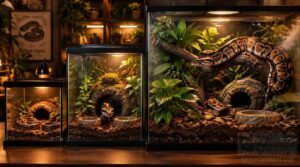
Getting the tank size right starts with knowing where your snake is in its life. Ball pythons have different space needs at each stage, and the wrong enclosure can cause stress, feeding refusal, or stunted development. Here’s what you need for hatchlings, juveniles, and adults.
For a full breakdown of enclosure dimensions at every growth stage, ball python tank size guides by age and weight make it easy to match your snake’s current needs without guessing.
Hatchling Tank Size
Most new keepers assume a 40-gallon minimum is needed, but your hatchling ball python tank size starts smaller. A 20-gallon long enclosure gives the right enclosure size without overwhelming them.
- Floor space: at least 12 by 12 inches
- Lid: secure, tight-fitting screen
- Substrate: coconut husk or reptile carpet
- Two hides on opposite ends
- Temperature gradients: 88-92°F basking, 78-82°F cool side
Juvenile Tank Size
As your ball python leaves the hatchling stage, the juvenile ball python tank size you need shifts up considerably.
A 20 to 40-gallon enclosure with 36 to 48 inches of floor length gives your snake the right growth room. Two hides at opposite ends lower stress.
Hold humidity at 50 to 60%, and let it spike briefly during each shedding.
A reptile digital hygrometer thermometer makes it easy to catch those humidity spikes at a glance and adjust before your snake’s shed is affected.
Adult Tank Size
Once your snake matures, tank size requirements jump considerably. A 40-gallon is the bare minimum, but a 4x2x2 enclosure around 120 gallons gives an adult ball python the floor space it needs to pace between hides, maintain a thermal gradient, and reduce daily stress.
A 4x2x2 enclosure gives adult ball pythons the floor space to thrive—40 gallons is merely the starting point
Longer, lower tanks always outperform taller ones. Prioritize total floor length over wall height every time.
Best Ball Python Tank Types Compared
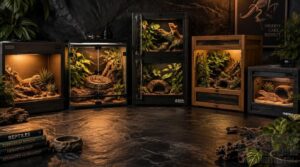
Once you’ve nailed the right size, tank type shapes everything from heat retention to daily maintenance. Here’s how common ball python enclosures compare:
Each material—glass, PVC, or wood—affects humidity control differently, so pairing your choice with solid ball python habitat setup fundamentals will help you get both warmth and moisture dialed in from day one.
- PVC Panel Ball Python Enclosure retains heat well and resists moisture, making it a top long-term pick.
- Exo Terra All Glass Terrarium delivers clear visibility but loses heat faster, so pair it with a quality under-tank heater.
- ReptiZoo Reptile Glass Tank offers front-opening doors, which makes feeding and handling noticeably easier.
- Modular reptile enclosures include built-in cable management and adjustable vents for consistent airflow.
- A ball python terrarium built from wood or foam is lightweight but demands careful humidity monitoring.
Pick your enclosure based on your specific heating method and how easily you can access the interior.
Top 7 Products for Ball Python Tanks
Once you’ve settled on the right tank type, the next step is choosing the specific products that perform.
The seven options below cover substrates, lighting, and enrichment to help you build a setup your ball python can actually thrive in.
If you’d like to see how these pieces fit together in a finished enclosure, this step-by-step ball python terrarium setup guide shows how to arrange hides, water, and climbing spots.
Each pick is chosen for safety, practicality, and compatibility with the care standards outlined in this guide.
1. ReptiSun 5.0 UVB T8 Fluorescent Bulb

Lighting does more than light up your enclosure. The Zoo Med ReptiSun 5.0 delivers 5% UVB output, triggering your ball python’s natural vitamin D3 synthesis and protecting against Metabolic Bone Disease without relying on supplements alone. At 25 watts, it fits standard T8 fixtures and works best when placed within 12 inches of your snake’s basking zone. That proximity matters, so don’t position it too far above the enclosure floor.
Plan on replacing it every six months if you’re running a 10 to 12-hour daily photoperiod. Consistent replacement keeps UVB output where it needs to be.
| Best For | Turtle, tortoise, and diurnal reptile owners who want to support bone health and natural vitamin D3 production without relying on synthetic supplements. |
|---|---|
| Wattage | 25W |
| UVB Output | 5% |
| Best For | Turtles, tortoises, diurnal reptiles |
| Replacement Schedule | Every 6 months |
| Fixture/Attachment | Standard T8 fixture |
| Material | N/A |
| Additional Features |
|
- Delivers 5% UVB output to support shell growth, bone health, appetite, and natural behaviors
- Fits standard T8 reptile fixtures at an accessible 25W
- Reduces the risk of vitamin D3 overdose compared to supplement-only approaches
- Effective UVB range tops out at 12 inches, requiring careful placement
- Needs replacement every six months under typical daily use, adding ongoing cost
- Not suitable for iguanas or reptiles that require higher UVB intensity
2. Exo Terra Repti Glo 20 Compact Fluorescent Lamp
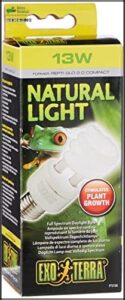
The Exo Terra Repti Glo 20 is a 13-watt compact fluorescent lamp built for terrarium daylight simulation. Its 98 CRI and 6700K color temperature render your enclosure in vivid, natural-looking light that makes colors pop and aids plant growth in bioactive setups.
This bulb also emits UVA radiation, which can stimulate appetite, activity, and reproductive behavior in your ball python. It’s a solid visual light source, but it’s not a UVB replacement. Exo Terra recommends pairing it with a Reptile UVB100, 150, or 200 for complete coverage.
One thing to monitor: fluorescent output degrades over time, dropping to roughly 50% light quality within a year. Check for dimming regularly and replace the bulb on schedule to keep your setup consistent.
| Best For | Planted terrariums and low-UVB reptiles like snakes, amphibians, and nocturnal animals that need strong visual light without high UVB output. |
|---|---|
| Wattage | 13W |
| UVB Output | Minimal |
| Best For | Planted terrariums, snakes, amphibians |
| Replacement Schedule | Within 1 year |
| Fixture/Attachment | Standard terrarium fixture |
| Material | N/A |
| Additional Features |
|
- 98 CRI and 6700K color temperature produce vivid, natural-looking light that supports plant growth and makes colors pop
- Emits UVA radiation, which can encourage appetite, activity, and reproductive behavior
- Compact fluorescent design fits standard terrarium fixtures and pairs easily with Exo Terra UVB bulbs
- Contains minimal UVB, so most reptiles will need a separate UVB bulb alongside it
- Output degrades significantly within a year, dropping to roughly 50% light quality and requiring regular replacement
- Some units have failed within six months, making lifespan inconsistent
3. Compressed Coconut Husk Reptile Bedding
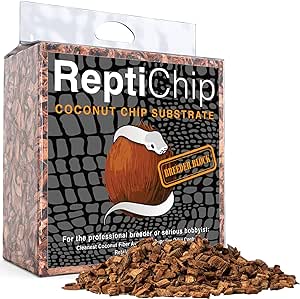
Keepers who’ve struggled with persistent humidity drops often point to compressed coconut husk as the substrate that turned things around. One small brick expands to fill a standard enclosure, making it a cost-effective, safe substrate that’s easy to store between uses.
What sets it apart for reptile substrate safety is straightforward: it’s non-aromatic, so it won’t irritate your ball python’s respiratory tract the way cedar or pine can. Add moisture gradually to support humidity control without causing surface pooling, and it stays workable for several weeks. Spot-clean soiled areas as needed. Replace the full substrate if you spot mold, because consistent mold prevention keeps your setup genuinely safe.
| Wattage | N/A |
|---|---|
| UVB Output | N/A |
| Best For | Geckos and crested geckos |
| Replacement Schedule | N/A |
| Fixture/Attachment | Suction cups |
| Material | Non-toxic polyethylene |
| Additional Features |
|
4. Zoo Med Aspen Snake Bedding 8 Qt
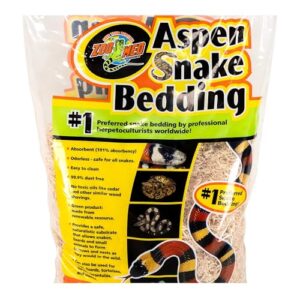
Picture a hatchling pressing softly into pale, fine shavings, burrowing just enough to feel secure. That’s what makes Zoo Med Aspen Snake Bedding a reliable safe substrate.
These aspen shavings stay relatively low-dust compared to pine, making reptile substrate safety a clear advantage. Keep the layer shallow at 1-2 cm and spot-clean regularly for solid enclosure maintenance.
- Use a 1-2 cm layer for hatchlings
- Spot-clean waste promptly to control odor
- Monitor humidity to prevent mold
- Avoid wetting the substrate
- Replace fully every 4-6 weeks
The 8 Qt bag suits a small ball python tank setup.
5. Galapagos Terrarium Green Sphagnum Moss 4 Quart
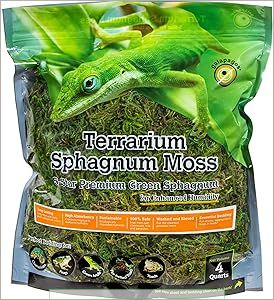
Sphagnum moss holds several times its weight in water, which makes the Galapagos Green Sphagnum Moss a strong humidity control option for any ball python tank setup. The 4-quart bag layers well over aspen shavings or cypress mulch and tucks around hides where moisture retention matters most.
Pre-soak before placing it inside. Dry moss draws moisture away rather than adding it.
| Feature | Benefit |
|---|---|
| High water retention | Stabilizes humidity levels |
| Reusable material | Lower maintenance cost |
| Natural green color | Naturalistic enclosure look |
| Pesticide-free sourcing | Safer substrate selection |
Don’t over-saturate it. Poor airflow combined with wet moss breeds mold quickly, a real health risk for your snake.
6. Zoo Med Forest Floor Cypress Mulch Bedding
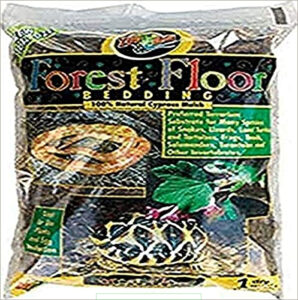
Zoo Med Forest Floor Cypress Mulch Bedding is one of the most reliable substrates you can choose for your ball python tank setup. It’s 100% natural cypress mulch, milled to a particle size that holds moisture without compacting, making humidity control noticeably easier day to day.
In dry climates, cypress mulch naturally stabilizes humidity between 50 and 60%, reducing how often you need to mist. In humid rooms, blot surface moisture weekly to prevent mold buildup. Spot-clean waste daily and replace the entire substrate every six to twelve months to stay ahead of odor and contamination.
Your snake will burrow into it comfortably, and live plants thrive in it too. Just source kiln-dried or sterilized mulch to minimize fungal risk from the start.
7. Flukers Repta Vines Artificial Pothos Terrarium Plant
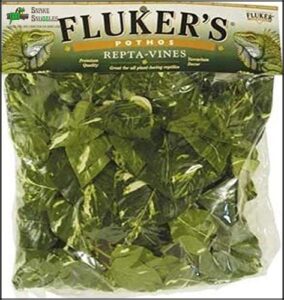
Once your substrate is settled, layering in vertical cover completes the setup. Fluker’s Repta Vines give you six feet of flexible artificial pothos made from non-toxic polyethylene, so there’s no concern if your snake contacts or mouths the leaves. Weave them through bend-a-branch structures or attach with the included suction cups to build visual depth and natural hiding spots.
Know that the suction cups are small and not directly attached to the vine, so test placement before committing. Leaves can detach over time and durability varies, but a quick wipe-down keeps them looking clean.
| Best For | Reptile and gecko keepers who want an easy, flexible way to add natural-looking cover and depth to a terrarium without worrying about plant toxicity. |
|---|
- Six feet of flexible vine gives you plenty of material to weave, drape, and layer through any terrarium setup
- Non-toxic polyethylene construction means no risk if your reptile contacts or mouths the leaves
- Compatible with bend-a-branch structures and includes suction cups for versatile mounting options
- Suction cups are small and not attached directly to the vine, so placement can be tricky and may not hold reliably
- Leaves can detach over time, requiring occasional maintenance or replacement
- Durability is hit or miss depending on the unit, with inconsistent quality reported by customers
How to Set Up a Ball Python Tank
With the right products in hand, setting up your ball python enclosure is straightforward. First, confirm your tank size requirements match your snake’s age.
Then layer your setup in this order:
- Spread 4-6 inches of your substrate selection across the floor to support burrowing and retain moisture.
- Place one hide on the warm side and one on the cool side to give your snake a retreat at each end.
- Set up your heat source with a thermostat to build a reliable thermal gradient, aiming for 88-92°F warm and 78-82°F cool.
- Add your water dish on the cool side and confirm humidity levels sit between 50-60%.
Once those four steps are done, add cork bark or artificial climbing vines for enrichment.
Ball Python Tank Cleaning and Maintenance
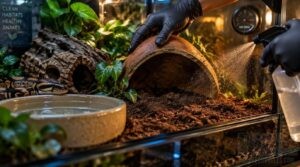
Once your enclosure is running, keeping it clean is what protects your snake’s long-term health. Daily spot-cleaning removes feces and uneaten prey before bacteria and odors build up. Pull anything contaminated immediately and check for mold while you’re at it. A reptile-safe spot cleaner makes quick daily removal safer and faster, without leaving residues that could irritate your snake.
Weekly, mist the enclosure to maintain 60–80% humidity without soaking the substrate. Wipe the water dish with hot water and mild soap, rinse it completely, and verify your temperature gradient is accurate.
Full substrate replacement happens every two to six months, or sooner if you’re spotting mold. During that deep clean, sanitize hides and decor with 70% isopropyl alcohol, dry everything fully before reassembling, and check for lid gaps to prevent escapes. Weigh your snake weekly to catch stress early.
Frequently Asked Questions (FAQs)
What kind of tank is best for ball pythons?
For most keepers, a PVC ball python tank with front-opening doors is the best overall choice. It holds heat and humidity better than glass, reduces stress on your snake, and makes daily access far simpler.
Is a 75 gallon tank too big for a ball python?
A 75 gallon tank isn’t too big for your ball python. What matters is maintaining a proper thermal gradient and humidity, which larger enclosures can make harder without careful planning and adequate heat source placement.
How much does a ball python tank cost?
Your ball python tank will usually cost from $15 to $300+, depending on enclosure size and material. Plastic options start around $15, glass terrariums top out near $150, and modular rack systems can reach $
What is the ideal size tank for a ball python?
Size depends on age. A hatchling needs a 10-20 gallon tank, but adults require a 40 gallon minimum, and larger snakes genuinely thrive in a 120 gallon ball python enclosure with plenty of floor space.
What size tank is best for a ball python?
For a hatchling, a 20–30 gallon enclosure is the right starting point. Adults need a 40-gallon minimum, ideally with dimensions of 48" x 24" x 24" to give your python enough room to move comfortably.
Can you leave a heat lamp on 24/7 for ball python?
A heat lamp running nonstop is like living under a sun that never sets. It stresses your snake and disrupts thermoregulation. Use a thermostat and timer to control heat and maintain a proper day-night cycle.
Is a 75 gallon tank big enough for a ball python?
For most adult ball pythons under five feet, a 75-gallon tank is a solid fit. Once your snake approaches six feet, you’ll want to step up to 120 gallons for the floor space it needs.
Is a 40 gallon tank good for a ball python?
Most ball pythons reach 3–5 feet, so a 40-gallon minimum falls short for adults. Your ball python enclosure should be at least 48" x 24" x 24" to give your snake real room to move.
Can ball pythons escape their enclosures easily?
Yes, they absolutely can. Ball pythons are highly skilled escape artists that exploit gaps over 1/4 inch wide. Use secure locks and tight-fitting lids for solid enclosure security, and inspect all seals weekly after handling.
How often should I replace tank accessories?
Think accessories last forever? Replace coconut husk substrate every 6–12 months, UVB bulbs every 9–12 months, and hides and décor every 2–3 years. Your reptile enclosure maintenance schedule actively prevents mold, bacteria, and health risks.
Conclusion
Picture a ball python coiled inside a hide that fits it perfectly, belly full, colors rich. That’s exactly what the right setup produces.
Ball python snake tanks aren’t just containers; they’re the entire environment your snake depends on to thrive. Get the size right for each life stage, match the materials to your maintenance style, and build the thermal gradient properly. Do that well, and your snake rewards you with decades of calm, healthy behavior.