This site is supported by our readers. We may earn a commission, at no cost to you, if you purchase through links.
Most people picture boas draped over tropical branches, soaking up equatorial heat. The reality is more complicated. Boa constrictor populations thrive from sea-level mangroves to Andean foothills at nearly 1,900 meters, across habitats as different as dripping rainforest and bone-dry savanna. That ecological range is impressive, and it creates a real challenge for keepers: which version of that environment belongs in your living room?
The answer is a carefully engineered middle ground. Boa constrictor habitat requirements aren’t about perfectly mimicking one environment. They’re about hitting precise temperature, humidity, and security parameters that keep your animal healthy for decades.
Table Of Contents
- Key Takeaways
- How Natural Boa Habitats Shape Captive Care
- Boa Constrictor Enclosure Size and Security
- Temperature, Lighting, and Thermal Gradients
- Humidity, Substrate, and Hydration Requirements
- Hides, Climbing Enrichment, and Maintenance
- Frequently Asked Questions (FAQs)
- What is the ideal habitat setup for a boa constrictor?
- How hot is too hot for a boa?
- Are boa constrictors hard to care for?
- Is a 120 gallon tank good for a boa?
- What do boa constrictors need in their habitat?
- What do boas need in their tank?
- What is the best enclosure for a boa constrictor?
- Are boa constrictors high maintenance?
- How often should I clean my boas water dish?
- Can boa constrictors share enclosures with other snakes?
- Conclusion
Key Takeaways
- Boa constrictors evolved across wildly different climates—from rainforest to dry savanna—which is why your enclosure needs a temperature gradient (22–32°C) and steady humidity between 50–60%, not a single fixed setting.
- Enclosure size should match your boa’s life stage: start neonates in a 20–24 inch space and scale up to at least a 4×2×2-foot enclosure for adults, since a snake that feels exposed or cramped will stress quickly.
- Two hide boxes—one on the warm side, one on the cool side—are non-negotiable; they let your boa thermoregulate and feel secure without ever having to choose between comfort and safety.
- Substrate depth (2–6 inches of cypress mulch or coconut fiber), a large soaking bowl on the cool side, and a moist hide during shedding cycles all work together to keep your boa properly hydrated and shed-ready year-round.
How Natural Boa Habitats Shape Captive Care
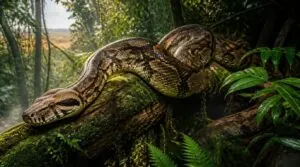
Before you build a single thing for your boa, it helps to know where these snakes actually come from.
Their origins span a remarkable range of climates, so brushing up on boa constrictor natural habitat and care requirements will shape every setup decision you make.
Boa constrictors roam everything from humid rainforests to dry savannas across Central and South America, and each habitat teaches us something about their needs.
Once you understand their wild instincts, the enclosure choices ahead of you’ll make a lot more sense.
Rainforests, Savannas, and Dry Forests
Wild boa constrictors don’t live in one single habitat type. They occupy rainforests, savannas, and dry forests across their range. Rainforests stay wet year-round with heavy canopy cover. Savannas have open grassland, scattered trees, and regular fires. Dry forests force boas to endure long dry seasons. Savannas experience hot, seasonally dry conditions with annual rainfall between 500 and 1,500 millimeters and dry seasons lasting 3 to 8 months, as described in savanna climatic conditions.
Why does this matter to you? Because your boa’s needs are shaped by all three. That’s why keepers provide a temperature gradient, humidity between 50-60, and a generous enclosure size with two hide boxes. Good substrate options like cypress mulch hold moisture well.
Riparian Habitats and Swimming
Beyond those dry habitats, many boas live in riparian areas near streams and rivers. Here they swim, hunt frogs and fish, and cool off in the water.
That’s why your water bowl setup matters. Provide a bowl large enough for full-body water soaking, and you’re practicing true habitat replication. Your boa will drink, soak, and stay hydrated, just like wild boas along the riverbank.
Central and South American Range
Those riverbanks stretch across a huge map. Boas range from southern Mexico through Central America into Brazil, Peru, and Ecuador. They live in tropical rainforests, dry forests, and cloud forests up to about 1,900 meters. That elevation spread means boas tolerate temperatures from 16 to 32°C. Your temperature gradient and humidity control should reflect this flexibility, not one narrow setting.
Climbing and Shelter Behaviors
That flexibility shows up in how boas use vertical space. Arboreal behavior, meaning tree-climbing, starts young. Juveniles perchicks perch high to survey territory and dodge ground predators. Adults climb too, but they pick thick, sturdy limbs that hold their weight. Climbing peaks at dawn and dusk, when prey moves and cover is thick. Shelter matters equally: boas wedge into bark crevices, hollows, and dense brush.
Replicating Natural Habitat Features
Bringing the wild indoors is easier than you think. Aim for a naturalistic habitat with climbing branches, leaf litter, and deep substrate. Add environmental enrichment like cork hollows and sturdy perches.
Maintain a proper thermal gradient and steady humidity control. Prioritize substrate safety by avoiding sharp materials.
You’ll create a space where your boa thrives, not just survives.
Build a habitat where your boa truly thrives, not merely survives
Boa Constrictor Enclosure Size and Security
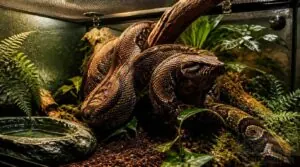
Getting the enclosure right is the single most important decision you’ll make for your boa constrictor. Size and security work together, because a boa that feels cramped gets stressed, and a boa that finds a weak spot will escape.
Let’s walk through the specific enclosure options for every life stage, from neonate to full-grown adult.
Neonate and Juvenile Enclosure Sizes
A baby boa in a giant cage feels exposed, not free. Enclosure size should match your snake’s age.
Start small and scale up as your snake grows — snake cage sizing and security tips can help you choose the right setup at every stage.
For the first 4 to 6 weeks, provide 20 to 24 inches of length. Then upgrade:
- 24 to 36 inches for juveniles
- Secure, escape-proof lids
- Substrate 2 to 4 inches deep
- Balanced ventilation
- One hide box per zone
Small spaces let neonates thermoregulate safely.
Adult Boa Enclosure Dimensions
An adult boa needs room to stretch, plain and simple. Your minimum enclosure size is a 4x2x2foot enclosure for average adults, but larger females reach 7 to 8 feet. For those big girls, go 8 feet long by 2 feet deep.
A proper thermal gradient and humidity between 50-60% need floor space to develop. Place hide boxes on both ends.
Enclosure Materials and Ventilation
The material you choose matters as much as the size. PVC enclosures are the top choice for boas, holding humidity beautifully and wiping clean in seconds. Wood with a waterproof coating works too, but seal every seam. Glass tanks look great yet dry out fast.
Whatever you pick, prioritize a frontopening design. It reduces stress during handling and improves airflow control.
For enclosure ventilation, aim for 5 to 10 air changes per hour. Place vents high and low on opposite walls to create crossventilation airflow. That exchange pushes stale, humid air out without chilling your snake. Screened, corrosionresistant vents prevent escapes and clogging. Check them monthly.
Escape-Proof Locks and Lids
A boa can push a loose lid with 15 pounds of force, so secure locking mechanisms aren’t optional. Choose reinforced steel locks with dual bolts and captive screws that resist prying. Front doors work well, since they suit your spatial layout and stay tight. Add internal pawls and child-resistant latches for delay. Check every lock monthly, because escape prevention beats searching walls for weeks.
Planning The Enclosure Layout
Think of your enclosure like a tiny apartment. Your boa needs a warm basking spot on one side, a cool retreat on the other, and hiding spots in between. Place hide boxes at both ends so your snake never chooses between comfort and security.
Keep the water bowl near the cool side, away from the heat source. That way your temperature gradient stays stable, and humidity holds between 50 and 60 percent.
Temperature, Lighting, and Thermal Gradients
Getting the temperature right is where most boa setups succeed or fail. Your boa constrictor can’t regulate its own body heat, so you’ll need to build that gradient for it. Here’s exactly what that means, zone by zone, starting with the basking spot.
Basking Spot Temperature Range
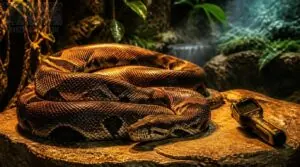
The single most important number in your setup is the basking spot temperature range. Aim for a surface temperature of 30 to 32 Celsius, measured with an infrared thermometer directly on the basking surface. This warmth helps digestion and proper thermal regulation.
Keep the surface about 5 to 10 Celsius warmer than surrounding air. Never exceed 34 Celsius, since overheating causes stress and burns.
Warm and Cool Zones
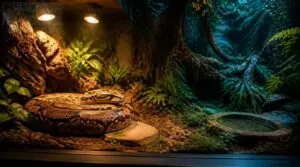
A basking spot alone isn’t enough. Your boa needs a temperature gradient, a warm side and a cool side in one enclosure.
Keep the warm zone at 29 to 32 Celsius, covering about 25 to 30 percent of the floor. The cool side stays at 22 to 26 Celsius.
This gradient lets your snake choose its own comfort level, which helps digestion and humidity control.
Safe Nighttime Temperature Drops
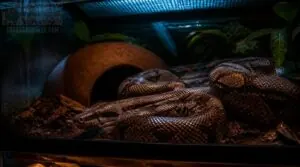
That gradient matters at night, too. Boas tolerate a 5 to 10 degree drop after lights out, but keep the ambient temperature between 18 and 24 Celsius (65 to 75 Fahrenheit).
A few rules keep nighttime cooling safe:
- Never let hatchlings fall below 15 Celsius (60 Fahrenheit)
- Make the drop gradual, not a sudden crash
- Keep hides warm so your boa can retreat
Rainforest boas prefer minimal change. Dry forest lineages handle cooler nights if humidity stays above 60 percent. Adults manage 8 to 10 degree drops; juveniles only 5 to 7. Apply seasonal temperature adjustments slowly, and use a low-wattage under-tank heater to hold your cool side steady overnight.
Thermostats and Digital Thermometers
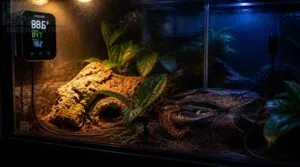
You can’t watch temperatures all night, so let a thermostat do it for you.
Thermostats and digital thermometers are your safety net. Place probes in both temperature zones, at snake height, away from direct heat. Digital probes read within 0.1 to 0.2 Celsius and respond in 2 to 5 minutes. Check calibration yearly against a reference thermometer. Your boa’s health depends on it.
Lighting and Photoperiod Needs
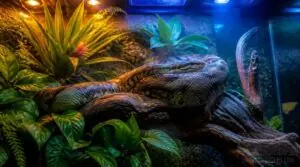
Lighting matters more than you’d think. Keep a 12-hour photoperiod with LEDs that add no heat. Mount bulbs above the warm zone, 12 to 18 inches from the basking spot. Three essentials:
- Use timers for consistent on/off cycles
- Replace UVB bulbs every 6 to 12 months
- Provide 10 hours of darkness nightly
Low-level UVB exposure can improve activity and natural behaviors.
Humidity, Substrate, and Hydration Requirements
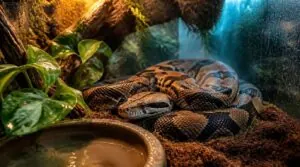
Humidity is where many boa keepers stumble, but it’s easier to manage than you might think. In this section, you’ll learn the exact moisture levels your boa needs, plus the substrates and water setup that keep them stable.
Let’s walk through each piece so you can build a hydration routine that works year-round.
Ideal Everyday Humidity Range
Getting humidity right is the backbone of boa constrictor care. Aim for 50-60 percent relative humidity daily, never below 30 or above 70.
For a deeper dive into substrate choices and hide placement, this boa constrictor humidity care guide walks through the enclosure design decisions that keep levels consistently in that target range.
Use a hygrometer to track ambient humidity zones across the enclosure. Consistent humidity management prevents dehydration and mold, keeping your boa thriving.
If you don’t own an automatic mister, you can still hold steady levels with simple humidity control methods that don’t need an automatic mister.
This band helps with healthy skin and proper humidity shedding correlation.
Shedding Humidity and Moist Hides
Boosting humidity slightly before a shed makes the whole process easier on your boa. Raise ambient humidity to 60-70 percent during shedding cycles, keeping the bump brief.
Add a moist hide lined with damp sphagnum moss, 2-4 inches deep, placed on the warm side. This loosens old skin, preventing stuck eye caps and flaky, incomplete sheds. Rehydrate the moss daily, and remove any white mold immediately.
A reptile moist hide box paired with fresh sphagnum moss gives you the easiest setup for keeping that microclimate consistent throughout the shed.
Hygrometer Placement and Monitoring
A hygrometer only helps if you put it in the right spot. Place your digital hygrometer centrally, at breathing height, where your boa actually rests. Keep it away from direct sunlight, vents, and drafts, since these skew humidity readings badly.
Use a primary sensor near the warm hide, plus a second one in the cool zone. This tracks your gradient’s stability. Recalibrate after any major enclosure change, because accurate humidity control depends on trustworthy numbers.
Safe Substrates and Depth
Your boa’s floor covering matters more than you might think. Use cypress mulch or coconut fiber, kept 2 to 6 inches deep, ideally 4 inches for adults. This depth helps with burrowing and thermoregulation.
Keep it moist, never soggy, and check weekly for compaction. Replace soiled sections promptly, since fresh substrate choices prevent mold and bacterial buildup.
Water Bowl Size and Placement
Think a water bowl is just a decoration? Your boa’s water bowl is its lifeline.
Choose a heavy ceramic dish sized 1.5 times your snake’s coiled width. Place it on the cool side, at least 15 centimeters from hides.
Keep water fresh, between 18 and 24 Celsius, and clean daily. A stable, shallow water dish prevents tipping and helps steady hydration.
Hides, Climbing Enrichment, and Maintenance
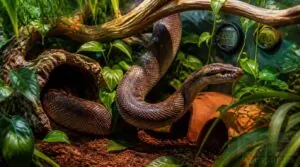
A boa constrictor’s enclosure isn’t just about temperature and humidity—it’s also about feeling secure and staying active. In the wild, these snakes spend their days hidden in cover or climbing through branches, and your setup should offer the same chances. Here’s what you’ll need for hides, climbing enrichment, and a cleaning routine that keeps everything healthy.
Warm and Cool Hide Placement
Place two snake hides in your boa’s enclosure, one on each end. This is the heart of your temperature gradient setup. Your boa will shuttle between hiding places to regulate body heat.
- A snug, opaque warm side hide over the basking zone
- A breathable cool side hide away from direct heat
- Both sitting flush on substrate for stable contact
Size each hide so your boa touches the walls when coiled.
Visual Barriers and Cover
Hides handle security, but your boa also wants cover between them. Visual barriers break up sightlines and mimic the dense understory of Boa constrictor habitat. Add artificial foliage, layered plants, and opaque backdrops to create private zones. Anchor everything securely so nothing tips during handling. Leave gaps for monitoring and cleaning, and choose non-toxic, washable pieces you can sanitize easily.
Sturdy Branches and Climbing Structures
The previous section showed how visual barriers create private spaces; now you’ll strengthen arboreal enrichment with reliable, climb-safe gear. Use thick, load-bearing branches (2–4 cm for juveniles, 5–10 cm for adults) with natural textures to grip and resist warping. Arrange a ladder-style setup at 60–75 cm spacing and make sure forks offer multiple routes. All branches should be anchored securely and regularly inspected for cracks.
- Choose hardwoods like oak, maple, or beech for stability.
- Provide branches at 45–60 degree inclines to boost grip.
- Include crossing bridges for alternate routes.
- Reserve retreat branches with tighter angles in shade.
- Rotate branch spots weekly to maintain novelty.
Daily Spot Cleaning Routine
While you’re inspecting branches, scan the enclosure floor too. Remove droppings and uneaten prey within 30 minutes, because ammonia builds fast in enclosed spaces.
Wipe any spill areas using a soft cloth and reptile-safe cleaner each day. Check the water bowl rim for algae buildup.
Always sanitize your tools and gloves after every session to stop cross-contamination from spreading.
Deep Cleaning and Health Checks
Every 4 weeks, remove your boa and strip everything out completely.
- Swap out all loose substrate
- Disinfect surfaces with a 3% bleach solution (10-minute contact time)
- Scrub water bowls with disinfectant, then rinse thoroughly
- Inspect your boa for skin issues or discharge
- Schedule annual vet checkups with parasite screening included
Keep brief records of feedings, shed cycles, and behavior changes.
Frequently Asked Questions (FAQs)
What is the ideal habitat setup for a boa constrictor?
A good setup balances enclosure size, a temperature gradient of 75-90°F, 50-60% humidity, a basking spot, and two hide boxes — one warm, one cool.
How hot is too hot for a boa?
Once the basking temperature climbs past 95°F (35°C), heat stress and organ damage become very real risks. Temperature monitoring catches dangerous spikes early. Keep your warm side dialed in, and your thermal gradient stays safe.
Are boa constrictors hard to care for?
Boa constrictors aren’t especially hard to care for, but they do require consistent attention to detail. Get the temperature, humidity, and enclosure size right, and you’ll have a fascinating, manageable pet.
Is a 120 gallon tank good for a boa?
You might think bigger is always better, but a 120 gallon enclosure hits the sweet spot for most adult boas. It provides enough floor space, a solid thermal gradient, and room for hides and climbing.
What do boa constrictors need in their habitat?
Your boa needs a basking spot between 88-92°F, humidity between 50-60%, moisture-retaining substrate, at least two hide boxes, and solid climbing structures for enrichment. A large, clean water dish completes the setup.
What do boas need in their tank?
Your tank needs temperatures of 78-88°F, humidity around 50-60%, and at least a 4x2x2-foot enclosure. Add proper substrate, heating elements, a large water dish, two hide boxes, and climbing structures for your boa’s well-being.
What is the best enclosure for a boa constrictor?
For adult boas, you need a secure 8x3x2-foot enclosure with coconut husk substrate, at least two hide boxes on each end, a basking zone of 85-90°F, sturdy climbing branches, and a consistent 60-70% humidity level.
Are boa constrictors high maintenance?
Like keeping a saltwater fish tank, boas need consistent daily checks. You’ll manage humidity at 50-60%, warm and cool temperature zones, shedding cycles, and a feeding schedule. With a properly sized enclosure, care becomes straightforward.
How often should I clean my boas water dish?
Daily water changes are non-negotiable. Empty the bowl each day, scrub it well with a 25% vinegar solution, rinse it twice, then refill. Once a week, do a deeper clean to keep bacteria in check.
Can boa constrictors share enclosures with other snakes?
No. Boa constrictors are solitary by nature and shouldn’t share enclosures with other snakes. Even same-species cohabitation creates competition for heat zones and hides, leading to stress and injury. Each snake needs its own space.
Conclusion
Picture a boa resting still at the warm end of its enclosure, body fully relaxed, scales smooth and bright. That stillness is the quiet signal you’ve done everything right.
Meeting boa constrictor habitat requirements isn’t complicated once you understand what your animal truly needs: precise temperatures, steady humidity, and two secure hides. Get those three key parameters working together consistently, and your boa won’t just survive in your care. It will truly thrive for decades.