This site is supported by our readers. We may earn a commission, at no cost to you, if you purchase through links.

A boa constrictor that can’t thermoregulate properly, rotate between hides, or fully extend its body isn’t just uncomfortable. It’s stressed, immunocompromised, and aging faster than it should.
Boa snake tank design inspiration goes beyond aesthetics. The layout you choose directly controls your animal’s internal temperature, shedding success, and behavioral health. An 8-foot red tail boa needs basking access at 90–95°F and a cool retreat at 75–85°F, all within a single, well-planned space.
The setups in this guide show you exactly how to build that space, whether you’re drawn to bioactive jungle habitats or clean minimalist displays.
Table Of Contents
- Key Takeaways
- Choose The Right Boa Enclosure Size
- Pick a Boa Tank Design Style
- Arrange Climbing Branches, Hides, and Plants
- Design Comfortable Heat and Humidity Zones
- Make Your Boa Tank Secure and Easy-Clean
- Frequently Asked Questions (FAQs)
- What is the ideal enclosure setup for a boa constrictor?
- What are some creative decor ideas for a snake terrarium?
- What is the most expensive boa morph?
- How big should a boas tank be?
- What substrate depth works best for burrowing?
- How often should décor be cleaned and replaced?
- Can multiple boas safely share one enclosure?
- What background colors reduce stress in boa tanks?
- How to prevent mold growth in humid setups?
- How often should substrate be completely replaced?
- Conclusion
Key Takeaways
- An adult boa needs an enclosure at least 8–10 ft long with distinct warm (90–95°F) and cool (75–85°F) zones, two strategically placed hides, and 60–70% humidity to stay healthy rather than just alive.
- Your design style — naturalistic, minimalist, or bioactive — isn’t just aesthetic; it directly shapes humidity control, behavioral expression, and how much daily maintenance the setup demands.
- Branch placement and hide positioning determine whether your boa actually uses the space, so stagger climbing branches across 60–75% of enclosure height and keep hides away from direct airflow at opposite thermal ends.
- Security and cleanliness are non-negotiable foundations: locking latches, non-porous substrates, sealed wood, and weekly deep-cleans prevent escapes, mold, and the slow health decline that comes from a poorly maintained enclosure.
Choose The Right Boa Enclosure Size
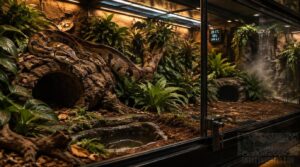
Three critical measurements determine boa enclosure success: length, width, and climbing height. Juveniles need a minimum 6 ft by 2-3 ft floor space, but don’t size down expecting to upsize later. Common boa constrictors hit 6-8 ft by adulthood, and red tail boa cages should reach 8-10 ft to match that growth without forcing a rushed rebuild.
For a deeper look at how floor space, climbing height, and material choices work together, boa constrictor enclosure size and setup guidelines cover everything from juvenile starter setups to full adult builds.
Choosing the right boa enclosure size also means accounting for behavior, not just body length. Your boa needs room to fully extend, rotate between multiple hides, and thermoregulate across distinct zones. Factor in enclosure security from the start, since larger builds demand reinforced locking hardware. Get sizing right, and your boa snake tank design inspiration takes shape on a foundation that actually works.
Pick a Boa Tank Design Style
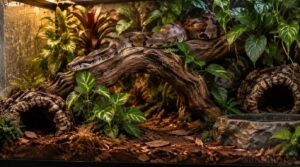
Once you’ve locked in the right dimensions, your next decision shapes everything from daily maintenance to the look of your entire setup.
Boa tank design style affects humidity control, décor choices, and how naturally your snake behaves.
There are three distinct approaches worth considering, each built around a different keeper priority.
Naturalistic Forest Retreat
Leaf-litter substrate anchors a naturalistic bioactive setup. Layer it at variable depths, tuck cork bark hides and driftwood for texture, and install climbing branches at 40–60 cm intervals to build your vertical pathways.
For deeper guidance on weaving these elements together, naturalistic boa constrictor enclosure design walks through how layered textures, live plants, and thermal gradients combine into a cohesive, enriching habitat.
Keep your color palette in muted greens and browns. Mist on a controlled schedule for humidity regulation without creating the mold-prone hotspots that undermine long-term habitat health.
Modern Minimalist Display
The Modern Minimalist Display trades the naturalistic style’s layered complexity for precision. A transparent enclosure with matte black framing directs every eye to your boa, not the hardware or substrate.
- Clean lines make movement read as deliberate, living art
- Two pieces of functional decor deliver species-appropriate enrichment without visual chaos
- A single warm-white LED at 2700K renders every scale detail
Bioactive Jungle Habitat
Where minimalism strips back, the bioactive jungle habitat builds forward.
Every layer of growth counts, from creeping groundcover to towering canopy, as explored in these python terrarium design ideas centered on lush, living environments.
A bioactive PVC setup with front-opening doors gives you direct access without disturbing climbing branches spaced 20-40 cm apart at height.
Live pothos and bromeliads buffer humidity spikes to 85% naturally, while springtails and isopods process waste below.
Use only reptile-safe products during maintenance to protect your microfauna colony long-term.
Arrange Climbing Branches, Hides, and Plants
Within a well-designed enclosure, branch placement and zoning decide whether your boa uses the space. Span climbing branches across 60–75% of enclosure height, staggering diameters between 1.5 and 3 inches so your snake encounters varied grip points on every route.
Position hides 8–12 inches off the floor as ambush points and thermoregulation breaks. Use one large hide for basking, one small for security, both away from direct airflow.
In a bioactive setup, anchor all driftwood and plants firmly to prevent branch movement.
Follow these priorities:
- Stagger branch diameters between 1.5 and 3 inches
- Overlap branches at multiple heights for continuous routes
- Keep hides away from direct airflow
- Use non-toxic plants with stable anchoring
- Allocate 40% of climbing surface to branches
Design Comfortable Heat and Humidity Zones
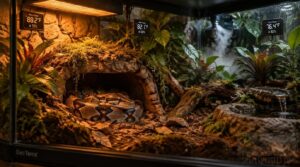
For thermal gradient maintenance, you need a basking spot design that consistently hits 90–95°F, dropping across the enclosure to a 75–85°F ambient zone on the cool end. A radiant heat panel positioned above the warm third, paired with an under-tank heater below, eliminates cold floor patches your boa would otherwise avoid.
Strategic hide temperature placement determines how effectively your boa thermoregulates. One hide belongs under the basking zone; the other belongs on the cool end. That placement alone reduces stress and promotes healthy digestion.
Mount your three temperature monitoring tools at the hotspot, mid-zone, and ambient locations, then log readings weekly. For humidity regulation, you’ll want 60–70% daily and 75–85% during all sheds, managed with a hygrometer-controlled humidifier with auto-shutoff.
Make Your Boa Tank Secure and Easy-Clean
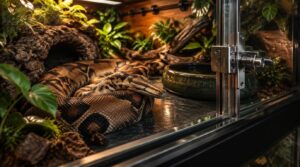
Picture a boa pressed against a loose panel at 2 a.m. One gap is all it takes. Secure and escapeproof doors with locking latches aren’t optional; they’re your first line of defense, whether you’re running a bioactive terrarium or a naturalistic enclosure built for display.
One gap at 2 a.m. is all a boa needs—locking latches aren’t optional
- Use a reinforced, leak-proof floor tray with raised edges to contain spills and waste
- Install locking latches on every door for consistent escape prevention
- Choose non-porous, wipe-clean substrates like sealed tile or epoxy resin
- Run all cords through high-positioned secure channels away from your boa
Seal all wood with reptilesafe materials before assembly. A front-access design lets you clean without disrupting water bowls. Weekly deep-cleans remove biofilm; daily spot-checks handle all waste before it builds.
Frequently Asked Questions (FAQs)
What is the ideal enclosure setup for a boa constrictor?
For an adult boa, you need a 4-6 foot enclosure with front-opening doors, a thermal gradient running from 78 to 90°F, two hides placed at opposite ends, several climbing branches, and 50-60% humidity maintained consistently.
What are some creative decor ideas for a snake terrarium?
Layer cork bark tubes and panels against naturalistic backgrounds for depth. Stagger climbing branches at varied heights, tuck reptile hides at opposite ends, and add a bioactive substrate with leaf litter for active reptile enrichment.
What is the most expensive boa morph?
The hypo phantom xanthic is currently the most expensive boa morph you’ll encounter on the market. Stacking multiple recessive genes drives prices highest, particularly when breeding stock is scarce and documented lineage confirms genetic authenticity.
How big should a boas tank be?
Solid boa snake tank design inspiration always begins with getting the size right: you need 8L x 4W x 4H at minimum. That footprint allows for thermal gradients, multilevel platforms, and front-opening doors without restricting movement.
What substrate depth works best for burrowing?
Want your boa to burrow properly? Keep substrate depth at 4–6 inches for most species. Larger individuals need 6+ inches to coil fully and reach the cooler temperature pockets that form deeper inside the substrate.
How often should décor be cleaned and replaced?
Your boa’s decor clearly maintains itself. Do weekly wipe-downs with reptile-safe disinfectant to preserve material safety.
Replace any cracked substrate-contact piece within 6-12 months, and rotate enrichment items every 6 months to actively prevent habituation.
Can multiple boas safely share one enclosure?
Two same-sex red-tails successfully cohabited in a 3-meter enclosure with multiple hides and distinct thermal zones. It can work, but species compatibility matters, same-sex pairing reduces breeding conflict, and separate feeding times are absolutely non-negotiable.
What background colors reduce stress in boa tanks?
Think background color doesn’t affect your boa’s stress levels? Use warm grays at 60-65% brightness or soft olive-brown tones to minimize stress hormone spikes; bright blues and high-contrast edges will measurably increase startle responses.
How to prevent mold growth in humid setups?
Mold colonies establish within 48 hours in stagnant, humid air. Keep relative humidity at 60–75%, use fast-drying bioactive substrate, and run ventilation systems delivering at least 5 air changes per hour. Replace moldy décor immediately.
How often should substrate be completely replaced?
Most keepers wait far too long. Replace substrate every 6-12 months in standard enclosures, spot-cleaning weekly between cycles.
With bioactive substrate, skip full replacement unless odor persists beyond two weeks or microfauna balance collapses entirely.
Conclusion
Picture a boa coiled on a warm branch, mid-shed skin peeling cleanly, retreating to a cool hide on its own terms. That’s not luck. That’s deliberate habitat engineering.
Good boa snake tank design inspiration starts with function: correct thermal gradients, secure anchor points, and accessible hides. Once those elements align, the aesthetic follows naturally. Build the enclosure your animal’s biology actually demands, and you’ll watch a stressed, sluggish captive slowly transform into a thriving one.