This site is supported by our readers. We may earn a commission, at no cost to you, if you purchase through links.

Your corn snake spends most of its day hidden, and where that hide sits decides whether it digests, sheds, and fights off illness properly.
Park one hide over the heat source and another in the shade, and you hand your snake a thermostat it can operate with its own body. Center the heat lamp or mat instead, and the gradient vanishes. Appetite drops. Sheds come off in stubborn patches.
Most keepers blame the snake or the food. The real culprit is usually a hide placement mistake hiding in plain sight. These corn snake hide placement tips fix it, starting with the two spots every enclosure needs.
Table Of Contents
- Key Takeaways
- Place Corn Snake Hides on Both Warm and Cool Sides
- Choose Snug, Opaque Hides That Fit Each Location
- Position a Humid Hide for Shedding Support
- Use Enclosure Decor to Keep Hide Entrances Sheltered
- Check Hide Conditions and Correct Placement Mistakes
- Frequently Asked Questions (FAQs)
- Where do corn snakes like to hide?
- How to lure a corn snake out of hiding?
- What are the best hides for corn snakes?
- Is it normal for a corn snake to hide all day?
- How often should I replace corn snake hides?
- Can corn snakes share hides with other snakes?
- Whats the best hide arrangement for breeding pairs?
- Should hatchlings have different hide materials than adults?
- Should corn snake hides be elevated or on the substrate?
- What hide setup works best for quarantine enclosures?
- Conclusion
Key Takeaways
- Put one snug, opaque hide over the heat source on the warm side and another in the shade on the cool side, so your snake can regulate its own temperature, and never center the heat, because that erases the gradient.
- Aim for roughly 83-88°F on the warm side and 72-78°F on the cool side, and measure inside the hides with secured probes, since that’s where your snake actually lives.
- Keep a humid hide with lightly dampened sphagnum moss available for shedding, never place any hide on a heat rock, and swap the moss every four to six weeks.
- Shelter every hide entrance with decor, clean hides weekly, and replace cracked or outgrown ones, because a hide only helps your snake if it feels secure and stays in good condition.
Place Corn Snake Hides on Both Warm and Cool Sides
A single hide isn’t enough. Your corn snake needs a choice, and that choice comes from smart hide placement on both ends of the enclosure.
Once your enclosure is set up with a warm hide and a cool hide, you can start looking at corn snake adoption near me to find a snake that will settle right in.
Put one hide directly over the heat source on the warm side. Put a second hide in the shade on the cool side. Together, they build a temperature gradient your snake can travel along, moving to digest a meal or retreat when it’s too hot.
Beyond the two hides, adding clutter like foliage and branches gives your snake more cover, and these decorations that help snakes feel secure can ease stress.
Aim for 83-88°F on the warm side surface inside the hide and 72-78°F on the cool side. Keep the heat at one end, never the center. A centered heater erases the gradient. Without a proper temperature gradient, your snake can struggle to digest food, fight off illness, or shed cleanly.
Your humid hide fits best on the cool side, where moisture lingers without overheating, so skip neither end.
Choose Snug, Opaque Hides That Fit Each Location
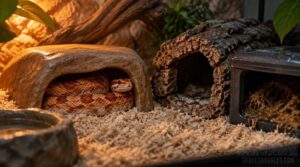
Placing hides is half the job. Now make sure each one actually works.
Choose snug opaque hides that let your corn snake touch the walls and roof while coiled. Match your hide box dimensions to your snake’s curled body, not its stretched length. Clear or tinted plastic never feels like cover, so skip it.
- Warm hide requirement: low-profile resin or java wood that holds heat without overheating.
- Cool hide requirement: cork bark or a smooth plastic tub, easy to clean.
- Humid hide: opaque too, so moisture never costs your snake its security.
- Stability: nothing tips, shifts, or collapses.
Keep entrances small. A tight opening keeps the interior dark and secure. Upsize as your snake grows. Check fit every few months.
If you’re unsure why snug spaces matter so much, this guide on whether snakes prefer tight-fitting hides explains how a close fit helps them feel safe.
Position a Humid Hide for Shedding Support
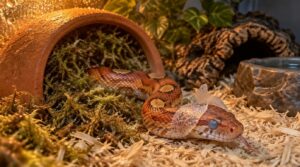
Your humid hide earns its spot during shedding, so give it the warm side. Heat speeds evaporation from the moss, and that keeps humidity high right where your snake needs it. Corn snakes only need this hide during shedding, so placement stays flexible. Just don’t crowd your other hides or break up the temperature gradient.
Pack it with lightly dampened sphagnum moss. Moist, not dripping, or mold takes over. Swap the moss every four to six weeks, or sooner if it’s soiled.
Keep ambient humidity near 70% while your snake sheds, then drop back to 40-60%. Never set the hide on a heat rock. It burns your snake and dries the moss unevenly.
Once the shed finishes, pull the hide if humidity holds.
Use Enclosure Decor to Keep Hide Entrances Sheltered
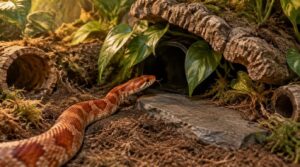
A well-placed humid hide still needs cover. Your corn snake judges safety by what it can’t see, so visual coverage matters as much as the hide itself. Shelter every entrance, and you’ll turn a plain box into one of the most secure hiding spots in the tank.
Once the hide feels secure, pair it with consistent husbandry habits, since how to help your corn snake live longer depends on getting temperature, humidity, and shelter right together.
- Lean cork bark against the wall to form an overhang.
- Drape a reptile-safe trailing plant across the opening.
- Set a flat rock or half-log in front as a baffle.
- Add a horizontal cork tube as a tunnel approach.
- Anchor everything so nothing shifts or collapses.
Leave multiple entry points so your snake never feels trapped. Good decor doubles as habitat enrichment. Behavioral observation cues, like calm, quick entries, tell you the cover works.
Check Hide Conditions and Correct Placement Mistakes
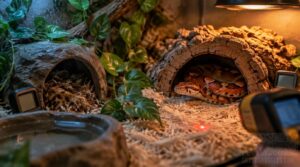
A hide only works if it’s doing its job, and you can’t tell that by glancing at it. Run through these four checks to catch hide placement mistakes before they turn into stress, bad sheds, or a snake that won’t eat. Each one is quick, and each one gives you more control over your corn snake’s setup.
Monitor Temperatures and Humidity Inside Hides
Your snake doesn’t live in the enclosure’s average temperature. It lives inside the hide.
Your corn snake doesn’t live in the enclosure’s average temperature; it lives inside the hide, so that’s where you should measure
Place digital probes inside each hide, secured with zip ties so they can’t shift.
Check temperature zones daily: warm hide near 90°F, cool side 75-82°F.
Track humidity levels in the humid hide, aiming for 65-75%.
This microclimate monitoring confirms your thermal gradient actually works as intended.
Troubleshoot Hide Avoidance and Overcrowding
You’ll know a hide isn’t working when your corn snake sits out in the open or crams into one spot. Start with insufficient hides: add a second one so your snake can choose.
Then check hide placement against your temperature gradient. If overcrowding persists, upsize the hide. Make sure each one is dark, snug, and matches your snake’s microclimate needs.
Keep Hides Accessible for Cleaning
A hide you can’t reach is a problem waiting to fester. Keep Hides Accessible for Cleaning by placing them near the front, with two inches of clearance.
Stick to weekly cleaning schedules and strict sanitation protocols. Run disinfectant compatibility testing on a small area first. Rinse well, and let everything be fully dry before replacing it. Your snake stays healthy.
Replace Damaged or Outgrown Hides
Picture a juvenile corn snake that tips its hide sideways every time it crawls in. That’s your cue. It’s outgrown the space, and growth stage upgrades can’t wait.
Cracks, sharp edges, or odors that won’t wash out mean you should replace damaged hides quickly. Choose smooth, opaque plastic or ceramic, and swap in the evening. Keep a minimum two hides, one warm, one cool, plus an optional humid hide.
Frequently Asked Questions (FAQs)
Where do corn snakes like to hide?
Corn snakes follow their natural hiding instincts, so they’ll choose snug hiding spots on both warm and cool sides. Your snake wants a secure retreat at each end, because hiding behavior shapes its privacy perception.
How to lure a corn snake out of hiding?
Picture a stubborn tenant who won’t leave a safe home. To lure a corn snake out of hiding, fix your hide placement first, then use thermal gradient management and behavioral enrichment around secure hiding spots.
What are the best hides for corn snakes?
Your warm side should hit 83-88°F, so hide material matters. Resin hides and natural woods both work if they’re snug and opaque. Buy one for each side, plus a humid hide on the cool side.
Is it normal for a corn snake to hide all day?
Hiding all day isn’t a warning sign, it’s normal. Corn snakes are nocturnal, so these natural behaviors need secure hiding spots for stress reduction.
Worry only if feeding refusal, weight loss, or nighttime lethargy appears.
How often should I replace corn snake hides?
Is hide replacement overkill? No. During enclosure cleaning, disinfect plastic weekly and replace it every three to six months; swap wood every two to three. Watch humidity levels, pick snug but not cramped hide design.
Can corn snakes share hides with other snakes?
A hide is a snake’s private doorway. Don’t share it.
Even breeding pairs need separate individual hides, since overcrowding fuels stress and feeding fights. Give each snake its own for stress reduction and behavioral enrichment.
Whats the best hide arrangement for breeding pairs?
Four hides is your minimum for breeding pairs. Give each snake one on the warm side (80-85°F) and one on the cool side (70-75°F). Don’t skip a humid hide. Good hide placement cuts competition fast.
Should hatchlings have different hide materials than adults?
Picture hatchlings tucked into a cardboard hide box, snug as pebbles in a pocket.
Replace it when soiled. Adults need durable plastic or ceramic instead. Skip cedar. Both need a humid hide and substrate burrowing.
Should corn snake hides be elevated or on the substrate?
Think elevated hides make corn snakes feel safer? That theory doesn’t hold up. Keep every hide on the substrate.
Hide placement shapes the thermal gradient: one on the warm side, one on the cool side.
What hide setup works best for quarantine enclosures?
Does a bare quarantine enclosure work better? No. Hide-free setups stress your snake.
Use accessible hide design: two plastic hides, one warm, one cool, with smooth interior surfaces, nontoxic materials, and easy-to-clean surfaces. Skip cork.
Conclusion
Picture your corn snake at dusk, sliding from a cool, dark hide into the glow of the warm side, then back again. That quiet shuttle is thermoregulation, and you control it.
Use these corn snake hide placement tips to build the route: one snug hide on each end, a humid hide for shedding, and clutter guarding every entrance. Then check temperatures weekly and swap out cracked hides.
Get hide placement right, and thriving replaces surviving.