This site is supported by our readers. We may earn a commission, at no cost to you, if you purchase through links.
Most snakes bite defensively and deliver little or nothing. The cottonmouth doesn’t work that way.
Cottonmouth water moccasin toxicity is hemotoxic and cytotoxic at the same time — a biochemical two-front assault that destroys tissue while simultaneously dismantling your blood’s ability to clot. A single bite can deliver up to 300 mg of venom, enough to trigger cascading organ-level damage within hours.
What makes this snake genuinely dangerous isn’t just the venom itself. It’s the speed at which that venom spreads, the enzymes that carry it deeper into tissue, and how quickly a "minor" bite can turn into a surgical emergency. Knowing exactly what’s happening inside your body — and why every minute matters — changes how you respond.
Table Of Contents
- Key Takeaways
- Cottonmouth Water Moccasin Toxicity Explained
- How Cottonmouth Venom Affects The Body
- Cottonmouth Bite Symptoms and Complications
- Cottonmouth Envenomation Treatment and Antivenom
- Identifying and Avoiding Cottonmouth Bites
- Frequently Asked Questions (FAQs)
- What is the antidote for cottonmouth snakes?
- Which is more venomous, a water moccasin or a cottonmouth?
- Is cottonmouth lethal?
- Can you survive getting bit by a cottonmouth?
- Are water moccasins in Canada?
- Are Cottonmouths venomous?
- Are water moccasins poisonous?
- Are water moccasins Cottonmouths?
- Was a cottonmouth a venomous water moccasin?
- How poisonous is a cottonmouth water moccasin?
- Conclusion
Key Takeaways
- Cottonmouth venom delivers a simultaneous two-front attack — destroying tissue through cellular rupture while dismantling your blood’s ability to clot, with a single bite potentially delivering a lethal 300 mg dose.
- Enzymes like hyaluronidase act as pathfinders, breaking down tissue barriers so metalloproteinases and serine proteases can spread deeper and faster than your body can counter.
- Severity isn’t predictable from pain alone — dry bites cause minimal damage, but deep muscle strikes or victims on blood thinners can tip quickly into life-threatening coagulopathy.
- Your only real treatment is CroFab or Anavip antivenom administered in an ER; every field remedy — suction, ice, tourniquets — wastes the minutes that determine whether you recover fully or don’t.
Cottonmouth Water Moccasin Toxicity Explained

Cottonmouth venom isn’t something your body can just shake off — it’s a complex chemical arsenal designed to break down tissue, disrupt blood clotting, and spread fast. Understanding exactly how potent it is helps you take the right steps if you’re ever near one. Here’s what you need to know about its toxicity.
Knowing how to identify water snakes in Texas can be life-saving, since mistaking a harmless species for a cottonmouth — or vice versa — affects how quickly you seek treatment.
Venom Potency
Cottonmouth venom isn’t uniformly deadly — its hemotoxic potency shifts based on toxin ratios, delivery mechanics, and even seasonal temperature. A single bite can meter anywhere from a dry nip to a full envenomation load of 300 mg.
That variability, driven partly by Phospholipase A2 and Metalloproteinases, means you can’t gauge severity by pain alone. This ability is facilitated by mechanisms of venom metering that allow for precise control.
Cytotoxic Effects
Venom potency only tells part of the story. What it does to your cells is where things get serious.
Cottonmouth hemotoxic venom triggers cellular membrane destruction, causing cells to rupture — spilling intracellular enzymes into surrounding tissue. That’s necrosis, not the controlled shutdown of apoptosis. Muscle fibers near the bite undergo myocyte necrosis, weakening tissue fast. Hyaluronidase then increases permeability, letting toxins spread deeper, accelerating local tissue damage rapidly.
Blood Clotting Disruption
Tissue destruction doesn’t stop there. Cottonmouth hemotoxins also hijack your clotting system — and that’s a different kind of danger entirely.
Disseminated microclotting can sweep through your circulation, consuming clotting factors and platelets faster than your body replaces them. The result? Coagulopathy — your blood loses the ability to clot reliably. Fibrin networks collapse. Platelets malfunction. You’re now bleeding from the inside while swelling externally.
Venom Yield
So how much venom are we actually talking about?
A single cottonmouth can deliver 80 to 300 mg of dried venom per extraction — and the human lethal dose sits between 100 and 150 mg. That overlap isn’t comfortable. Yield varies by size, age, and last feeding. Larger snakes produce more. Even a "small" bite can cross that threshold.
A cottonmouth can deliver enough venom to kill a human in a single bite — even a small one
Bite Severity Factors
Not every bite hits the same. Severity depends on venom injection volume — dry bites cause minimal damage, while deep muscle penetration delivers far more toxin.
Children and older adults face worse outcomes. Preexisting clotting disorders or blood thinners increase bleeding risk dramatically. Delay antivenom, and local tissue damage accelerates into systemic complications. Every hour genuinely counts.
How Cottonmouth Venom Affects The Body
Cottonmouth venom doesn’t just hurt — it works through a precise chain of chemical attacks that your body struggles to fight on its own. Each component has a specific job, and together they create a cascade of damage that can escalate fast. Here’s how the key players break down.
PLA2 Enzymes

PLA2 enzymes go to work on your cell membranes almost instantly.
- They cleave the sn-2 ester bond inside phospholipids
- Calcium ions activate the reaction within tissue
- Free fatty acids flood surrounding cells
- Lysophospholipids warp and distort membrane structure
- Lipid mediators rapidly accelerate local inflammation
This phospholipid hydrolysis dismantles cellular integrity fast, triggering a destructive cascade your body can’t easily stop.
The venom’s enzymatic destruction of cell membranes sets off a chain reaction that explains why Gaboon viper bites cause such rapid, life-threatening tissue damage.
Metalloproteinases
While PLA2 enzymes tear into cell membranes, metalloproteinases attack the structural scaffolding holding your tissue together. These zinc-dependent enzymes use a catalytic zinc ion to cleave collagen, laminin, and other matrix proteins — dismantling the architecture beneath your skin.
That destruction isn’t contained. Matrix degradation spreads outward, destabilizing blood vessel walls and accelerating local necrosis far beyond the bite site.
Serine Proteases

Cottonmouth venom contains serine proteases that hijack your clotting system at the molecular level. Each enzyme carries a catalytic triad — serine, histidine, and aspartate — that slices peptide bonds with surgical precision, fragmenting clotting factors before they can do their job.
They’re stored as inactive zymogens, then activated on contact with tissue. The result is rapid, compounding coagulopathy — your blood loses its ability to clot.
Hyaluronidase Spread

Think of hyaluronidase as the venom’s pathfinder. It degrades hyaluronic acid in the extracellular matrix, collapsing the tissue barrier that normally slows toxin movement.
- Breaks down the ECM’s structural gel
- Lowers interstitial resistance rapidly
- Opens diffusion pathways within minutes
- Allows metalloproteinases and serine proteases to spread further
- Amplifies local edema through wider toxin dispersion
That’s how envenomation escalates so fast.
Platelet Inhibition
When cottonmouth venom first enters your blood, blood clotting disruption begins immediately. ADP signaling disruption halts platelet activation. Thromboxane pathway interference slows clot recruitment. IIb/IIIa impairment blocks fibrinogen bridging — no stable clot forms.
| Mechanism | What It Blocks | Effect on Clotting |
|---|---|---|
| ADP signaling disruption | Platelet activation | Reduced plug formation |
| Thromboxane pathway interference | Clot recruitment signals | Weakened aggregation |
| IIb/IIIa impairment | Fibrinogen bridging | Unstable thrombus |
Cyclic nucleotide signaling shifts toward inhibition, collapsing thrombus formation stability. Abnormal blood clotting and blood clotting problems can escalate into full coagulopathy — or worse, disseminated intravascular coagulopathy.
Cottonmouth Bite Symptoms and Complications
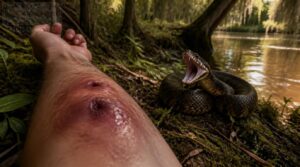
A cottonmouth bite doesn’t leave you guessing — the symptoms come fast and they’re hard to miss. Knowing what to expect helps you act quickly, and in a situation like this, speed genuinely matters. Here’s what a bite usually looks like, from the first sign at the wound site to the complications that can follow.
Fang Marks
Two small holes — that’s what a cottonmouth bite usually leaves behind. Each fang puncture sits roughly 1 to 3 centimeters apart, often with a faint crescent of bruising forming within an hour or two.
The marks themselves are small, but they’re your first confirmation that venom may already be moving beneath the skin.
Burning Pain
Those fang marks signal more than skin-deep damage. Almost immediately, burning pain ignites at the bite site — not a dull ache, but a searing sensation driven by venom irritating sensory nerve endings directly.
Key pain drivers include:
- Inflammatory mediators amplifying local pain receptor sensitivity
- Tissue barrier disruption exposing raw nerve endings
- Sensory pathways remaining sensitized as venom spreads
That burn usually intensifies over hours, not minutes.
Swelling and Redness
That burning pain rarely travels alone. Right behind it comes rapid swelling and redness — erythema driven by dilated blood vessels flooding the area with blood, while increased vascular permeability lets fluid leak into surrounding tissue.
| Stage | Sign | Cause |
|---|---|---|
| Early | Redness | Vascular dilation |
| Mid | Swelling | Fluid accumulation |
| Late | Expanding edema | Venom tissue spread |
Swelling can grow well beyond the fang marks.
Nausea and Dizziness
Swelling stays local, but nausea and dizziness spread system-wide. Venom activates brainstem reflex pathways, triggering your body’s vomiting response and disrupting the vestibular signals that keep you balanced — so the room can feel like it’s tilting.
Vomiting then pulls fluid and electrolytes out fast. That dehydration compounds dizziness, strains circulation, and makes standing dangerous. Worsening unsteadiness signals progressing toxicity — seek immediate care.
Tissue Necrosis
Dead tissue doesn’t come back. When cottonmouth venom breaks down cellular membranes, cells spill their contents into surrounding tissue, triggering intense inflammation and local tissue damage.
That cascade can progress into gangrenous necrosis — dry if blood flow is simply cut off, wet if bacterial infection joins in. Secondary infections thrive in dead tissue, turning a bite site into a rapidly worsening emergency.
Cottonmouth Envenomation Treatment and Antivenom

Getting the right treatment fast can mean the difference between a full recovery and lasting damage.
Cottonmouth envenomation follows a predictable course, which means doctors have a clear, structured playbook to work through. Here’s what that treatment process actually looks like, from the moment you arrive at the ER to managing the most serious complications.
Emergency Medical Care
Every second counts after a cottonmouth bite. Scene safety comes first — responders must confirm the snake is gone before approaching.
From there, EMS assesses your airway, breathing, and circulation immediately. If swelling threatens your throat, airway management becomes critical. Health indicators are monitored continuously during transport.
Getting you to a hospital fast isn’t optional — it’s the whole strategy.
CroFab Antivenom
CroFab is North America’s front-line antivenom for cottonmouth bites, built from small, targeted Fab fragments that bind and neutralize venom toxins directly.
- Papain digestion cleaves ovine IgG antibodies into active Fab fragments
- Four monospecific antivenoms are combined into one standardized product
- Fc fragment removal lowers your allergic reaction risk a lot
- Affinity purification isolates only venom-specific antibodies
- Viral clearance protocols safeguard each individual component
Doctors start with 4–6 vials intravenously.
Anavip Antivenom
Anavip uses equine-derived F(ab’)2 fragments — a longer-lasting alternative to CroFab’s Fab design. Each vial caps protein at 120 mg, standardized against seven venom immunogens.
| Venom | Minimum Neutralization |
|---|---|
| Bothrops asper | ≥780× mouse LD50 |
| Crotalus durissus | ≥790× mouse LD50 |
| Protein limit | ≤120 mg per vial |
These fragments bind venom toxins, helping your body clear them faster. Potency is tested batch by batch.
Coagulation Monitoring
Cottonmouth venom throws your clotting system into chaos fast. Doctors track this using baseline lab metrics — prothrombin time, fibrinogen levels, and platelet counts — to pinpoint whether you’re losing clotting factors, platelets, or both.
Bedside coagulation assays like thrombelastography give real-time clot strength data without waiting on lab results. Platelet function analysis catches dysfunction that standard tests miss, guiding every antivenom and transfusion decision made for you.
Compartment Syndrome
When swelling has nowhere to go, pressure builds until blood can’t get through. This is compartment syndrome — a surgical emergency.
Watch for the Five P’s: pain, paresthesia, paralysis, pallor, and pulselessness. Pain worsening with passive stretch is an early warning. Pressure exceeding 30 mmHg confirms it.
Fasciotomy — cutting the compartment open — is the only fix.
Identifying and Avoiding Cottonmouth Bites

Knowing how to spot a cottonmouth before it feels threatened is your best defense in the field. A few key physical traits and behavioral cues set this snake apart from harmless look-alikes. Here’s what to watch for — and what to do if things go wrong.
Triangular Head Shape
The cottonmouth’s triangular head shape is your clearest visual warning. The jawline — the mandible’s broad, angular base — is noticeably wider than the neck, creating a bottom-heavy facial silhouette.
That distinctive skull anatomy sets it apart from harmless water snakes at a glance. If the head looks like a blunt arrowhead, treat it as a threat.
Vertical Pupils
Beyond the head shape, the eyes tell you just as much. A cottonmouth’s vertical, cat-like pupils — elliptical slits rather than round circles — reflect its identity as an ambush predator built for low-light strikes.
That slit pupil design regulates light intake at dawn and dusk, sharpening depth perception at ground level. Harmless water snakes have round pupils. That difference alone can save you.
White Mouth Display
That iconic gaping posture is your clearest warning. When a cottonmouth snakes open its jaws wide, the pale mucous membrane inside creates a stark white mouth display — a sharp contrast against dark scales designed to stop you cold.
Don’t wait for escalation. That oral tissue contrast signals the snake has shifted from tolerating you to preparing to strike.
Wetland Habitats
Knowing the warning signs is step one. Step two is knowing where these snakes actually live.
Semiaquatic ecosystems across the southeastern U.S. — Virginia to eastern Texas — are prime cottonmouth territory. They thrive in:
- Slow-moving rivers and streams
- Swamps and marshland edges
- Flooded fields after heavy rain
- Muddy pond and lake banks
- Dense cattail stands
Stay alert near any standing water.
Snakebite First Aid
If a cottonmouth bites you, call emergency services immediately — first aid buys time, nothing more. Watch for nausea or breathing changes — those signal serious envenomation.
Keep still, remove jewelry before swelling locks it in place, and loosely bandage the wound. A pressure immobilization bandage limits venom spread without cutting circulation. Never use suction, cut the wound, or apply a tourniquet.
Frequently Asked Questions (FAQs)
What is the antidote for cottonmouth snakes?
Fewer than 1 in 600 snakebite victims die annually in the U.S. — largely because antivenom treatment exists. The antidote for cottonmouth envenomation is CroFab or Anavip, both administered intravenously by a qualified healthcare provider in a medical emergency setting only.
Which is more venomous, a water moccasin or a cottonmouth?
They’re the same snake. Water moccasin and cottonmouth are two names for Agkistrodon piscivorus — one species, one venom, zero difference in toxicity. You’re not comparing two snakes; you’re comparing two nicknames.
Is cottonmouth lethal?
Deaths from cottonmouth bites are extremely rare in healthy adults — less than 1% of treated cases prove fatal. That said, venom destroys tissue and disrupts clotting fast. Immediate medical care isn’t optional.
Can you survive getting bit by a cottonmouth?
Yes, you can survive a cottonmouth bite — most victims recover fully with prompt medical care. Deaths are rare. The key is getting to an emergency room immediately, where antivenom neutralizes the venom before serious damage sets in.
Are water moccasins in Canada?
No, water moccasins aren’t found in Canada. Their range stays firmly within the southeastern United States — Virginia down to Florida, across to eastern Texas. Canada’s colder climate simply doesn’t suit these heat-dependent pit vipers.
Are Cottonmouths venomous?
Cottonmouths are highly venomous pit vipers in the Agkistrodon genus, part of the Crotalinae family. Their hemotoxic venom destroys blood vessels and disrupts clotting — rarely fatal, but every bite is a medical emergency.
Are water moccasins poisonous?
Technically, they’re venomous, not poisonous. Poison causes harm through ingestion or skin contact — venom gets injected. Water moccasins deliver hemotoxic venom through their fangs, attacking your blood, tissue, and cells with immediate, damaging force.
Because that damage can escalate so quickly, knowing how dangerous a water moccasin bite can become helps you recognize when it’s time to seek emergency care.
Are water moccasins Cottonmouths?
They’re the same snake. Water moccasin and cottonmouth are interchangeable names for Agkistrodon piscivorus — a venomous, semiaquatic pit viper native to the southeastern United States. Same species, two names.
Was a cottonmouth a venomous water moccasin?
Yes — same snake, different nickname. The cottonmouth (Agkistrodon piscivorus) is a venomous pit viper, and "water moccasin" is just its regional alias. One species, one very serious bite.
If you want a deeper dive into their defensive threat display and hunting habits, this guide on cottonmouth snake facts and bite information covers what makes them so distinctive.
How poisonous is a cottonmouth water moccasin?
Highly dangerous but rarely fatal with treatment. The venom is hemotoxic — it breaks down your tissue and disrupts blood clotting fast. You’ll feel intense pain within minutes, and serious complications can develop without immediate care.
Knowing how to distinguish the culprit species — using the venomous snake breed identification guide — can help medical teams choose the right antivenom faster.
Since these rear-fanged bites can escalate quickly, it’s worth reading up on venomous snake identification and bite response tips before you ever encounter one in the wild.
Conclusion
Funny how the same weekend you spot a cottonmouth sunning near a dock, a friend calls asking what to do after a close encounter. Cottonmouth water moccasin toxicity doesn’t announce itself politely — it moves fast, dismantles clotting, and destroys tissue before doubt finishes crossing your mind.
Call 911 immediately. Stay still. Don’t cut, suck, or apply ice. The antivenom works, but only if you get there. Every minute you spend deciding is a minute the venom isn’t.