This site is supported by our readers. We may earn a commission, at no cost to you, if you purchase through links.

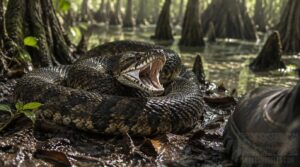
The cottonmouth holds its ground when threatened, opening its mouth wide to flash the white lining that gave it its name. Most snakes flee at the first sign of a human, but cottonmouth snakes don’t always bother. That combination of venom, attitude, and a range stretching from Virginia to Texas puts them in regular contact with hikers, anglers, and swimmers throughout the southeastern United States.
A bite from this species isn’t just painful. Its venom attacks tissue directly, causing damage that can require surgery within hours if left untreated.
Knowing what you’re dealing with keeps that encounter from becoming an emergency.
Table Of Contents
- Key Takeaways
- Cottonmouth Identification and Physical Traits
- Cottonmouth Habitat, Range, and Swimming Habits
- Fascinating Cottonmouth Behavior and Life Cycle
- Cottonmouth Venom and Bite Severity
- Cottonmouth Bite Prevention and First Aid
- Frequently Asked Questions (FAQs)
- What are some interesting facts about cottonmouth snakes?
- Can a human survive a cottonmouth bite?
- What kills cottonmouth snakes?
- What bite is worse, copperhead or cottonmouth?
- How bad is a cottonmouth bite?
- Is cottonmouth lethal?
- What are some interesting facts about cottonmouths?
- How serious is a cottonmouth bite?
- Can you survive a cottonmouth bite without treatment?
- What are the odds of surviving a cottonmouth bite?
- Conclusion
Key Takeaways
- Cottonmouths are the only semiaquatic pit viper in North America, and their willingness to hold their ground rather than flee makes encounters in southeastern wetlands far riskier than with most snake species.
- Their venom destroys tissue directly at the cellular level, meaning an untreated bite can escalate to surgery within hours—making speed of treatment the single most important factor in your outcome.
- Not every strike injects venom, but you should treat every bite as a medical emergency, since you can’t tell a dry bite from envenomation without clinical evaluation.
- If bitten, keep the victim still, don’t cut, tourniquet, or attempt suction, and call emergency services immediately—correct first aid is about stabilizing, not intervening.
Cottonmouth Identification and Physical Traits
Although many water snakes look similar, the Cottonmouth Snake has physical traits that make venomous snake identification straightforward once you know what to look for. Its broad, triangular head is noticeably wider than the neck, a reliable feature shared across all pit viper species. You’ll also notice keeled scales that give the body a rough, matte texture rather than a smooth, glossy appearance. A venomous snake field guide can help you memorize these distinguishing features before you ever set foot near the water’s edge.
Knowing these features becomes especially useful in the field when you’re navigating areas like the Louisiana bayous, where venomous and non-venomous water snakes share the same habitat.
Adults are usually olive to dark brown, sometimes appearing nearly uniform in color. Juveniles show bolder crossbands and lighter tones that fade as they age, though a pale line behind the eye often persists. In dim light, the pupils appear vertical and elliptical. Between the nostril and eye, a heat-sensing pit further separates it from non-venomous lookalikes.
Cottonmouth Habitat, Range, and Swimming Habits

Knowing what a Cottonmouth Snake looks like helps, but knowing where it lives is just as important for avoiding one. This semiaquatic species favors freshwater wetlands across the southeastern United States, from southern Virginia down through Florida and west into Texas and parts of Mexico. You’ll find it in swamps, marshes, and slow-moving streams, particularly where muddy banks and overhanging vegetation provide cover.
It’s a strong swimmer, using sinusoidal body motion to move efficiently through calm water, and it’ll pursue fish and amphibians below the surface. Species distribution follows water closely, so during drought, snakes concentrate around whatever habitat remains, which raises your encounter risk. Activity peaks in spring and fall, though summer heat drives them toward water more regularly.
Fascinating Cottonmouth Behavior and Life Cycle

The cottonmouth’s behavior is as distinctive as its appearance. Understanding how it hunts, reproduces, defends itself, and fits into the broader environment gives you a clearer picture of what you’re actually dealing with in the field. Here’s what you need to know about its life cycle and key behaviors.
Threat Displays and Warning Signals
Picture a wide-open white mouth, body flat, fangs visible. That’s a cottonmouth’s threat display in action, part of its snake behavior.
Watch for these signals:
- Tail vibrating rapidly
- Mouth gaping, fangs exposed
- Body darkening and flattening
- Hissing with sharp tongue flicks
Defensive mechanisms in reptiles like the Cottonmouth Snake escalate when escape routes close. Back away slowly; it’s a warning. A snake hook for safe handling lets you guide a defensive cottonmouth to safety without closing its escape route further.
Recognizing early warning signs—like a raspy hiss, tight coiling, or fast tongue flicks—can prevent escalation, and understanding safe snake handling distances and timing helps you respond calmly before defensive behavior peaks.
Hunting and Diet Differences
Once it’s done displaying, the cottonmouth shifts into hunting mode. Ambush predator behavior drives it to lie submerged near cover in swamps and slow streams, waiting for prey to pass close.
| Life Stage | Primary Prey | Typical Habitat |
|---|---|---|
| Juvenile | Frogs, invertebrates | Shorelines, shallow water |
| Adult | Fish, small mammals | Swamps, slow-moving streams |
| Low prey season | Crayfish, amphibians | Benthic zones, wetlands |
Snake predation here is highly flexible. Juveniles favor frogs and invertebrates, while adults target larger fish and occasionally small mammals. Its carnivorous diet adjusts with season and prey availability.
This adaptability makes sense given how widespread frog-eating is among snakes, as do snakes eat frogs explains.
Mating and Male Combat
When late spring arrives, male cottonmouths intensify their mating dance, using pheromonal cues to locate gravid females. If you spot two males grappling body-to-body near wetlands, that’s active combat, with bouts lasting up to 15 minutes. Body mass decides who wins.
These battles also drive natural selection for potency, since the victors sire offspring with the most robust venom systems—explore how timber rattlesnake venom varies by region and season to see how reproduction and toxicity intertwine.
Because cottonmouths are ovoviviparous, these reptile mating rituals determine which males gain access to reproduction and sire live young.
Live Birth and Lifespan
Cottonmouths are ovoviviparous, meaning they deliver live young rather than eggs. A single litter usually contains 6-12 neonates, and juveniles are independent from birth.
Key facts about cottonmouth reproduction:
- Gestation lasts 3-4 months after spring mating
- Lifespan in the wild averages 6-9 years
- Captive individuals often reach 15-20 years
Their reproductive biology shapes local population trends across diverse wetland habitats.
Predators and Ecological Role
Like a keystone in an arch, cottonmouths help hold wetland food webs in balance, though you’d rarely see it at first glance.
Raptors, wading birds, otters, and foxes all prey on them, with juveniles facing the highest predation risk in their first year. Their ecological role extends beyond being prey: their venom filters out weakened animals, supporting healthy predator-prey relationships.
Cottonmouth Venom and Bite Severity

Cottonmouth venom is genuinely dangerous, but the outcome of a bite depends on several factors you should understand clearly. Not every bite delivers venom, and severity varies based on the type of strike, the amount injected, and how quickly you get treatment.
Here’s what you need to know about how cottonmouth venom works, what symptoms to expect, and how survivable these bites actually are.
Dry Bites and Venom Function
Not every strike from a venomous pit viper releases toxin. A cottonmouth snake can deliver a dry bite, where venom function is defensive and little enters the wound.
- Snakes bite to warn, not always to kill
- Venom’s costly to produce, so snakes conserve it
- Cold temperatures reduce flow, increasing dry bite likelihood
You still need medical evaluation after any bite.
Bite Symptoms and Tissue Damage
If you’re bitten by a cottonmouth snake, rapid pain and swelling spread 5–10 cm from the wound within a few hours.
Venom components drive vascular damage at the cellular level, causing bruising and discoloration as blood leaks into the surrounding tissue. In serious envenomations, tissue necrosis sets in, and the resulting dead flesh often requires surgical debridement to prevent infection.
Survival and Fatality Risk
Human deaths are rare, but that doesn’t mean the risk is trivial. Venom toxicity sets in fast, and serious coagulopathy can develop within just 4 to 8 hours in untreated adults.
In rural areas, delayed antivenom administration is what turns a survivable bite into something much worse. Getting immediate medical attention and the right snakebite treatment are what matter most.
In snakebite survival, delayed antivenom doesn’t just slow recovery—it turns the survivable into the fatal
Cottonmouth Versus Copperhead Bites
Knowing which species you’re dealing with affects how doctors approach treatment. A cottonmouth snake bite causes faster, more aggressive tissue damage than a copperhead’s venomous bite, while copperhead bites progress more slowly with pronounced blistering and swelling.
Both need snakebite treatment, but cottonmouth envenomation more often demands antivenom. Venomous snake identification directly shapes your doctor’s first clinical decisions.
Cottonmouth Bite Prevention and First Aid
Since severity depends on how fast you respond, the first few minutes after a cottonmouth snake bite matter a great deal. Call emergency services immediately and keep the victim as still as possible. Don’t cut the wound, apply a tourniquet, or try to suck out venom; these methods cause harm, not help. In remote areas where cellular service is unreliable, carrying a personal emergency GPS beacon ensures rescuers can reach you even when you can’t make a call.
Remove rings and tight clothing before swelling progresses. Keep the bitten limb near heart level, stay calm, and monitor breathing and alertness while you wait for help. Snake bite first aid is about stabilizing the victim, not intervening.
For venomous snake safety in high-risk areas, avoid murky shorelines and dense vegetation, and always wear closed shoes near water. Immediate medical attention is the only reliable path to recovery.
Frequently Asked Questions (FAQs)
What are some interesting facts about cottonmouth snakes?
The cottonmouth snake, or Agkistrodon piscivorus, is North America’s only semi-aquatic pit viper. It’s a strong swimmer, uses ambush hunting near water, delivers cytotoxic venom, and gives birth to live young rather than laying eggs.
Can a human survive a cottonmouth bite?
Your arm swells within minutes, but you can definitely survive a cottonmouth snake bite. It’s critical to get immediate medical attention. Antivenom efficacy against this venomous pit viper is strong, making survival the likely outcome.
What kills cottonmouth snakes?
You’d be surprised how many predators regularly hunt the cottonmouth snake despite its venom: kingsnakes, great blue herons, alligators, and raptors all do. Habitat destruction and road mortality from humans remain their most significant threats.
What bite is worse, copperhead or cottonmouth?
Picture two punches landing on the same spot. One bruises badly, but the other does far worse. A Cottonmouth snake bite delivers more potent venom, producing faster and deeper tissue damage than a Copperhead bite.
How bad is a cottonmouth bite?
One cottonmouth snake bite can make it feel like your entire hand is on fire. Severe pain and swelling set in almost immediately, the venom destroys tissue, and you’re looking at a real medical emergency.
Is cottonmouth lethal?
Cottonmouth Snake venom is potent, but it’s rarely lethal when you seek prompt medical care. The hemotoxins cause severe tissue damage and serious systemic effects, so treat every Cottonmouth snake bite as a medical emergency.
What are some interesting facts about cottonmouths?
Almost every snake retreats when threatened, but not this one. The Cottonmouth Snake, Agkistrodon piscivorus, stands its ground, and it’s North America’s only semiaquatic viper, capable of hunting fish underwater and pursuing prey on land.
How serious is a cottonmouth bite?
A cottonmouth snake bite is a genuine medical emergency. Snake venom toxicity destroys tissue fast, so you’ll need hospitalization right away. Without prompt treatment, postbite complications can include permanent tissue loss, infection, and even amputation.
Can you survive a cottonmouth bite without treatment?
Some people survive a cottonmouth snake bite without treatment, often because it was a dry bite. But a venomous pit viper delivers unpredictable venom amounts, and seeking emergency medical response is always the safer call.
What are the odds of surviving a cottonmouth bite?
Think of it as a coin flip weighted heavily in your favor. A cottonmouth snake bite is rarely fatal today. Antivenom efficacy is high, and prompt hospitalization with venom neutralization makes survival the expected outcome.
Conclusion
That white-lined mouth gaping open isn’t aggression for its own sake. It’s a warning, and one worth heeding. The cottonmouth snakes interesting facts and bite information covered here share a common thread: respect built on knowledge keeps you out of trouble.
Stay on trails, watch where you step near water, and give any stocky, dark snake room to retreat. Identify correctly, react calmly, and get to an emergency room fast if fangs make contact. That’s all it takes.