This site is supported by our readers. We may earn a commission, at no cost to you, if you purchase through links.

That hatchling coiled in your palm weighs less than a bag of coffee beans. Give it five years and it could stretch past 16 feet, with a female topping 90 kg.
Most new keepers fall for the pattern and the glossy sheen, then discover the real challenge is geometry and logistics: an 8×4 foot enclosure, a latch system that survives a determined shove, and two handlers for any snake over six feet. Reticulated python size and care demand planning long before the purchase, not after.
You’ll learn how big your snake will grow, what it needs to thrive, and how to keep everyone safe, starting with the numbers.
Table Of Contents
- Key Takeaways
- Reticulated Python Size, Growth, and Lifespan
- Choosing a Reticulated Python: Temperament, Safety, and Long-Term Commitment
- Reticulated Python Enclosure Size and Setup Requirements
- Feeding Your Reticulated Python: Prey Size, Frequency, and Healthy Weight
- Reticulated Python Handling and Health Care: Safe Routines, Cleaning, and Veterinary Support
- Frequently Asked Questions (FAQs)
- Is a reticulated python a good pet?
- How big is a 4 year old reticulated python?
- What states ban reticulated pythons?
- Do pythons like to be petted?
- How often do reticulated pythons shed their skin?
- What permits or licenses are required for ownership?
- Can reticulated pythons be trained or conditioned?
- How much do reticulated pythons typically cost?
- What signs indicate a reticulated python is stressed?
- Can reticulated pythons live with other snakes?
- Conclusion
Key Takeaways
- Plan for the adult snake, not the hatchling: females often pass 16 feet and 90 kg, males run smaller, and growth never fully stops, so size depends on locality and sex.
- You’ll need an escape-proof 8×4 foot enclosure with multilatch security, a heat gradient (88-92°F basking, 76-80°F cool side) run through a thermostat, and 65-90% humidity.
- Handling is a team job: bring a second person for any snake over six feet, tap with a hook before opening the enclosure, and never handle at feeding time.
- Buy a captive-bred snake from a documented breeder, check your local laws and permits first, and feed frozen-thawed prey sized to the snake’s girth, because rehoming a giant later is rarely an option.
Reticulated Python Size, Growth, and Lifespan

Before you bring home a reticulated python, you need to know how big it will actually get. Below, you’ll find the three things that shape your size expectations: the standard, dwarf, and super dwarf forms, how males and females differ, and how fast these snakes grow.
If you want exact length ranges and growth timelines for each morph, this guide to how long reticulated pythons get and how fast they grow is worth a look.
Get these right, and you’ll plan your space, budget, and handling routine with confidence instead of guesswork.
Standard, Dwarf, and Super Dwarf Sizes
The label on a retic’s tank tells you less than its locality does. Plan around these adult ranges:
- Mainland retics: 12-16 feet, often more
- Dwarf reticulated pythons: 7-13 feet
- Super dwarf reticulated pythons: 6-9 feet
- Selayer dwarfs: sometimes beyond 13 feet
Size drives your reticulated python enclosure size, feeding schedule for reticulated pythons, and safe handling techniques for large constrictors.
Male Vs. Female Size and Weight
Locality sets the range, but sex decides where you land inside it. Reticulated pythons show strong sexual dimorphism: females commonly reach 16 to 20 feet and 90 kilograms or more, while males average 10 to 14 feet and under 45 kilograms. Across all size categories, expect a female to outgrow her brother, and budget space accordingly.
Males also mature faster.
Even the largest females fall short of the record, since this species is the longest snake species on Earth, with the largest recorded individual measuring 10 meters (32.8 feet).
Growth Rates and Adult Size Expectations
Males mature faster, but neither sex stops growing on a schedule. These growth patterns are indeterminate, so the snake growth rate simply slows after year three.
Because their growth never fully stops, a snake’s size is only a rough clue to its age, so this guide to how to age a snake walks through the more reliable signs.
Plan for your snake’s adult size expectations now, across all size categories:
- The cute 24-inch hatchling becomes a 10-foot python fast.
- Your "temporary" tub won’t hold her.
- Enclosure size becomes your biggest regret, quickly.
Choosing a Reticulated Python: Temperament, Safety, and Long-Term Commitment
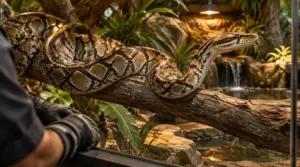
A reticulated python is a snake you’ll share your home with for decades, so it pays to choose carefully before you buy. You’ll want to weigh how it behaves, how large it will get, and whether you’re ready to handle it safely. The five points below walk you through that decision one step at a time.
Temperament And Individual Variation
Picture two retics from the same clutch. One slides calmly onto your arm at feeding time. The other, raised in a different home, strikes at the hook. That’s individual variation for you, and it’s real.
Temperament depends on locality, early handling, and enclosure conditions. Captive-bred animals tolerate people far better, but they’re still intelligent, active, messy, potentially dangerous animals to keep as a pet. Never assume safe handling is optional.
Adult Size Expectations
A reticulated python’s adult size expectations should shape your decision before you ever buy one. Females commonly pass 16 feet and 250 pounds, so plan your enclosure size around the largest animal you might get.
Growth patterns are fast, with many snakes topping 12 feet in two years.
Add handling safety and captive longevity, and you’re signing up for decades.
Captive-Bred Snake Selection
You’ll want captivebred specimens from an established breeder, full stop. They arrive with documented hatch dates, parentage, and feeding records, so you know exactly what you’re buying.
Ask about dwarf varieties and super dwarfs, since lineage records confirm adult size potential. Watch the snake feed, check for clear eyes and smooth skin, and ask for customer references.
Safe Handling Requirements
Picture a keeper alone with a nine-foot retic, the phone buzzing in the next room. He reaches in for a quick check and gets bitten, because nobody was there to steady the tail. Don’t be him.
Never handle a nine-foot retic alone, because one quick check without a helper to steady its tail can end in a bite
Safe handling techniques start with numbers: two handlers past six feet, one per eight feet beyond that. Skip handling at feeding time, and keep enclosure security tight.
Lifelong Care Commitment
Think you can rehome it when it outgrows you? Sanctuaries rarely accept surrenders. Plan for the long-term commitment instead:
- Upgrading enclosure size every year.
- Sticking to your feeding schedule, even on vacation.
- Practicing safe handling techniques with a helper.
- Managing growth rate so it stays healthy.
- Outliving your own plans, because this snake might.
That’s the deal you’re truly signing.
Reticulated Python Enclosure Size and Setup Requirements
Your retic’s enclosure is the one purchase you can’t cut corners on, because a snake that outgrows its home is a safety problem, not just a comfort issue. Below, we’ll cover the three areas that matter most: enclosure size and escape-proofing, the climate you’ll need to control, and the interior furnishings.
Get these right from the start, and you’ll spend far less time fixing mistakes later.
Enclosure Dimensions and Escape Prevention
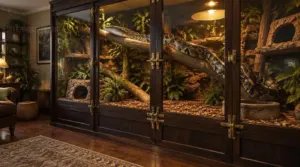
Enclosure size matters more than most beginners expect. Retics are strong, clever, and patient, so escape prevention starts on day one. Choose secure multilatch systems, check seals often, and treat enclosure security as routine.
Adults need roughly 8×4 feet, with height for climbing.
| Stage | Floor | Height |
|---|---|---|
| Juvenile | 36x18in | 18in |
| Adult | 8×4 ft | 6 ft+ |
Substrate options never excuse loose latches.
Heating, Humidity, and Water
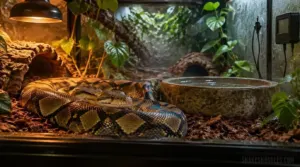
Get the heat wrong and everything else falls apart. Build a proper temperature gradient: basking temperatures of 88-92°F on one end, 76-80°F on the cool side, and 74-78°F at night using a ceramic emitter. Run every heater through a thermostat.
Keep humidity levels at 65-90%. Pick a water dish that fits your enclosure size and your whole snake. Change daily.
Lighting, Substrate, Hides, and Climbing Structures
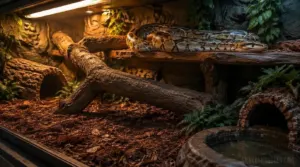
With your thermal gradient set, give the enclosure a real day and night. Run a linear UVB tube over one end on a timer, leave shaded retreats beneath it, and turn everything off after dark.
Lay 4-6 inches of substrate, like cypress mulch or coconut fiber, so it holds humidity. Add sturdy hides on both ends, plus thick branches and ledges rated for your snake’s weight.
Feeding Your Reticulated Python: Prey Size, Frequency, and Healthy Weight

Once the enclosure is built, feeding is where your routine really begins.
Prey item sizing is where most keepers slip. Match prey size to the widest part of your snake’s midsection, roughly 1 to 1.5 times its girth. Hatchlings take fuzzy mice, and by 4 feet you’ll move to medium rats, then 3-pound rabbits around 6 to 7 feet.
Feeding frequency shifts with age. Hatchlings eat every 3 to 4 days, juveniles every 1 to 3 weeks, and adults every 10 to 14 days.
Stick with frozen-thawed prey, which is safer and more humane than live. Among thawing methods, use warm water, never the microwave. Always offer food with long tongs.
Healthy weight means looking taller than wide, never wider.
Reticulated Python Handling and Health Care: Safe Routines, Cleaning, and Veterinary Support

Feeding done, the real routine begins: handling, cleaning, and watching your snake closely.
With a reticulated python over 10 feet, bring an experienced assistant every time. Tap with a snake hook before you open the enclosure, so your python knows it’s handling time, not dinner. Support the whole body and never lift by the tail.
Cleaning is simple but unglamorous. Spot clean daily, disinfect the whole enclosure every 4 weeks with a reptile-safe product, and keep dedicated tools (never share them with your kitchen).
Check temperature weekly, since humidity and heat drive clean sheds. Incomplete sheds often point to a humidity problem.
- Weekly health checks catch trouble early: clear eyes, steady weight, normal appetite.
- Find a reptile vet before you buy the snake.
- Call the vet fast for open-mouth breathing or refusing more than two meals.
Frequently Asked Questions (FAQs)
Is a reticulated python a good pet?
Think they’re too scary? Not always. Is a reticulated python a good pet? For experienced keepers, yes, with captive-bred specimens, generous enclosure size, a steady feeding schedule, and safe handling. Everyone else should skip it.
How big is a 4 year old reticulated python?
Wondering what you’ll actually be dealing with by year four? Expect 3 to 4 meters (10 to 13 feet) for a standard reticulated python, with females running bigger and heavier than males, while dwarfs top out near 5 to 7 feet.
What states ban reticulated pythons?
Think a ban only matters if you’re caught? Think again. Hawaii, Florida, Iowa, Louisiana, and New York restrict reticulated pythons, while Texas demands permit requirements.
Check pet snake legal considerations, and keep enclosure security tight.
Do pythons like to be petted?
A motionless python draped across your forearm looks content, but it’s often a held breath. Stillness isn’t pleasure.
Snake temperament varies, so practice snake handling safety and keep sessions brief and calm, never petting for fun.
How often do reticulated pythons shed their skin?
Frequent shedding isn’t alarming. Shedding cycles run every 3-4 weeks in juveniles, 6-8 in adults.
Humidity matters, so keep it high; stuck skin needs shedding assistance, and enclosure cleaning afterward helps catch reptile health issues.
What permits or licenses are required for ownership?
Permit requirements for reticulated pythons vary by state and town, so check both before buying. Louisiana inspects your enclosure size, secure multilatch systems, and escape prevention, while Texas charges $ Some places ban retics entirely.
Can reticulated pythons be trained or conditioned?
Yes, retics learn through conditioning. Tap training teaches them handling isn’t feeding, so you’ll see fewer strikes. Use a hook, tap first, and let your snake choose to engage. Never skip it.
How much do reticulated pythons typically cost?
Cheap snake, expensive habit.
The price of reticulated pythons starts near $100 for normals, while captive-bred specimens of dwarf varieties and super dwarfs run $1,000-$1, Budget for shipping and for a hefty feeding schedule too.
What signs indicate a reticulated python is stressed?
A retic that bolts across the enclosure at noon isn’t being dramatic. Watch for stress indicators like refused meals, constant hiding, striking, stuck shed, labored breathing, and relentless pushing at the walls. Check heat, humidity, and ventilation first.
Can reticulated pythons live with other snakes?
No, and it’s not worth testing. Retics are loners by nature, and sharing a reptile enclosure means stress, injuries, and shared disease risk. Give each snake its own enclosure size and treat safe handling as a solo job.
Conclusion
A hatchling that weighs less than a bag of coffee beans can top 90 kg as an adult, and that gap is the whole story. Reticulated python size and care reward keepers who plan for the finished animal, not the cute coil in their palm.
Build the enclosure big, latch it like you mean it, and keep a second handler on call. Do that, and you’ll get two decades of mastery instead of a crisis.