This site is supported by our readers. We may earn a commission, at no cost to you, if you purchase through links.
The scarlet kingsnake and the eastern coral snake can share the same rotting log. Both wear red, black, and yellow bands. One carries a neurotoxic venom potent enough to cause respiratory failure; the other is completely harmless.
Snakes that look like a coral snake have evolved this resemblance over millions of years, and the similarity is precise enough to fool even experienced naturalists. Misidentification has real consequences, whether you’re hiking the Florida scrublands, turning over debris in a Sonoran wash, or simply encountering a banded snake in your yard.
Knowing which species you’re actually looking at could matter more than any rhyme you’ve memorized.
Table Of Contents
- Key Takeaways
- 7 Snakes That Look Like Coral Snakes
- How to Tell a Coral Snake From Its Mimics
- Why The “Red Touches Yellow” Rhyme is Unreliable
- Where Coral Snakes and Their Look-Alikes Live
- What to Do When You Encounter a Coral Snake Look-Alike
- Frequently Asked Questions (FAQs)
- What snake is mistaken for coral snake?
- What looks like a coral snake but is not poisonous?
- What is the fake coral snake called?
- What snake is mistaken for a coral snake?
- What does a false coral snake look like?
- What snake pretends to be a coral snake?
- How to tell the difference between a coral snake and a corn snake?
- How can I treat a coral snake bite?
- What time of day are coral snakes active?
- Do coral snakes have natural predators?
- Conclusion
Key Takeaways
- Several harmless snakes—including the scarlet kingsnake, scarlet snake, red milk snake, and Sonoran shovel-nosed snake—mimic the coral snake’s red, yellow, and black banding through Batesian mimicry, making visual identification genuinely difficult.
- The "red touches yellow" rhyme is only reliable in North America and fails in South America, and it can be defeated even there by juvenile coloration, faded bands, and poor lighting.
- The most dependable identification cues combine band sequence (red touching yellow signals a coral snake), a black-tipped snout, and irregular belly banding on nonvenomous mimics.
- If you encounter any banded snake, back away slowly, never handle it, and if bitten, immobilize the limb, wash the area, and get to a hospital immediately for antivenom without waiting for symptoms.
7 Snakes That Look Like Coral Snakes
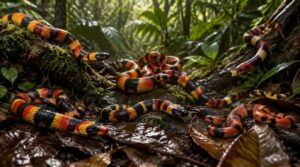
Several snakes share coral snakes’ red, yellow, and black banding, making identification tricky and sometimes dangerous.
The tricolor hognose snake is one such look-alike, sporting the same vivid banding despite being a harmless, compact species rarely exceeding two feet.
The seven species below are the most commonly confused with true coral snakes across North and South America. Knowing what sets each one apart can keep you safe in the field.
Scarlet Kingsnake
The Scarlet Kingsnake is the most common coral snake lookalike you’ll encounter in the southeastern U.S. It shares red, black, and yellow banding, but the key to snake identification is band order: red touches black, not yellow. That detail alone separates venomous vs nonvenomous at a glance. A North America snake field guide can help you quickly confirm band patterns in the field before getting any closer.
The "red touch yellow" rhyme doesn’t apply here, so check the sequence carefully.
Scarlet Snake
Another lookalike worth knowing is the Scarlet Snake. Unlike the Scarlet Kingsnake, this species carries no yellow in its color pattern. You’ll see red and black bands separated by white or gray, and that’s still enough for mimicry in nature to work.
Its geographic range covers the southeastern U.S., where it overlaps with coral snakes, making snake identification especially important.
Red Milk Snake
The Red Milk Snake pushes mimicry further than you’d expect. Its red, yellow, and black bands can touch in a pattern that mirrors coral snakes. These nonvenomous snakes are among the most convincing false coral snakes in the U.S. Use these snake identification clues: A quality venomous snake field guide can help you distinguish subtle band patterns that separate harmless mimics from their dangerous lookalikes.
The red-touches-black rule is your quickest field check, but regional milk snake color variations can shift band brightness enough to keep even experienced observers second-guessing themselves.
- Red bands touch yellow
- Rocky or arid terrain
- Nonvenomous constrictor
- Flees, doesn’t bite
- Less uniform contrast
Long-Nosed Snake
Unlike the Red Milk Snake, the Long-Nosed Snake isn’t a convincing mimic. Its brown-to-gray snake coloration and faint blotches look nothing like a coral snake’s bold bands. You won’t find red, yellow, or black triads here.
Still, snake identification matters: this nonvenomous snake is rear-fanged with mild venom. The Texas longnosed snake prefers dry desert washes and arid rocky terrain.
When exploring the rocky desert habitat where longnosed snakes roam, a reptile snake hook tool lets you safely observe them without causing stress to the animal.
Sonoran Shovel-Nosed Snake
In the Sonoran Desert, the Sonoran shovelnose snake is one of many harmless snake mimics. Here’s what distinguishes it:
- Shovel-shaped snout
- Smooth scales
- Rounded tail
- Limited venom
- Desert habitat
Its color banding patterns can fool you, but snake identification comes down to head shape. Among snakes that look like a coral snake, it’s actually one of the easiest to identify.
Knowing the subtle differences in banding width and head shape—covered in this guide to identifying non-venomous snake breeds—can spare you a dangerous mistake in the field.
California Mountain Kingsnake
Bands of red, black, and white run across the California Mountain Kingsnake’s body, making it one of the most realistic snakes that look like a coral snake. You’ll find this species in rocky chaparral and oak woodlands across central to southern California, up to 1,500 meters.
Its color banding patterns closely match coral snake mimicry. It’s nonvenomous and retreats fast.
South American False Coral Snake
Across parts of the Amazon basin, this snake regularly fools even experienced observers. The South American False Coral Snake displays red, black, and yellow bands, but the band sequence doesn’t match true coral snakes consistently.
Its venom exists, but delivery is usually limited. Still, you shouldn’t handle it. Treat any coral-patterned snake as dangerous and observe from a safe distance.
How to Tell a Coral Snake From Its Mimics
Studies on snakebite incidents show that misidentification is one of the most common factors in unnecessary panic and delayed medical response. Knowing what to look for changes that.
Misidentifying a snake doesn’t just cause panic—it delays the medical response that saves lives
Here’s what to check:
- Band sequence: if red touches yellow on the body, that’s your first coral snake signal; "red touching yellow kills a fellow."
- Snout color: coral snakes have a black-tipped snout; most nonvenomous snakes don’t.
- Belly pattern: look underneath the body; nonvenomous snakes often show broken or irregular banding.
- Field identification guides: cross-reference with a regional guide before drawing any conclusion.
Pattern recognition works best when you combine cues. "Red on black is a friend of Jack" is useful, but it’s only part of the picture.
Why The “Red Touches Yellow” Rhyme is Unreliable
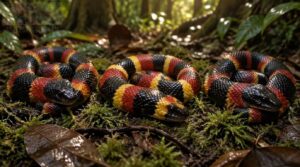
The rhyme "red touches yellow, kill a fellow" sounds like a reliable shortcut, but it’s built for a limited context.
In North America, red touch yellow does identify true coral snakes in most cases, and red touch black points to a harmless mimic. That’s where the rule works. But false coral snakes in South America follow entirely different banding sequences. The rhyme doesn’t apply there at all.
Even within North America, the Scarlet Kingsnake can fool you if you rely only on pattern recognition. Juvenile snakes show colors that differ from adults. Worn or faded bands make the order impossible to read quickly. Poor lighting adds another layer of uncertainty.
| Factor | Effect on Rhyme Reliability |
|---|---|
| South American false coral snakes | Rhyme doesn’t apply |
| Juvenile coloration | Differs from adult pattern |
| Faded or worn bands | Color order becomes unclear |
| Poor lighting | Misread band sequence |
| Non-front-fanged colubrids | Mimic coral snakes closely |
Color order is one clue. It’s not the whole answer.
Where Coral Snakes and Their Look-Alikes Live

Knowing where these snakes live can help you gauge your risk before stepping outside.
In the southeastern U.S. and Gulf Coast, coral snakes and their mimics share the same mixed hardwood-pine forests and sandy scrublands. That’s a true sympatric zone, where encounters with both species are possible in the same patch of ground.
Farther west, the Sonoran Desert and Baja California host the Shovel-Nosed Snake in habitat overlap zones near coral snake ranges. These desert margins and sandy washes deserve your attention.
In Central and South America, geographic distribution extends into tropical forest mosaics through the Andean foothills and Amazonian lowlands. Both groups stay active at low to mid elevations, generally below 1,500 meters, with peak activity following seasonal rains.
What to Do When You Encounter a Coral Snake Look-Alike
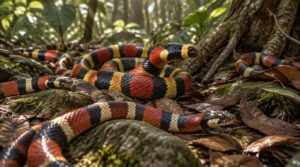
Once you’re in that terrain, your behavior matters as much as your identification skills.
If you spot a banded snake, back away slowly and give it at least one body-width of space. Don’t try to capture, pin, or kill it. Even if you’re confident it’s a harmless mimic, handling any banded snake still carries real risk. Carrying a snake bite first aid kit in your pack won’t replace hospital care, but it gives you critical options while help is on the way.
Keep your eyes on it from a distance. Note the color band sequence, the setting, and the time. That information helps with any reporting later. (https://everysimply.com/wildlife+observation+binoculars+compact/search/snakesnuggles0s-20/) let you track band patterns and markings clearly without closing the distance between you and the snake.
If a bite does happen, don’t panic. Immobilize the limb, avoid movement, and get to a hospital immediately. Don’t wait for symptoms. Wash the bite area with soap and water while you wait for help, but keep movement minimal.
Frequently Asked Questions (FAQs)
What snake is mistaken for coral snake?
You’re most likely to confuse the Scarlet Kingsnake with a coral snake. Its red, yellow, and black banding mirrors the coral’s coloration so closely that even experienced observers can find venomous snake identification genuinely difficult.
What looks like a coral snake but is not poisonous?
Ironically, the snake you’re most afraid of is probably harmless. False coral snakes like the Scarlet Kingsnake use red yellow and black bands and Batesian mimicry, making them look quite dangerous but staying completely nonvenomous.
What is the fake coral snake called?
The fake coral snake is called the South American False Coral Snake. It copies coral snake colors but has no venom or fangs. You’ll find it in South America, where mimicry protects it from predators.
What snake is mistaken for a coral snake?
You’ll mistake several harmless species for coral snakes. Scarlet kingsnakes, scarlet snakes, red milk snakes, long-nosed snakes, and false coral snakes all copy their colors. This is Batesian mimicry: harmless snake species imitate dangerous ones.
What does a false coral snake look like?
False coral snakes have bright red, orange, or pink bodies marked by 50 to 60 black bands, each 2 to 4 scales wide. Their tube-shaped bodies keep a uniform diameter, with smooth, shiny scales and a rounded head shape.
What snake pretends to be a coral snake?
If you’re asking which snake pretends to be a coral snake, look at Scarlet Kingsnakes. They practice Batesian mimicry, copying coral snake banding so predators avoid them. False coral snakes and scarlet snakes use the same trick.
How to tell the difference between a coral snake and a corn snake?
Wondering which snake you’re seeing? Check the color patterns: coral snakes have red, yellow, and black rings circling the body, plus a black nose. Corn snakes show red blotches on orange, no rings, and they’re non-venomous constrictors.
Milk snakes can mimic these patterns too, so this guide to milk snake regional differences shows how their color and size vary across their range.
How can I treat a coral snake bite?
Wondering how to treat a coral snake bite? You can’t treat it yourself. Go to a hospital immediately for antivenom. Immobilize the limb, remove jewelry, and skip tourniquets or suction.
What time of day are coral snakes active?
Roughly 90% of coral snake bites happen during daylight encounters. You’ll find these snakes are diurnal, not nocturnal. Their diurnal activity cycles peak mid-morning, with crepuscular behavior at dawn and dusk, avoiding midday heat.
Do coral snakes have natural predators?
Think nothing hunts a venomous snake? You’d be wrong. Kingsnakes and eastern indigo snakes resist coral snake venom and eat them. Hawks and mammals opportunistically take juveniles, shaping predator-prey relationships.
Conclusion
Nature’s copycats prove a point: appearance is not identity. The seven snakes that look like a coral snake survive precisely because they blur that line, and they blur it well.
So trust pattern details, not rhymes. Check the snout, the band order, the color sequence. When you can’t confirm the ID, keep your distance and let the snake move on. Respect experiences uncertainty better than a memorized verse ever will.