This site is supported by our readers. We may earn a commission, at no cost to you, if you purchase through links.
A gardener lifts a damp flowerpot and finds what looks like a pink earthworm slipping into the soil. On closer inspection, it has glossy scales, a tiny blunt head, and a pointed tail. It is a snake.
Many snakes that look like worms spend their lives below ground, where reduced eyes and smooth cylindrical bodies help them move through loose soil. Species such as blind snakes and worm snakes feed on ants, termites, and other small invertebrates, not people. Knowing the signs can prevent an unnecessary scare and protect a backyard animal. Shape, scales, habitat, diet, and safety reveal it.
Table Of Contents
- Key Takeaways
- Common Snakes That Look Like Worms
- How to Identify a Worm-Like Snake
- Where Worm-Like Snakes Live
- What Worm-Like Snakes Eat
- Are Snakes That Look Like Worms Dangerous?
- Frequently Asked Questions (FAQs)
- Are worm snakes harmful to humans?
- What kind of small snakes look like worms?
- What is the small, snake-like worm in my house?
- Are there worm snakes?
- Do Worm snakes look like worms?
- Do baby snakes look like worms?
- What is the difference between worm snakes and blind snakes?
- Are snakes that resemble worms poisonous?
- What is a worm snake called?
- What is a western worm snake?
- Conclusion
Key Takeaways
- Snakes that resemble worms are usually small burrowing species with smooth glossy scales, tiny eyes, a blunt head, and a pointed or rounded tail.
- Blind snakes commonly eat ants, termites, eggs, larvae, and pupae, while worm snakes often feed on earthworms, slugs, and other soft-bodied invertebrates.
- You are most likely to find these snakes in damp soil, leaf litter, under rocks or logs, and sometimes in garden beds or flowerpots.
- Most worm-like snakes are nonvenomous and harmless to people, so leave them alone when possible and contact a local wildlife expert if identification is uncertain.
Common Snakes That Look Like Worms
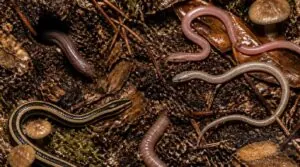
Fourteen snake species in the United States alone can stop you in your tracks, making you wonder whether you’re looking at a snake or just an unusually adventurous earthworm. Most of them belong to a handful of distinct groups, each with their own quirks, ranges, and habits worth knowing. Here are the ones you’re most likely to encounter.
For a broader look at identification and safety, explore these common snake species in North America.
Brahminy and Western Blind Snakes
If you spot a pink, worm-like creature in your garden soil, it may well be a Brahminy blind snake. These tiny reptiles stay under 6 inches, with smooth, glossy scales that closely mimic earthworm skin. Remarkably, the Brahminy blind snake reproduces through parthenogenesis virgin birth, meaning all known specimens are female and a single individual can produce up to eight genetically identical offspring.
The Western blind snake shares the same subterranean habitat and build. Both pursue an insectivorous diet targeting ant larvae and are entirely harmless to humans.
Texas and Trans-Pecos Blind Snakes
Close relatives in the Leptotyphlopidae family, the Texas Blind Snake and Trans-Pecos Blind Snake look strikingly similar to the Western Worm Snake but occupy the rocky desert terrain of west Texas instead.
They rely on their underground habitat to hunt ants and termites beneath sandy loam and stones. Pink to brown and rarely exceeding 12 inches, both are completely harmless.
Eastern and Western Worm Snakes
Unlike those desert specialists, the Eastern Worm Snake and Western Worm Snake both belong to genus Carphophis and share the same wormlike morphology, shaped by their subterranean adaptation.
The eastern species shows a brown back with a pink to reddish belly. The western form has smooth, glossy scales and a pointed snout, a clear burrowing adaptation for pushing through soil.
Sharp-Tailed and Flat-Headed Snakes
The sharp-tailed snake and flatheaded snake share a wormlike morphology built for underground life. Smooth scales give you an easy scale texture identification cue. Their burrowing adaptation appears in a few reliable features:
- Pointed tail on sharp-tailed species
- Broad, flat head on flatheaded species
- Glossy, smooth scales on both
- Muted brown or gray dorsal color
- Pale, uniform belly coloring
Waray Dwarf Burrowing Snake
The Waray dwarf burrowing snake (Levitonius mirus) was only described in 2020 from the Philippine islands of Samar and Leyte.
At 17.2 centimeters, it’s one of the smallest known fossorial reptiles, spending nearly all its time underground and surfacing mainly after rain.
If you ever find one, its soil burrowing build and pale, cylindrical form make worm mimicry convincingly complete.
How to Identify a Worm-Like Snake
Telling a worm-like snake apart from an actual earthworm takes knowing what to look for. A few physical details make the difference once you know where to focus. These are the key features that give them away.
If you find one, follow these baby snake handling tips to avoid stressing the animal while you look more closely.
Tiny, Cylindrical Body Shape
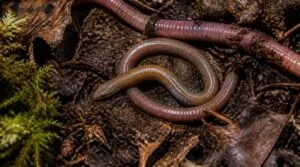
The tiny, cylindrical body shape of fossorial reptiles is the first clue you’re not looking at a worm.
Key features of this elongated body form:
- Uniform width along most of the body length
- Worm mimicry that confuses predators and casual observers
- Rounded cross-section that channels pressure evenly through soil
- Minimal tapering between the head and tail
- Compact profile that slides through tight underground spaces
Smooth, Glossy Scales
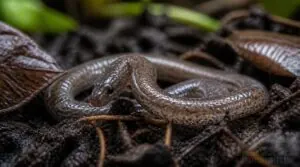
A worm-like snake often has smooth scales that form an unbroken, polished surface. Its glossy appearance can resemble a damp earthworm, especially after rain.
| Feature | What you see | Why it helps |
|---|---|---|
| Surface | Shiny scales | Reduces drag |
| Color | Even brown or gray | Hides scale edges |
| Habitat clue | Soil moisture preference | Keeps skin reflective |
This finish suits burrowing snakes moving through litter.
Reduced Eyes and Blunt Head
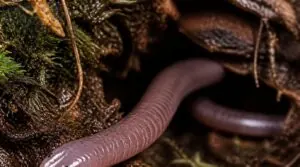
Reduced eyes are a strong clue that you have found a burrowing snake. The eyes may look like dark dots beneath clear scales and can be hard to see from above.
Its blunt head is broad and rounded with little neck definition. In the Leptotyphlopidae family this shape helps support a fossorial lifestyle. These nonvenomous snakes use touch and chemical cues more than vision.
Pink, Brown, or Gray Color
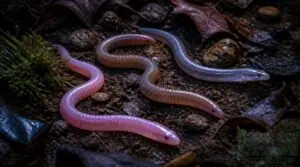
Color can make a burrowing snake resemble an earthworm at first glance. Pink, Brown, or Gray Color is common, often with a pale belly and darker back.
Pink shades may appear after shedding. Brown and gray scales match soil, stones, and leaf litter, especially during nocturnal activity. Light can shift these tones, so use color with other traits.
Tail Tips and Belly Markings
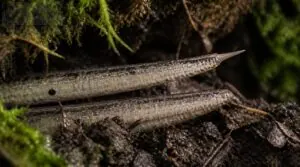
Look at the rear end before deciding what you found. A tail spine or pointed tip helps a burrowing snake brace itself, while defensive tail probing may distract predators.
- Fine point or blunt tip
- Smooth scale sheen and luster
- Pale ventral coloration patterns
- Speckles or faint checks
They rarely cause a superficial bite if you handle them carelessly.
Where Worm-Like Snakes Live
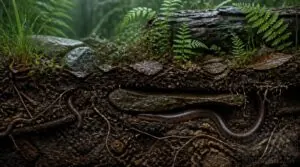
Worm-like snakes spend most of their lives hidden below the surface. You are most likely to find them where soil stays damp and cover is close at hand. Their habitats range from backyard gardens to wild landscapes across several regions.
Moist Soil and Leaf Litter
A damp layer of leaf litter creates moist soil habitats where tiny, harmless serpents can move unseen. These snakes often follow tunnels made by earthworms and search the soil for prey. For garden beds, natural leaf litter mulch helps retain cool, damp soil while supporting the insects these snakes hunt.
| Condition | Value |
|---|---|
| Damp litter | cover |
| Cool soil | moisture |
| Insects | food |
| Fungal scent | prey |
Their insect diet includes ant larvae and termites, which rain brings close to the soft surface.
Rocks, Logs, and Debris
Flat stones, rotting logs, and discarded boards trap moisture above loose soil. Beneath them, harmless serpents find cool cover beside leaf litter and small prey. When arranging flat landscaping stones, leave some edges undisturbed to preserve cool, sheltered microhabitats.
Rock fissures can remain damp for two days in shade. Pebbles and moss create tiny shelters for invertebrates. Snakes emerge for nocturnal foraging after heat fades. Removing cover creates habitat loss threats for these secretive animals.
Gardens and Flowerpots
Garden beds and containers provide loose soil, mulch, and moist hiding places. The Brahminy Blind Snake often arrives with nursery plants and is among the flowerpot snakes.
- Check organic potting soil before carrying pots indoors.
- Keep drainage holes clear and avoid standing water.
- Don’t release unwanted reptile pets; they can disrupt local wildlife.
Lift pots, then replace them after inspection.
Forests, Grasslands, and Wetlands
Beyond beds and pots, these secretive reptiles occupy forests, grasslands, and wetland edges. Blind snake morphology suits this life: a narrow cylindrical body, smooth scales, reduced eyes, and a blunt head help it pass through soil and leaf litter.
At night, they forage beneath fallen wood and dense grasses, following soil-dwelling fauna. Wetland margins offer moist cover but standing water.
Geographic Ranges by Species
Range is often the first useful clue. The Western blind snake occurs across much of the arid Southwest and northern Mexico. The New Mexico Blind Snake and Texas Blind Snake overlap from the southern Plains into the Southwest. The TransPecos Blindsnake is centered in western Texas and nearby New Mexico.
If you’re still unsure which species you’ve spotted, a guide to types of snakes in New Mexico can help narrow it down.
Most of the state’s snakes are harmless, but a list of New Mexico snake species shows which ones, like rattlesnakes, deserve extra distance.
Brahminy blind snake populations are introduced, arriving with nursery plants.
Because these tiny, burrowing snakes hitch rides in potted soil, they’ve quietly spread across the islands, and you can learn which snakes actually live in Hawaii and why.
What Worm-Like Snakes Eat
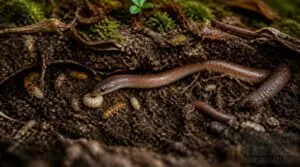
Worm-like snakes eat prey that matches their small size and underground habits. Their diet varies by species and by the food available beneath the soil. The following feeding patterns show what these secretive snakes look for.
Ants, Termites, and Eggs
Many worm-like snakes specialize in ant and termite predation. Their small mouth lets them pick up soft-bodied insects and insect eggs from chambers beneath leaf litter or soil.
Blind snakes often enter ant or termite nests and feed on eggs, larvae, and pupae. This diet links them closely to hidden soil-dwelling fauna.
Earthworms, Slugs, and Snails
Earthworms are an important food source for several worm-like snakes, especially worm snakes that search through damp leaf litter and loose soil. Their small mouth suits narrow prey that can be swallowed whole.
Some species also take slugs and small snails. This slug consumption helps connect these snakes with other soil-dwelling fauna that recycle decaying plant material.
Chemical Cues for Hunting
Scent leads the hunt. A worm-like snake uses tongueflicking behavior to collect odors from soil, then reads them through its vomeronasal system.
It may follow slime trails, ant and termite predation cues, or reptile defense secretions left in cover.
- prey odors
- soil moisture
- vibrational sensing
Damp ground carries these signals farther, helping snakes search beneath leaves and loose soil.
Specialized Jaws and Tail Spines
Specialized jaws help these snakes hold small, slippery soil-dwelling fauna. Tiny curved teeth and strong jaw muscles grip ants, termites, eggs, or soft-bodied prey while the snake pushes food backward through its mouth.
A pointed tail spine can anchor a burrowing snake in loose soil. It also works as a defense mechanism. Some species press the tail outward or release a foul smell when disturbed.
Benefits for Backyard Ecosystems
Worm-like snakes support healthy garden soil by eating ants, termites, larvae, and other microfauna in mulch and leaf litter. Their burrowing also helps soil aeration, much like a tiny natural tiller.
Worm-like snakes help gardens thrive by eating pests and aerating soil as they burrow
They usually forage at night and use harmless defenses when uncovered. Leave them wild rather than collecting them for the reptile pet trade. Their presence often signals a balanced backyard food web.
Are Snakes That Look Like Worms Dangerous?
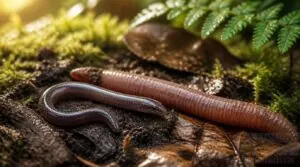
Most snakes that resemble worms are non-venomous and pose no danger to you. Still, their appearance and defensive behavior can make identification confusing. The points below explain what to watch for and when to seek help.
Most Are Non-Venomous
Nearly all snakes that resemble worms are nonvenomous snakes. Blind snakes, worm snakes, and similar soil-dwelling fauna lack venom glands and long injecting fangs. Their small mouths are adapted for tiny prey, not defense against people.
A pointed tail spine may look alarming, but it does not deliver venom. Understanding this distinction helps sensible reptile handling safety and prevents harmless animals from being killed.
Common Harmless Defense Behaviors
Rather than bite, these small snakes rely on harmless defense mechanisms. They may flatten, coil, tuck the head, or move sideways before slipping beneath leaf litter. Some blind snakes release a foul smell, while others wriggle a contrasting tail tip.
Nocturnal activity patterns keep encounters brief. For reptile handling safety, don’t grip or rub its smooth scale texture at all.
Snake Versus Earthworm Identification
Those nocturnal little creatures can seem identical at first glance, but snake vs worm morphology offers clues. A snake has smooth, dry scales, a defined head, and a mouth. Earthworms have moist segmented skin with rings and no scales.
Look for movement too. Snakes form side-to-side curves. Earthworms shorten and lengthen their bodies. Unlike earthworms, snakes perform soil invertebrate predation.
Safe Handling and Relocation
Once you confirm it has scales, give nocturnal little creatures space. Their soil invertebrate predation makes them useful neighbors, so choose a minimal handling preference.
- Wear gloves and eye protection.
- Use a hook, never your hands.
- Guide it into a ventilated tub.
- Let it leave the container itself.
For safe handling and relocation, reptile relocation safety means calm, slow movement.
When to Contact an Expert
When snake identification remains uncertain, contact a local wildlife expert before moving it. This matters most during urban snake encounters indoors, near children, pets, or vehicles.
Call for help if it appears injured, has an unusual head or tail, or occurs in a protected wetland. Experts can advise reptile relocation safety, nocturnal behavior, and the animal’s microhabitat preference.
Frequently Asked Questions (FAQs)
Are worm snakes harmful to humans?
Like a quiet thread beneath the earth, worm snakes are harmless to humans. These nonvenomous snakes are soil-dwelling species with nocturnal behavior, feeding on earthworms and insects. They may wriggle or release musk when disturbed.
What kind of small snakes look like worms?
Small burrowing species include the Texas Blind Snake, Worm Snake, Western Worm Snake, Brahminy Blind Snake, and Sharptailed snake. Their smooth scales, blunt heads, tiny eyes, and soil-colored bodies help them move underground like earthworms.
What is the small, snake-like worm in my house?
It may be a Brahminy Blind Snake or Western Threadsnake. SharpTailed Snake and Ringnecked snake are less likely. Unlike earthworms, it has glossy scales. Keep distance, photograph it, and reduce moisture near pipes.
Are there worm snakes?
Yes. Worm Snake species are real, quiet threads beneath the ground. Many Blind Snake species belong to the Leptotyphlopidae family and feed on earthworms, ants, and other soil-dwelling fauna, usually without posing danger to people.
Do Worm snakes look like worms?
A Worm Snake closely resembles an earthworm: both are slender and glossy. Its blunt head, reduced eyes, and pink belly reflect ocular reduction in snakes. Smooth Earthsnake and Leptotyphlopidae family members are also soildwelling fauna.
Do baby snakes look like worms?
At a glance, baby snakes can look almost identical to worms. Blind snakes show ocular reduction in snakes, but scales, tongue flicks, and slithering reveal secretive reptile behavior among soildwelling fauna using reptile camouflage.
What is the difference between worm snakes and blind snakes?
A Worm Snake eats earthworms and slugs near moist leaf litter. A Blind Snake, including Texas and New Mexico Blind Snakes, hunts ants underground. Smooth Earthsnakes differ again, feeding on soft-bodied invertebrates.
Are snakes that resemble worms poisonous?
Field evidence disproves the idea that these small snakes are poisonous. Texas Blind Snake, New Mexico Blind Snake, Worm Snake, Smooth Earthsnake, and Rough Earth Snake are non-venomous and eat small invertebrates, making them beneficial.
What is a worm snake called?
The Eastern Worm Snake, Carphophis amoenus amoenus, belongs to the Colubridae family. This small non-venomous reptile feeds on earthworms and often emerges after dark for nocturnal foraging in moist soil and leaf litter.
What is a western worm snake?
Like a pencil slipping through soil, the Western worm snake (Carphophis vermis) is a nocturnal Colubridae species in the central U.S. It eats earthworms underground. Unlike the Western Threadsnake, it has dark body, pink belly.
Conclusion
Picture a small glossy body disappearing beneath damp leaves after a summer rain. That quiet movement is usually a sign of a harmless soil specialist, not a threat.
When you recognize snakes that look like worms by their scales, head shape, and habitat, you can leave them safely in place or move them gently with expert help.
Beneath the garden’s surface, these little hunters keep an unseen food web balanced naturally, season after season.