This site is supported by our readers. We may earn a commission, at no cost to you, if you purchase through links.

A Burmese python can swallow a deer whole and then skip dinner for the next six months. No shame, no shortcut, just a metabolism that idles low until hunger returns.
That single meal might carry a snake through winter, drought, or a lean stretch when prey disappears. It’s a survival strategy built on patience and precision, not appetite.
So what do pythons eat, exactly, and how do they pull off feats that would put most predators in the hospital? The answer involves heat-sensing pits, jaws that unhinge like elastic, and a hunting style refined over millions of years.
Table Of Contents
- Key Takeaways
- What Do Pythons Eat? Whole-Animal Prey
- How Python Diets Vary by Species
- How Pythons Hunt and Eat Prey
- How Often Do Pythons Eat?
- What Should Pet Pythons Eat?
- Frequently Asked Questions (FAQs)
- What do python snakes eat?
- What do pythons eat as pets?
- What do ball pythons eat?
- How big should a Python eat?
- Should pythons eat live or pre-killed food?
- What do Burmese pythons eat?
- What do you feed a python?
- Can a python swallow a deer?
- What’s the biggest thing a python can eat?
- Do pythons eat live animals?
- Conclusion
Key Takeaways
- Pythons swallow prey whole—anything from rodents and birds to deer or warthogs—with size and species dictating the menu rather than pickiness.
- Hunting relies on patient ambush tactics and heat-sensing pits that detect warm bodies in the dark, followed by constriction that kills through cutting off blood flow, not suffocation.
- After a big meal, a python’s metabolism can spike dramatically to power digestion, letting it then fast for weeks or even months by drastically slowing its energy use.
- Pet owners should feed appropriately sized frozen-thawed rodents matched to their snake’s girth, since this avoids injury risks and mirrors safe, natural feeding patterns.
What Do Pythons Eat? Whole-Animal Prey

Pythons aren’t picky eaters, but they are whole-animal eaters, swallowing prey head to tail rather than tearing it apart. What lands on the menu depends on the snake’s size, species, and home turf. Here’s a closer look at what you’ll actually find on a python’s plate.
Take carpet pythons, for example—their unique hunting adaptations and prey preferences reveal just how much a snake’s environment shapes its dinner options.
Mammals and Rodents
A python’s dinner menu is built around mammals and rodents. Rodent prey selection ranges from mice to squirrels, though larger snakes tackle bigger meals. The Burmese python favors rabbits and small deer, while the African rock python takes warthogs.
Rodents make up over 2,050 species with continuously growing rootless incisors that shape their gnawing behavior and habitat use. Rodent population impact can be significant locally, since python rodent digestion controls bones and fur efficiently, absorbing nearly everything consumed.
Birds and Eggs
Not every meal has feathers still attached. Pythons raid nests for songbirds, pigeons, and whole eggs, swallowing shells and all. Strong stomach acid controls eggshell digestion easily, while yolk delivers concentrated fat and protein.
Why birds work as prey:
- Nest raiding catches chicks before flight
- Eggs offer easy, low-risk calories
- Yolk nutrition rivals rodent meals
- Avian prey adds dietary variety
Reptiles and Amphibians
Nests aren’t the only target. Larger pythons also prey on other reptiles, including lizards and smaller snakes, along with amphibians like frogs found near breeding ponds.
Since most reptiles breathe entirely with lungs and rely on dry, scaly skin, they offer a different digestive challenge than soft-bodied amphibians, whose moist skin and pond habitats make them easy, seasonal catches.
Fish and Aquatic Prey
Water’s edge is hunting ground too. Rivers, streams, and floodplains hold abundant fish prey, and pythons ambush them using heat-sensing pits to detect warm bodies in shallow water.
Common catches include:
- Minnows and dace
- Gobies and loaches
- Tilapia
- Catfish fry
- Fish eggs
Fatty fish deliver strong energy, helping fuel your python’s long fasting stretches between meals.
Prey Size and Availability
Size matters more than species when a python picks its next meal. As an ambush predator, it waits for prey within its gape limit, usually a prey weight range of 1 to 10 kilograms.
For pet owners, matching this instinct means offering prey around 10% of your snake’s body weight, and this guide to ball python feeding behavior breaks down how to size meals safely.
Seasonal prey shifts, habitat prey diversity, and even urban prey encounters shape those choices, while conservation prey support helps keep natural options stable, easing pressure between feeding intervals and the constriction process that follows.
How Python Diets Vary by Species

Not every python eats the same way, and size has a lot to do with it. A ball python’s menu looks nothing like what a Burmese python hunts down in the wild. Here’s how five well-known species stack up.
Ball Python Diet
Small and manageable, the ball python is the classic starter snake, and its diet reflects that simplicity.
You’ll feed frozen-thawed mice or rats, sized to your snake’s body width, following a schedule from every 5-7 days as hatchlings to every 2-3 weeks as adults.
Watch feeding response cues and body weight to keep meals balanced and digestion smooth.
Burmese Python Diet
Rodents, rats, and even bats make up the bulk of a Burmese python’s diet, though larger individuals tackle pigs or deer when the chance arises. Birds and eggs round things out near nesting sites.
You’ll notice prey size climbs with body girth, and adults have swallowed items nearly a third their own length whole, a powerful reminder of why their invasive spread in Florida hit native mammals so hard.
African Rock Python Diet
Few snakes ambush as patiently as the African rock python. Adults target antelope, warthogs, and mid-sized ungulates, while juveniles shift toward rodents, birds, and lizards.
They also raid goat pens near villages. Using heat-sensing pits, they strike from cover, then rely on constriction before swallowing whole:
- Rodents and lizards (juveniles)
- Antelope and warthogs (adults)
- Crocodiles, occasionally
Reticulated and Scrub Python Diets
What happens when a snake’s menu depends entirely on what’s crawling, swimming, or flying nearby? The reticulated python eats rats, birds, and small opossums, scaling up to deer and piglets as it grows.
Scrub pythons favor arboreal prey like tree squirrels. Both use ambush tactics and flexible jaws, taking fish and amphibians near wetlands when available.
Habitat and Seasonal Influences
Where a python lives shapes what it eats. Savanna, floodplain, or rainforest, each habitat’s cover and water proximity dictate prey selection.
Rainy seasons boost prey density; dry spells push hunting toward rivers. Habitat fragmentation shrinks shelter and raises road-kill risk. Geographic distribution and seasonal temperature shifts together explain why the same species might feast in one region and fast in another.
How Pythons Hunt and Eat Prey
Once a python finds its target, the real work begins. Eating isn’t a quick bite here—it’s a careful, step-by-step process built for survival. Here’s how that process actually unfolds, from the first strike to the final swallow.
Ambush Hunting Techniques

Patience defines a python’s hunting style. Rather than chase prey, it waits, using camouflage and concealment among logs or brush.
Trail ambush strategies matter too: pythons often settle along game trails where animals travel between feeding and bedding sites. Downwind positioning keeps scent from giving them away, while natural cover and slight terrain rises offer a hidden, clear strike zone.
Heat-Sensing Prey Detection

Waiting quietly only gets a python so far. It also needs a way to "see" in the dark, which is where heatsensing pits between the eyes and nostrils come in. These organs pick up infrared radiation from warm bodies within about a meter, translating heat into precise strike coordinates for nocturnal hunts.
Constriction Restricts Blood Flow

Once those pits find their target, the strike happens fast. Coils tighten with each exhale, and here’s the key point: constriction cuts off blood flow, not air. Rising blood pressure and limited oxygen delivery quickly stress tissue perfusion, triggering cardiac arrest within seconds, a far more efficient kill than suffocation for prey of any size.
Constriction kills not by suffocation but by cutting off blood flow, triggering cardiac arrest within seconds
Flexible Jaws and Ligaments
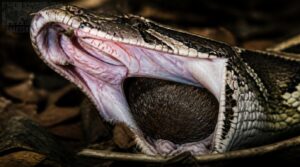
Getting prey down whole takes more than a big mouth. Jaw joint mobility lets paired mandibles hinge and slide wide, while elastic ligaments stretch without causing jaw dislocation.
This is a muscular hydrostat at work: soft tissue pressure, not rigid bone, repositions the jaw. Palatal tissue flexes too, protecting vessels as prey width exceeds the head.
Swallowing Prey Whole

Once jaw flexibility opens the gape, the head goes in first and the rest follows in slow, deliberate waves. Muscles ripple prey downward while gravity-assisted swallowing lends a hand.
- Esophageal stretch widens gradually
- Mucosal layers guard against abrasion
- Prey transit takes hours, sometimes days
Constriction already did the hard work. Now digestion, matched to prey size, takes over.
How Often Do Pythons Eat?

You might expect a snake this large to eat every day, but pythons play a much longer game. Their feeding schedule depends on age, size, temperature, and how big that last meal really was. Here’s what shapes how often a python actually eats.
Feeding Frequency in Nature
How often does a wild python eat? Far less than you’d guess. Between meals, its metabolic rate drops sharply, letting it fast for weeks or months.
Juveniles feed more often, driven by rapid growth. Prey availability, temperature, and energy reserves all shape the rhythm, so feeding habits shift naturally with the seasons and habitat.
Meal Size and Feeding Intervals
Size and timing go hand in hand. Most pythons target prey close to their own Prey Width Ratio, roughly 1 to 1.5 times body width, which keeps swallowing manageable.
Bigger meals mean longer waits. A large rat can satisfy a python for weeks, since a full gut curbs hunting drive until Energy Reserves run low and the feeding schedule resets.
Temperature and Appetite
Ever wonder why your python skips dinner during a heat wave? Heat effects on appetite are real, warm temperatures curb hunger, while cooler nights boost it.
Three factors shape this:
- Cool temperatures increase feeding motivation.
- Night temperature drops lengthen fasting.
- Extreme heat shifts prey selection toward easy targets.
Your feeding schedule should track ambient temperature, not the calendar.
Long Fasting Adaptations
Going eighteen months without a meal sounds impossible, yet pythons manage it through extreme energy conservation.
| Adaptation | Effect |
|---|---|
| Slow metabolism | Cuts energy use |
| Fat utilization | Fuels the body |
| Hormonal shifts | Preserve lean mass |
| Organ shrinkage | Saves resources |
| Minimal mass loss | 0.004% daily |
Cortisol and glucagon keep blood sugar steady, while low insulin aids fat breakdown during these long fasting periods.
Digestion After Large Meals
A python that just swallowed a deer isn’t going anywhere for days. Digestion takes 4 to 14 days, with gastric acid secretion dropping to pH 1.5 and enzyme release surging to break down bone and fur.
Your snake’s metabolic rate can spike 1600%, driving organ growth in the liver and intestines while it digests slowly and steadily.
What Should Pet Pythons Eat?

Feeding your pet python isn’t quite the same as feeding one in the wild. You’ll need to think about what to offer, how big it should be, and how often to serve it. Here’s what actually matters when you’re planning meals for your snake.
Frozen-Thawed Mice and Rats
Wondering what belongs in your snake’s bowl? Frozen-thawed prey is the best choice. Mice and rats are stored at minus 20 to minus 40°C, preserving texture and nutrition.
Thaw in warm water or the fridge, never at room temperature, to limit bacteria. Always inspect for freezer burn or odd smells. Use within 12 to 24 hours for peak freshness and consistent feeding schedules.
Choosing The Right Prey Size
Once you’ve got fresh prey thawed, size matters just as much as freshness. Match prey width to your snake’s girth, not length. Juveniles need prey about one-third to one-half their girth; subadults can handle prey up to full body width. Adults scale similarly, rarely exceeding body width by more than half. Skip head-first grabs on oversized rodents, they raise choking risk.
Age-Based Feeding Schedules
Getting size right matters, but so does timing. Hatchlings eat every 5-7 days for steady growth. Juveniles shift to 7-14 day intervals as prey size increases. Subadults stretch to 10-21 days. Ball pythons and Burmese pythons follow different paces at similar ages. Cooler temperatures often boost appetite; extreme heat can dampen it.
Avoiding Live-Prey Injuries
Timing feeds well is only half the job. Live rodents can bite or scratch when cornered, so most keepers choose frozen-thawed prey instead.
If live feeding is unavoidable, thaw thoroughly, use tongs, feed in a quiet space, and never leave a struggling rodent unattended. Supervision prevents most injuries, both to your snake and to the prey itself.
Safe Handling After Feeding
Once the meal’s down, resist the urge to pick your snake up and show it off. Post-feeding calm matters more than affection right now.
- Leave it still for two to four hours
- Wash hands before and after contact
- Watch for stress signs like head thrashing
- Clean the enclosure promptly
Gentle handling later protects digestion and keeps your python relaxed, not defensive.
Frequently Asked Questions (FAQs)
What do python snakes eat?
A mouse trembles in the grass; a warthog grazes nearby, unaware. Both fit the menu. Python diet spans rodents to large mammals, driven by size and prey selection, hunted through ambush, constriction, and slow, patient feeding behavior.
What do pythons eat as pets?
Your snake’s menu should stay simple: frozen-thawed mice or rats, warmed near body temperature, offered with feeding tongs inside the enclosure.
Match prey girth to your python’s widest point, keep fresh water available, and skip live prey entirely to prevent bite injuries.
What do ball pythons eat?
Rodents rule the ball python menu. Your pet thrives on frozen-thawed mice or rats, sized no wider than its girth, offered weekly as a juvenile and monthly once grown, matching wild feeding patterns.
How big should a Python eat?
Match prey girth to your python’s widest point, not length. Ball pythons need mouse-sized meals; Burmese pythons handle rabbits. Proper portion sizes prevent regurgitation and support smooth digestion readiness between feedings.
Should pythons eat live or pre-killed food?
Letting nature take its course sounds noble, but it’s not the kindest option. Pre-killed prey wins on safety, cutting bite wounds and stress while still triggering natural feeding instincts through gentle warming and movement simulation.
What do Burmese pythons eat?
Your yard offers a fair sense of their range: mammals and rodents dominate, from rats to rabbits, alongside birds and eggs. Younger pythons take reptiles and amphibians; near water, fish and aquatic prey appear too, with prey size scaling to the snake’s girth.
What do you feed a python?
Give your python frozen-thawed mice, rats, or rabbits sized to its girth, never live prey. Match portions to age and species, keep feeding schedules consistent, and always provide fresh water for proper hydration.
Can a python swallow a deer?
Like a python’s jaw unhinging into a living drawstring bag, yes, it can swallow a deer whole. Constriction subdues the prey first, then flexible jaws stretch wide enough for animals up to 120 pounds.
What’s the biggest thing a python can eat?
Full-grown deer, warthogs, and even crocodiles top the list. Large Burmese and African rock pythons rely on flexible jaws and slow digestive capacity to handle prey several times their own body mass.
Do pythons eat live animals?
Yes, in the wild pythons hunt live prey, striking, constricting, and stopping circulation fast.
Captive keepers often choose frozen-thawed rodents instead, since live prey injury risks like bites and scratches make prekilled feeding the safer, more ethical option.
Conclusion
Long before humans invented the stopwatch, pythons had already perfected the art of waiting. That patience is the real answer to what do pythons eat: whatever crosses their path, on their own timeline, whether that’s a rat, a bird, or a deer.
You now understand the jaws, the heat-sensing pits, and the muscle behind each meal. Respect that rhythm. Feed your python wisely, and you’ll watch nature’s slowest strategist thrive.