This site is supported by our readers. We may earn a commission, at no cost to you, if you purchase through links.

A garter snake slipping through shoreline brush rarely makes headlines, yet it answers a question most Tahoe visitors eventually ask: are there snakes in Lake Tahoe, and should you worry about them? The basin’s rocky slopes, wetlands, and sun-warmed ledges support several species, from harmless garter snakes to the region’s lone venomous resident, the western rattlesnake.
Knowing which is which changes how you hike, swim, and let your dog explore. This guide breaks down where these snakes live, how to identify them, and what to do if you meet one on the trail.
Table Of Contents
- Key Takeaways
- Are There Snakes in Lake Tahoe? A Quick Reference Guide
- Yes—Snakes Live Around Lake Tahoe
- Common Lake Tahoe Snake Species
- Are Lake Tahoe Snakes Venomous?
- Lake Tahoe Snake Safety Tips
- Frequently Asked Questions (FAQs)
- Are snakes common in Lake Tahoe?
- What is the largest predator in Lake Tahoe?
- Which lake has the most snakes?
- What state has the worst snake problem?
- How do snakes survive Tahoe’s winter?
- What to do if bitten by snake?
- Are there water snakes in Tahoe?
- Can snakes enter Tahoe campgrounds?
- Do snakes impact Tahoe’s ecosystem?
- Can snakes climb into kayaks or paddleboards?
- Conclusion
Key Takeaways
- Snakes stick to Tahoe’s shorelines, wetlands, and sunny rocky slopes rather than the lake’s cold open water, since they need warmth to stay active.
- Garter snakes are the ones you’ll spot most often, and they’re harmless to people—only the western rattlesnake, found on drier slopes below 5,500 feet, carries venom.
- You can tell a rattlesnake apart by its triangular head, vertical pupils, heat-sensing pits, and rattle, while nonvenomous snakes have round pupils and slender, tapering bodies.
- Staying safe comes down to simple habits: watch your footing near rocks and logs, keep dogs leashed, back away slowly if you meet a snake, and never try to handle one.
Are There Snakes in Lake Tahoe? A Quick Reference Guide
If you’re planning a hike or a swim along the Sierra Nevada’s most famous alpine lake, you’re probably wondering what’s sharing the trail with you. The short answer: yes, snakes live in the Tahoe Basin, though not in the way most people imagine.
You won’t find serpents cruising the open, deep water of the lake itself. Instead, snake sightings cluster near shorelines, wetlands, and rocky slopes, places offering food, cover, and sun for basking. Several garter snake species are common, along with one venomous species, the Western rattlesnake.
If you’re curious how these habitats compare to other freshwater ecosystems, this guide to how snakes use rivers, lakes, and wetlands breaks down the patterns nicely.
Understanding where these animals live, when they’re active, and how to identify them turns uncertainty into confidence, letting you enjoy Tahoe’s trails and waters with your eyes open. Surprisingly, increased rattlesnake sightings began after 2015 and have been linked to climate change, as noted by the Tahoe Institute for Natural Science.
Yes—Snakes Live Around Lake Tahoe

Snakes do share the Tahoe Basin with hikers, swimmers, and paddlers, though not in the way most people imagine. Their presence follows clear patterns tied to habitat, water depth, and season. Here’s what you need to know before your next trip to the shoreline.
Where Snakes Are Usually Found
Tahoe’s shoreline tells you exactly where to look. You’ll find most snakes hugging habitat edges—spots where water, sun, and cover overlap.
- Basking rock ledges near the shore
- Sheltered log crevices and rock fissures
- Shoreline brush cover for concealment
- Forest floor litter on gentle slopes
Rocky slopes and high elevation terrain surrounding the lake round out this reptile habitat, so trail safety starts with watching where you step.
Deep-Water Encounters Are Unlikely
Wondering if snakes patrol Tahoe’s open water? Not really. As an alpine lake, Tahoe’s depths stay cold, and coldwater limits digestion and muscle performance—snakes need warmth.
| Factor | Shallow Shoreline | Deep Water |
|---|---|---|
| Temperature | Warm, sunlit | Cold, dark |
| Prey density | High | Low |
| Snake activity | Frequent | Rare |
Shore proximity wins; energetics don’t favor deep swims.
When Tahoe Snakes Are Active
Timing matters more than depth here. Snakes brumate through Sierra winters, emerging late April into May, with peak activity June through August once daytime temperatures top 70°F.
If you’re wondering what’s actually sunning itself on that trail, this guide to common household snake types makes spotting them a lot easier.
- Spring: daytime basking, cooler thresholds
- Midsummer: dawn/dusk shifts, nocturnal activity
- Early fall: juveniles emerge, sightings rise
- Post-October: dormancy returns
Watch trail edges during these windows—casual wildlife observation, not alarm.
Common Lake Tahoe Snake Species
Five species make up most of what you’ll spot around the Tahoe Basin, each with its own habitat and habits. Knowing which is which helps you tell a harmless garter snake from something worth more caution. Here’s a closer look at each one.
Sierra Garter Snake
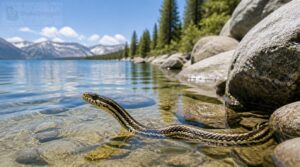
Slender and striped, the Sierra garter snake is the species you’re most likely to spot near Tahoe’s shoreline. It swims well, diving after fish, tadpoles, and amphibians along rocky banks and shallow streams.
Active by day, it basks on sunlit rocks between hunts. Mildly venomous to prey only, it poses no threat to humans—just a harmless, water-loving neighbor in the mountain habitat.
Western Terrestrial Garter Snake

A generalist by nature, Thamnophis elegans thrives where meadows meet forest edges throughout the Tahoe Basin. Its dorsal stripe ranges yellow to orange, with some populations showing melanistic, all-dark variation.
You’ll find it hunting slugs, worms, and amphibians during warm afternoons. Identification tips:
- Scale rows: 17-19
- Length: 40-90 cm
- Diurnal activity pattern
Valley Garter Snake

Three pale stripes running the length of a black or olive body give Thamnophis sirtalis fitchi away instantly along Tahoe’s lower-elevation wetlands and stream edges.
You’ll spot it basking near Pacific treefrogs and small fish, its preferred prey. When threatened, it musks and coils rather than strikes—good news for hikers who value calm identification over panic near high elevation fauna.
Northern Rubber Boa

Rubbery skin and a tail that mimics its head? That’s the boa’s trick against predators.
You’ll find it beneath moist logs in shaded riparian zones, rarely on open trails.
- Thick, uniform body with smooth scales
- Blunt head, hard to distinguish from tail
- Excellent swimmer despite secretive habits
- Musks or plays dead when threatened
It hunts rodents by ambush and bears live young, favoring cooler microhabitats around Tahoe’s forest edges.
Great Basin Gopher Snake
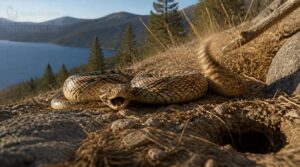
Mistaken for a rattlesnake more than once, this bluffer hisses, flattens its head, and vibrates its tail—pure theater, no venom.
You’ll spot it on sunny, rocky slopes near rodent burrows, hunting ground squirrels by constriction. Tan to yellowish, with dark checkerboard blotches.
Adults reach 3.5 to 7 feet. Give it space; misidentification causes needless fear, not danger.
Give the gopher snake its space—misidentifying this harmless bluffer causes needless fear, not real danger
Are Lake Tahoe Snakes Venomous?

Only one snake in the Tahoe region carries venom, and knowing which one it is takes away most of the worry. You’ll want to recognize its shape, its range, and how it differs from the harmless garter snakes you’re far more likely to spot near the water.
Here’s what to look for, from risk factors to the telltale signs that set it apart.
Western Rattlesnake Risks
One venomous species calls the Tahoe basin home: the Western Rattlesnake, Great Basin subspecies. Sightings around South Lake Tahoe have climbed since 2015, especially on warm, rocky slopes below 5,500 feet.
Bite risk peaks from spring through fall, when snakes bask on sun-warmed rocks and logs. Most bites happen accidentally—stepping too close or handling a snake that’s simply defending itself.
Rattlesnake Identification Clues
Knowing a snake’s defensive habits matters less than knowing its face. Five features separate the Western Rattlesnake from every harmless species sharing the basin:
- Triangular head shape with narrow neck
- Vertical slit pupils, not round
- Heat sensing pits between eye and nostril
- Segmented rattle tail, sometimes dull in young snakes
- Diamond or blotched body pattern in tan, brown, or olive tones
Nonvenomous Snake Identification
Garter snakes and gopher snakes show the opposite traits: round pupils, no facial pits, and slender bodies tapering gradually without a rattle.
The Sierra Garter Snake, Western Terrestrial Garter Snake, Valley Garter Snake, Northern Rubber Boa, and Great Basin Gopher Snake all retreat in a straight line rather than coiling.
Smooth or lightly keeled scales and straight dorsal stripes near water or meadows confirm a nonvenomous identity.
No Venomous Water Snakes
No venomous water snakes exist in Lake Tahoe. Species swimming its shallows belong to the Natricinae family, relying on constriction, not venom.
- Round pupils, no heat pits
- Slender, tapering bodies
- Olive-brown banding
- Retreat when approached
The Great Basin Rattlesnake stays on dry slopes, rarely entering water. So splashing near shore? Still just garter snakes doing their thing.
Lake Tahoe Snake Safety Tips

Most snake encounters near Lake Tahoe come down to a few simple habits, not luck. Knowing what to watch for and how to react keeps both you and the snake safe. Here are five practical guidelines worth keeping in mind on your next hike or lakeside walk.
Watch Rocks, Logs, and Trails
Uneven rocks and shaded ledges near shore hide two hazards at once: slick footing and basking snakes. Test logs before crossing, watch for hidden drop-offs, and keep three points of contact on rocky stretches.
| Surface | Hazard | Precaution |
|---|---|---|
| Rocks | Slippery, snake basking | Careful footing |
| Logs | Hollow, rot | Test before stepping |
| Trail edges | Erosion | Watch foot placement |
Keep Dogs Leashed Nearby
Your dog’s nose doesn’t know the difference between a garter snake and a rattler, which is exactly the problem. Rock piles and dense underbrush near shore hide wildlife that a curious muzzle can startle.
Keep dogs leashed on a six-to-ten-foot line near water and trailheads, with current ID tags attached, since most trails require it anyway.
Back Away Slowly
Freeze first, then move. Keep facing the snake, take small steps back, and widen the gap to at least three body lengths.
Don’t pivot or bolt — a calm, steady retreat beats panic every time. Scan for a second route in case rocks or brush block your path, and once clear, note the location before continuing your hike.
Never Handle Wild Snakes
Curiosity kills caution fastest. Picking up a garter snake or nudging a rattlesnake with a stick invites a defensive strike, even from species that seem docile.
Handling also risks Salmonella transfer, since snakes carry it naturally. Give snakes several body lengths of space and let them move on their own — respecting wildlife boundaries keeps both you and the snake safe.
Responding to Snakebites
A bite doesn’t have to become a crisis if you act fast. Apply firm pressure, immobilize the limb below heart level, and call 911 with your exact location.
- Note the snake’s color and head shape
- Avoid tourniquets unless trained
- Keep the victim calm and hydrated
- Seek antivenom-stocked hospitals nearby
Monitor swelling every 15 minutes until help arrives.
Frequently Asked Questions (FAQs)
Are snakes common in Lake Tahoe?
Yes, but they’re rarely abundant near the shoreline itself. Garter snakes turn up often on hiking trails and rocky nearshore habitat, especially during peak seasonal activity from June through August, while rattlesnake distribution stays concentrated in drier, sun-warmed slopes farther inland.
What is the largest predator in Lake Tahoe?
The California black bear holds that title, reaching 400 pounds and roaming Sierra Nevada forests around the basin. Though formidable on land, bears rarely interact with Tahoe’s open water or aquatic life.
Which lake has the most snakes?
Regional surveys point to lakes like Emerald Bay and nearby reservoirs, where shoreline habitat diversity, abundant basking rocks, and strong prey abundance support higher snake density than Tahoe’s open, colder waters offer.
What state has the worst snake problem?
Snakebite risk is a lottery ticket nobody wants to win, and North Carolina holds the worst odds, averaging 8 bites per million people annually—well above West Virginia and Arkansas, driven by dense venomous species distribution and warm, humid habitat conditions.
How do snakes survive Tahoe’s winter?
Tahoe snakes don’t migrate south—they enter brumation, tucking into rock crevices or burrows below the frost line. Slowed metabolism and snow insulation help them endure high-elevation winters until seasonal warmth triggers emergence.
What to do if bitten by snake?
Call 911 immediately, keep the victim calm and still, and position the bitten limb below heart level. Remove rings or tight clothing, avoid ice or tourniquets, and note the snake’s appearance for responders.
Are there water snakes in Tahoe?
No true water snakes patrol these depths—just semi-aquatic garter snake swimming near shorelines. Sightings involve shore-based encounters, not lake monsters.
Rattlesnakes occasionally enter water too, but coldwater adaptation limits deep, open-water activity for any species here.
Can snakes enter Tahoe campgrounds?
Yes, snakes regularly enter campground areas through wooded edges and rocky terrain, seeking shelter under logs, rocks, and leaf litter. Nighttime and cool-morning activity is common, so inspect resting spots and keep pets leashed near trails.
Do snakes impact Tahoe’s ecosystem?
Absolutely—snakes serve as mid-level predators in this mountain habitat, checking rodent and amphibian numbers while supporting nutrient cycling. Their predator-prey relationships and habitat influence quietly shape alpine wildlife balance, proving even small reptiles carry outsized ecological weight.
Can snakes climb into kayaks or paddleboards?
Snakes can climb aboard, using exposed scupper holes on sit-on-top kayaks or dropping from overhanging branches onto paddleboards.
Stationary crafts near weed beds attract more attention.
Paddling steadily and avoiding vegetation-heavy shorelines reduces the odds of an uninvited passenger.
Conclusion
Like Eden’s serpent, Tahoe’s snakes carry a reputation bigger than their bite. Most are harmless wanderers—garter snakes gliding through wetlands, gopher snakes mimicking rattles for show. Only the western rattlesnake demands real caution, and even then, distance and awareness keep you safe.
So when people ask, "are there snakes in Lake Tahoe, a quick reference guide help?"—yes, and knowledge turns fear into respect. Stay alert, stay curious, and the trail remains yours.