This site is supported by our readers. We may earn a commission, at no cost to you, if you purchase through links.
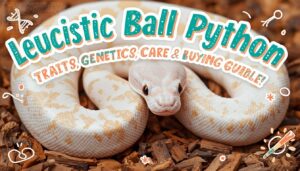
Picture a hatchling barely 10 inches long, near-solid white, with eyes that hold color instead of the washed-out pink you’d expect from a pale snake. That’s the giveaway. A leucistic ball python isn’t albino, and mixing the two up trips up plenty of newcomers scanning breeder listings for their first snow-white morph.
The distinction matters because it changes everything: eye color, genetics, even how you’d pair this snake in a breeding project down the road. Leucism strips pigment through a different pathway than albinism does, and the results—jaw-dropping snow-white scales against dark or blue eyes—come from genetics worth understanding before you buy.
Here’s what separates true leucistics from ivory, piebald, and everything else marketed as "white.
Table Of Contents
- Key Takeaways
- What is a Leucistic Ball Python?
- Leucistic Ball Python Appearance and Variants
- How Leucistic Ball Python Genetics Work
- Leucistic Ball Python Care and Health
- Price, Rarity, and Buying Tips
- Frequently Asked Questions (FAQs)
- How much is a leucistic ball in python?
- Are leucistic ball pythons friendly?
- What is the rarest color of ball python?
- How rare is a blue-eyed leucistic ball python?
- Are leucistic ball pythons rare?
- What is a leucistic ball python?
- What is the difference between leucistic and albino ball pythons?
- Are leucistic ball pythons venomous?
- How do you take care of a leucistic ball python?
- How much do Leucistic Ball Pythons typically cost?
- Conclusion
Key Takeaways
- Leucistic ball pythons are easy to tell apart from albinos because they keep their dark or blue eyes, while albinos have pink or red eyes from true melanin loss.
- Leucism follows incomplete dominant inheritance, so pairing two "visual" leucistics or specific gene combos (like Mojave x Butter) is what actually produces blue-eyed or black-eyed offspring, not simple luck.
- Day-to-day care for a leucistic ball python is no different from any other ball python, so a warm-side of 88-92°F, 50-60% humidity, and rat every 10-14 days will keep your snake healthy.
- Prices vary widely by lineage and eye color, with hatchlings typically running $150-$400 and rare, well-documented blue-eyed lines climbing toward $1,200 or more.
What is a Leucistic Ball Python?
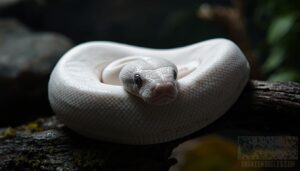
A leucistic ball python catches your eye the moment you see one, but the term "leucistic" actually covers more ground than most keepers realize.
Depending on which genetic pathway produces the effect, these snakes can vary widely in ball python price range, so it pays to know what you’re actually buying.
Before you fall for that white coat and those striking eyes, you’ll want to know what sets this morph apart from a few commonly confused ones.
Here’s how leucism stacks up against albino, ivory, and piebald pythons.
Leucism Meaning
Ever wonder why some ball pythons look almost ghost-white? That’s leucism, a genetic quirk causing partial pigment loss during embryonic development, not total absence.
Unlike solid-color mutations, leucism affects pigment cell formation unevenly, producing:
- Pale skin with normal eye color retained
- Patchy or uniform pale patterns
- Reduced (not absent) pigment types
- Genetic, developmental root causes
One key difference from albinism is that leucistic animals retain normal eye color, which helps distinguish the two conditions visually. Leucism vs albinism is an important concept for understanding pigmentation differences in reptiles like ball pythons.
Leucistic Versus Albino
The eyes give it away every time. Leucistic ball pythons keep dark or blue eyes, while albinos show pink or red irises from visible blood vessels.
Body-wise, leucistics often carry faint speckling; albinos run uniformly pale.
That’s pigment loss versus true melanin absence—different genetic inheritance patterns entirely, and a reliable visual identification method for breeders sorting morphs.
Leucistic Versus Ivory
Pigment loss isn’t binary—Ivory ball pythons prove that. Where leucistic snakes run pure white with dark or blue eyes, Ivory keeps a warm cream tone with pale, yellowish irises.
Genetically, they’re separate morphs entirely, not degrees of the same mutation.
What sets them apart:
- Color depth – cream versus stark white
- Eye pigmentation – pale yellow versus dark/blue
- Pattern retention – faint striping versus smooth uniformity
- Color stability – Ivory warms with age; leucistic stays fixed
Leucistic Versus Piebald
Where Ivory warms with age, piebald patterns work on a totally different mechanism—patchy, not uniform.
| Trait | Leucistic | Piebald |
|---|---|---|
| Pigment Loss | Systemic, whole-body | Localized patches |
| Eye Color | Normal/blue-black | Normal |
| Pattern | Diffuse, uniform | Sharp-edged, blotchy |
Recessive inheritance drives piebald; leucism follows incomplete dominance—an easy morph comparison mix-up for newcomers.
Regardless of which morph you’re keeping, getting the enclosure basics right matters just as much as genetics, so check out this guide on boa constrictor housing and temperature setup before bringing one home.
Leucistic Ball Python Appearance and Variants
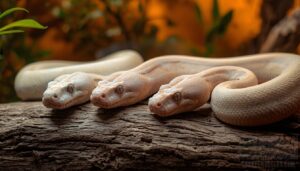
Once you understand what leucism actually means, the fun part is seeing how differently it shows up from one snake to the next. Not every leucistic ball python looks the same, and the differences come down to genetics, age, and even individual quirks in pigmentation. Here’s what you’ll want to know before picking one out.
Once you’ve settled on a snake, the enclosure details matter too—like whether substrate liners are actually necessary for your setup, since comfort and cleanliness go hand in hand with good husbandry.
Whatever pattern your leucistic ball python shows, it’ll thrive best once you’ve nailed the basics of setting up a proper thermal gradient for ball pythons, with a warm basking side and a cooler retreat to match its natural instincts.
Blue-Eyed Leucistic Traits
Sky-blue eyes set against snow-white scales — that’s the calling card of a Blue-Eyed Leucistic ball python. Breeders nickname it the "BlueEyed Lucy," and eye color stability holds strong from hatchling to adult.
Scale whiteness stays consistent through every shed, though genetic expression variation means some BEL pythons carry faint residual pigment patterns that fade as juvenile traits mature.
Black-Eyed Leucistic Traits
Where BEL pythons flaunt sky-blue irises, their BlackEyed Leucistic cousins keep pupils deep black against snow-white scales. This complex trait involves:
- Recessive inheritance patterns
- Multi-gene combinations for true expression
- Consistent eye color from hatchling onward
- Stable body whiteness with minimal residual speckling
Genetic basis varies by line, and pigment loss remains uniform—no significant health considerations tied to this ball python morph’s growth patterns.
White and Cream Coloration
A snowy hatchling doesn’t stay one shade forever. White vs cream tones vary by line—white runs stark and bright, cream carries a warm undertone.
| Trait | Effect |
|---|---|
| White | Cooler, crisper look |
| Cream | Yellowish, ivory-like warmth |
| Lighting | Shifts perceived tone |
| Age | Contrast fades with sheds |
Breeder projects prize that uniform pale appearance once residual pattern fades.
Speckling and Residual Pigment
Perfect white is rare—most leucistic ball pythons carry faint speckling or residual pigment near the eyes and tail.
- Speckle formation stems from localized pigment cell clusters
- Pigment distribution favors dorsal surfaces over belly scales
- Genetic modifiers control speckling density between clutch mates
- Visual camouflage softens harsh white-on-white contrast
- Developmental patterns shift slightly through each shed cycle
This color mutation rarely produces perfect white on every genetic morph.
Hatchling and Adult Appearance
A hatchling Leucistic Ball Python hatches at 10 inches, often near-solid white with faint head shading that fades over several sheds. Expect smoother scales, minimal blotching, and blue or pale eyes that darken with maturity.
Adults reach 3–6 feet, developing thicker tails, sharper contrast, and gradual pigment migration toward the dorsal midline as scale texture and pattern shift with age.
How Leucistic Ball Python Genetics Work
Genetics is where this morph gets genuinely interesting, and understanding it will make you a smarter breeder or buyer. It’s not one simple trait but a handful of related genes working together in different ways. Here’s what’s actually happening under the hood.
Incomplete Dominant Inheritance
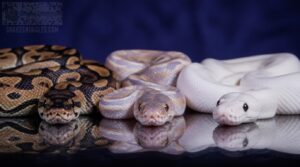
Genetics gets fun here: leucism follows incomplete dominant inheritance, so heterozygous animals (one gene copy) show subtle changes, while homozygous pairings produce full white expression. Think blending, not a simple on/off switch.
- One copy: mild pattern reduction
- Two copies: dramatic white appearance
- Offspring: unpredictable intermediate looks
- Ratios: don’t follow standard dominant/recessive math
That’s why breeding outcomes require careful calculation, not guesswork.
Blue-Eyed Leucistic Complex
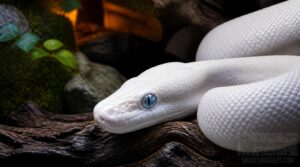
No single gene "makes" a blue-eyed leucistic; it’s a complex of Mojave, Butter, Lesser Platinum, Bamboo, Phantom, Mystic, Mocha, Special, and Daddy genes.
| Pairing | Offspring Odds | Result |
|---|---|---|
| Mojave x Butter | ~25% | Blue-Eyed Leucistic |
| Super Lesser x Normal | 100% | Visual Lesser carriers |
| Butter x Russo | ~25% | Blue-Eyed Leucistic |
Mojave ball pythons often anchor these projects, carrying hidden traits like piebald undetected.
Black-Eyed Leucistic Genetics
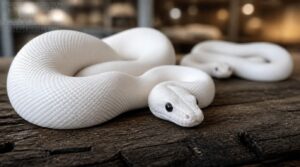
Where blue-eyed leucistics come from a gene complex, Black-Eyed Leucistic works differently: it’s the super form of a single gene, Yellow-Belly. Breeding two Yellow-Bellies together follows classic recessive inheritance, producing 25% BEL offspring through homozygous expression. That double-allele combination triggers near-total pigment loss while sparing eye melanin entirely—a modifier quirk that keeps those irises jet black regardless of body coloration.
Black-Eyed Leucistic ball pythons emerge when two Yellow-Bellies pair up, stripping away pigment yet leaving their jet-black eyes untouched
Breeding Outcome Chances
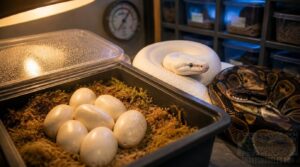
Punnett squares only tell part of the story—actual clutches vary. Expect these ranges when planning pairings:
- Clutch size: 6–8 eggs typical
- Incubation success: 70–90%
- Hatchling survival: 85%+ in month one
- Sex ratio: roughly 1:1
- Genetic outcome: 25% homozygous leucistic, rest heterozygous carriers or normals
Recessive pairings need both copies expressed; dominant traits show with just one.
Combining Other Genetic Traits
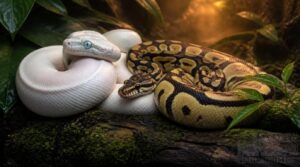
Those percentages shift once you start stacking morphs. Pair leucistic lines with Super Pastels or piebald for pattern blending, but check trait compatibility first—some combos hide behind modifier genes affecting eye color pairing or pigment.
Since leucistic follows codominant/incomplete dominant inheritance, heterozygous expression stays subtle until paired right. Serious breeders track lineage carefully, since dominant inheritance mixed carelessly muddies results fast.
Leucistic Ball Python Care and Health
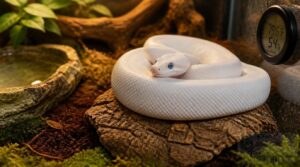
Here’s the good news: caring for a leucistic ball python is basically the same as caring for any normal ball python, since the white scales don’t come with any special requirements.
Your snake still needs the same setup, the same feeding routine, and the same handling approach that’s worked for keepers for decades.
Let’s start with the enclosure itself.
Enclosure, Hides, and Substrate
Setting up housing for your leucistic ball python isn’t different from standard morphs—same husbandry, same white scales to admire.
Adults need a 40 gallon enclosure, front-opening for low-stress access. Place two hides on opposite ends for thermal choice.
Cypress mulch substrate holds moisture beautifully, supporting humidity microclimates and easy burrowing without impaction risks that rock substrates carry.
Temperature and Humidity
Get the thermal gradient right and your leucistic stays healthy: 88-92°F basking, cooler end 78-82°F. Use a thermostat to prevent spikes.
Keep humidity at 50-60%, bumping toward 70% in hides during shedding. Nighttime drops to 70-75°F are fine, provided the hotspot itself doesn’t cool. Sealed enclosures trap moisture, so balance ventilation with humidity gradient control.
Feeding Schedule and Prey Size
Rarely do keepers overthink feeding once they’ve got the rhythm down. Hatchlings eat every 5-7 days until 300 grams; juveniles shift to 7-10 days. Adults settle into 10-14 day intervals, prey no wider than midbody girth—frozen-thawed rodents work great. Target 3-6% body weight per meal. Skip handling 48 hours post-feeding, and watch for smooth retreats, not regurgitation, as your health signal.
Handling and Temperament
Most leucistic ball pythons settle into handling acclimation with a docile, easygoing nature, though temperament varies individual to individual.
Wash hands, move slowly, and watch body language:
- Relaxed coils and tongue flicks mean comfort
- Hissing or striking signals stress
- Support the full body, no squeezing
- Return to short sessions if regression appears
Consistent, gentle sessions build trust and reduce stress over time.
Health Risks and Lifespan
White scales hide nothing about a snake’s true health, so watch closely. Proper humidity (50-60%) prevents most skin shedding issues, while temps below 75°F invite respiratory trouble.
Calcium gaps cause metabolic bone disease; D3 supplements cut deformities by 90%. Reduced melanin means slower healing.
With good husbandry, expect a solid 20-30 year lifespan.
Price, Rarity, and Buying Tips
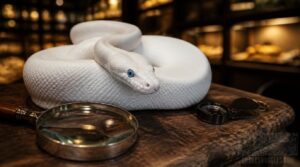
Once you’ve got a handle on care, the next question is usually what these snakes cost and where to find a good one.
Prices swing quite a bit depending on the specific genetics behind the white scales, so it pays to know what you’re looking at before you buy.
Here’s what actually drives the price tag and how to shop smart.
Typical Price Range
So what’s your budget looking like? Hatchling prices usually run $150 to $400, while blue-eyed leucistics with prized lineage climb toward $800–$1,200. Proven adult females fetch $500–$900.
Expos often offer $250–$600 deals, but certified breeders with health guarantees charge $350–$650.
Rare genetic combos can exceed $1,500—market demand and morph rarity drive nearly every price tag you’ll encounter.
Factors Affecting Morph Value
Numbers only tell half the story—genetic rarity and pedigree fill in the rest. Blue-eyed complexes command premiums over black-eyed lines, especially with morph combinations like piebald or clown stacked in.
Breeder reputation matters too: proven selective breeding programs with documented lineage justify higher tags than unverified stock ever could.
Availability and Market Demand
That pedigree premium only holds if you can actually find stock. Blue-eyed lines sell fastest, with North America seeing steadiest turnover.
- Spring/summer hatchling spikes
- Tighter EU supply from licensing
- Shortages when top breeders scale back
- Steady collector demand keeps prices firm
Availability shifts with the seasons, so timing your search matters as much as budget.
Choosing a Reputable Breeder
Once you’ve tracked down available stock, the real work starts: choosing a reputable breeder. Look for a written health guarantee, transparent lineage documentation, and veterinary records confirming genetic screening. Ask about socialization practices during those early weeks, since handled hatchlings settle in faster. Reputable sellers also offer post-sale support long after the sale closes.
Pre-Purchase Health Checks
Post-sale support matters little if the snake’s already sick, so put hands on it before money changes hands. Check for clear nostrils (no wheezing), bright, cloudless eyes, and smooth skin free of scale rot or retained shed. Watch for stuck eye cap retention after shedding.
Confirm firm stools (fecal parasite test if possible) and steady body condition, then observe alert, calm behavior.
Frequently Asked Questions (FAQs)
How much is a leucistic ball in python?
You get what you pay for with this morph, plain and simple. Blue-eyed variants run $349–$1299, black-eyed types $295–$799, and hatchlings start around $249, depending on lineage and eye color.
Are leucistic ball pythons friendly?
Yes, they’re every bit as docile as standard morphs. With consistent handling acclimation, most stay calm and curious, showing few stress indicators, and bond well through regular, gentle social interaction over time.
What is the rarest color of ball python?
Hands down, the Blue-Eyed Leucistic takes the crown for rarity, driven by tricky genetic combinations and limited hatchling numbers each season. Ivory and Piebald morphs turn heads too, but collector demand keeps pushing BEL prices toward the top of the market.
How rare is a blue-eyed leucistic ball python?
True blue-eyed leucistic status demands homozygous complex genes plus true blue eyes, so genetic rarity stays high—breeding probability sits around 25% per clutch, and collector demand keeps market availability tight for genuine, well-documented BEL pythons.
Are leucistic ball pythons rare?
This morph is genuinely rare in wild populations, only showing up through decades of selective breeding. With 25% odds per clutch, hobbyists still pay premium prices, driven by strong collector demand and limited geographic availability of established bloodlines.
What is a leucistic ball python?
Picture a ghost wearing a snake’s skin: color fades, but the eyes stay lit. That’s pigment reduction, not absence, giving you a pale body with true eye color retention — the hallmark of leucism itself.
What is the difference between leucistic and albino ball pythons?
The main divide comes down to melanin deficiency versus pigment cell loss. Albinism wipes out melanin entirely, giving pink or red eyes, while leucism just reduces pigment, leaving dark or blue eyes and some pattern retention.
Are leucistic ball pythons venomous?
Don’t let the pale scales fool you into a "venom-ous" assumption. No venom glands exist here at all. Leucism only changes pigment, not biology, so this snake still relies on constriction, not toxins, to subdue prey.
How do you take care of a leucistic ball python?
Care comes down to a secure enclosure, warm-side temps of 88–92°F, 50–60% humidity, and rats every 10–14 days. Handle gently, and check sheds closely, since leucistic scales show retained eye caps clearly.
How much do Leucistic Ball Pythons typically cost?
Ready for sticker shock? Expect $350–$900 for hatchlings, with prized blue-eyed leucistics reaching $1,200, while black-eyed morphs stay slightly cheaper—rarity, lineage, and market demand drive every dollar of that spread.
Conclusion
Two hatchlings from the same clutch can hatch coincidentally identical in pattern yet diverge completely in genetics, one true leucistic, one merely close. That coincidence is exactly why you verify lineage instead of trusting appearance alone.
A leucistic ball python rewards patience: correct identification, steady husbandry, and a breeder who documents genetics rather than guesses. Skip that groundwork, and you risk paying premium prices for an imitation. Get it right, and you’re holding one of the cleanest, most striking morphs the hobby offers.