This site is supported by our readers. We may earn a commission, at no cost to you, if you purchase through links.

A ball python and a blue-tongued skink share the same enclosure. Both look healthy, both seem calm, and for the first week, nothing goes wrong. Then one morning, one is dead.
Cohabitation between snakes and lizards plays out this way more often than most keepers expect, not through dramatic attacks but through stress, disease, and mismatched environments eroding both animals quietly from the inside.
Whether snakes and lizards can live together has a clear answer, but understanding the biology behind it helps you make better decisions for every reptile in your care.
Table Of Contents
- Key Takeaways
- Can Snakes and Lizards Live Together? Usually Not
- Why Don’t Their Habitat Needs Match?
- Can Snakes Attack or Eat Lizards?
- What Health Risks Does Cohabitation Create?
- How Should Snakes and Lizards Be Housed?
- Frequently Asked Questions (FAQs)
- Do lizards and snakes get along?
- What reptiles can live with each other?
- What is the best animal to keep snakes away?
- Are snakes attracted to lizards?
- What types of snakes and lizards get along the best?
- Can snakes and lizards recognize each other as threats?
- How often should reptile enclosures be cleaned and sanitized?
- What substrates work best for desert reptile species?
- Can reptiles experience loneliness or benefit from enrichment?
- Are some reptile species safer as beginner pets?
- Conclusion
Key Takeaways
- Snakes and lizards shouldn’t share an enclosure because their temperature, humidity, and lighting needs pull in opposite directions — satisfying one animal almost always means shortchanging the other.
- Even without direct contact, cohabitation creates real health risks: parasites, airborne pathogens, and chronic stress can quietly wear both animals down before you notice anything is wrong.
- A snake doesn’t need to be hungry to strike at a lizard — prey recognition is instinctive, triggered by movement, heat, or scent, and it fires whether the snake ate an hour ago or a week ago.
- The safest setup is simple: each reptile gets its own dedicated enclosure with species-specific conditions, separate feeding routines, and no unsupervised contact with the other.
Can Snakes and Lizards Live Together? Usually Not
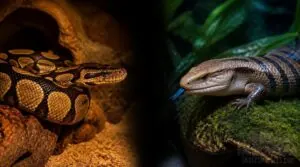
The short answer is no — snakes and lizards generally shouldn’t share the same space, and the reasons go deeper than most people expect.
Even when housed separately, the stress responses triggered by proximity alone can make everyday care harder — understanding why snakes and lizards shouldn’t share an enclosure helps you set up a calmer environment where medicating and handling go more smoothly.
Whether you’re housing them in the same enclosure or just the same room, the risks vary quite a bit depending on the setup.
Here’s what you need to know about each scenario, the safety concerns involved, and the rare cases where exceptions might apply.
Same Room Versus Same Enclosure
There’s an important distinction worth making here: sharing a room isn’t the same as sharing an enclosure, but neither option is truly safe.
Even in separate tanks side by side, scent and visual cues transfer freely between species, triggering stress responses in both animals. Routine maintenance like feeding, cleaning, or spot-checking also raises the chance of accidental direct contact, which can escalate quickly. Much like stress responses in controlled studies show measurable behavioral shifts over time, chronic proximity stress in reptiles can lead to lasting changes in their habits and overall health.
Why Cohabitation is Unsafe
Putting a snake and lizard in the same enclosure creates predation risk that no enrichment strategy reliably eliminates. Even a well-fed snake may strike your lizard on instinct alone.
Cohabitation dangers include:
- Territorial aggression that escalates into bites
- Disease transmission through shared substrate
- Chronic stress weakening immune response
- Resource competition over basking spots
- Parasite and mite spread rapidly between species
Rare Species-Specific Exceptions
Most reptile keepers will never find themselves in this category, but a handful of documented cases do exist.
Certain nocturnal snake and diurnal lizard pairings allow enough temporal separation to reduce direct conflict, and some skink or gecko species produce chemical scent cues that suppress territorial aggression. Still, even these rare setups require constant supervision and strict feeding time separation.
Why Don’t Their Habitat Needs Match?
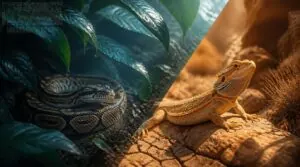
Snakes and lizards don’t just have different personalities — they need genuinely different environments to stay healthy. Getting those conditions right for one species often means getting them wrong for the other. Here’s a closer look at where their needs pull in opposite directions.
Temperature Gradient Differences
Snakes and lizards don’t just need different temperatures, they need entirely different thermal landscapes. Snakes thrive with a warmer ambient range of 75 to 90°F, while lizards require basking spots reaching up to 95°F alongside cooler retreat zones near 70°F.
Setting up that temperature range is easier than it sounds, especially if you follow a thermal gradient guide for reptile enclosures that walks you through zoning your setup from basking spot to cool retreat.
Squeezing both gradient profiles into a single enclosure without shortchanging either animal is practically impossible.
Humidity Requirement Conflicts
Humidity tells a similar story. Lizards often need 60-80% relative humidity, particularly in vertical hides where they retreat to shed comfortably, while snakes do best in drier conditions around 40-60%.
Trying to split the difference leaves both animals in a habitat that works for neither. Poor ventilation compounds this further, creating moisture pockets that encourage fungal growth and disrupt shedding.
UVB Lighting Needs
UVB lighting is where the gap really widens. Most lizards need a basking zone UVB index of 2 to 5, using a T5 or T8 bulb mounted directly above the enclosure.
Snakes don’t need any of this at all. Running UVB for your lizard creates conditions that don’t suit a snake, and sharing the same enclosure space makes that unavoidable.
Substrate and Hiding Spaces
For substrate, orchid bark and coconut husk fibers suit moisture-loving lizards well, but snakes prefer compact bedding that firmly holds their body as they move.
Hiding spots matter too. Lizards use concealed spaces for ambush and temperature regulation, while snakes need secure, snug hides that fit their full body length. A shared enclosure won’t meet both needs.
Basking Area Competition
The basking area is like prime real estate, and neither species will share it peacefully.
- Thermal zone overlap forces one species to overheat or go inactive
- Basking platform conflict cuts available resting space for both animals
- UVB access competition leaves one reptile calcium-deficient over time
- Basking spot hierarchy triggers stress and daily defensive posturing
Habitat separation eliminates these conflicts entirely.
Can Snakes Attack or Eat Lizards?

Yes, snakes can absolutely attack and eat lizards — and it doesn’t matter how well-fed your snake is when it happens. This isn’t just a size issue; it’s hardwired behavior that kicks in the moment a snake registers a lizard as prey. Here’s what you actually need to understand about how these conflicts unfold.
Instinctive Predatory Behavior
Snakes don’t need to be hungry to strike at a lizard. Prey recognition triggers fire automatically when a snake detects movement, body heat, or chemical scent, activating a fixed action pattern that plays out fast and instinctively. Visual depth perception helps them judge distance and time a strike with precision. Even a well-fed snake can still act on these cues.
A snake’s instinct to strike fires automatically on movement, heat, or scent — hunger has nothing to do with it
Lizard Territorial Aggression
Lizards don’t just wait to be attacked. Many species respond to an unfamiliar presence with territorial display behavior first, using head bobbing, lateral flattening, or dewlap extension to signal ownership of basking spots and shelter.
If the intruder doesn’t retreat, those displays escalate into chasing or outright biting. A snake moving through a lizard’s defended zone can trigger this fast.
Feeding-Time Conflicts
Territorial aggression aside, feeding time adds another layer of risk. A snake’s predator-prey instinct doesn’t switch off just because it’s already eaten.
Live prey risks cut both ways. If a lizard is nearby when prey is introduced, a misdirected strike is real.
Separate feeding stations and a staggered feeding schedule keep both animals safer and reduce cross-contamination between nearby enclosures.
Stress and Warning Signs
Chronic stress shows up fast in captive reptiles. Watch closely for hissing or tail lashing during routine handling, restlessness between feedings, and sudden refusal to eat.
Physical signs like muscle tension or labored breathing signal a reptile pushed well past its comfort zone. If your animal starts hiding constantly or striking without any clear provocation, that’s your clearest warning sign.
What Health Risks Does Cohabitation Create?

Even if snakes and lizards never come to blows, sharing a space still puts both animals at real risk. The health concerns go beyond what you can see at a glance, and some of them build up slowly enough that you might not notice until serious damage is done. Here’s what you need to watch out for.
Parasite and Mite Transmission
One of the quieter dangers of shared housing is how quickly external parasites spread. Snake mites travel through direct contact and contaminated substrate, meaning a single infested animal can seed the entire enclosure. These parasites survive off the host long enough to reach a second animal that never touched the first. Shared bedding and crevices make your reptiles easy targets.
Cross-Species Disease Exposure
Parasites aren’t the only threat. Viral pathogens like ferlaviruses and adenoviruses spread between snakes and lizards through shared air, contaminated surfaces, and water, making disease transmission a real ongoing concern.
- Airborne respiratory droplets from infected snakes can reach nearby lizards
- Contaminated substrate harbors adenovirus spores
- Shared water dishes easily transfer waterborne pathogens
- Handling without disinfection moves bacteria between both animals
Bites and Scratches
When cohabitation goes wrong, bites and scratches happen fast. A snake striking a lizard can cause puncture wounds and tissue damage, while lizard claws leave linear cuts that carry dirt and bacteria into the wound.
Clean it with soap and water for 5 to 10 minutes, apply gentle pressure, and watch for redness or swelling within 24 to 72 hours.
Chronic Stress and Illness
Stress that never lets up wears reptiles down in ways that aren’t always immediately visible. When your snake or lizard stays constantly on edge, stress hormone levels remain elevated, suppressing immune function and exposing animals to long-term health decline.
That’s why even a well-fed, parasite-free reptile can get sick when the body’s stress response never gets a chance to reset.
Quarantine Before Nearby Housing
Before housing any new reptile anywhere near your current collection, quarantine it first for 14 to 30 days in a completely separate space with no shared airflow. Use dedicated cleaning gear for that enclosure only.
During quarantine, check every 3 days for:
- Temperature changes
- Fecal test results
- External parasites or mites
- Visible wounds or behavioral shifts
Document everything you observe.
How Should Snakes and Lizards Be Housed?
Keeping snakes and lizards safe comes down to making smart, species-specific choices before problems have a chance to start. The good news is that with the right setup, both animals can thrive, just not in the same space. Here’s what that looks like in practice.
Use Separate Secure Enclosures
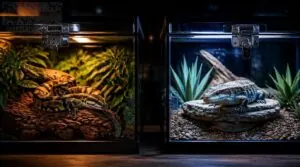
The simplest rule here is also the most important one: each reptile needs its own enclosure. Enclosure locking systems and independent climate control prevent accidental mixing and cross-contamination between species. Labeling each tank with species-specific care requirements keeps things clear, especially when multiple people share feeding duties. Separate, secure enclosures aren’t just safer, they’re the foundation of responsible reptile keeping.
Customize Each Habitat
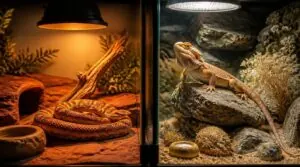
Once you have separate enclosures in place, the real work begins: dialing in each habitat to match its resident’s exact needs. A corn snake, for instance, thrives with an 82-92°F warm side and a cool retreat around 75°F, while a bearded dragon needs basking spots reaching 95°F and daily UVB exposure for 10-12 hours.
Feed Reptiles Separately
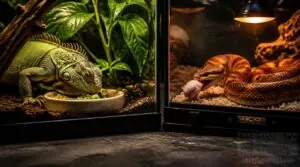
Even a well-fed snake can strike at a nearby lizard during feeding, drawn by prey scent alone. Keep these four practices consistently in place:
- Feed in separate enclosures to eliminate predation risk.
- Use species-specific prey and avoid similar items nearby.
- Gut-load feeder insects before offering them to lizards.
- Log every feeding session to track appetite and spot health issues early.
Prevent Unsupervised Contact
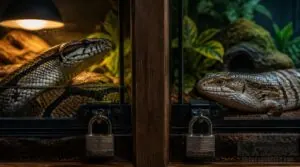
Once feeding is handled, the next piece of the puzzle is making sure your reptiles can’t reach each other when you’re not watching. Secure enclosure locks aren’t optional here. A determined snake can push against a lid with surprising force, and even brief contact between species can trigger aggression, injury, or serious stress.
Dedicated handling zones and separate feeding schedules keep accidental crossover from happening during the moments you’re most distracted.
Monitor Health and Behavior
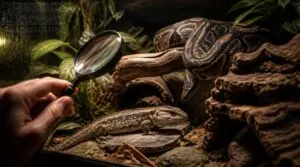
Keeping a close eye on each reptile is the last line of defense in good husbandry. Watch for feeding refusal, lethargy, or breathing irregularities like wheezing, since these signal trouble early.
Check skin condition after every shed. Any patchiness or retained shed warrants a closer look.
Behavioral shifts, like hiding more than usual, often appear before physical symptoms do.
Frequently Asked Questions (FAQs)
Do lizards and snakes get along?
Not really. Snakes and lizards rarely coexist peacefully because instinctive predatory behavior, territorial aggression, and mismatched habitat needs create stress and safety risks for both animals from the start.
What reptiles can live with each other?
Most reptiles do best with their own species, and even then, only when size and temperament match closely. Compatible pairs are rare and always require careful observation before any shared housing is considered.
What is the best animal to keep snakes away?
No single animal is best. Guinea fowl actively patrol and attack snakes, dogs deter through territorial behavior, and cats alert to smaller species. Your best choice depends on your property and lifestyle.
Are snakes attracted to lizards?
Yes, snakes are drawn to lizards. They detect them through heat signatures, movement, and chemical scent cues on the skin, triggering instinctive predatory responses even in well-fed snakes that aren’t actively hunting.
What types of snakes and lizards get along the best?
Corn snakes and crested geckos sit at the lower end of the risk scale, but calm temperaments and similar sizes only reduce danger, they don’t remove it. Separate enclosures are still the safest option.
Can snakes and lizards recognize each other as threats?
Think of it like a built-in alarm system on both sides. Lizards sample snake chemical cues through their Jacobson’s organ and retreat. Snakes read rapid movement as a clear trigger for predatory or defensive response.
How often should reptile enclosures be cleaned and sanitized?
Remove waste and refresh water daily. Disinfect dishes, substrate, and surfaces weekly. Do a full enclosure reset monthly to clear debris that routine cleaning misses.
What substrates work best for desert reptile species?
Desert reptiles need moisture to shed properly, yet too much dampness causes illness. Fine, untreated sand helps with burrowing and temperature regulation, while a deeper substrate layer gives your desert lizard room to thermoregulate safely underground.
Can reptiles experience loneliness or benefit from enrichment?
Reptiles don’t experience loneliness the way mammals do, but they respond well to environmental enrichment. Novel objects, varied substrates, and climbing structures encourage exploratory behavior and reduce stress, keeping your reptile healthier over time.
Are some reptile species safer as beginner pets?
Leopard geckos, corn snakes, and bearded dragons are among the most beginner-friendly choices because they tolerate regular handling, have simple enclosure setups, and don’t need complex humidity control or specialized diets to stay healthy.
Conclusion
Noah’s Ark may have housed every creature side by side, but the biology of real reptiles doesn’t work that way. Can snakes and lizards live together? Rarely, and only under conditions most home enclosures simply can’t provide.
Each species evolved for its own niche, its own temperature gradient, its own sense of calm. Respect that biology. Give every reptile in your care its own dedicated space, and you give it a genuine chance at thriving.