This site is supported by our readers. We may earn a commission, at no cost to you, if you purchase through links.
Over 800 recognized morphs exist for a single species, all traced back to one wild-caught orange snake with black saddles. That’s the corn snake’s genetic playground, and breeders have spent decades mixing pigment mutations into colors nature never planned.
You’ll find snakes that look frosted in snow, others glowing like drops of blood, and some so pale they seem carved from lavender soap. Each pattern comes from tiny genetic switches flipping on or off.
Whether you’re hunting for your first pet or comparing popular corn snake morphs with pictures and facts before your next purchase, knowing what makes each one tick helps you choose wisely and appreciate the genetics behind the beauty.
Table Of Contents
- Key Takeaways
- Corn Snake Morph Types and Genetics
- Classic Corn Snake Morphs With Pictures
- Popular Color Morphs With Pictures
- Popular Pattern and Specialty Morphs
- Comparing Corn Snake Morphs Before Buying
- Frequently Asked Questions (FAQs)
- What is the rarest cornsnake morph?
- How to tell what morph your corn snake is?
- What is the rare color of corn snakes?
- What is the darkest corn snake morph?
- How much does a palmetto corn snake typically cost?
- What is the average price range for a blizzard corn snake?
- Can you provide a picture of a striped corn snake?
- How often do corn snake morphs shed?
- Can different morphs breed together successfully?
- Do morphs affect corn snake lifespan?
- Conclusion
Key Takeaways
- Every one of the 800+ corn snake morphs traces back to a single wild orange-and-black snake, with breeders using recessive, dominant, and codominant genes to create colors nature never intended.
- Morphs fall into color, pattern, or combination categories, while locality types like Okeetee or Miami Phase come from wild geographic variation rather than lab breeding.
- Prices vary widely based on rarity and complexity, with normals running $30-$80, snow and lavender morphs landing at $60-$200, and premium combos like palmetto climbing past $1,000.
- No matter how flashy the morph, every corn snake needs the same basic care (an 82-88°F gradient, weekly feeding, and a 40-gallon tank), so genetics affect looks and price, not husbandry.
Corn Snake Morph Types and Genetics
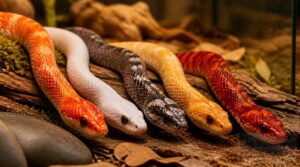
Corn snakes come in a wild range of colors and patterns, and it all comes down to genetics. Before you fall in love with a particular look, it helps to know what’s actually creating it. Let’s break down the different morph types and how breeders make them happen.
For a deeper dive into recessive, dominant, and co-dominant traits, this complete guide to corn snake morphs breaks down how each combination gets its unique look.
Color, Pattern, and Combination Morphs
Three buckets, endless combos. Color morphs like amelanistic albino, anerythristic anery, or lavender morph shift pigment. Pattern morphs rearrange saddles. Combination morphs (think Blood Red x tessera) stack traits for wild results.
- Fiery orange amelanistic albinos
- Smoky gray anerythristic anerys
- Pastel purple lavender morphs
Locality types differ too, that’s next.
How Genetics Create Corn Snake Morphs
So how does a snake go from plain brown to snowy white? Blame genetic mutations in pigment cells. Melanophores, xanthophores, and iridophores control color, and glitches there create the amelanistic albino, anerythristic anery, or lavender morph. Recessive alleles need two copies to show; codominant ones mix. Timing matters too, since gene expression shifts mid-development change color boundaries.
Breeders have developed over 800 recognized corn snake morphs through selective breeding of pigment mutations.
Locality Types Versus Genetic Morphs
Ever wonder why an Okeetee corn snake looks different from one bred a state away? That’s geographic origin, not a lab-made mutation. Localities like Okeetee or Miami Phase reflect wild population variation.
Genetic morphs, like scaleless or palmetto, come from captive breeding and follow clear inheritance patterns, appearing across many lineages rather than one hometown.
Selective Breeding and Trait Pairing
Breeders don’t just hope for cool colors, they plan them. Pairing a color morph with a pattern morph uses basic Mendelian inheritance to predict offspring, though polygenic traits keep results interesting. Smart pairings create the combination morphs collectors chase:
- Snow x Motley
- Bloodred x Stripe
- Lavender x Palmetto
- Amelanistic x Tessera
- Anerythristic x Avalanche
Responsible Corn Snake Breeding
Good genetics mean nothing without good ethics behind them. Responsible breeders track lineage, quarantine new stock 6-8 weeks, and run health checkups before pairing.
| Practice | Purpose | Frequency |
|---|---|---|
| Lineage records | Prevent inbreeding | Every hatchling |
| Genetic testing | Confirm morph authenticity | Before pairing |
| Health clearances | Reduce disease | Pre-breeding |
| Buyer education | Support ownership | Every sale |
| Welfare audits | Track survival rates | Yearly |
Classic Corn Snake Morphs With Pictures
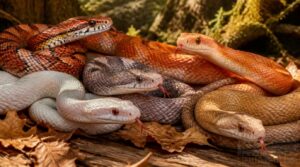
Before you get to the fancy designer stuff, it helps to know where it all started. These five classics are the foundation every breeder builds on, from wild-caught roots to the first big color breaks. Let’s meet the corn snakes that started it all.
Once you’ve got these classics down, dive into our guide to the best corn snake morphs to see how far selective breeding has taken this hobby.
Normal Wild-Type Corn Snake
Picture that classic orange body with brown saddles marching down the back, that’s the Normal Wild-Type, nature’s original blueprint.
Wild ones roam southeastern grasslands, climbing shrubs and hunting rodents at dusk. They’re shy but calm, reaching 4-5 feet. Females lay 10-30 eggs each spring, hatching in 60-70 days. Genetics haven’t touched this one yet.
Okeetee Corn Snake
Fire in scale form, that’s the Okeetee, and it’s often called the standard of locality-based Corn Snake Morphs.
Okeetee color intensity runs deep red to burnt orange, with black-bordered saddles widening toward midbody. Ventral markings show a crisp checkerboard, while head tones glow orange-yellow and eye color leans reddish-orange.
Five standout traits:
- Bold saddle borders
- Vivid orange base
- Checkered belly
- Warm-toned head
- Selective breeding refinement
Miami Phase Corn Snake
Ever seen a snake that looks like it’s wearing a silver raincoat over orange flames? That’s the Miami Phase corn snake, named for its Southeastern United States range around old Florida populations, not any club like the Okeetee Hunt Club origin story.
Its gray ground color stays cool and silvery, with smaller, tighter saddle blotches than most morphs, and that pattern consistency holds from hatchling to adult.
- Smaller, compact orange-red saddles
- Minimal side banding for a sleek look
- Larger clutch sizes than average
- Feeding response can lag early on
Breeding stability depends on keeping phase lines pure since crossing dilutes that signature gray.
Amelanistic Albino Corn Snake
Strip away the black pigment and you get pure fire: the Amelanistic Albino Corn Snake, glowing orange and white with pink eyes. That eye color comes from an OCA2 mutation blocking melanin. Saddle patterns stay intact, just brighter.
Strip away the black pigment and the Amelanistic Albino Corn Snake blazes pure orange and white, its pink eyes born from a melanin-blocking mutation
Pair two amels and they breed true every time. Prices run $30-$80, budget-friendly for beginners craving classic reptile genetics.
Anerythristic Anery Corn Snake
No red, no orange, just cool grays and blacks with a silvery edge. That’s Anerythristic Anery genetics at work, a recessive trait needing two copies. Anery color traits create striking black-bordered saddles.
- Grayscale to black body
- Black-white checkered belly
- 3-5 foot adult size
- $30-$80 price range
- Combines well with other morphs
Popular Color Morphs With Pictures
Once you’ve met the classics, it’s time to see what breeders can really do with color. These morphs take the basics and push them into brand-new shades, from soft pastels to bold, saturated hues. Here are five color morphs that show off just how varied a corn snake’s palette can get.
Snow Corn Snake
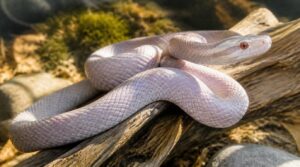
When you stack the Amelanistic Albino and Anerythristic Anery genes together, you get the Snow Corn Snake, a pale beauty with lavender or pinkish accents. Adults run 3 to 4.5 feet, with reddish eyes and faded saddle markings.
This genetic combo makes them genuinely rare, so expect prices on the higher end for such striking color morphs.
Caramel and Butter Corn Snakes
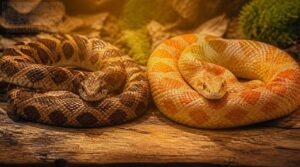
After Snow’s icy pastels, Caramel and Butter bring the warmth back. Caramel shows a brown base with golden undertones and hollowed blotches; Butter goes bolder, with a lemony-yellow ground and crisp orange saddles that catch light with a faint rainbow sheen.
Prices land mid-tier, and both morphs deepen in contrast as they mature.
Bloodred Diffused Corn Snake
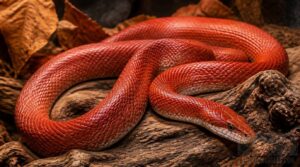
Butter’s rainbow sheen is nice, but if you want a snake that looks like it’s on fire, meet the Bloodred Diffused corn snake. Genetic mutations here erase side patterns, boosting color intensity into a near-solid red. Pattern reduction and belly clarity go hand-in-hand, especially when paired with Masque. Easy morph identification: clean saddles, brick-to-scarlet tone, minimal black edging.
Lavender Corn Snake
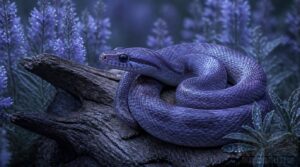
After all that fire and intensity, here’s a color shift that feels like stepping into moonlight. The lavender morph carries a recessive gene, cooling reds into soft gray-purple with dark eyes, not pink ones.
- Hatchlings often look muddy brown before true color emerges
- Two carrier parents are needed to produce lavender offspring
- Combo morphs (lavender pinstripe, lavender motley) expand the look
- Cooler temps intensify pattern, warmth fades it slightly
Care stays standard corn snake fare, just watch lighting for accurate color.
Blizzard Corn Snake
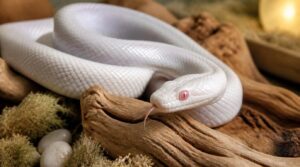
Ghostly and near-white, the Blizzard corn snake trades saddle patterns for a pale, glossy canvas with pink eyes. It comes from recessive albino genetics layered onto normal coloring, staying stable into adulthood.
Expect 3 to 5 feet in length, 15 to 25 years of life, and easy feeding on appropriately sized mice every 7 to 14 days once grown.
Popular Pattern and Specialty Morphs
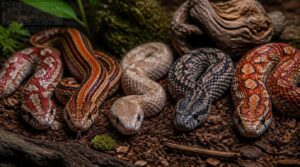
Color is only half the story with corn snakes. The other half comes down to pattern, texture, and those wild genetic combos breeders love stacking together. Here are five morphs that prove pattern can be just as eye-catching as color.
Motley and Stripe Corn Snakes
Ever seen a snake wearing polka dots next to one wearing pinstripes? That’s motley and stripe, basically.
Motley scatters circular blotches down the back with dashed sides, while stripe runs two bold parallel lines.
Combine them and you get MotleyStripe, blending dots and lines with varied head patterns and warm tan-to-gold contrast.
Tessera Corn Snake
Picture a single racing stripe running nose to tail instead of stacked saddles, that’s Tessera. This dominant pattern morph replaces blotches with pattern lateral patterning, plus tan-to-orange tones and head-neck alignment. Stripe clarity varies, some broken, some solid. Since it’s dominant, one gene copy shows the trait, making visual het identification trickier when allelic combinations produce subtler pattern reduction.
Palmetto Corn Snake
Some morphs whisper, but Palmetto shouts in white and red. This recessive inheritance trait needs two carrier genes to show, producing a pale body with scattered spots, no two arrangements alike. Forget saddle blotches, this pattern’s all about random confetti-like speckling.
Care stays standard corn snake fare: 20-gallon tank, 75-85°F gradient, mice every week or so. Combination potential? Huge, breeders love stacking Palmetto with other genes for wild designer results.
Scaleless Corn Snake
Run your hand down one of these, and you’d swear the scales just quit. The scaleless trait is recessive, needing two carrier parents, and it doesn’t touch head or eye structure, just skin texture and pigmentation changes across whatever pattern variations it’s paired with.
- Keep humidity between 40-60% to prevent shedding trouble
- Use smooth substrate to avoid skin abrasions
- Handle gently, supporting the whole body
- Watch closely during sheds every 4-6 weeks
That sensitivity means extra care, but steady hands make it manageable.
Avalanche and Designer Combinations
Frosted and pale, the avalanche color blending turns a corn snake almost ghostly under bright light. Breeders pair it with sulfured or scale-reduced traits for designer morph combinations, keeping strong pattern contrast between blotch and body.
These compound morphs rely on tracked lineage for stable genetic traits, so pattern variations stay predictable generation after generation.
Comparing Corn Snake Morphs Before Buying
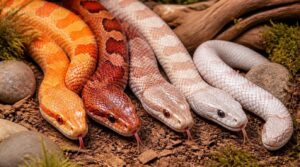
So you’ve fallen for a few morphs and now what? Picking a corn snake isn’t just about looks—price, care, and personality all factor in too. Let’s break down what actually separates one morph from another.
Colors and Patterns With Age
Since genetic mutations don’t freeze color in place, expect real shifts as your snake grows.
- Juvenile color vibrancy fades into deeper, muted tones
- Orange and red pigment concentration intensifies with maturity
- Pattern softening occurs as scale wear settles edges
Yellow underlays mute, blacks shift subtly with shedding. That hatchling’s crisp look won’t last forever, and that’s perfectly normal.
Typical Morph Price Ranges
Colors change over time, but so does your wallet.
Budget morph ranges like normals and amelanistic run $30 to $80, while snow and lavender sit at $60 to $200.
Premium designer costs for palmetto or complex combos climb to $300, sometimes past $1,000.
Scaleless traits? Tack on a 50 to 100% premium.
Juveniles cost less than proven adults.
Care Needs Across Morphs
Here’s the good news: your wallet takes the hit, not your care routine.
Every morph needs the same 82 to 88°F gradient, weekly feeding schedule, and 40-gallon enclosure.
Scaleless snakes just need slightly higher humidity to protect their bare skin.
Handle gently, in short sessions, regardless of pattern.
Genetics change looks, not husbandry.
Best Morphs for Beginners
So which morph should you actually start with? Normal wild-types top the list, they’re hardy, predictable, and easy to read.
Amelanistic, caramel, and butter morphs follow close behind, calm temperaments and simple care needs.
Skip scaleless or palmetto morphs your first year, they demand extra handling care beginners haven’t mastered yet.
Choosing a Healthy Corn Snake
Forget flashy colors for a second, health comes first. Check for clear, bright eyes, smooth skin, and a clean vent.
- Eyes with no discharge
- Even body muscle, no visible ribs
- Steady weight, consistent girth
- Calm, predictable temperament
Regardless of morph identification, genetic screening reduces future health concerns. Good care requirements start with a snake that’s already thriving.
Frequently Asked Questions (FAQs)
What is the rarest cornsnake morph?
Rarity often comes down to stacked recessive alleles, unstable documentation, and tiny breeder pools.
True investment-level rarities combine multiple rare traits, like the scaleless corn snake crossed with locality-based lines, verified through genetic screening records and long-term health data.
How to tell what morph your corn snake is?
Picture a breeder spotting red eyes and pale orange scales, that’s an amelanistic clue. Check color base, pattern features, eye tone, and scale texture together, since genetic traits rarely show just one telltale sign alone.
What is the rare color of corn snakes?
Palmetto, Opal, and Lavender top the list, each rare for stacking multiple genes. Palmetto’s charcoal speckling, Opal’s patternless red-eyed glow, and Lavender’s pastel-gray mix make these the corn snake world’s true showstoppers.
What is the darkest corn snake morph?
Ever wonder which snake looks like it slithered out of shadow? Anerythristic and Charcoal morphs win, using pigment suppression to erase warm tones, leaving bold black borders and a cool toned, near black-and-white checkerboard appearance under dim lighting.
How much does a palmetto corn snake typically cost?
Expect to pay $400 to $800 for a solid palmetto, with clean patterns and strong lineage pushing prices toward $1,000. Eye quality, breeder reputation, and regional demand all shift the final number.
What is the average price range for a blizzard corn snake?
Ghost-white one day, faint blush the next: blizzard corn snake pricing swings just as much. Hatchlings start near $100, while pedigreed adults with proven genetic traits from selective breeding can climb toward $300, occasionally higher.
Can you provide a picture of a striped corn snake?
Picture a striped corn snake running three to four pale lines head to tail, no big blotches. Genetics pair with morph colors like anery or classic, so pattern variations and shading differ snake to snake, even within the same clutch.
How often do corn snake morphs shed?
Like clockwork turning faster in youth, hatchlings shed every 4-6 weeks, adults slow to every 6-8 weeks. Humidity, growth rate, and hydration drive the pace, not morph genetics.
Can different morphs breed together successfully?
Yes, breeding different morphs works well thanks to strong genetic compatibility across corn snake lines. Trait inheritance follows predictable patterns, so combination morphs and unique offspring variation happen naturally through careful, selective breeding practices.
Do morphs affect corn snake lifespan?
Not really. With consistent husbandry, most morphs, amelanistic included, hit the same 15-25 year range. Genetic health stays stable across popular lines. Rare fragile morphs are the exception, so always ask breeders about longterm health data before buying.
Conclusion
The wildest part about corn snakes? The more unnatural their colors look, the more they prove nature’s own code at work. That contradiction is exactly why exploring the most popular corn snake morphs with pictures and facts feels like uncovering a secret language hidden in scales.
Whether you fall for a fiery Bloodred or a ghostly Lavender, you’re choosing a tiny, living piece of genetic art.