This site is supported by our readers. We may earn a commission, at no cost to you, if you purchase through links.

Pair two normal-looking corn snakes and you might get a clutch full of pastel lavender hatchlings, animals worth three to four times more than their wild-type siblings. That’s the quiet magic of recessive genetics at work. Neither parent shows a hint of purple, yet each carries a hidden allele waiting for the right match.
Breeders chase this result for good reason: lavender corn snake breeding rewards patience and precision more than luck. Get the Punnett square math wrong, skip a health screening, or fumble incubation temps, and you’ll lose clutches or produce animals nobody wants to buy.
Get the fundamentals right, though, and you’re looking at a repeatable formula for gorgeous, healthy hatchlings and a reputation buyers trust.
Table Of Contents
- Key Takeaways
- How Lavender Corn Snake Genetics Work
- Prepare Healthy Lavender Breeding Pairs
- Pair Lavender Corn Snakes Safely
- Incubate Lavender Corn Snake Eggs
- Hatch, Raise, and Document Lavender Offspring
- Frequently Asked Questions (FAQs)
- Are lavender corn snakes rare?
- What is the rarest cornsnake morph?
- What’s the easiest snake to breed?
- How big do lavender corn snakes get?
- How can you identify the sex of a lavender corn snake?
- What permits are required for breeding corn snakes?
- How do you find reputable lavender corn snake buyers?
- Can lavender corn snakes breed with other species?
- What records should breeders maintain for lineage tracking?
- How do you quarantine new breeding stock properly?
- Conclusion
Key Takeaways
- Lavender only shows up when two carriers pair up, since it’s a recessive trait—normal-looking parents can each hide one silent copy and still produce 25% lavender hatchlings in a clutch.
- Successful breeding depends on more than genetics: healthy, unrelated adults at proper weight, vet-screened for parasites, and conditioned through brumation before you even introduce a pair.
- Incubation makes or breaks the clutch, so keeping temps steady at 80-81°F and substrate moisture around 60-70% is what stands between healthy hatchlings and kinked spines or lost eggs.
- Careful pedigree tracking and legal compliance protect both your reputation and your snakes, since verified lineage boosts prices 20-40% while sloppy records risk accidental inbreeding down the line.
How Lavender Corn Snake Genetics Work
Genetics might sound intimidating, but lavender inheritance actually follows a straightforward pattern once you see it laid out. Every successful breeding decision starts with understanding how that recessive gene gets passed down and expressed. Here’s what you need to know before pairing up your snakes.
If you’re curious how lavender compares to other simple recessive traits, this guide to axanthic ball python morphs and genetics breaks down the same inheritance basics from a different angle.
Since lavender is just one piece of the puzzle, it helps to see how it fits alongside other common ball python morph types before you start planning pairings.
Recessive Lavender Gene Inheritance

Lavender works as a recessive gene, meaning full color only shows up through homozygous recessive allele pairing, one copy from each parent. A single copy makes your snake a silent heterozygous carrier, no lavender visible, but the allele’s passed down anyway. That’s the sneaky part of Mendelian inheritance patterns: looks can lie. Carrier detection often means test breeding or checking pedigrees.
Lavender hides in silent carriers for generations, one copy passed down invisibly until two recessive genes finally meet
Understanding autosomal recessive inheritance is essential for predicting trait expression in offspring. autosomal recessive inheritance
Predicting Offspring With Punnett Squares
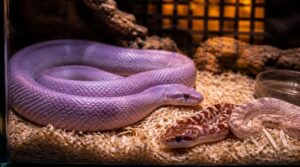
So how do you actually forecast what hatches? Grab a Punnett square: a simple grid mapping each parent’s gametes to predict genotype odds. Three things it reveals:
- Exact allele combinations possible
- Genotype-to-phenotype odds
- Mendelian ratios like 1:2:1
Two carriers (Aa x Aa) produce 25% lavender, 50% carriers, 25% wild-type, pure math, no guesswork.
Carrier Pairings and Expected Ratios

Pair two carriers, and math takes over: 25% lavender, 50% carriers, 25% wild-type. Pair a carrier with a non-carrier? Zero lavender hatchlings, though 50% may still carry the gene silently.
Carrier probability compounds fast in mixed pedigrees. That’s why pedigree verification and, when possible, genetic testing matter, guesswork breeds disappointment, not lavender snakes.
Combining Lavender With Other Morphs
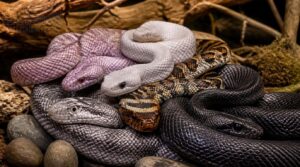
Once you’ve got lavender locked in, why stop there? Layer in snow, tiger, anerythristic, black night, or buttermilk genetics for designer morphs worth $200-$500+. Each combo needs both parents carrying the target recessive alongside lavender, since recessive traits don’t compromise.
Pedigree tracking becomes non-negotiable here, stacking genes without documentation is how breeders lose track fast.
Verifying Genetics and Pedigrees

Once you’re stacking morphs, sloppy records will bite you. Build a real pedigree: squares for males, circles for females, filled shapes marking affected traits.
This confirms inheritance patterns and flags heterozygous carriers hiding behind normal coloring. Track lineage across generations using roman numerals, since affected offspring from unaffected parents always signal recessive genetics at work, not guesswork.
Prepare Healthy Lavender Breeding Pairs
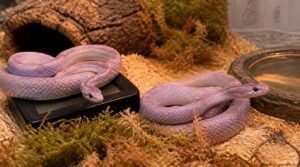
Good genetics only get you so far if the snakes behind them aren’t ready to breed. Pairing lavenders successfully takes more than tossing two adults together and hoping for the best. Here’s what you need to check off before you even think about introductions.
It’s also worth confirming your paperwork is in order first, since some states like Texas require a $60 controlled snake permit before you can legally breed, and this guide to exotic snake ownership requirements breaks down what to check.
Choosing Unrelated, Compatible Adults
Good genetics mean nothing if your pair shares a family tree. Genetic lineage verification and pedigree documentation should show no common ancestors within three to four generations.
Cross-check pedigree records, favor geographic origin diversity, and confirm health screening compliance plus temperament compatibility before pairing any heterozygous carrier or confirmed lavender in your breeding pairs.
Age, Weight, and Body Condition
Sexual maturity hits around 2-3 years, but don’t breed on age alone. Wait for 400-600 grams minimum, ideally 900-1500 grams for adults.
Score body condition on a 1-5 scale, aiming for that solid 3. Track weight monthly and watch growth rate: hatchlings pack on 10-20 grams weekly,0 grams weekly, then stabilize by year two or three.
Feeding your hatchling the right prey at the right size makes all the difference, so check out this guide to the best food for baby snakes to keep that growth steady.
If growth stalls or weight suddenly drops, the troubleshooting guide for common snake breeding problems walks you through likely culprits and fixes.
Prebreeding Health and Parasite Screening
A snake that looks fine can still harbor parasites. That’s why breeding pairs need a full vet exam first: fecal flotation for nematodes and coccidia, PCR testing for Cryptosporidium, plus blood work checking organ function. Your reptile veterinarian scores body condition and inspects skin, eyes, and vent.
Skipping genetic screening and parasite checks risks passing disease straight into your clutch.
Conditioning and Brumation Options
Cooling triggers reproduction. Cool your pairs to 50-60°F for 8-10 weeks, mimicking winter, then rewarm gradually.
- Temperature control: daytime 84-88°F, dips to 78-82°F nights
- Photoperiod adjustment: 12-14 hours light
- Fresh water year-round; monitor hydration
- Health checks weekly, watching weight and stool
Skip feeding during brumation. Resume small meals post-brumation once temperatures stabilize.
Ethical and Legal Breeding Duties
Breeding lavenders isn’t just genetics, it’s paperwork too. Check your state’s rules: California requires an $83.95 propagation permit, Texas needs a $60 commercial license, Virginia caps possession at five snakes.
Keep two years of records, disclose lavender’s known health quirks to buyers, and vet enclosures before selling. Ethical breeding protects your reputation and every hatchling’s welfare.
Pair Lavender Corn Snakes Safely
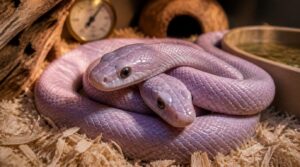
Your snakes are conditioned and ready, so now comes the part that actually gets you eggs: pairing them up. Timing and technique matter here just as much as genetics did earlier, since a rushed or mismatched introduction can set your whole season back.
Here’s what you need to know, from picking the right week to building a lay box your female will actually use.
Timing The Corn Snake Season
Once your snakes finish your snakes brumation period at 50-60°F, gradual warming triggers spring readiness. Watch for feeding resumption, that’s your cue reproductive hormones are kicking in.
Introduce males late winter to early spring, staggering pairings over 2-4 weeks. Track dates carefully; timing directly shapes clutch success for your breeding pairs.
Introducing The Breeding Pair
Timing sets the stage, but a staged introduction protects your pair. Start with visual contact behind a barrier, then full contact if calm.
Watch for:
- Tongue flicking and tail pairing
- Relaxed, non-aggressive following
- Zero biting or wrestling
Record every date and outcome. Genetic pairing means nothing if your lavender lineage gets injured before copulation even starts.
Recognizing Courtship and Copulation
Once your pair tolerates contact, courtship kicks in fast. Watch for red-orange saddle flashes, tail coiling, and the male trailing close with rhythmic tongue-flicks reading her pheromones.
| Signal Type | What You’ll See |
|---|---|
| Visual | Color flashes, coiling |
| Sensory | Tongue-flicks, vibrations |
| Postural | Neck grip, alignment |
| Synchrony | Pacing shifts |
| Copulation | Brief cloacal contact |
Copulation itself runs short, often just minutes, then they separate and reset.
Tracking Ovulation and Prelay Shed
After mating ends, your job shifts to detective work. Ovulation hits roughly two weeks post-surge, so watch for:
- Abdominal swelling and softer body tone
- Spiking activity, tolerance, or rubbing behavior
- Prelay shed within 24-72 hours after
Log each cycle date. Consistent tracking here sets up smart lay box timing later.
Preparing a Secure Lay Box
Egg-laying time calls for a nest that’s calm, clean, and rock-solid on temperature stability. Use a tub with tight lids, deep aspen bedding, and mesh venting.
| Feature | Material | Purpose |
|---|---|---|
| Box | Plastic tub | Security |
| Bedding | Aspen/coconut | Moisture |
| Vent | Fine mesh | Airflow |
| Monitor | Probe thermometer | Stability |
| Cleaning | Reptile-safe wipes | Hygiene |
Sanitize between clutches, always.
Incubate Lavender Corn Snake Eggs
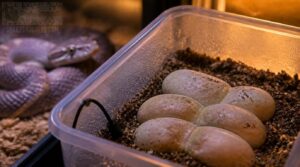
Eggs are laid, but the real work is just getting started. From here on out, precision matters more than instinct—temperature swings and moisture guesswork are what turn a promising clutch into kinked or lost hatchlings. Here’s what you need to get right, step by step.
Before your eggs even pip, it’s worth sorting out the paperwork trail—our guide on navigating Lacey Act compliance and Article 10 certification for captive-bred reptiles walks through what to line up early.
Beyond incubation, keep an eye on shedding too, since a milky film lingering over the spectacle can point to signs of an incomplete snake shed that needs your attention.
Collecting, Marking, and Candling Eggs
Found your clutch? Don’t touch it yet. Wait until laying finishes, usually within hours, then collect gently without rotating eggs.
Mark each shell’s top with a non-toxic dot for orientation.
Candle 7-10 days later: darken the room, hold a bright light behind the shell. Fertile eggs reveal veins and embryos; track the air cell’s edge for growth.
Setting Stable Incubation Temperatures
Once eggs are marked, temperature control becomes your top priority. Keep incubation temperature between 80-81°F (26.7-27.2°C), since anything above 82°F raises spinal kinking risk.
Thermal fluctuation effects compound fast: swings over 2°F stress embryos daily. Calibrate your thermometer monthly, use two probes for the best range maintenance, and preheat 12 hours before loading.
Stable heat protects the genetic inheritance you’ve worked hard to produce.
Balancing Substrate Moisture and Humidity
Get moisture wrong and you’ll open the box to shriveled eggs or a moldy mess, no in-between. Aim for 60-70% substrate moisture, checked with a probe meter reaching the center.
Layer dry substrate over a damp base for buffering. Orchid bark with sphagnum beats plain vermiculite for stability. Pair this with steady 82-86°F temps, since heat spikes dry substrate fast if humidity isn’t compensated.
Monitoring Mold and Egg Viability
Mold doesn’t knock, it just shows up. Candle every egg at day 7 and 14: check air cells, veining, translucency. Isolate moldy eggs immediately in a biohazard bag with sterile gloves. Log outcomes by egg ID.
- Dark, veined yolk: healthy
- Pale, clear center: failing
- No growth by day 14: pull for observation
Reducing Kinks and Hatch Failures
A kinked spine usually traces back to one thing: temperature stability. Keep incubation temperature at 80-81°F, swings under 0.5°F daily.
Pair that with steady humidity management, 45-55% humidity, correct substrate moisture, and thorough egg candling at day 7 and 14.
Genetic screening during breeding season also matters, since double-recessive combos already run lower hatch rates before incubation even starts.
Hatch, Raise, and Document Lavender Offspring
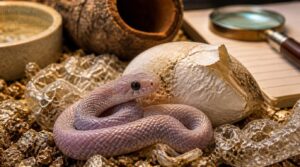
Those eggs finally split open, and now the real work begins. Every hatchling needs the right start—from that first shed to its first meal to a permanent home in your records. Here’s what you need to know, step by step.
Managing Pipping and First Shed
That first crack in the shell is the payoff for weeks of careful humidity management. Pipping starts 12-48 hours after viability, finishing within 24-72 hours. Keep temps steady at 80-85°F, humidity 75-85%. Don’t assist unless stuck days later. Resist poking eggs.
First shed follows roughly a week post-hatch, once hydration and energy reserves stabilize.
Setting Up Hatchling Enclosures
Once that first shed is done, it’s time to build a proper home. A 20-gallon long works great for 1-2 hatchlings through 3-6 months. Line it with aspen shavings or paper towels, add two hides, a shallow water dish, and a warm end at 88-92°F dropping to 72-78°F at night.
Starting First Meals Safely
Once the enclosure’s set, watch for readiness: alert eyes, active tongue flicks, restless movement near dusk.
Offer a pinky mouse (frozen-thawed, warmed) after that first shed, roughly one week post-hatch. Feed every 5-7 days at this age. Use tongs, never bare hands, and keep the setup quiet.
Skip force-feeding; patience beats pressure in reptile nutrition.
Identifying Morphs and Health Issues
Once feeding’s steady, turn your eye to the color itself. True lavender shows pale lilac tones with reduced melanin, strong saddle contrast, and muted red shading, consistent across sheds.
Watch for cloudy eyes, wheezing, or scale rot signs. Cross-check against pedigree records, since carriers can hide in "normal" lines without visible lavender parents.
Recording Pedigrees, Pricing, and Sales
Paperwork is where good breeders separate themselves from hobbyists. Assign each hatchling a unique ID, log parent lineage, hatch date, and morph status. This pedigree tracking proves recessive gene inheritance and prevents accidental pairing of related snakes down the line.
Price by clarity and condition, usually $150-$900. Verified genetics add 20-40% premium. Include bills of sale, health guarantees, and compliance records for every transaction.
Frequently Asked Questions (FAQs)
Are lavender corn snakes rare?
Rare is relative: not lavender corn snakes. As a recessive gene morph, they’re common in the hobby, priced $75-$200, widely stocked through steady breeder supply cycles and growing online market availability across US and European sellers.
What is the rarest cornsnake morph?
Honestly, it depends who you ask.
Scaleless morphs stay genuinely scarce due to low hatch rates, while albino lavender, ghost, caramel, and ultramel combos rank high too, since stacking recessive genes into designer morphs like plasma lavender only shrinks the odds further.
What’s the easiest snake to breed?
Talk about a slither of luck: corn snakes take the crown. They’re a top beginner snake species, breeding reliably with minimal handling, simple incubation setups, and reliable egg production by 18 to 24 months old.
How big do lavender corn snakes get?
Most lavenders settle in the 3 to 5 foot range, with males topping near 4 feet and females stretching further. Growth continues 18-36 months on good feeding, and rare females push close to six feet.
How can you identify the sex of a lavender corn snake?
Flipping your snake over and guessing is basically fortune-telling with scales. Visual tail comparison, cloacal bulge assessment, and probing depth accuracy actually confirm sex, especially once your corn snake hits 12-18 months old.
What permits are required for breeding corn snakes?
Requirements vary by state, so check yours before pairing snakes. Many states require commercial propagation permits for wild-type corn snakes, but exempt distinct morphs like lavender.
Federal CBW registration only applies if species fall under Endangered Species Act protections.
How do you find reputable lavender corn snake buyers?
Start with verifying buyer reputation on MorphMarket or Kingsnake, checking marketplace reviews and pedigree requests. Attend reptile expos, assess breeder transparency, and confirm legal compliance before trusting any lavender morph sale to reputable buyers.
Can lavender corn snakes breed with other species?
Like mules born from horses and donkeys, hybrids sound tempting but rarely work out clean.
Corn snakes crossed with rat snakes hit real species compatibility barriers, lower hatch rates, genetic health risks, and legal restrictions apply in many regions.
What records should breeders maintain for lineage tracking?
Good lineage tracking means parentage confirmation, genetic test logs, offspring ID tracking, and health record correlation.
Every sire, dam, and clutch gets tied to verified pedigrees, so trait inheritance, carrier status, and proven lines stay accurate across generations.
How do you quarantine new breeding stock properly?
Think of quarantine as a 30-day probation period. Give newcomers a separate setup with a vet exam within 48 hours, daily health checks, and strict disinfection, catching mouth rot or respiratory infections before they ever reach your breeding group.
Conclusion
The most invisible snakes produce the most visible results: that’s the paradox at the center of lavender corn snake breeding. Two ordinary-looking parents, patient math, and careful incubation turn into hatchlings people line up to buy. You don’t need luck once you understand the genetics.
You need discipline, clean records, and healthy pairs. Master those basics, and every clutch becomes proof that hidden traits were there all along, waiting for you to find them.