This site is supported by our readers. We may earn a commission, at no cost to you, if you purchase through links.

Most respiratory infections I diagnose in captive green tree pythons trace back to one culprit: keepers who mistake a warm cage for a properly gradient-controlled enclosure. That distinction, seemingly minor, separates a thriving arboreal specimen from a chronically stressed one prone to regurgitation, poor sheds, and secondary infections.
Green tree python arboreal care demands precision that ground-dwelling species simply don’t require, from vertical space calculations to humidity swings timed around shed cycles. Get the fundamentals wrong, and you’re treating symptoms for years.
What follows is the exact clinical protocol I use, covering enclosure architecture, thermal gradients, feeding intervals, and the six products that make compliance achievable rather than aspirational.
Table Of Contents
- Key Takeaways
- Step 1: Build a Safe Arboreal Enclosure
- Step 2: Set Temperature and Humidity
- Step 3: Establish a Feeding Routine
- Step 4: Support Health and Behavior
- Top 6 Green Tree Python Care Products
- Frequently Asked Questions (FAQs)
- Are green tree pythons arboreal?
- What are the common health problems of green tree pythons?
- What is the lifespan of a green tree python?
- Are green tree pythons high maintenance?
- What is the best habitat for a green tree python?
- Are green tree pythons difficult to care for?
- Can green tree pythons swim?
- How do you care for a green tree python?
- What is a green tree python?
- How should a green tree python habitat be oriented?
- Conclusion
Key Takeaways
- A properly gradient-controlled enclosure, not just a warm cage, is what actually keeps green tree pythons healthy and prevents chronic stress, regurgitation, and respiratory infections.
- Getting the thermal gradient right matters most: aim for 86-92°F on the warm side, 75-82°F on the cool side, and 84-88°F at the basking spot, checked with reliable digital sensors rather than guesswork.
- Feeding should scale with age and weight, from pinky mice every 5-7 days for hatchlings to properly sized prey every 2-4 weeks for adults, with monthly weigh-ins to catch overfeeding early.
- Daily health checks, strict 30-day quarantine for new snakes, and gentle, side-approach handling are what catch problems early and keep these naturally nervous, arboreal snakes calm and thriving.
Step 1: Build a Safe Arboreal Enclosure
Green tree pythons are obligate arborealists, and their enclosure has to reflect that biology before anything else falls into place. Get the dimensions, escape-proofing, and internal structure wrong, and you’re managing a cascade of stress-related health problems for years to come.
Before building the enclosure, it helps to see how green tree pythons compare to other captive species in this detailed pet snake species overview, which highlights just how demanding their arboreal setup really is.
Here’s exactly what your setup needs to include, piece by piece.
Juvenile and Adult Enclosure Dimensions
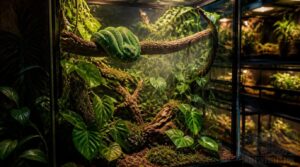
Growth dictates cage size: hatchlings need a 24×18-inch footprint, juveniles graduate to 36×24. Adult enclosure size demands 30×24 inches minimum floor area, 48 inches vertical space. Maintain 2.5-3.5 inches wall clearance around outer perches, preventing confinement. Substrate depth of 2-4 inches helps moisture retention. Undersized housing stunts natural climbing behavior your python requires.
Vertical Space and Escape Prevention
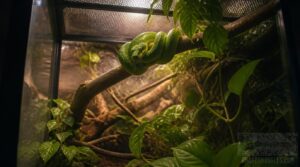
Floor footprint means little if your python can’t climb without hitting glass. Vertical space demands continuous grip points to 200cm, staggered branch offsets, and an escape-proof lid. Prevent gaps via:
- Joint sealing with silicone
- Perch spacing checks (6-8cm)
- Vertical clearance verification
- Wall-stud anchoring (10mm screws)
Dense foliage and floor sealing eliminate hidden escape routes entirely.
Secure Perch Sizing and Placement
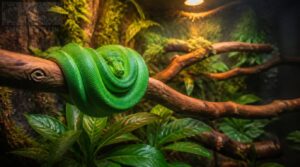
Anchoring lids and sealing joints only matters if what’s inside won’t buckle.
Match perch diameter to life stage, 2.5–3.5 cm for juveniles, 4.5–6 cm for adults, so grip stays secure. Space branches 15–30 cm apart vertically, 12 cm from walls, leaving two clear access sides. Wobbly or cracked wood? Replace it immediately.
Elevated Hides and Visual Barriers
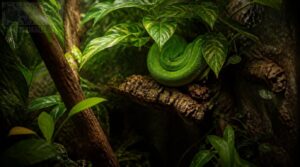
A secure perch means nothing if your python has nowhere to retreat. Elevated hides raised 30–60 cm create shaded microclimates, tucked behind cork bark or dense foliage.
Visual barriers, mottled and multi-height, block sightlines without stress. Rotate placement monthly.
You’re not decorating, you’re engineering confidence into a nervous arboreal species.
You’re not decorating an enclosure, you’re engineering confidence into a nervous arboreal species
Substrate, Drainage, and Ventilation
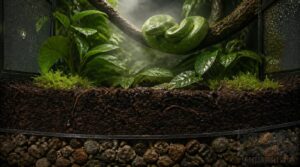
Beneath every thriving canopy dweller lies a substrate doing quiet, essential work. Depth of 5–8 inches allows drainage layering and moisture retention.
Five non-negotiables:
- Coir or plantation soil for aeration
- Gravel drainage layer beneath substrate
- Mesh barrier preventing clogged outlets
- Cross-vent placement for airflow balance
- Monthly inspection for humidity control
Step 2: Set Temperature and Humidity
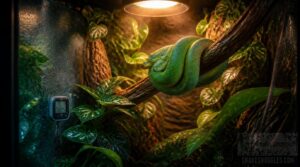
A well-built enclosure means nothing without the right thermal and humidity gradient running through it.
Green tree pythons rely on precise warm-to-cool zones and consistent moisture to digest, shed, and thermoregulate properly.
Here’s what you need to get those numbers right, from basking spot placement to daily humidity checks.
Warm-Side and Cool-Side Temperatures
Precision separates thriving pythons from stressed ones: keep the warm side between 86 and 92°F and the cool zone at 75 to 82°F, a 6 to 10 degree split that sustains proper thermal gradient balance.
This spread helps digestion, activity, and thermal regulation, letting your python self-regulate across perches without ever facing dangerous extremes.
Basking Heat and Thermostat Placement
Get the heat source placement wrong and every other setting collapses with it. Mount your basking bulb or ceramic emitter directly over a secure perch, targeting a 84 to 88°F basking surface temp, then position the thermostat probe right beside that perch, not floating mid-air.
For arboreal setups, laying the probe on the perch itself mimics proper probe surface contact used in ground-level placements, ensuring accurate readings.
Verify the thermal gradient setup with a secondary cool-side sensor, and always keep a mechanical backup thermostat for safety redundancy.
Digital Temperature and Humidity Monitoring
Trust numbers, not guesswork. A digital probe thermometer paired with a hygrometer eliminates the 5–40 point drift plaguing analog dials.
Practice dual sensor monitoring, placing units on opposite sides to map the thermal gradient accurately. Calibrate quarterly against a reference thermometer, replace sensors every 12–18 months, and keep sensor placement away from direct airflow for reliable data interpretation.
Daily Humidity and Hydration
Water without wetness, that’s the goal. Place the dish on the cool side, reachable from lower branches, away from basking heat and climbing paths.
Scrub it daily, refill with fresh water, and watch for cloudiness. Between dish access and hand misting branches, you’ll sustain 40–70% humidity without soggy substrate, dull skin, or dehydration risk creeping in unnoticed.
Shedding Humidity Adjustments
A dull, clinging shed usually means one thing: your humidity fell short when it mattered most. Nudge levels to 55-60%, favoring gradual humidity adjustments over sudden spikes past 70%, which invite fungal trouble on delicate membranes.
Build a warm-side shedding support zone near 60-65% using moisture-retentive substrate, then confirm accuracy through calibrated digital hygrometers, not guesswork.
Step 3: Establish a Feeding Routine
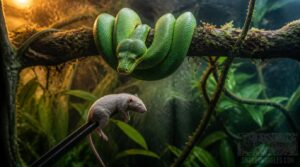
Feeding a green tree python isn’t guesswork—every meal has to match the snake’s size, age, and metabolism to keep it healthy. Get the timing or portions wrong, and you’re looking at regurgitation, obesity, or worse down the road.
Here’s exactly what a proper feeding routine looks like, from prey size to safe handling technique.
Prey Sizes by Life Stage
Matching prey to your python’s gape prevents strain injuries and choking hazards.
- Neonate prey: pinky mice under 0.5 kg
- Juvenile prey: fuzzy mice, 0.2–1 kg
- Subadult prey: hopper-to-adult mice, 1–3 kg
Never exceed 1.5x midbody diameter. Adult prey limits stay proportional to snout width, and seasonal prey shifts occur naturally as appetite fluctuates with temperature and shedding cycles.
Age-Appropriate Feeding Schedules
Prey size means little without the right clock behind it. Babies eat every 5–7 days at ≤15% body weight; juveniles stretch to 1–2 weeks; adults settle into 2–4 weeks, sometimes 2–6, always weight-based.
| Life Stage | Feeding Frequency |
|---|---|
| Neonate | 5–7 days |
| Juvenile | 1–2 weeks |
| Adult | 2–4 weeks |
| Overweight adult | Reduced frequency |
Seasonal appetite dips are normal, not alarming.
Frozen-Thawed Rodent Preparation
Once the clock dictates when your Green Tree Python eats, preparation dictates how safely it eats.
Select rodents by skull width matched to prey sizing, inspect for freezer burn, and thaw at room temperature, 20–25°C, for 20–40 minutes. Never use hot water or sunlight.
Wash hands, sanitize surfaces, and discard any prey showing odor or slime before serving.
Safe Tong-Feeding Techniques
Thawed prey meets a wary hunter next, and tong technique decides whether that meal succeeds.
Hold the mouse steady at mid-body height, dangling beneath your python’s perch without contact. Scent enhancement, chick down or a touch of blood serum, sharpens feeding response. Stop instantly if biak flailing appears.
- Use long feeding tweezers to preserve striking distance
- Keep tongs motionless once positioned
- Never force feed to avoid regurgitation
Overfeeding and Obesity Prevention
Fat pythons stop climbing, full stop. Watch for a "sausage" silhouette and reduced perch time, then cut back.
| Sign | Action |
|---|---|
| No visible ribs | Extend interval 2-3 weeks |
| >10% weight gain | Reduce portion, reassess |
| Floor-dwelling | Check body condition score |
Monthly weigh-ins catch drift early. Adjust feeding frequency before it becomes a habit, not a rescue.
Step 4: Support Health and Behavior
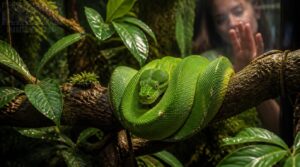
A well-built enclosure only gets you halfway there—the rest comes down to what you do inside it, day after day. Your green tree python’s health depends on vigilance you can’t outsource: spotting trouble early, keeping stress low, and giving those muscles and senses something to work with.
Here’s what that actually looks like in practice.
Daily Health and Shed Checks
Run your hands and eyes over your python every single day, since early problems hide in plain sight. Check shed quality, eye caps, and vent scales for retained tissue. Palpate along the spine for firmness, not mushiness. Watch behavior closely:
- Lethargy or excessive hiding
- Tight defensive coiling
- Reduced tongue flicking
Consistent handling and moisture checks catch trouble before it escalates.
Respiratory Infection Prevention
Stagnant air kills faster than most keepers realize. Proper enclosure ventilation demands cross-flow: lower and upper mesh vents working together, never opposite panels on tanks under 45cm, or you’ll invite drafts instead of airflow.
Pair this with disciplined humidity control (50-70%), since soggy substrate breeds the bacteria behind scale rot.
Balance your temperature gradient carefully; prolonged cold exposure below 65°F compromises respiratory defenses entirely.
Quarantine and Veterinary Care
A new arrival isn’t ready for your display enclosure, full stop.
Quarantine in a bare plastic tub for 30 days minimum, with weekly weigh-ins, vet exam and bloodwork within a week, and fecal testing for parasites.
Watch respiration and vent condition daily.
Skip this and you’re gambling your collection’s health on one untested animal.
Low-Stress Handling Techniques
Grab a green tree python from above and you’ve just mimicked a hawk strike, so approach from the side and let it crawl onto your hand voluntarily.
Support the spine fully, hand behind the head, one under the body, never by the tail.
Keep sessions to 5-10 minutes, evenings only, warm room, dim light, quiet space.
Climbing and Sensory Enrichment
A bored python is a stressed python, plain and simple. Rotate perch variety and foliage monthly, offer branches at 1.5-5 cm diameters, and vary angles 10-40 degrees for tactile grip challenges.
- Scent trail exploration on branches
- Elevated hide placement for retreat
- Visual pattern stimulation via varied textures
- Vertical space climbing progression
- Dense foliage barriers reducing stress
Top 6 Green Tree Python Care Products
Building the enclosure is only half the equation—what you put inside it, and what you clean it with, determines whether your green tree python thrives or merely survives.
Substrate choice affects humidity retention, burrowing behavior, and bacterial load, while your disinfectant protocol dictates how well you contain pathogens between quarantine cycles.
Here are six products worth stocking before your snake ever sets a coil in its new home.
1. Coco Bliss Organic Coco Coir
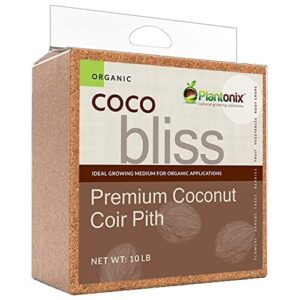
Substrate choice matters more than most keepers realize, and Coco Bliss Organic Coco Coir earns its spot through sheer functional performance. Made entirely from coconut husk pith, this compressed 10-pound block expands to roughly 10 gallons once hydrated, delivering the moisture retention your python’s 40-70% humidity baseline demands without waterlogging the enclosure floor.
The neutral pH and pre-rinsed, pre-screened processing strip out sand, fiber debris, and rocks that could otherwise irritate ventral scales during shedding. That fine, cushioned texture also reduces abrasion risk, a real concern for arboreal species that occasionally descend to ground level.
Where this Plantonix product distinguishes itself is structural longevity. It resists rapid compaction better than cheaper alternatives, allows spot-cleaning without full substrate replacement, and offers a renewable, sustainable footprint. For keepers managing humidity gradients precisely, that consistency translates directly into fewer respiratory complications down the line.
| Best For | reptile keepers, especially python owners, who need a moisture-retentive, low-abrasion substrate to maintain precise humidity gradients in their enclosures. |
|---|---|
| Type | Substrate |
| Ready to Use | Requires Hydration |
| Weight | 10 lbs |
| Humidity Support | 40-70% |
| Odor Control | Not Specified |
| Natural Ingredients | Yes, Coco Coir |
| Additional Features |
|
- Pre-rinsed and pre-screened to remove sand, fiber, and rocks, reducing the risk of scale irritation during shedding
- Expands to roughly 10 gallons from a compact 10-pound block, offering excellent value and easy storage
- Resists rapid compaction, allowing for spot-cleaning without needing a full substrate replacement
- Can still compact over time with repeated watering, often requiring perlite or a similar amendment for aeration
- Surface may look wet while staying dry underneath in hot conditions, making it easy to misjudge moisture levels
- May need additional rinsing or buffering for sensitive setups or situations requiring low EC
2. F10 All Purpose Disinfectant Spray
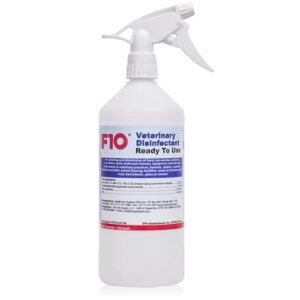
Clean substrate only gets you halfway there; what lives on your glass, perches, and water bowls determines whether your biosecurity protocol actually holds up. F10 All Purpose Disinfectant Spray is an EPA-registered veterinary formula, effective against bacteria, viruses, fungi, and spores, built specifically for clinics, shelters, and breeding operations where pathogen control isn’t optional.
You won’t need to dilute or measure anything. Spray perches, glass panels, and feeding dishes after removing your python, let the surface air-dry fully, then reintroduce your snake once residue is gone. That drying window matters more than keepers realize, since reintroducing a python too early can undo your humidity gradient and stress the animal unnecessarily.
At 2.65 pounds and unscented, it won’t overwhelm sensitive respiratory systems the way harsher chemical cleaners can. For arboreal setups demanding consistent hygiene, that’s not a luxury. That’s baseline care.
| Best For | Reptile keepers, veterinary clinics, shelters, and breeders who need a broad-spectrum, no-rinse disinfectant for habitats and equipment used around sensitive animals. |
|---|---|
| Type | Disinfectant |
| Ready to Use | Yes, No Dilution |
| Weight | 2.65 lbs |
| Humidity Support | Indirect |
| Odor Control | Yes |
| Natural Ingredients | No, Chemical Formula |
| Additional Features |
|
- Ready-to-use formula that requires no dilution or measuring
- EPA-registered to kill bacteria, viruses, fungi, and spores
- Unscented and biodegradable, making it safer around reptiles, birds, and other sensitive species
- Costs more than standard household disinfectants or concentrate options
- Ready-to-use version may face shipping restrictions in some states
- Can be more than what’s needed for routine, non-veterinary household cleaning
3. Zoo Med Reptile Soil
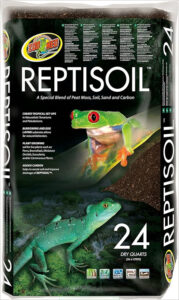
Disinfection experiences what’s living on surfaces, but what’s underfoot matters just as much, and that’s where Zoo Med Reptile Soil earns its keep. Built from peat moss, organic topsoil, sand, and carbon, this substrate isn’t just filler beneath your perches, it’s an active component of your humidity system.
The coconut carbon fraction creates a porous matrix that hosts beneficial bacteria while cutting down on odor, something you’ll appreciate during those muggy shedding weeks. Peat moss grips water absorption, sand keeps drainage from stalling out, and the resulting mixture holds moisture without turning into a swamp.
You can pack it 2 to 4 inches deep, layer it over hydro granules, and expect it to support live plants if you’re building bioactive. At 17 pounds per bag, one unit covers a standard floor footprint. Inspect it first, though. Debris fragments do show up occasionally.
| Best For | Keepers building bioactive terrariums or paludariums for tropical lizards, amphibians, box turtles, hermit crabs, or tarantulas who need a moisture-retentive, plant-friendly substrate. |
|---|---|
| Type | Substrate |
| Ready to Use | Requires Moistening |
| Weight | 17 lbs |
| Humidity Support | Moisture Retentive |
| Odor Control | Yes |
| Natural Ingredients | Yes, Peat and Soil |
| Additional Features |
|
- Coconut carbon content supports beneficial bacteria colonization and helps reduce odor
- Formulated to support natural burrowing and egg-laying behaviors while sustaining live plant growth
- Clumps when moistened, making waste removal and spot-cleaning simple
- May contain sharp wood, stone, or debris fragments, so inspect thoroughly before use
- Can lose volume over time in dry conditions compared to coconut fiber alternatives
- Needs periodic moistening to maintain humidity levels for dependent species
4. Zoo Med Coconut Fiber Substrate
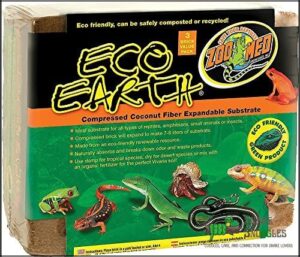
Where Zoo Med Reptile Soil builds a habitat underfoot, Zoo Med Coconut Fiber Substrate takes a leaner approach. One compressed brick, once soaked, expands to 7-8 liters of loose coir, giving you a burrowing-friendly medium that holds humidity between 40-70% without demanding a soil mix.
At 3.9 pounds per three-pack, it’s economical for keepers managing multiple enclosures. Expect a messy prep process, though. You’ll break apart and hydrate bricks by hand, and gnats can appear if you oversaturate without regular stirring.
| Best For | Reptile, amphibian, and small animal keepers who want an affordable, humidity-friendly burrowing substrate for tropical terrariums. |
|---|---|
| Type | Substrate |
| Ready to Use | Requires Hydration |
| Weight | 3.9 lbs |
| Humidity Support | 40-70% |
| Odor Control | Yes |
| Natural Ingredients | Yes, Coconut Fiber |
| Additional Features |
|
- Expands to 7-8 liters per brick, offering great value for multiple enclosures
- Naturally helps break down odor and waste for a cleaner habitat
- Retains humidity well, ideal for tropical and burrowing species
- Requires manual hydration and breaking apart before use
- Prone to gnats if kept too wet without regular stirring
- Preparation can be messy, involving water and hands-on mixing
5. Exo Terra Plantation Soil
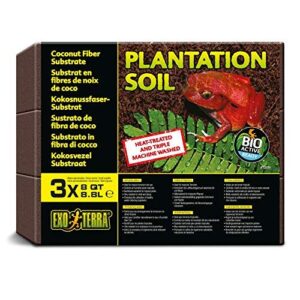
Coconut husk fiber, triple-washed and heat treated to strip away salt residue and dust, expands from a compressed brick into roughly 8.8 liters of fine bedding once hydrated. That processing matters clinically: residual salts irritate ventral scales and mucous membranes over prolonged contact, so the extra washing step isn’t marketing fluff, it’s a hygiene safeguard.
You’ll find this substrate holds humidity in the 40-70% range your Green Tree Python needs, with the finer texture retaining moisture more evenly than coarser coir products. Mold resistance in warm, humid enclosures is a genuine concern with organic substrates, and this one’s washing process helps blunt that risk, though it won’t eliminate it outright.
For bioactive setups incorporating live plants, the fiber’s nutritional properties support root development while satisfying your snake’s burrowing instincts during juvenile stages. Weighing 3.9 pounds per package, it’s a practical, low-fuss option for tropical terrarium maintenance.
| Best For | keepers setting up tropical, high-humidity terrariums for frogs, salamanders, or burrowing reptiles who want a natural substrate that also works for live planting. |
|---|---|
| Type | Substrate |
| Ready to Use | Requires Hydration |
| Weight | 3.9 lbs |
| Humidity Support | 40-70% |
| Odor Control | Not Specified |
| Natural Ingredients | Yes, Coconut Fiber |
| Additional Features |
|
- Expands into a generous amount of fine, humidity-retentive bedding from a compact brick
- 100% natural coconut husk fiber that’s safe for amphibians and burrowing animals
- Doubles as nutritional planting soil, supporting live plants in bioactive setups
- Requires manual breaking apart and soaking before use, which adds prep time
- Expansion and moisture retention can vary from batch to batch
- May contain debris that needs sifting out before adding it to the enclosure
6. Rescue Disinfectant Cleaner For Pets
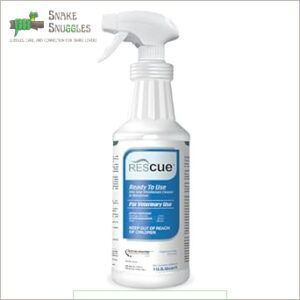
Six pathogens don’t stand a chance against this hydrogen peroxide formula, and that’s exactly the point once quarantine protocols demand real results. Rescue Disinfectant Cleaner uses an accelerated hydrogen peroxide base at 0.5% concentration, applied directly to hard surfaces like glass panels, removable perches, and platforms. Leave it wet for five minutes and you get 99.9% reduction against parvovirus, calicivirus, and fungal agents, the same culprits that spread fastest between newly acquired specimens and your existing collection.
What sets it apart from phenolic or quaternary ammonium cleaners is what happens after: it breaks down into water and oxygen, leaving no toxic residue behind on surfaces your snake will touch again within hours. No dilution, no mixing, just spray and wait.
At $17.99 for 2.09 pounds of ready-to-use liquid, it’s a practical staple for any keeper serious about parasite control and disciplined sanitation between enclosures.
| Best For | Reptile and exotic pet keepers who need a fast, no-rinse disinfectant to control parasites and pathogens between enclosures during quarantine or after illness. |
|---|---|
| Type | Disinfectant |
| Ready to Use | Yes, No Dilution |
| Weight | 2.09 lbs |
| Humidity Support | Indirect |
| Odor Control | Yes |
| Natural Ingredients | No, Chemical Formula |
| Additional Features |
|
- Ready-to-use formula requires no dilution or mixing, saving time between cleanings
- Fragrance-free and breaks down into water and oxygen, making it safe for pets and surfaces they’ll touch again soon
- Effective on both hard and soft surfaces, including enclosures, toys, and bedding
- Doesn’t come with a spray nozzle, so you’ll need to buy one separately
- Some users report a strong chemical odor that may require ventilation or a mask during use
- Can leave visible residue or streaks on clear surfaces like plastic panels
Frequently Asked Questions (FAQs)
Are green tree pythons arboreal?
Yes, they’re highly arboreal, spending nearly all adult life perched on branches across New Guinea and Australian rainforests, descending only to hunt or relocate. Juveniles show the same tree-bound instinct, rarely touching ground once established in the canopy.
What are the common health problems of green tree pythons?
Respiratory infections, rectal prolapse, dehydration, and poor sheds top the list, usually stemming from humidity swings or inadequate ventilation. Obesity from overfeeding compounds these risks.
Catching symptoms early, raspy breathing, retained eye caps, swollen vent tissue, makes treatment far more successful than waiting.
What is the lifespan of a green tree python?
With attentive husbandry, you’ll see 15 years in the wild stretch toward 20 in captivity, occasionally past Consistent heating, humidity, and veterinary oversight determine whether your specimen merely survives or genuinely thrives long-term.
Are green tree pythons high maintenance?
Think of them as living puzzle boxes demanding daily attention. They’re not beginner pets: precise humidity swings, strict feeding windows, and vigilant shed checks make green tree pythons genuinely high maintenance, rewarding careful keepers while punishing neglect fast.
What is the best habitat for a green tree python?
Despite the name, these snakes favor low shrubby vegetation over towering canopies. Give yours secure vertical perches, humidity at 50-70%, stable warm-to-cool gradients, and well-draining substrate, the four pillars of a genuinely livable arboreal setup.
Are green tree pythons difficult to care for?
Like a tightrope walker demanding precise balance, this species tolerates no shortcuts.
Green tree pythons require intermediate to expert care, given narrow temperature and humidity margins.
Captive-bred specimens prove much hardier than wild-caught individuals when keepers maintain consistent, species-appropriate parameters.
Can green tree pythons swim?
Yes, using undulating strokes when streams cross their range, though swimming stays a brief, situational skill, not routine behavior.
Larger pythons sustain longer swims than juveniles.
In captivity, provide shallow water access, never treat it as primary enrichment for this canopy-dwelling species.
How do you care for a green tree python?
A canopy dweller thrives only when its keeper mimics the forest itself.
Caring for a green tree python means precise thermal gradients, secure branch perches, tong-fed rodents, vigilant health checks, and consistent veterinary partnership guiding every husbandry decision you make.
What is a green tree python?
Morelia viridis is a nonvenomous constrictor native to New Guinea’s rainforest canopy, prized for emerald adult coloration that emerges only after hatchlings shed their initial yellow or red hues over several months.
How should a green tree python habitat be oriented?
Forget skyscraper enclosures reaching toward the ceiling. Orient habitats for horizontal movement, front-opening access, and layered perches at modest heights, prioritizing ventilation and stable gradients over dramatic vertical showpieces that impress owners but stress pythons.
Conclusion
A canopy doesn’t forgive guesswork, and neither does the python living in it. Every gradient you calibrate, every perch you anchor, every shed cycle you monitor becomes a rung in the same ladder: green tree python arboreal care built on precision, not luck.
Skip a step, and you’re back in my exam room explaining regurgitation you could’ve prevented.
Master these fundamentals instead, and you’ll watch a genuinely thriving specimen, not just a surviving one, coil confidently through its world.