This site is supported by our readers. We may earn a commission, at no cost to you, if you purchase through links.

Picture a snake wearing armor plating, with scales that catch light like oil on water. That’s your first look at Xenodermus javanicus, a snake that looks like a dragon straight out of folklore. Herpetologists call it the dragon snake, and once you spot those three ridged rows running down its back, you’ll understand why.
This isn’t costume-shop fantasy. It’s a real, secretive reptile from Southeast Asia’s rice paddies and swamps, built for a life most people never witness.
Its body holds clues to survival, camouflage, and a temperament that makes it a poor choice for casual keepers. Let’s get into what makes this creature tick.
Table Of Contents
- Key Takeaways
- What Snake Looks Most Like a Dragon?
- Why Dragon Snakes Look Dragon-Like
- Dragon Snake Habitat, Diet, and Behavior
- Why Dragon Snakes Make Difficult Pets
- Other Real Snakes That Look Like Dragons
- Frequently Asked Questions (FAQs)
- Are dragon snakes poisonous?
- What are the snake-like dragons called?
- Is there a toothless snake?
- Does Dragon Snake exist?
- What are the snake like dragons called?
- What dragon is like a snake?
- What kind of viper looks like a dragon?
- What snake species resemble mythical dragons?
- How do snakes achieve a dragon-like appearance?
- Are dragon-like snakes found in specific regions?
- Conclusion
Key Takeaways
- The dragon snake (Xenodermus javanicus) gets its mythical look from three rows of keeled, armor-like scales, a triangular head, and iridescent skin, but it’s completely nonvenomous and harmless.
- You’ll find these secretive snakes hiding in Southeast Asia’s swamps, rice paddies, and wetlands, where they hunt fish, frogs, and tadpoles at night using stealthy, ambush-style tactics.
- Dragon snakes make poor pets because they’re extremely stress-prone, need very specific humidity and temperature conditions, and often refuse to eat if their care isn’t just right.
- Other real snakes, like the spiny bush viper and rhinoceros viper, also pull off a dragon-like appearance through keeled scales and hornlike features, showing nature has more than one way to build a "dragon.
What Snake Looks Most Like a Dragon?
If you picture a dragon shrinking down and growing scales, you’d land pretty close to this snake. Meet Xenodermus javanicus, the real animal behind the myth. Here’s what makes it look like something out of a legend.
It’s the sole member of its genus, and this guide to dragon snake facts and care digs into why this odd little reptile stands so completely alone in the snake world.
Xenodermus Javanicus at a Glance

Picture a snake wearing tiny armor plates, and you’ve basically met Xenodermus javanicus. This Southeast Asian native grows 50-75 centimeters, with a slender body and tapered head.
Three things stand out immediately:
- Three rows of raised keeled scales running down its back
- Brown-to-gray mottled coloring
- Nocturnal hunting habits across wetland habitats
Dragon Snake Common Names

That armored look earns Xenodermus javanicus a whole passport of nicknames across Southeast Asia’s wetlands.
| Region | Common Name | Meaning |
|---|---|---|
| English | Dragon Snake | Armored, dragonlike features |
| Thai | Ngu khon thong khao | Local field usage |
| Indonesian | Ular naga jawa | Dragon imagery |
| Malay | Ular naga jawa | Regional equivalent |
Some guides also say Javan mudsnake, nodding to those three rows of raised keeled scales.
The species is classified as Least Concern on the IUCN Red List due to its stable populations in wet habitats.
The species is classified as Least Concern
Why It Resembles a Dragon

So what earns this snake its dragonlike features? Look closer and you’ll spot keeled scale texture stacked in three ridged rows, a triangular head shape wider than the neck, and an iridescent color pattern flashing across dark skin.
Add a pale underbelly contrast and a semi-flexible posture, and you’ve got a genuine reptile appearance echoing mythical resemblance—pure evolutionary adaptation, not fantasy.
Adult Size and Body Shape
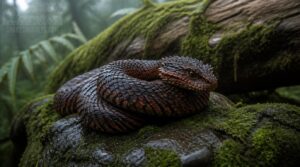
Body-wise, the Dragon Snake stays surprisingly modest. Adults run 60 to 90 centimeters, so most stay under two feet long once you subtract that stubby tail.
The triangular head shape sits wider than the neck, tapering into a slender trunk with rough, keeled scales—sharp scales that feel almost armored. Stress it, though, and you’ll notice body stiffening instead of a strike.
Nonvenomous Yet Highly Specialized

Though it looks fierce, the Dragon Snake carries no venom—its menace is pure theater. That triangular head and armored ridge are classic venomous mimicry, borrowed from Southeast Asia’s wetlands to scare off predators.
Unlike the truly dangerous species profiled in this guide to aggressive snake species you should avoid, the Dragon Snake’s bark is far worse than its bite—because it has none at all.
Real specialization runs deeper: stress-sensitive physiology, narrow diet, and picky feeding ecology make captive breeding brutally hard. Nature’s serpentine dragon isn’t dangerous. It’s just impossibly particular.
This serpentine dragon isn’t dangerous, just impossibly particular, guarding its secrets with stress and specialized needs
Why Dragon Snakes Look Dragon-Like

So what actually gives this snake its dragon-like look? A handful of physical traits work together to create that mythical, armored appearance. Here’s what makes it stand out.
Three Rows of Keeled Scales
Run a finger down a Dragon Snake’s back and you’ll feel it before you see it: three raised rows of keeled scales, ridged like tiny mountain ranges.
That roughness isn’t random — it scatters light for camouflage, roughens surface texture, and helps researchers spot this species in Southeast Asia’s wetlands.
Sharp scales, real function.
Armored Back and Iridescent Color
That ridged dorsal shield isn’t just for looks. Those keeled scale plates overlap like tiny shields, deflecting scrapes from rocks and thorns.
Here’s the neat part: under humid light, the same scales flash blue, green, or purple. That iridescent color comes from microscopic structures bending light, not pigment. Moist skin makes the shift even more vivid, blending armor with camouflage in one package.
Triangular Head and Slender Body
Ever notice how a dragon snake’s head seems too wide for its neck? That head width ratio is real: the triangular head flares broader than the neck, then tapers into a slender body.
Jaw mechanics let it grip slippery prey, while a gradual body taper and flexible tail support quick turns through Southeast Asia’s wetlands, echoing its mythological connection.
Contrasting Pale Underbelly
Flip a Dragon Snake over, and the dark armor vanishes. Its pale underbelly runs chin to tail, smooth-scaled against the keeled back.
That contrast does real work:
- Reflects heat away from the ground
- Resists soil staining
- Shifts tone with lighting
- Signals species identity
Coloration varies slightly by individual, but the belly-dorsal contrast stays reliable—handy camouflage across Southeast Asia’s wetlands.
Camouflage and Defensive Adaptations
Stillness is this snake’s best weapon. Its scale texture mimicry turns keeled ridges into fake bark or leaf litter, while eyes match against substrate, hiding focal points from predators.
| Trait | Function | Habitat Match |
|---|---|---|
| Keeled scales | Breaks reflection | Bark, moss |
| Motionless posture | Avoids detection | Leaf litter |
| Body stiffening | Defensive response | Any disturbance |
As nocturnal hunters, they favor microhabitat specialization over flight—freezing beats fleeing.
Dragon Snake Habitat, Diet, and Behavior

So where does this dragon-like snake actually live, and what does it eat? Its whole lifestyle, from hunting style to habitat needs, comes down to a few key details. Let’s break down exactly what makes this snake tick.
Southeast Asian Geographic Range
Picture a map stretching from Thailand and Malaysia down through Sumatra, Java, and Borneo — that’s Dragon Snake territory. It crosses the Isthmus Kra link, linking mainland Southeast Asia to island Southeast Asia.
- Thailand’s lowland swamps
- Malaysia’s river basins
- Sumatra, Java, and Borneo’s wetlands
- Scattered pockets near the Mekong River basin
The Javan tubercle snake’s range makes habitat conservation across Southeast Asia’s wetlands genuinely urgent.
Swamps, Wetlands, and Rice Paddies
That range means nothing without the right terrain. Dragon Snakes stick to swamps, wetlands, and flooded rice paddies, where standing water and thick vegetation create the perfect wetland home.
These waterlogged habitats aren’t just backdrops. Swamp biodiversity, rice paddy ecology, nutrient cycling, flood control, and wetland conservation all depend on the same soggy ground this dragon-faced snake calls home.
Cool, Humid Habitat Conditions
Standing water only tells half the story. This snake also needs a humid forest microclimate, staying within 70-95% humidity year-round.
Southeast Asia’s wetlands deliver that naturally:
- Canopy cover blocking harsh sun
- Night cooling near 15-20°C
- Vegetation structure trapping moisture
Waterlogged soils and seasonal humidity shifts keep tropical habitats stable—exactly what dragon-faced hunters require.
Fish, Frogs, and Tadpoles
That humid microclimate isn’t just for comfort—it’s a hunting ground. Dragon snakes eat small fish, tadpoles, and frogs, all pulled from swamps, forests, or rice fields.
Tadpoles start out grazing algae, then shift diets as legs sprout—easy pickings mid-metamorphosis. Adult frogs hunting insects nearby? Also fair game.
Unlike a Desert Horned Viper’s dry ambush style, this predator sticks close to water’s edge.
Nocturnal Semi-Fossorial Hunting
Darkness flips the switch. Dragon snakes become true nocturnal hunters, using slow, deliberate stealth movement tactics and ambush from burrows to strike prey with surprising accuracy.
- Underground foraging behavior near mud tunnels
- Nocturnal prey detection via tactile snout cues
- Nighttime strike accuracy rivaling other fossorial snakes
Unlike a desert horned viper’s dry ambush or a spiny bush viper’s arboreal wait, this one strikes from underground, near water.
Why Dragon Snakes Make Difficult Pets
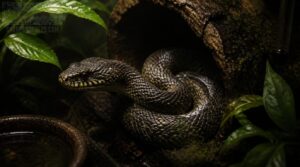
So you’ve fallen for that dragon-like stare, but can you actually keep one happy at home? Dragon snakes aren’t your typical low-maintenance reptile, and their needs go far beyond a tank and a heat lamp. Here’s what makes them such a demanding pet, starting with their temperament.
Stress-Prone Temperament
Ever met a pet that acts like every touch is a threat? That’s the dragon snake. Its body stiffens, it freezes, and stress hormones spike fast.
Think of it like high harm avoidance in temperament science: heightened worry, cautious reactions, elevated cortisol. Low novelty seeking means new situations feel dangerous, not exciting. This isn’t drama. It’s biology asking for calm, predictable care.
Why Handling Should Be Limited
So what happens when you pick one up anyway? Heart rate spikes, cortisol climbs, and that calm posture turns rigid fast.
Limit handling to true needs only, like medical checks. Watch weight and skin from outside the glass instead. Unlike Atheris hispida and other highly venomous vipers, dragon snakes aren’t dangerous, but stressed captive care still means fewer hands, more patience.
Specialized Enclosure Requirements
Building a proper home for this snake is basically running a mini rainforest. You need 70–95% humidity, stable cool temps, sphagnum moss substrate, and real water access points.
Ventilation design matters too, since stale air breeds infection. Skimp on any piece, and captive care turns risky fast, much like housing a Spiny Bush Viper’s sharp scales safely.
Feeding Refusal in Captivity
Ever offer a snake dinner and watch it turn away? That’s dragon snake life. Stress-induced appetite loss hits hard here, especially with wrong humidity or clumsy handling near feeding time.
They’re picky about prey type preferences, often ignoring fish or frogs that don’t feel "right." Unlike hardy exotic pet trade staples, this species needs quiet, careful routines, or feeding refusal in captivity becomes the norm.
Health Risks and Lifespan
A dragon snake’s biggest threat isn’t a predator, it’s poor husbandry. Respiratory infections cause 35% of deaths in young captives, often tied to bad humidity. Parasites, calcium gaps, and chronic stress shorten life further.
Wild snakes reach 8 years; zoo-kept ones average 12. Get care right, and yours might outlive both.
Other Real Snakes That Look Like Dragons

The dragon snake isn’t the only reptile pulling off that mythical look. Nature’s found a few other clever ways to build a "dragon" out of scales, spikes, and horns. Here are some real snakes that might make you do a double take.
African Bush Vipers’ Keeled Scales
Picture a viper wearing a tiny coat of thorns. That’s the Spiny Bush Viper, Atheris squamigera, whose ridged scales create a shaggy, bristled look rivaling any dragon snake.
Those keeled scales aren’t just for show. They scatter light into shimmering colors, help with camouflage among leaves, and may even influence heat absorption across the body.
Rhinoceros Vipers’ Hornlike Snouts
Bristled scales are one trick—but what about a snake wearing tiny horns? The Rhinoceros Viper flaunts hornlike head structures above its nostrils, built from flexible keratin, not bone. These horns aid snout camouflage and prey detection, sensing vibrations in leaf litter.
As a venomous member of the Viperidae family, its horn size varies by age and individual growth.
Eyelash Vipers’ Raised Scales
Horns aren’t the only facial flair in the snake world. Eyelash Vipers sport raised, keeled scales above each eye, giving them a lash-like look while leaving the pupil exposed.
These scales aid camouflage among leaves and stay consistent across every color morph—green, yellow, or brown. As arboreal, venomous vipers, their scaled bodies and brow ridges add rugged texture and disruptive cover.
Flying Snakes’ Gliding Ability
Forget fangs and horns—some snakes skip the ground entirely. Chrysopelea paradisi, the paradise flying snake, launches from branches and flattens its ribs into a wing-like shape, achieving true wingless aerial locomotion.
- Body flattening creates lift
- Undulatory waves steer the glide
- Trajectory shifts with body posture
- Landing relies on precise timing
No wings needed—just serpentine aerodynamics doing the work.
Venomous Species Safety Warning
Since dragon-like looks sometimes signal real danger, know your snakes before you get close. Neurotoxic venom from species like the Spiny Bush Viper demands respect, not curiosity.
| Rule | Why It Matters |
|---|---|
| Keep 2m clearance | Prevents strikes |
| Wear boots/thick clothing | Blocks bites |
| Learn local species | Avoids misidentification |
| Never handle | Reduces risk |
| Call emergency services | Saves lives |
Frequently Asked Questions (FAQs)
Are dragon snakes poisonous?
No, dragon snakes aren’t venomous. They lack fangs built for envenomation, so bites cause only mild pain or swelling, not poisoning. Their real defense is body-stiffening, not toxins—busting the myth that a dragon-like look means danger.
What are the snake-like dragons called?
Scientists call it Xenodermus javanicus, though most people just say dragon snake. That’s the real serpentine dragon of Southeast Asia—no myth required, just solid biological realism wrapped in armored, keeled scales.
Is there a toothless snake?
Imagine this: egg eating adaptations let African Dasypeltis swallow eggs whole, no biting required. Yes, functional toothlessness exists.
These snakes use throat cracking mechanisms instead of teeth—true reduced dentition species among limbless vertebrates, proving nature finds clever workarounds.
Does Dragon Snake exist?
Yes, it’s real — scientific name Xenodermus javanicus, native to Southeast Asia’s wetlands. Nonvenomous and secretive, this dragon snake proves biological realism can rival fantasy, unlike the Spiny Bush Viper’s spikier look.
What are the snake like dragons called?
Harmless yet named for terror—that’s the twist. Snake like dragons belong to genus Xenodermus, especially javanicus: called dragon snake, Javan tubercle snake, or roughbacked litter snake, named for keeled, armor-like scales echoing serpentine dragons from myth.
What dragon is like a snake?
Long, coiling serpentine dragons from Chinese and Japanese folklore fit the bill. No legs, keeled scales, iridescent shimmer, gliding through clouds or rivers. That’s real serpent symbolism, blending ancient myth with the dragon snake’s own biological realism.
What kind of viper looks like a dragon?
Bristling like a tiny dragon shaken from myth, the spiny bush viper wears keeled scales, a triangular head shape, and horns above its eyes—armor rivaling anything found across Southeast Asia’s wetlands.
What snake species resemble mythical dragons?
A handful of real species channel serpentine dragons: Xenodermus javanicus, spiny bush vipers, and rhinoceros vipers, thanks to keeled scales, hornlike snouts, and dark iridescence—proof that biological realism in fantasy often starts with actual, nonvenomous look-alikes.
How do snakes achieve a dragon-like appearance?
Like armor forged by evolution itself, keeled scales, a triangular head, and dark iridescent coloring team up. Add stiff, coiled posture when threatened, and you get pure scale texture illusion—biological realism dressed up as myth.
Are dragon-like snakes found in specific regions?
Yes—Xenodermus javanicus sticks to Southeast Asia’s wetlands: Malaysia, Thailand, Sumatra, Java, and Borneo, below 1,100 meters. Habitat fragmentation isolates populations, unlike Africa’s vipers or Arabia’s desert vipers, which occupy entirely different rainforest and arid ranges.
Conclusion
Some myths slither out of legend and into real swamps. The snake that looks like a dragon isn’t magic, it’s evolution wearing armor.
You’ve seen its keeled scales, traced its hunting grounds, and learned why it resists captivity. That knowledge is your edge, whether you’re a curious observer or a future herpetologist.
Respect it from a distance, and this dragon keeps its mystery alive, a lasting reminder that folklore sometimes hides in plain, muddy sight.